# Leo Mühlfeld — full corpus
Generated: 2026-09-06T16:58:35.787Z
Projects: 39
Source: https://leomuehlfeld.at
> Vienna-based designer working with museums, research institutions, and cultural organizations. This file concatenates every published project in markdown format for single-fetch LLM ingestion.
---
# Sound of Insight
Canonical URL: https://leomuehlfeld.at/en/sound-of-insight
---
title: 'Sound of Insight'
for: 'MDW Vienna'
category: 'Exhibition & Installation'
metaDesc: 'Designing a spatial experience translating research into multisensorial encounters at MDW Vienna.'
thumbnail: /img/sound-of-insight-soi-people.jpg
date: '2025-10-07T00:00'
showOnLanding: true
heroImage: /img/sound-of-insight-soi-people.jpg
collab: Max Kure, Anton Posch
imageCredit: Daniel Willinger
---
# Sound of Insight
## Designing a spatial experience translating research into multisensorial encounters at MDW Vienna.
## The three pillars of universities
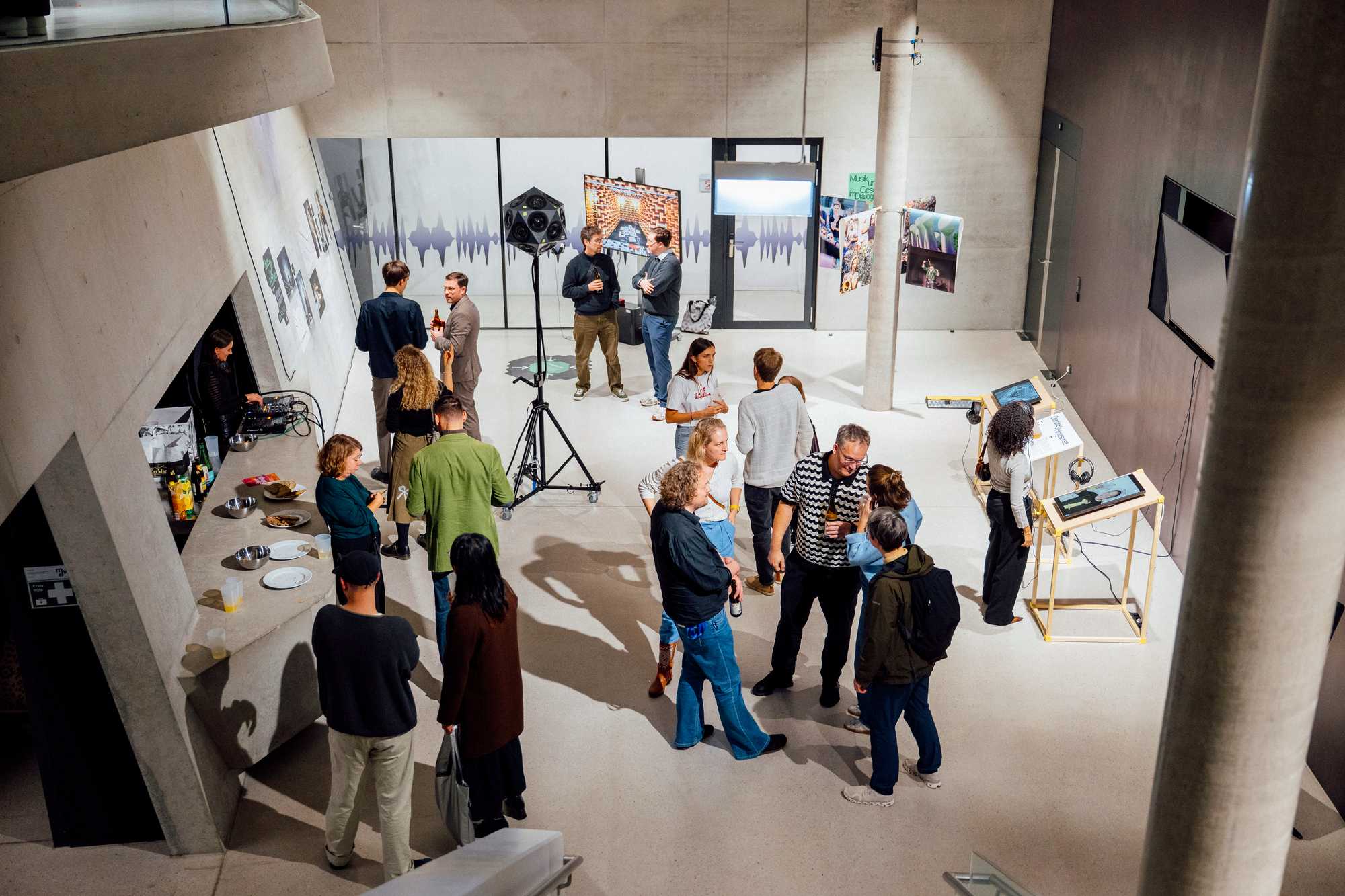
Universities operate on three fundamental pillars: Teaching, Research, and the third—often overlooked—pillar of building public understanding and communicating the craft they pursue. Sound of Insight was conceived to serve this essential third category, translating the complex research happening across MDW Vienna's institutes into an accessible spatial experience.
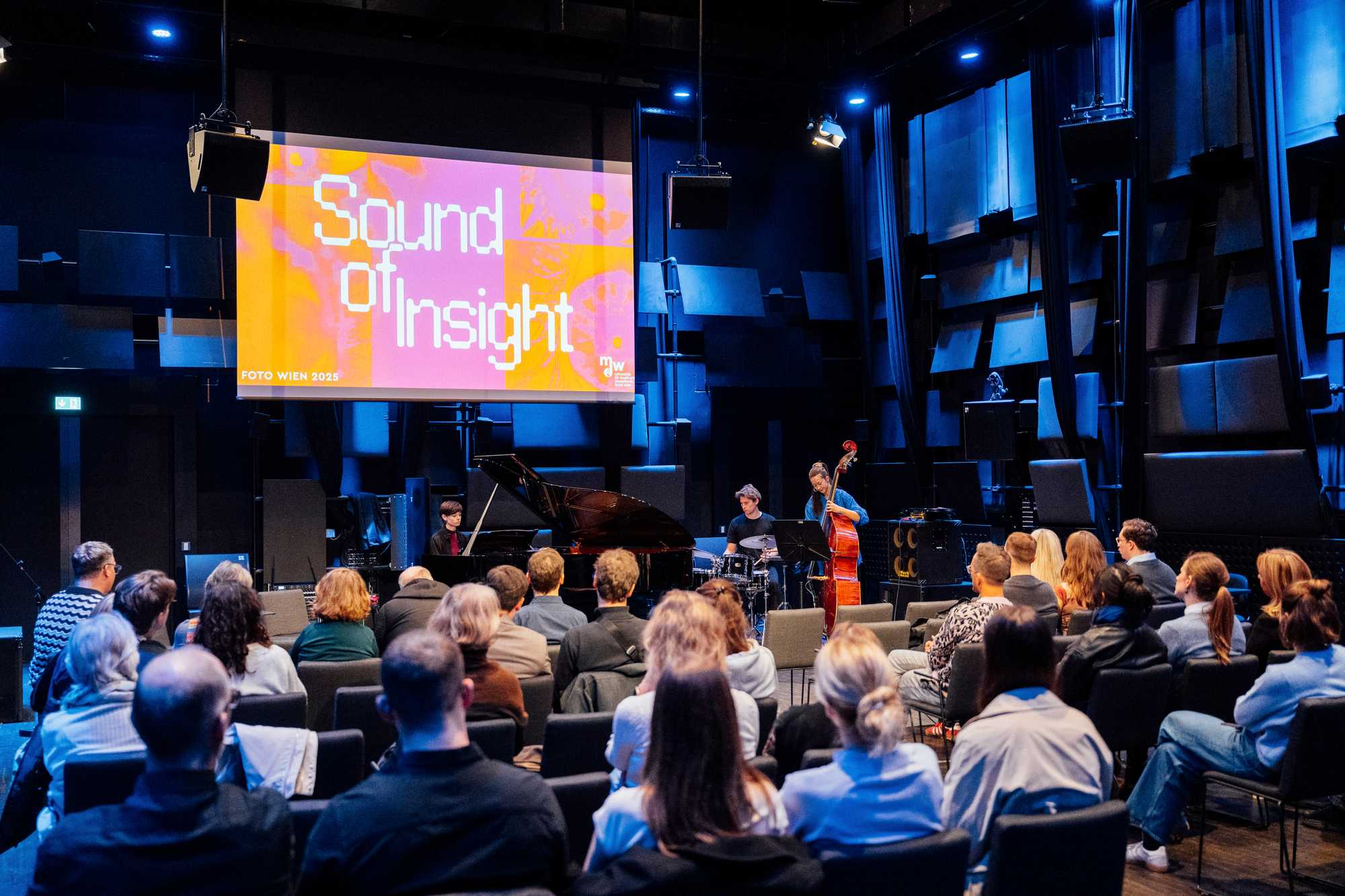
The exhibition, curated by Stephan Polzer, opened as part of Foto Wien 2025, running from October to September, and aimed to provide insights into artistic and research practices from different institutes and labs around the university through the lens of audiovisual media and photography.
---
## MDW Future Art Lab
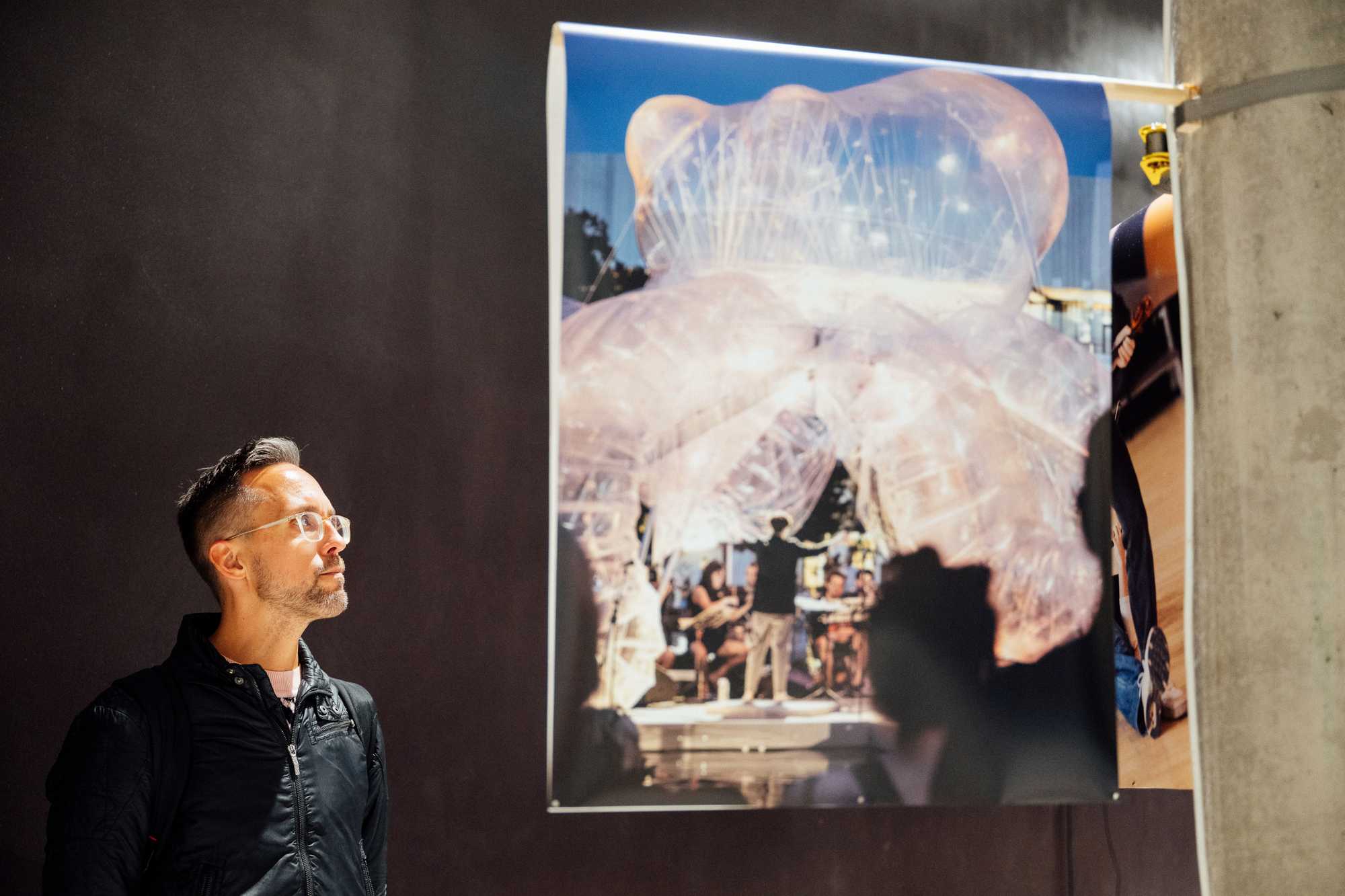
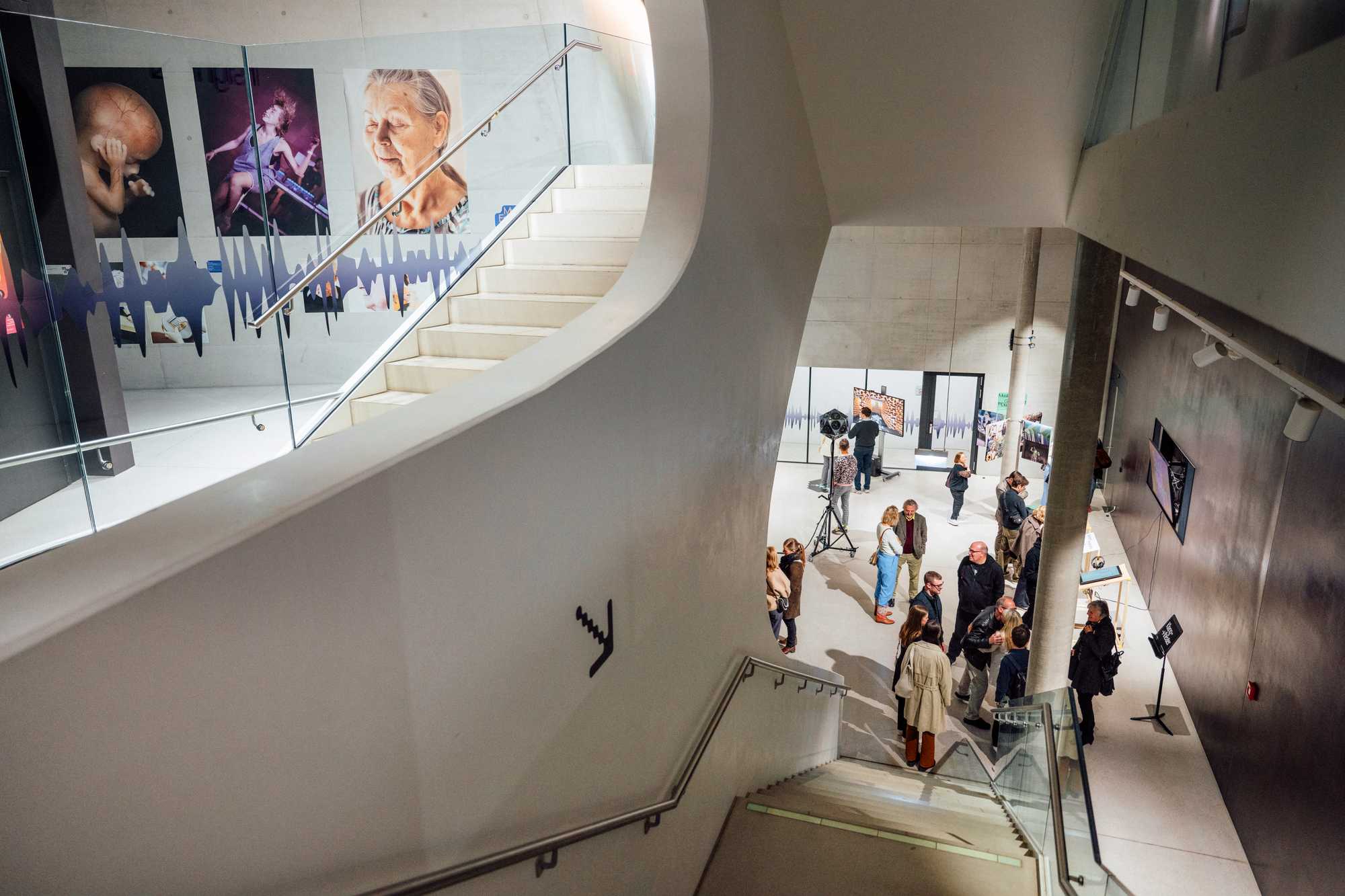
The site selection was crucial to the exhibition's success. MDW's Future Art Lab offered a building whose hallways exist in a constant state of flow—staircases curve into round corners, open floor plans merge seamlessly, creating a dynamic architectural canvas that mirrors the fluid nature of research itself.
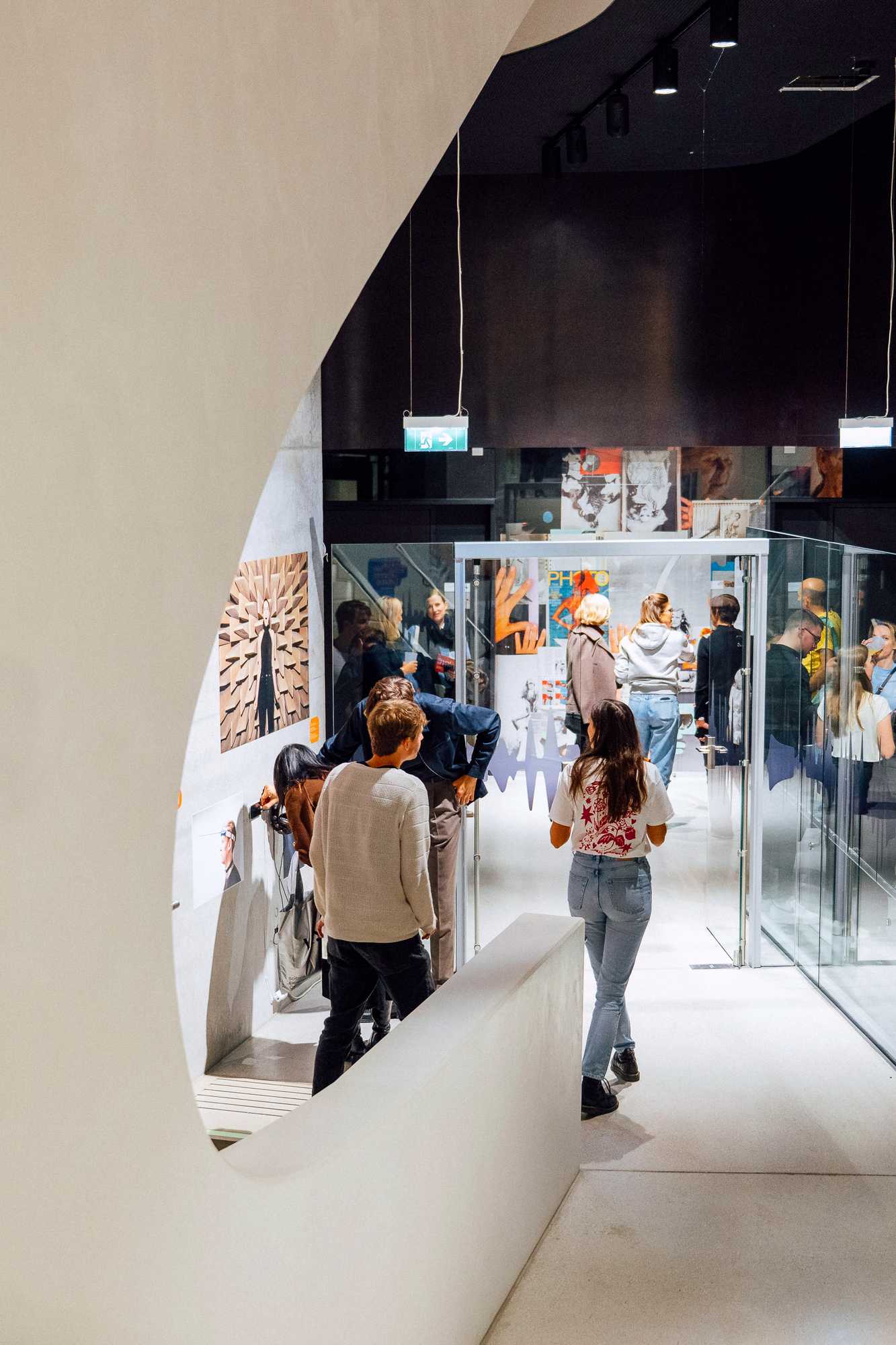
Within these flowing areas, we created layered information exchange hotspots, each focusing on a different topic from a different institution. The architecture itself became part of the narrative, with its organic geometry supporting the idea of research as a living, evolving practice.
---
## Visual System
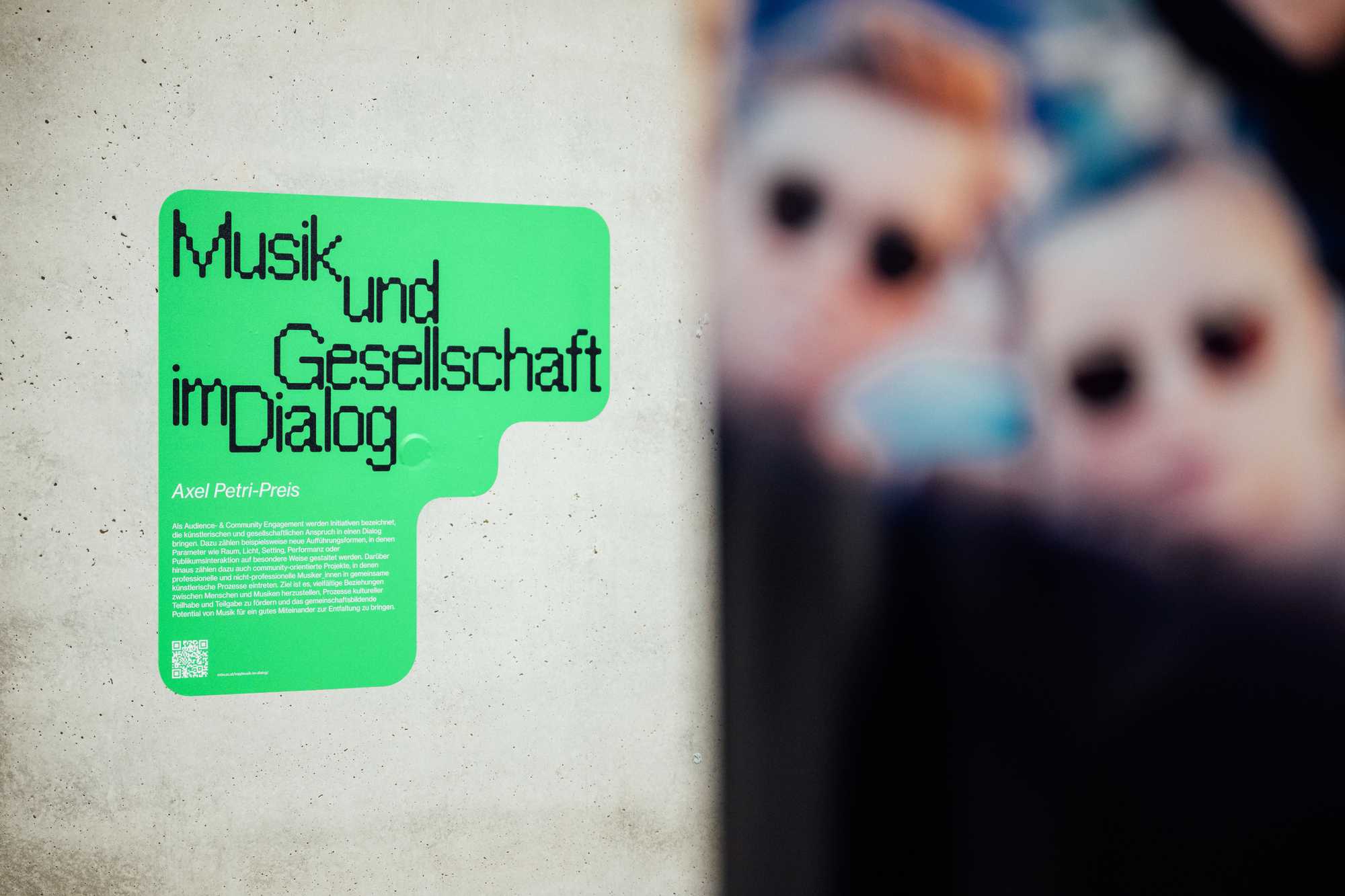
The Future Art Lab's existing monotonous color scheme presented both a challenge and an opportunity. We achieved visual clarity by implementing our own bold color coding system, with each research area distinguished by vibrant colors that stood in deliberate contrast to the building's neutral palette.
This approach created distinct zones of information while maintaining overall coherence throughout the space. The bold colors acted as wayfinding elements, guiding visitors through different research territories while maintaining the exhibition's unified identity.
---
## Typography
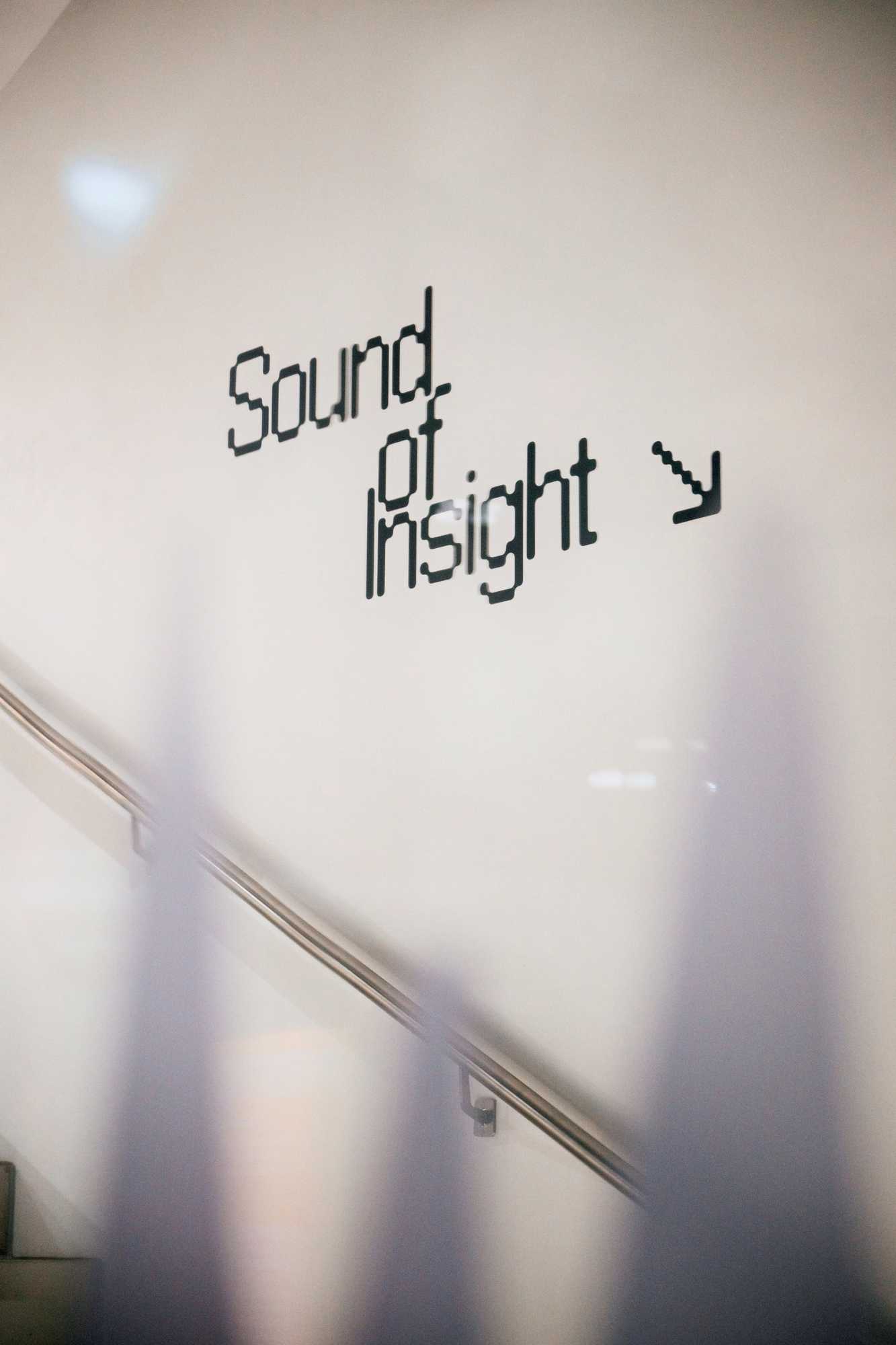
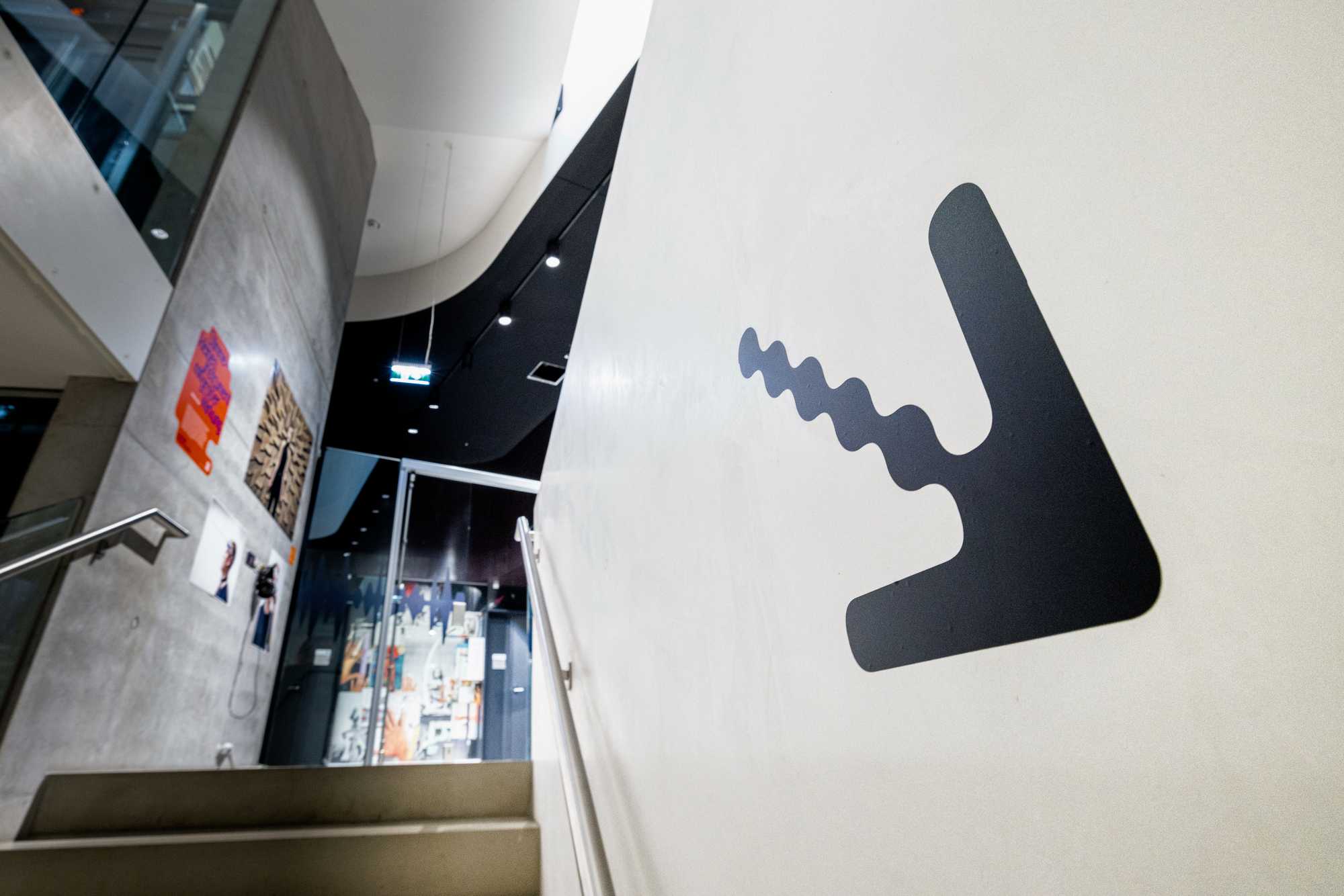
We selected Raster Grotesk as our primary typeface—a choice that embodied both the digital and the analogue, like soundwaves traveling through space, yet discrete like bits inside a machine.
This philosophy traveled through the entire exhibition, with rounded corners and bold colors creating a consistent visual language that unified all graphic elements while supporting the theme of research as limitless exploration.
---
## Media Setup
For the presentation of audiovisual works, we constructed three custom pedestals, each hosting a media player and screen for video presentations. A projector was strategically mounted to enable large-scale projection of information and research, creating moments of immersion within the flowing architectural space.
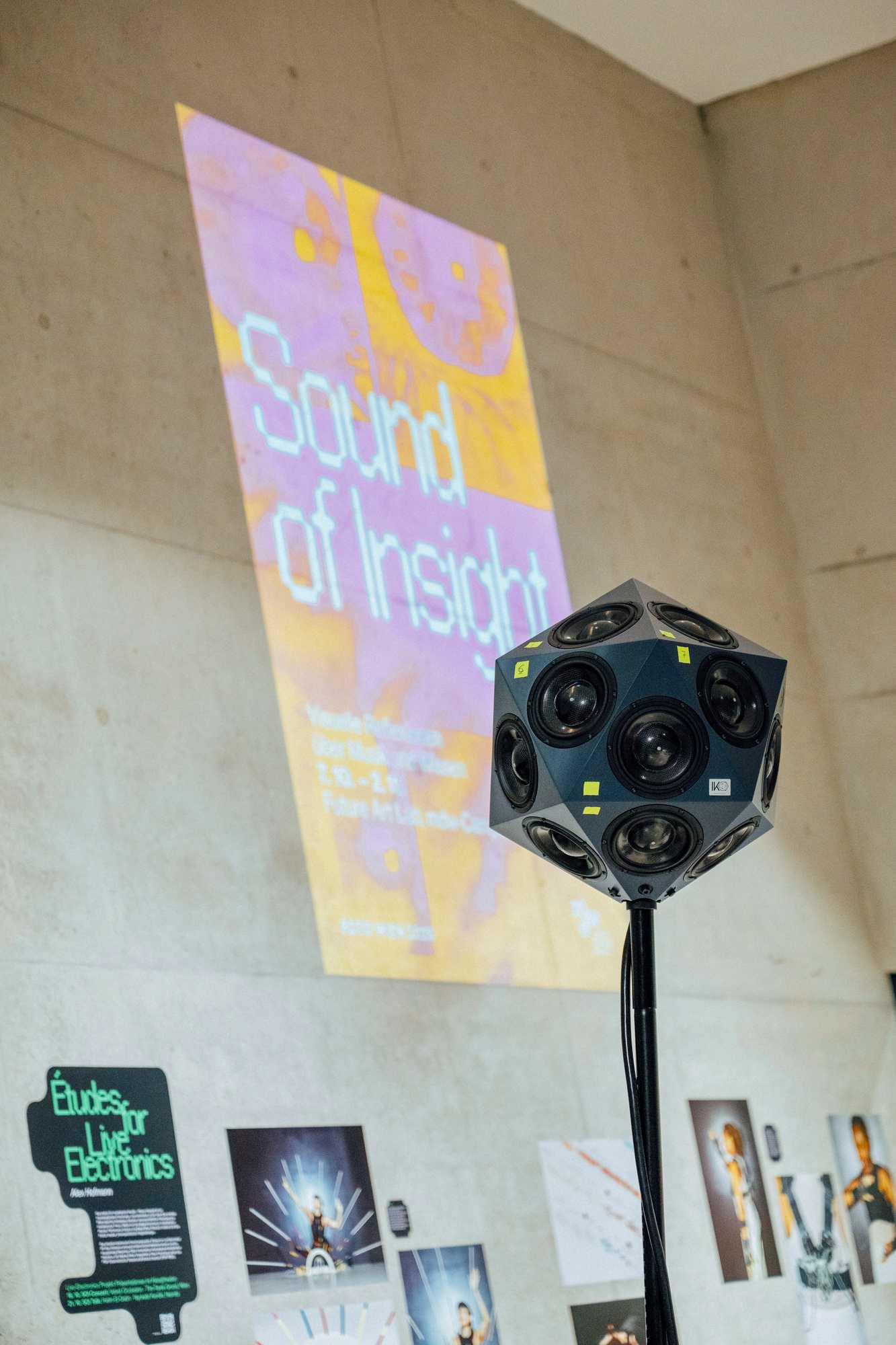
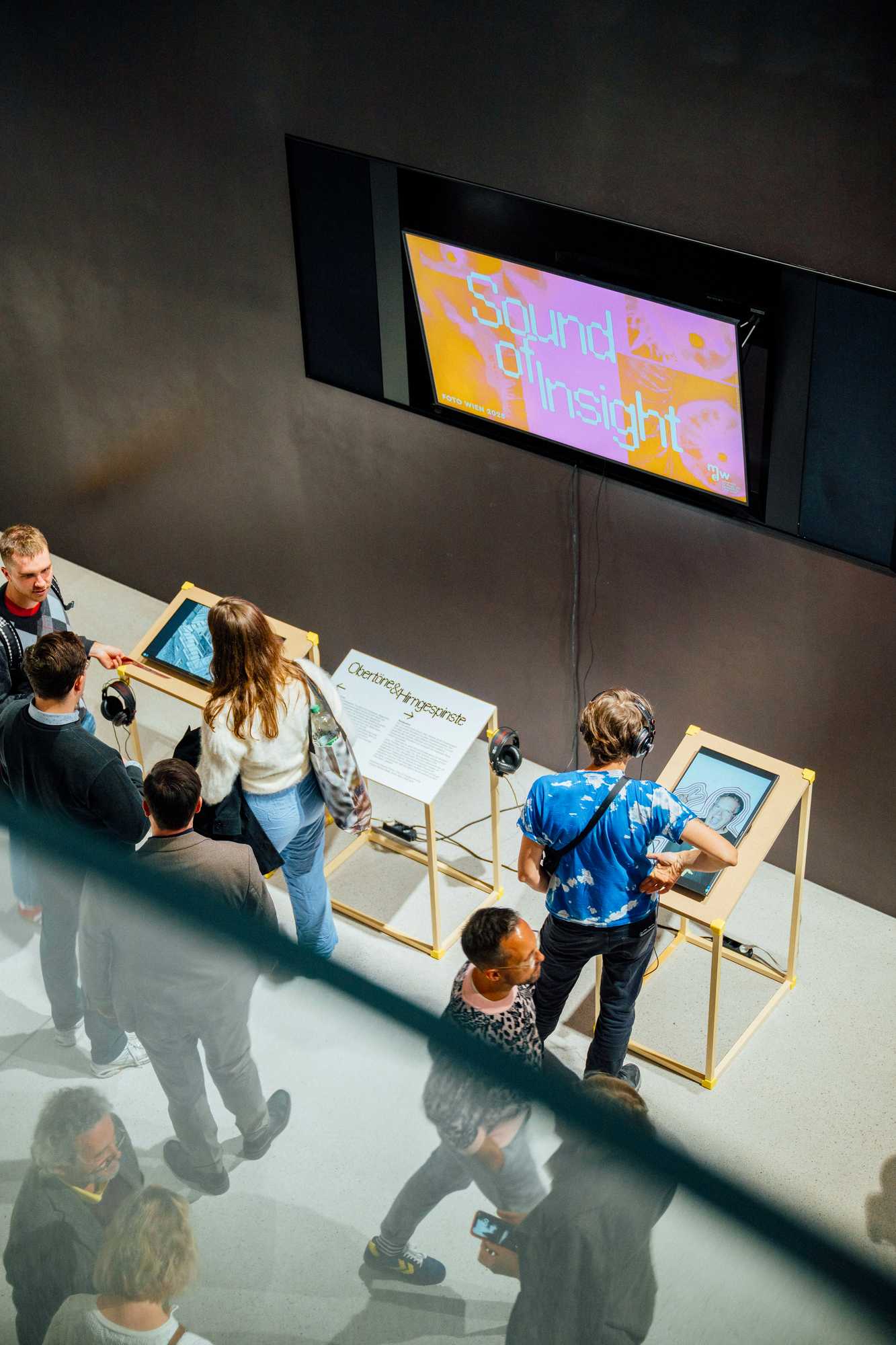
The media infrastructure was designed to be unobtrusive yet effective, allowing the research content to take center stage while providing the technical foundation necessary for audiovisual presentations. Each station could operate independently while contributing to the overall exhibition narrative.
---
## Overview
Sound of Insights emerged from a fundamental desire to translate research into spatial experience, reaching audiences on a multisensorial level. The challenge was: create an engaging exhibition within an operating hallway that needed to remain accessible during normal university operations.
We achieved this goal through graphic language, strategic audiovisual interventions, and excessive use of available wall space, all accentuated and guided by targeted lighting. The result was an exhibition that functioned both as an informational display and as a testament to the power of design to make complex research accessible and engaging.
---
## Credits
**Inhaltliche Partner:**
Alex Hofmann – Musikalische Akustik
Elsa Campbell – Musiktherapie
Malte Kob – Stimmforschung
Matthias Bertsch – Musikphysiologie
Axel Petri-Preis – Musikpädagogik
Caroline Heïder – Artistic Research
Jorge Sánchez-Chiong – Medienkomposition
**Im Rahmen der Foto Wien 2025**
Kuration: [Stephan Polzer](https://stephanpolzer.com){target=_blank}
**Fotografien:** Stephan Polzer, Caroline Heïder, Luisa Ricciarini u.a.
**Ausstellungsdesign:** [Max Kure](https://gemeindebau.im){target=_blank}, Leo Mühlfeld, Anton Posch (LMGI)
---
# AI in Science Futures
Canonical URL: https://leomuehlfeld.at/en/ai-in-science-futures
---
title: 'AI in Science Futures'
for: 'VISTA Science Experience Center'
category: 'Design Research & Speculation'
metaDesc: 'Facilitating a workshop that critically examines AI-futures within science using roleplay and craft methods.'
thumbnail: /img/vistawsthumb.jpg
date: '2025-10-05T00:00'
showOnLanding: true
heroImage: /img/vistaws01.jpg
collab: Stefan Schönauer
imageCredit: ISTA/Niko Havranek
---
# AI in Science Futures
## Facilitating a workshop that critically examines AI-futures within science using roleplay and craft methods.
## The Workshop
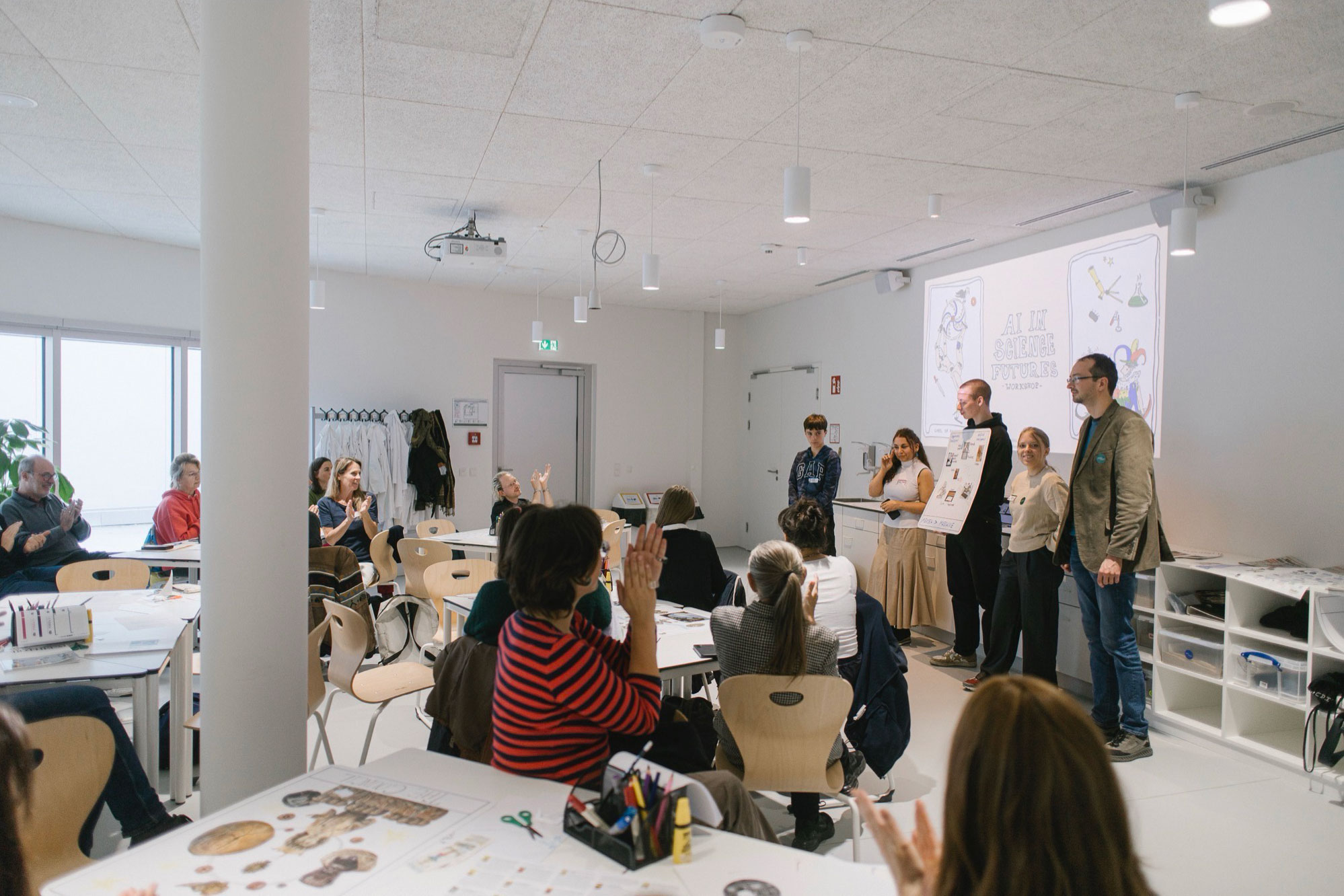
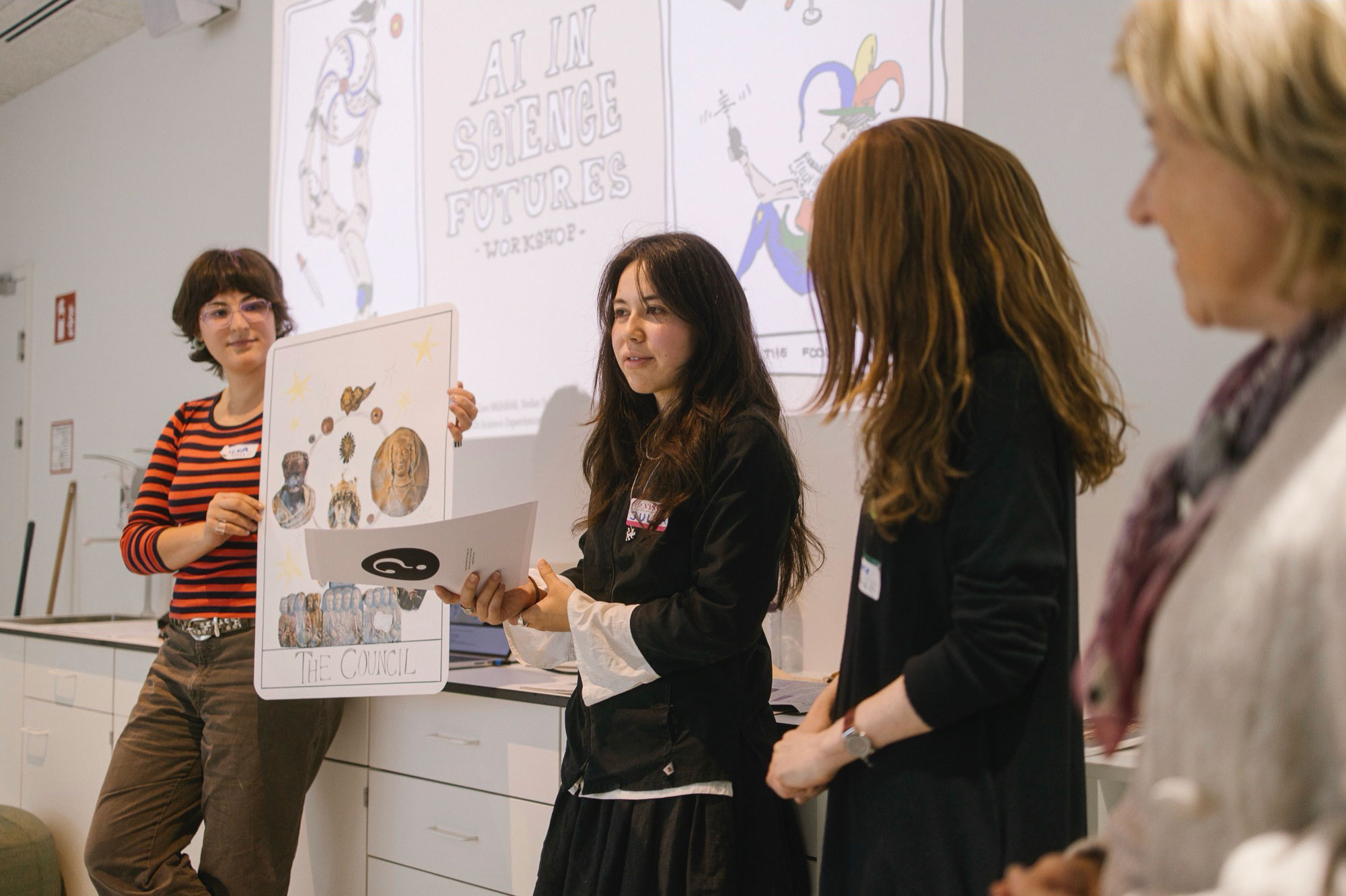
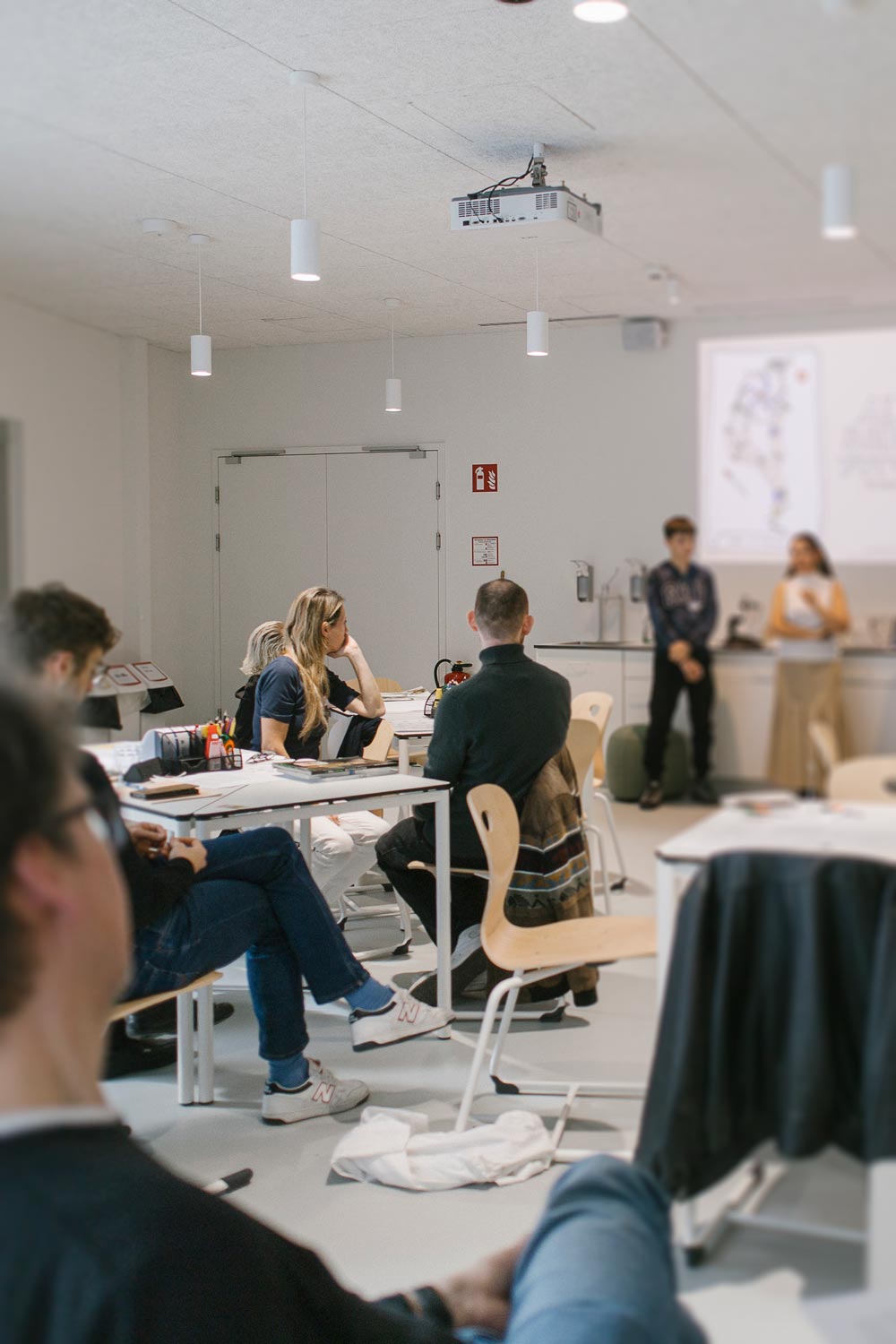
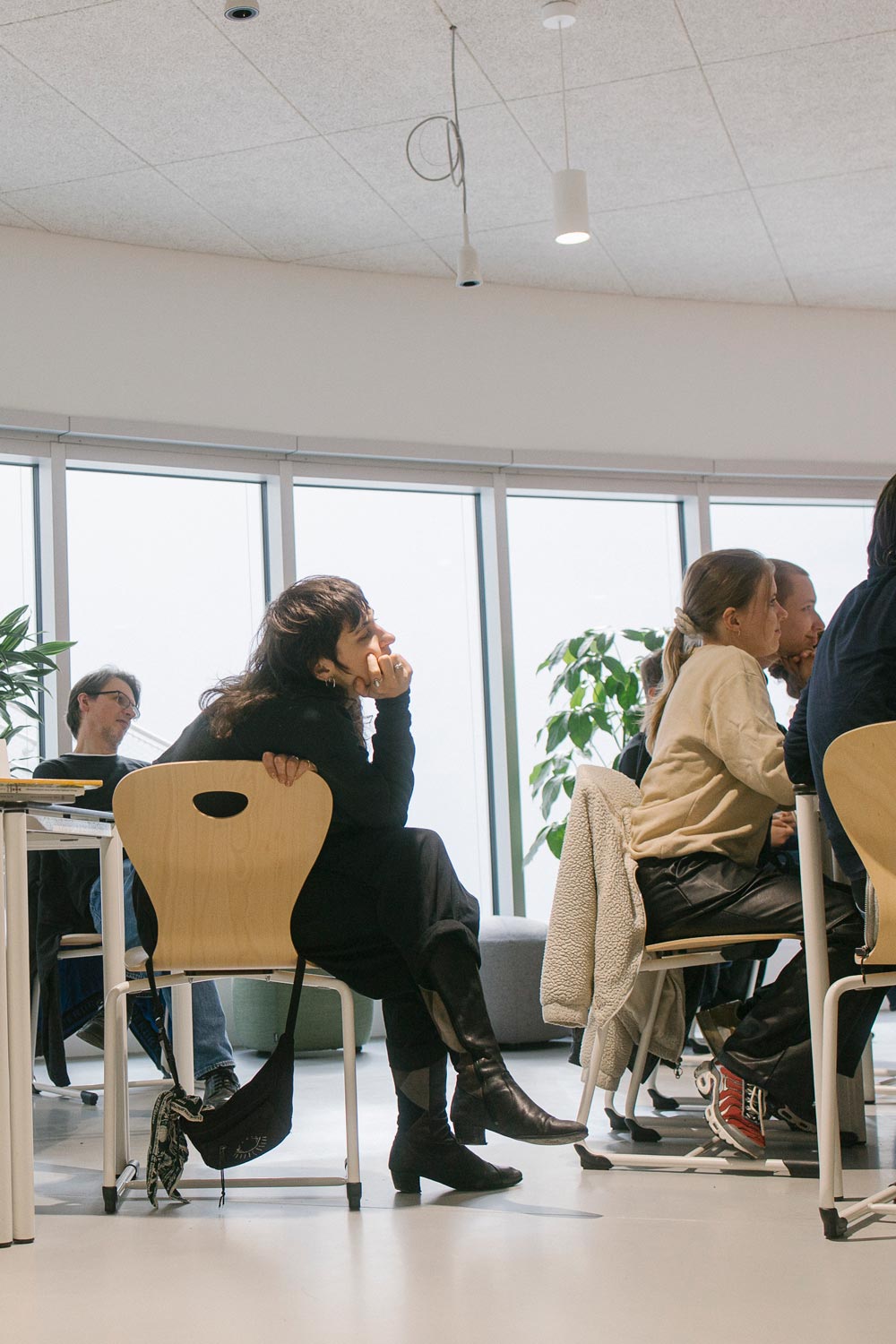
For the opening weekend of the [VISTA Science Experience Center](https://www.vistascience.at/de){target=_blank} in Klosterneuburg, Austria, we developed a playful and creative workshop format that would tap into worldbuilding and roleplay techniques in order to create a low barrier of entry for anyone interested in discussing the use of AI within a scientific Context.
The workshop was open for all and unfolded speculative future narratives over a period of 2 hours, engaging all participants in group discussions and hands-on creative exercises.
## Context
The [VISTA Science Experience Center](https://www.vistascience.at/de){target=_blank} is located on the campus of the Institute of Science and Technology Austria [(ISTA)](https://ista.ac.at/home){target=_blank} - a PhD-granting research institution dedicated to cutting-edge research in the physical, mathematical, computer and life sciences.
Its main focus is communicating a broad spectrum of scientific work and knowledge to a wide public - situating itself between society and science.
For the opening weekend, we were asked to hold a workshop that would critically examine the role of artificial intelligence within the science context.
---
## Defining Technology
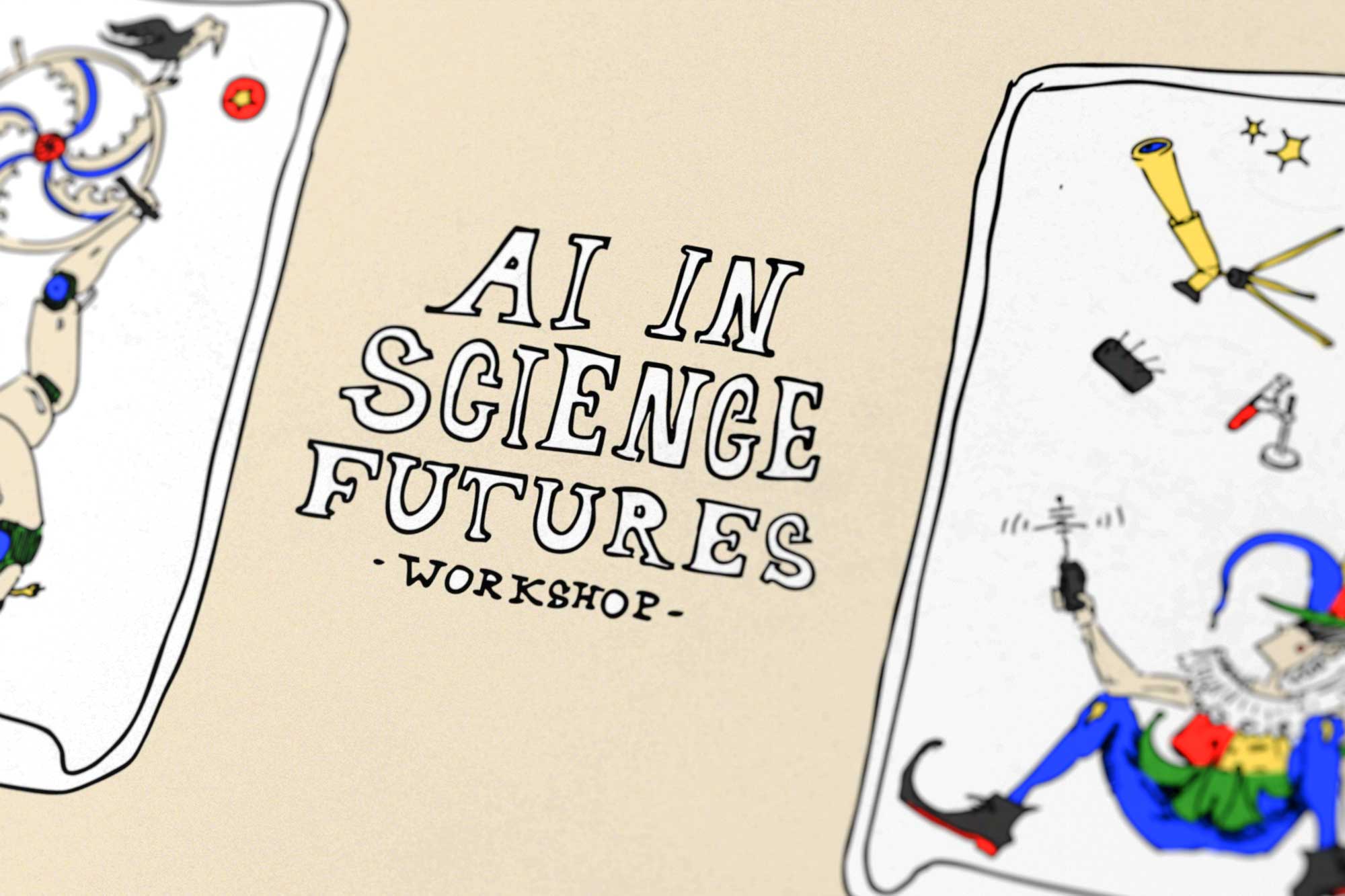
In order to break open rigid ideas around AI and science, we used Tarot Archetypes and Imagery as a starting point for ethical, ecological and moral exploration. In a short introduction that got all participants up to speed on the current projections around AI as well as the everyday struggles science is facing, we playfully introduced Tarot as an analog and archaic technology - not too dissimilar to AI and LLMs.
With both often being dismissed as mythical, opaque and dangerous as well as drawing on big, general convolutes of knowledge - in AI’s case training data, and in Tarot’s case a collective unconscious as described by Carl Jung - they might be more similar than one would initially think.
For the technical insight we based our intro on the [AI 2027 Report](https://ai-2027.com){target=_blank}.
## Stepping Outside of Ourselves
Within the workshop, we introduced participants to very specific narratives that featured scientists, activists and everyday people. These vignettes described a future, in which AI and science were already tightly connected and presented points of friction to be resolved or - at the very least - critically examined.
In order to break the ice and take people outside of their everyday assumptions and patterns, each person drew a Tarot Archetype to inspire their positionality on the topic for the duration of the workshop.
---
## Speculative Worlds
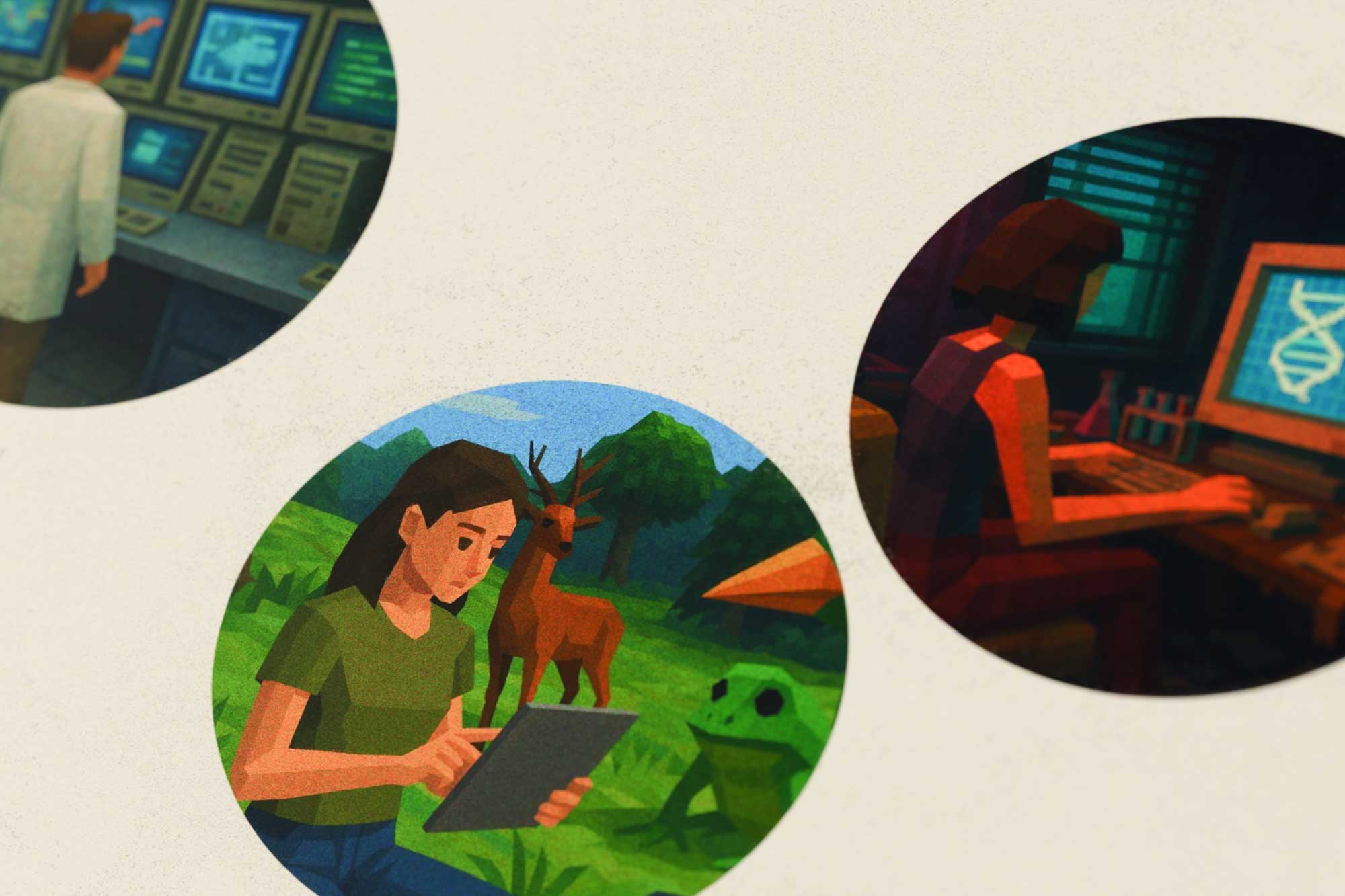
These narratives were based on 3 specific “worlds”; AI as a Scientist, Symbiotic Collaborations and Biohacking Chaos. These are also present within the work "AI, as a Scientist" of the permanent exhibition of the VISTA Science Experience Center. Thus, the workshop seamlessly extended from the Visitor Experience.
## AI as a scientist
AI designs faster than any human solving problems we no longer fully understand.Science advances, but itslogic is hidden in the machine.
> How do you stay curious when the answers are unreadable?
## Symbiotic Collaboration
AI helps us tune into the hidden complexity of living systems—ecosystems, microbes, entire networks of life. But tools built by humans risk shaping the world in our image.
> Can we build with nature, not over it?
## Biohacking Chaos
AI tools are everywhere—unlocked, remixed, and reshaped by anyone. Innovation explodes, but so do the risks.
> What do you grow in a world without rules?
---
## Crafting new Archetypes
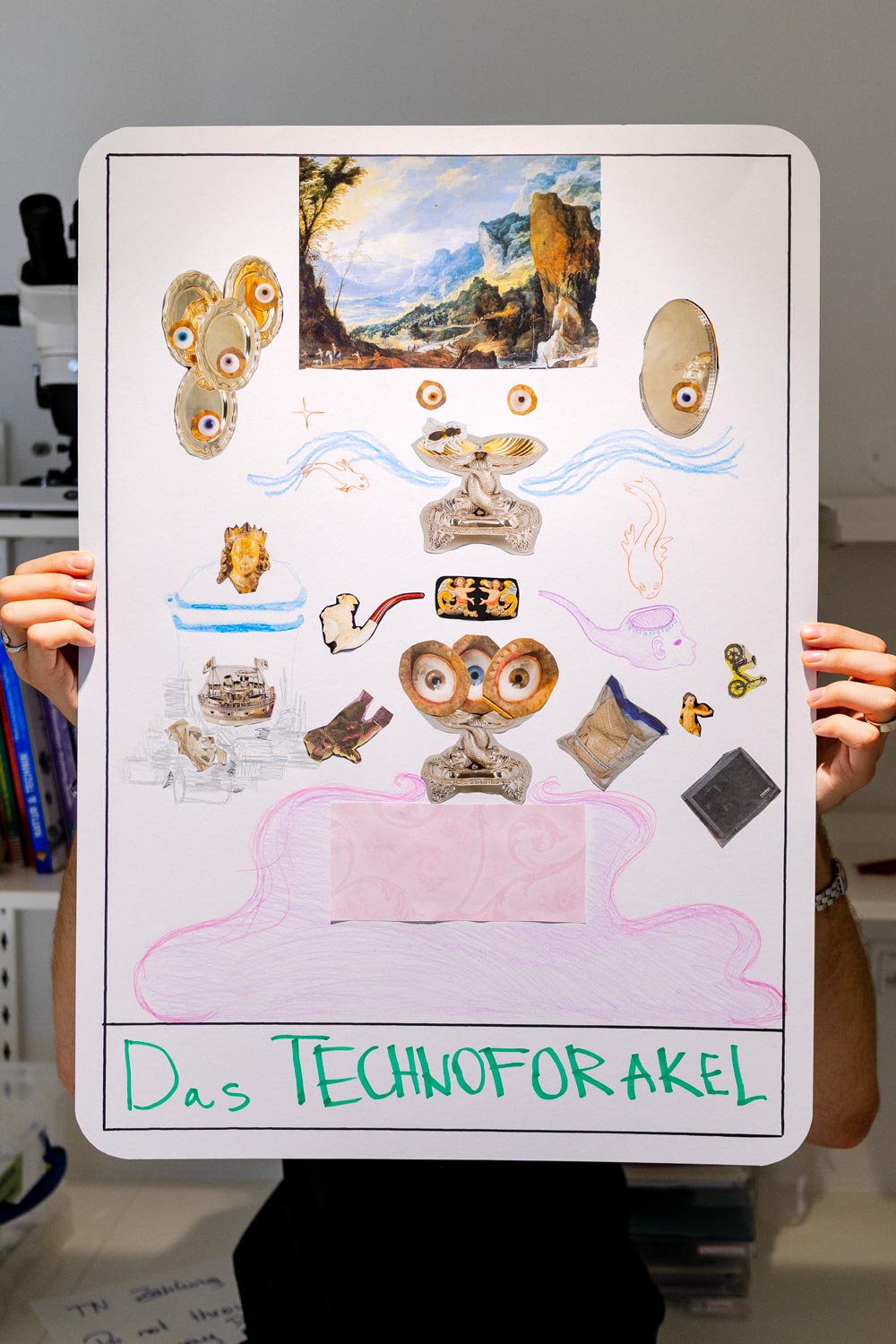
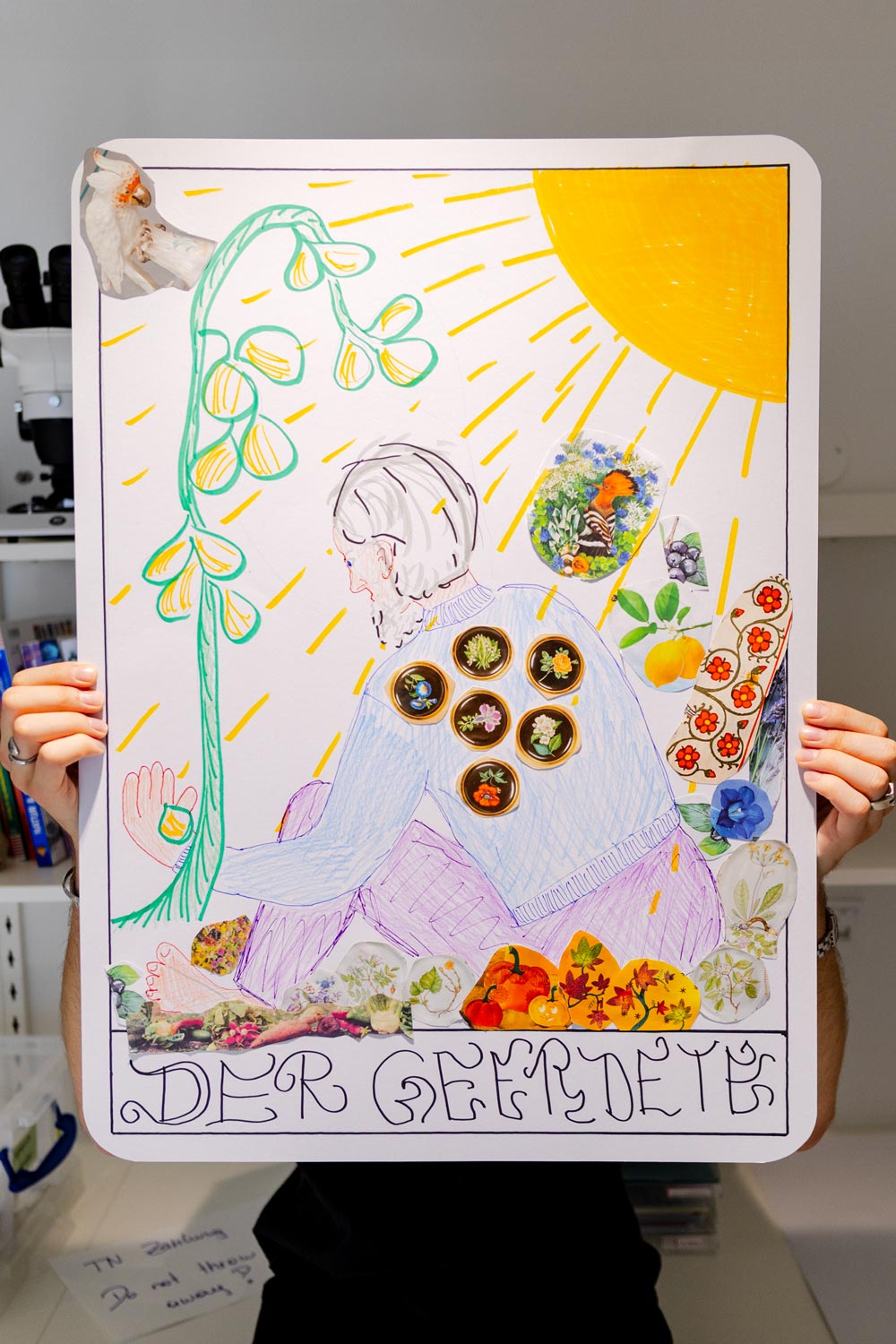
Finally the workshop concluded with participants coming together in groups to collage, sketch and write. Together they crafted new archetypes, symbols and storylines from their scenarios that were thought-provoking and original.
Drawing from the initial impulse of Tarot as a tool for reflection, their thoughts, emotions and narratives were captured in the form of new and inventive Tarot cards.
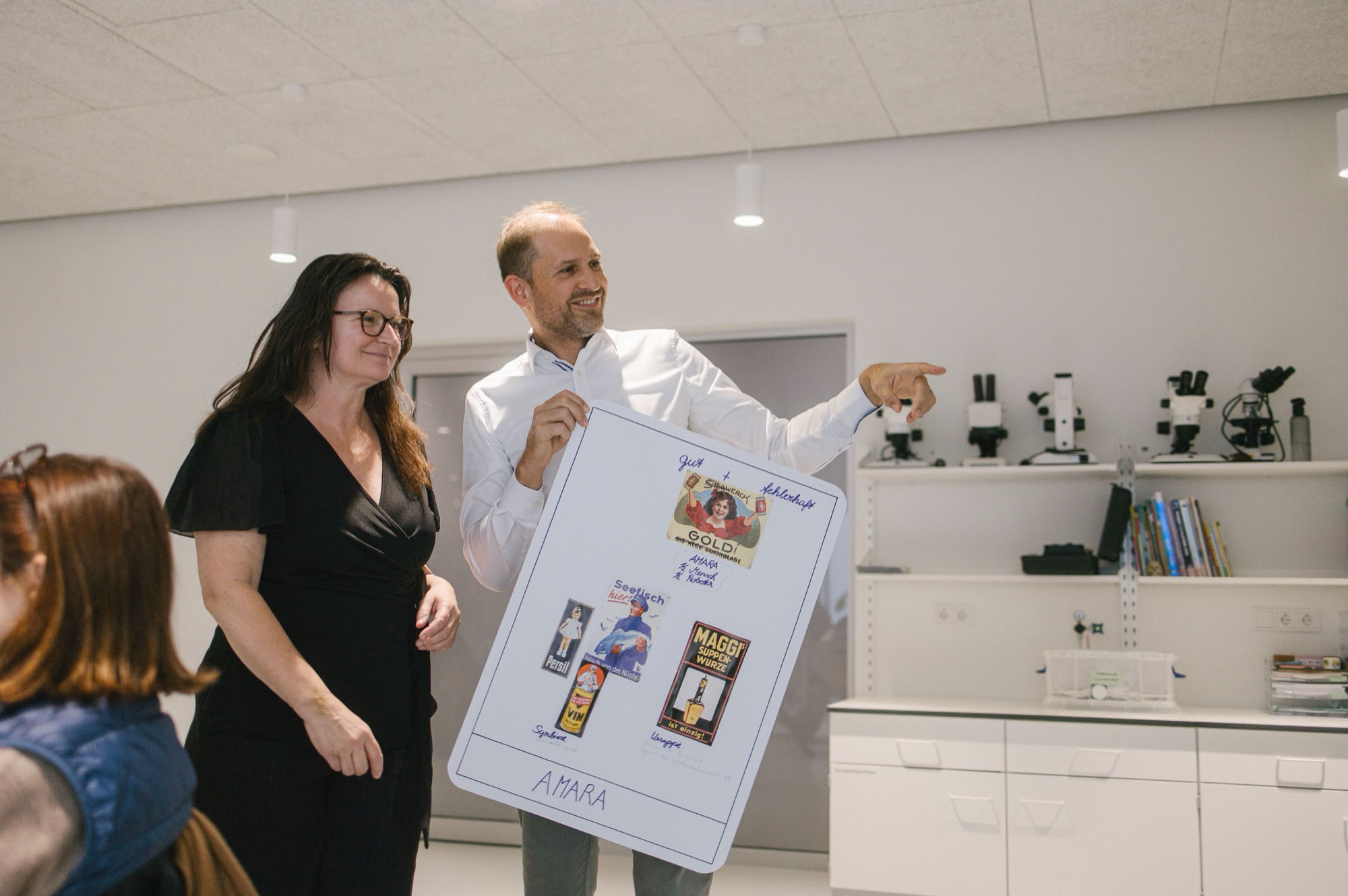
Together they crafted a deck of archetypes confronting an uncertain future for scientists and society dealing with the implications of AI systems that are pervasive and highly intelligent.
The participants skillfully wrote, collaged and sketched their storylines together and finally presented them to their fellow AI-stronauts.
---
## Credits
Workshop realised at and for [VISTA Science Experience Center](https://www.vistascience.at/de){target=_blank}
Done in collaboration with [Stefan Schönauer.](https://schoenauerstefan.at){target=_blank} Thank you to [Lucy Li.](https://lilucy.at)
---
# Snapdragon
Canonical URL: https://leomuehlfeld.at/en/snapdragon
---
title: 'Snapdragon'
for: 'Process Studio'
category: 'Film & Motion'
metaDesc: 'Translating the wonder scientists feel at the frontier of genetic research into a data-driven film for a permanent science exhibition.'
thumbnail: /img/SD14.jpg
date: '2025-10-03T00:00'
showOnLanding: true
heroImage: /img/SD14.jpg
collab: Stefan Schönauer
---
# Snapdragon
## Translating the wonder scientists feel at the frontier of research into a film that makes a broad audience feel it too.
## Fifteen Years in the Valley
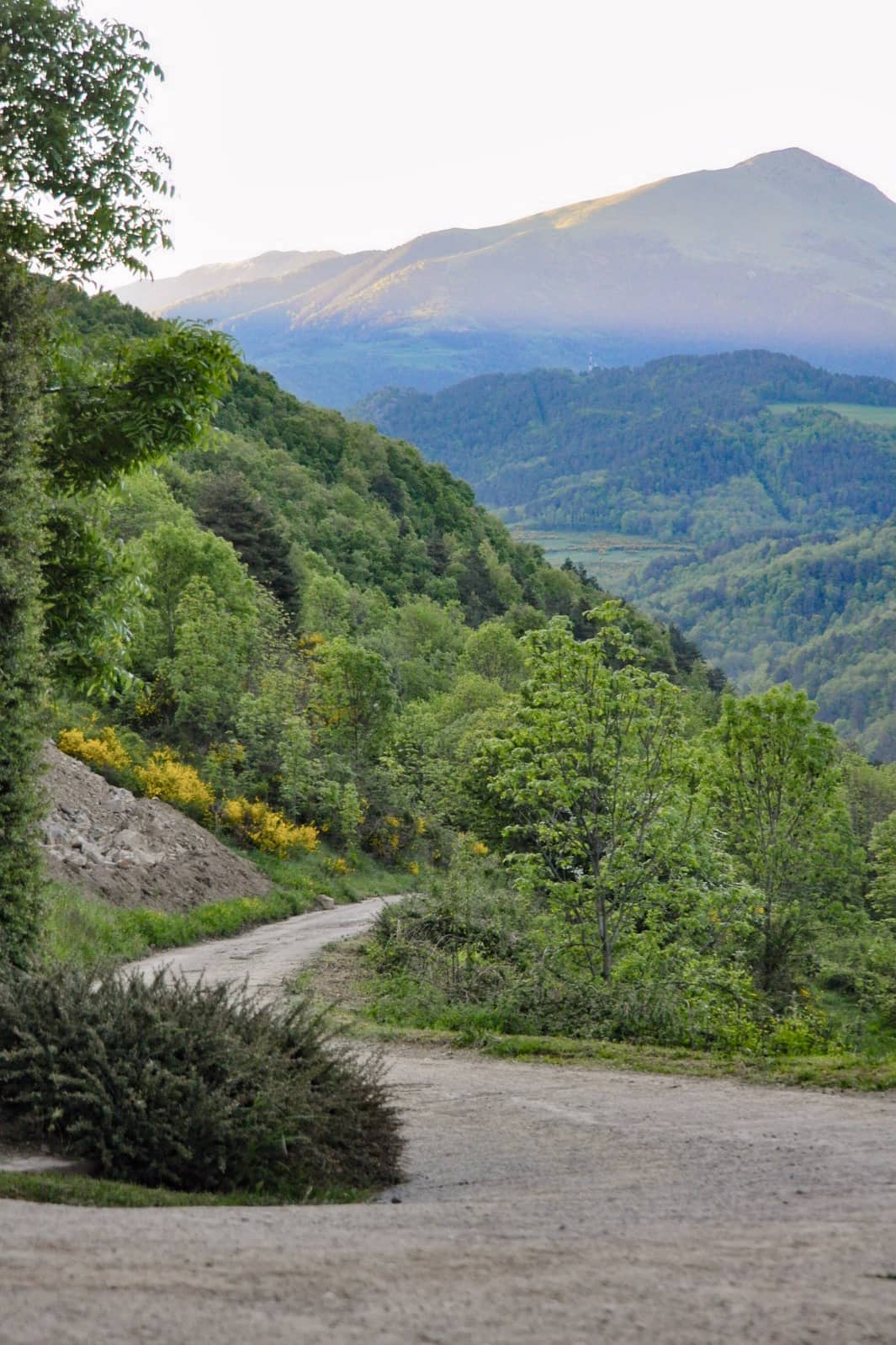
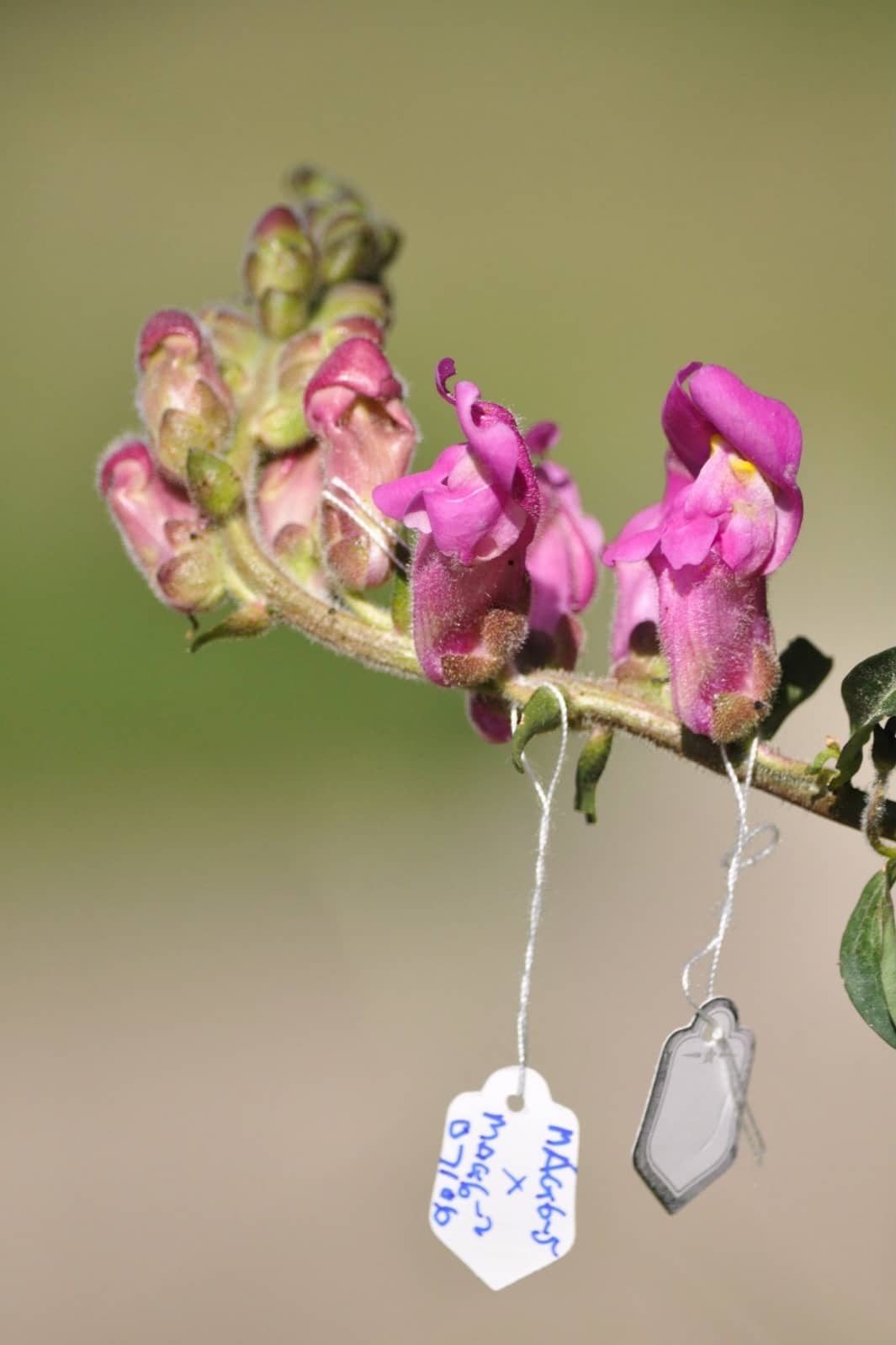
When researchers from the [Barton Group](https://ist.ac.at/en/research/barton-group/){target=_blank} at the Institute of Science and Technology Austria [(ISTA)](https://ist.ac.at/en/home/){target=_blank} pack their bags for the Andorra region each year, they are returning to something close to a ritual. For over fifteen years, Nick Barton and his team have made the journey to the Spanish-French border to find, tag, and document almost every individual Snapdragon growing there. They are following something that genuinely fascinates them. The population holds answers to deep questions about how species form, how genes travel through generations, and why living things look the way they do.
## The Snapdragon
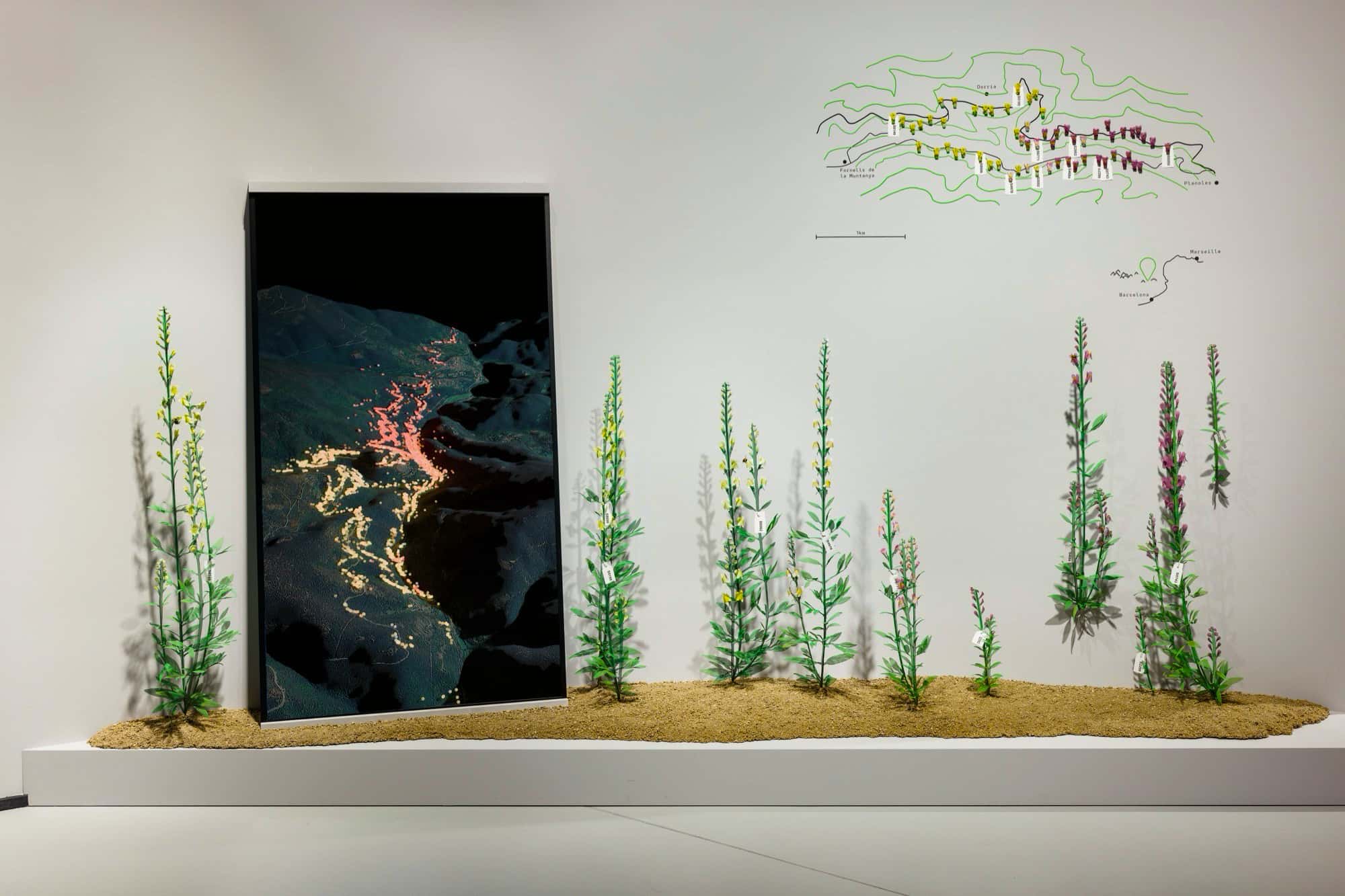
The Snapdragon — also known as Antirrhinum — is not an obvious candidate for scientific obsession. Its blossoms are best known for the way they "snap" open when squeezed, a small theatrical trick that has charmed generations of children. But the Andorra population holds something rarer: a continuous gradient of colour running across the landscape, from blazing yellow in the west to deep magenta in the east. In the zone between them, hybrid specimens paint the hillsides in white, orange, and intricate multicoloured patterns.
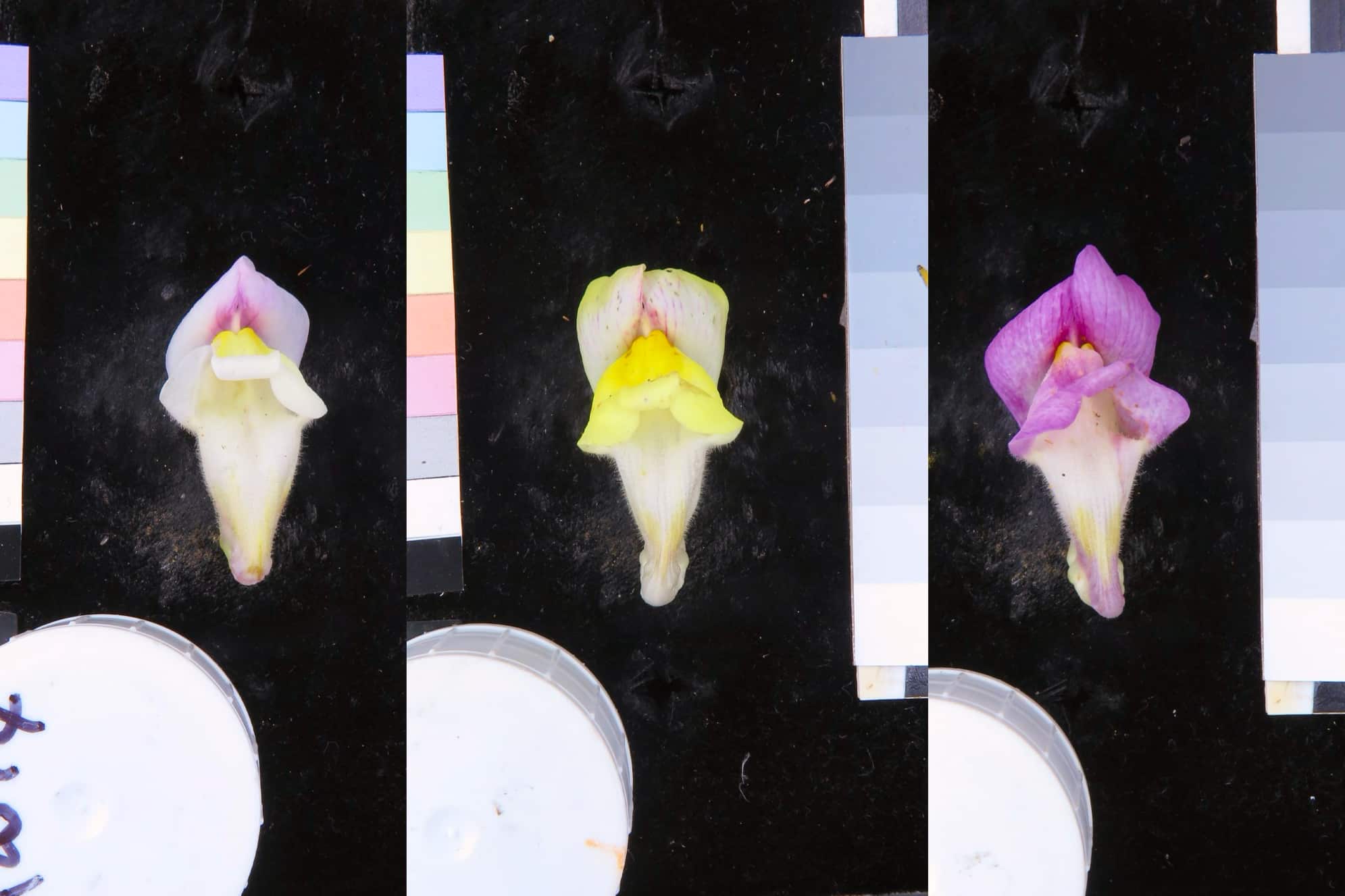
For a geneticist, this gradient is a map. Each colour is the visible expression of specific DNA snippets — called SNPs — competing and cooperating across generations. By tracking individual plants and sampling their genes over years, the Barton Group could read that map: identifying which sequences drive which colours, and what the slow drift of those colours across the valley tells us about the mechanisms of genetic inheritance.
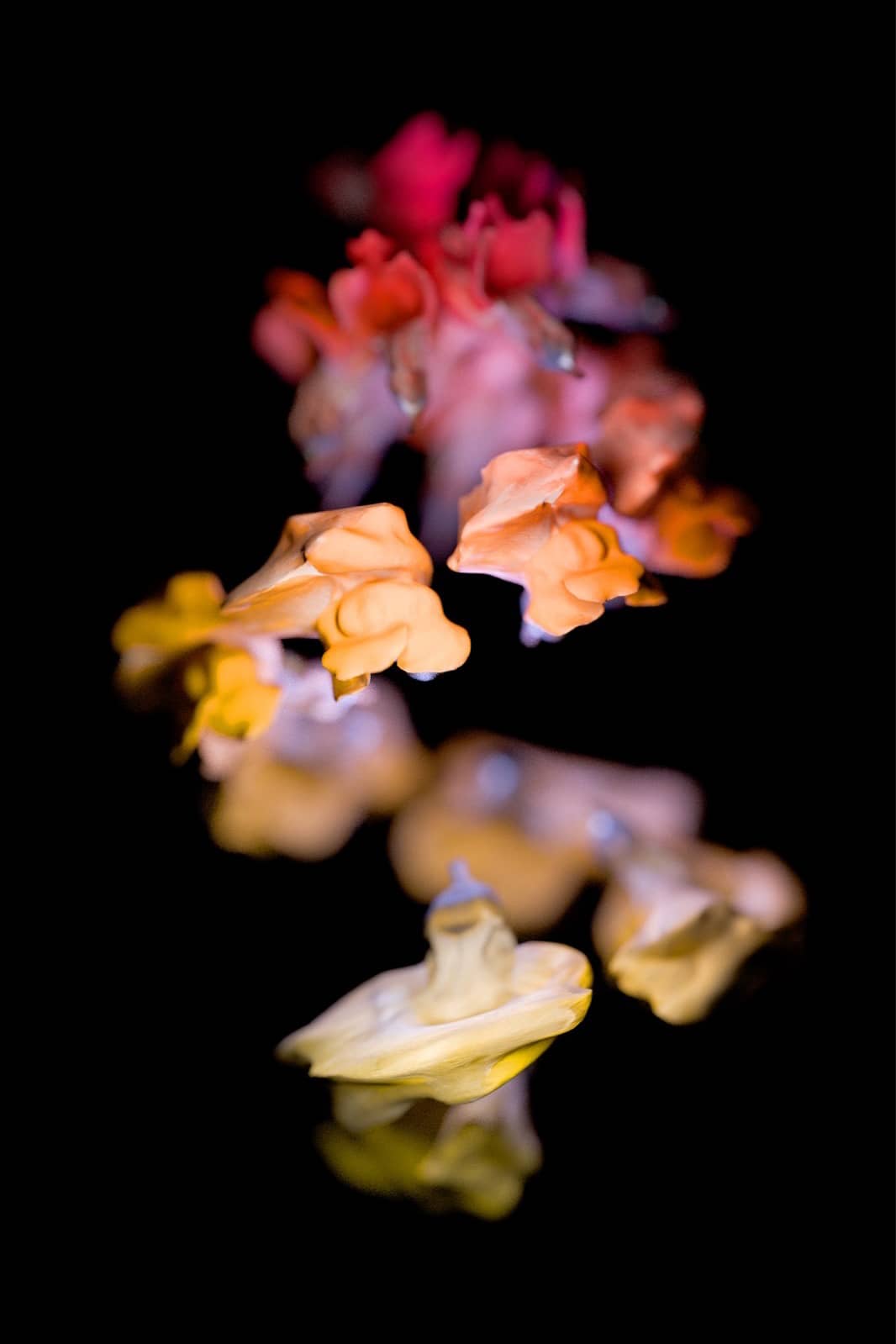

What the scientists feel standing in that valley: the sense that something genuinely important is hidden in plain sight, waiting to be understood. It's not easy to transmit. Their most important tool is a spreadsheet. Their most dramatic output, a pedigree.
---
## Communicating the Craft
The brief was not simply to explain the research. It was to close a perceptual gap — to make a visitor at a science exhibition feel, even briefly, what it is like to be someone who has spent fifteen years caring deeply about a flower.
That kind of work is easy to misread as dry. Rows of data, field notes, genetic sequences. The design challenge was to find the visual and spatial language that the data itself cannot supply: the sense of scale, the feeling of pattern emerging from noise, the moment where years of meticulous documentation suddenly resolves into something you can see and feel.
## Making the Data Felt
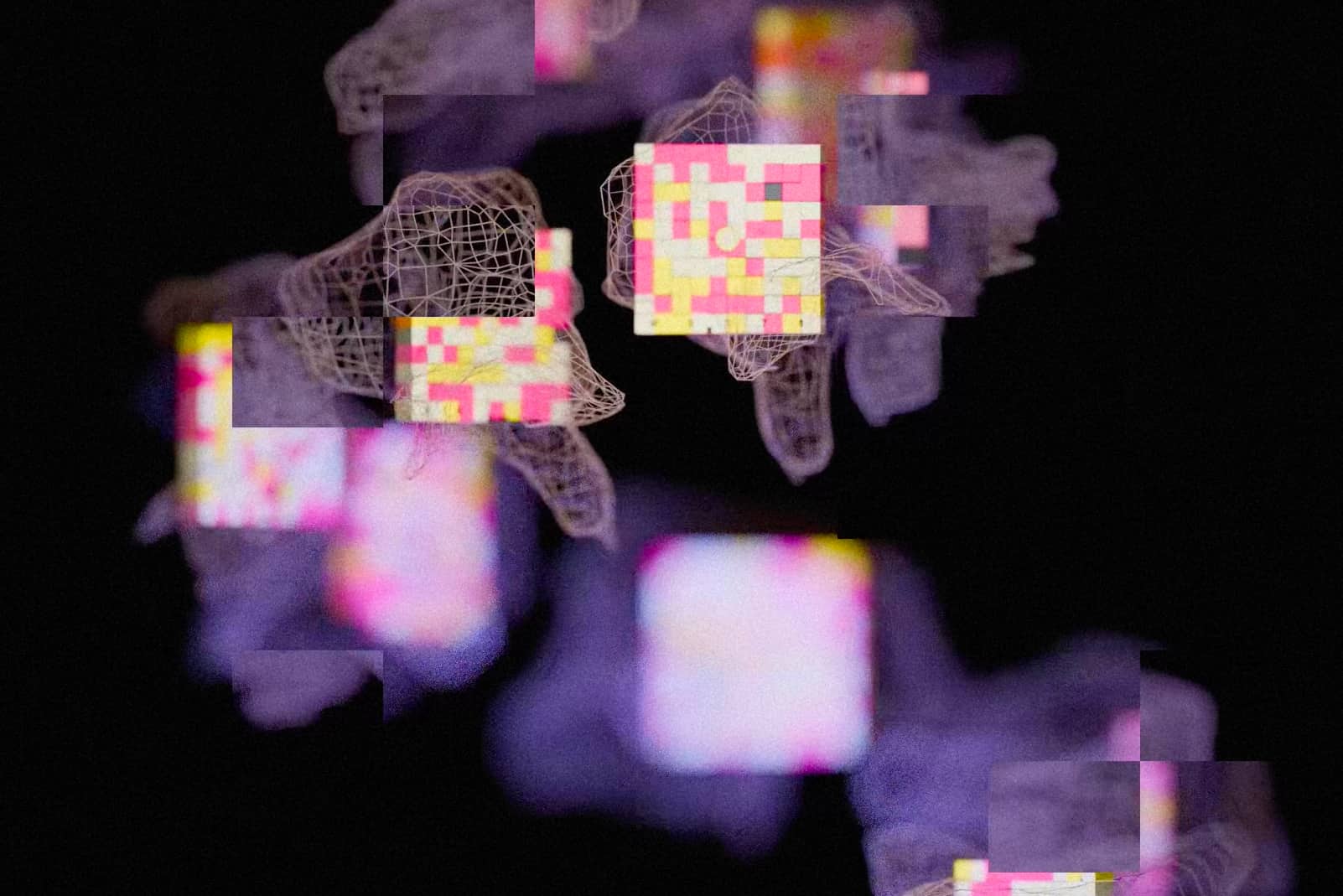
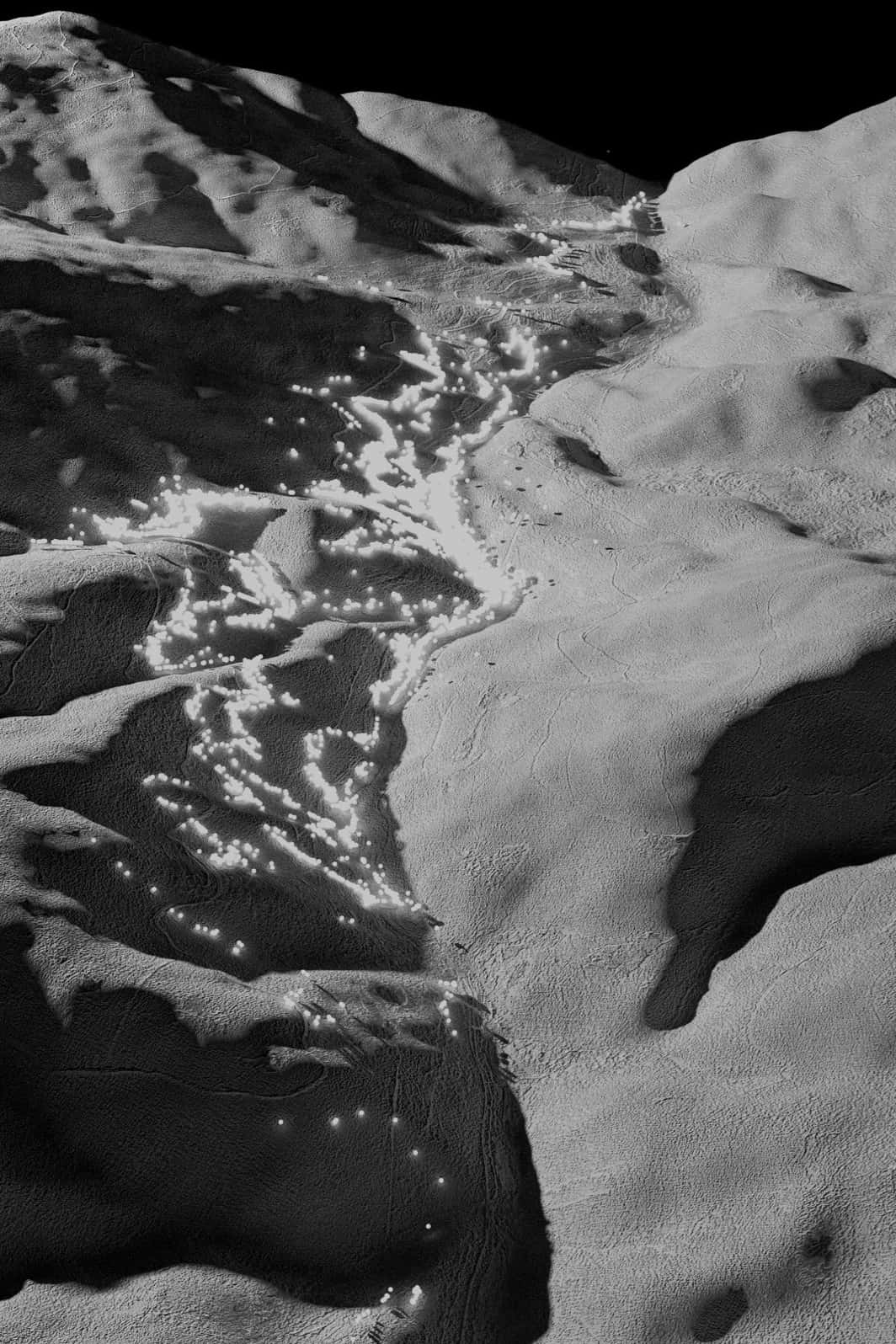
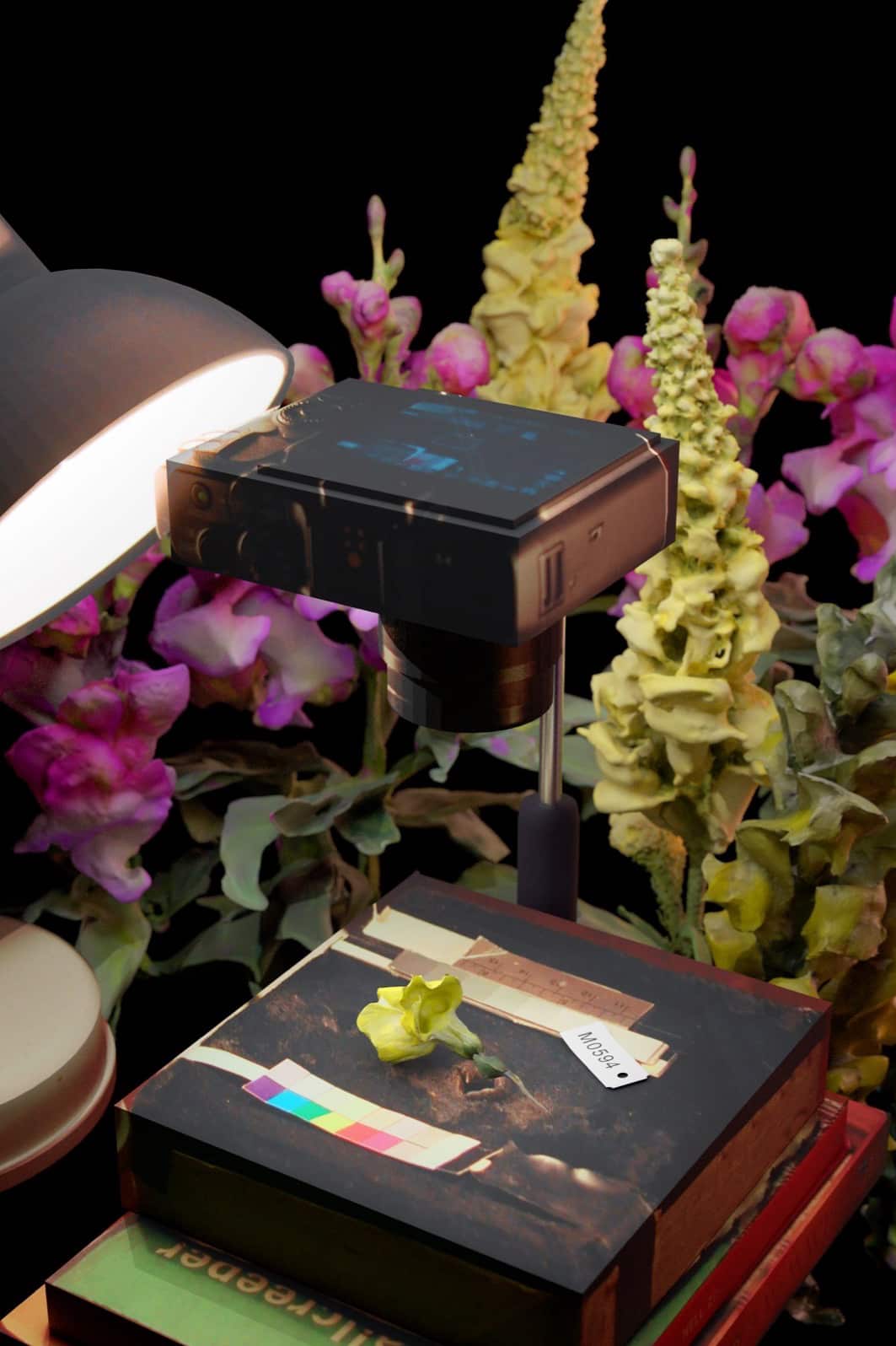
To build that experience, we worked across archival footage from the Barton Group's field trips, custom 3D scans of the flowers, and data visualisations that moved between faithful representation and deliberate artistic interpretation. Each choice was made in service of a single question: does this help a viewer feel the significance of what they are looking at?


The animation moves at the rhythm of the research itself — circling the landscape at a macro level, then zooming into individual blossoms and the data points clustered around them, then pulling back out again to show the population as a whole. It is the same movement a scientist makes: between the single specimen and the pattern it belongs to, between the close and the vast.
---
## Credits
Work realised for and with [Process Studio](https://process.studio){target=_blank}
Done in collaboration with [Stefan Schönauer.](https://schoenauerstefan.at){target=_blank}
---
# AI the Scientist
Canonical URL: https://leomuehlfeld.at/en/ai-the-scientist
---
title: 'AI the Scientist'
for: 'VISTA Science Experience Center'
category: 'Exhibition & Installation'
metaDesc: 'Designing an interactive exhibit on AI in science and protein research for the VISTA Science Experience Center.'
thumbnail: /img/ai-the-scientist-heroimage.jpg
date: '2025-10-02T00:00'
showOnLanding: true
heroImage: /img/ai-the-scientist-heroimage.jpg
collab: Lucy Li, Alan Schiegl
---
# AI the Scientist
## Designing an interactive exhibit on AI in science and protein research for the VISTA Science Experience Center.
## What does AI mean for research?
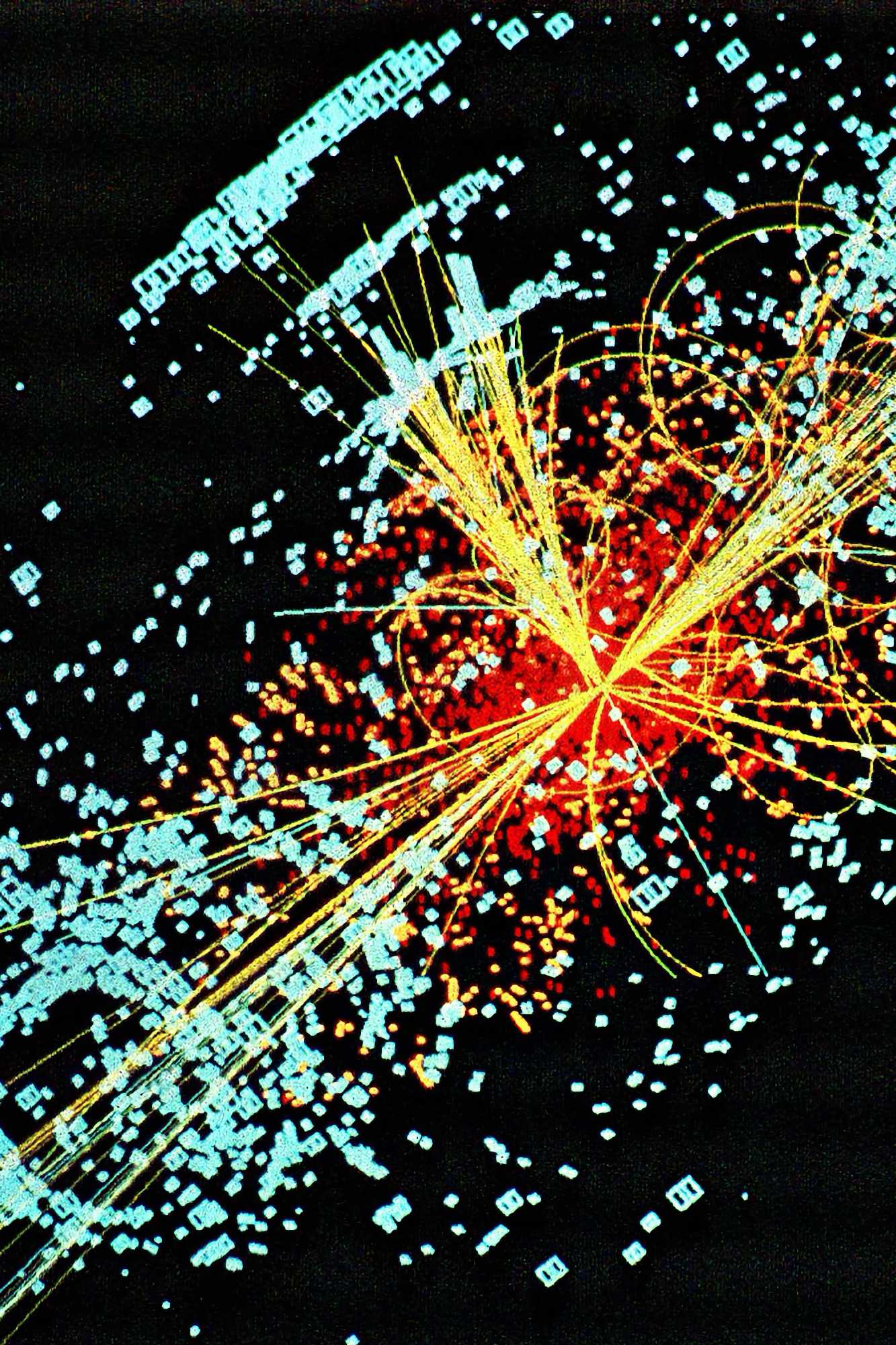
Protein research has been quietly transformed. AI-tools like AlphaFold now predict molecular structures in hours that once took decades of painstaking lab work. But the science is abstract, the tools invisible, and the implications difficult to grasp. VISTA Science Experience Center commissioned us to make this shift legible to visitors.
## Embodying the Abstract
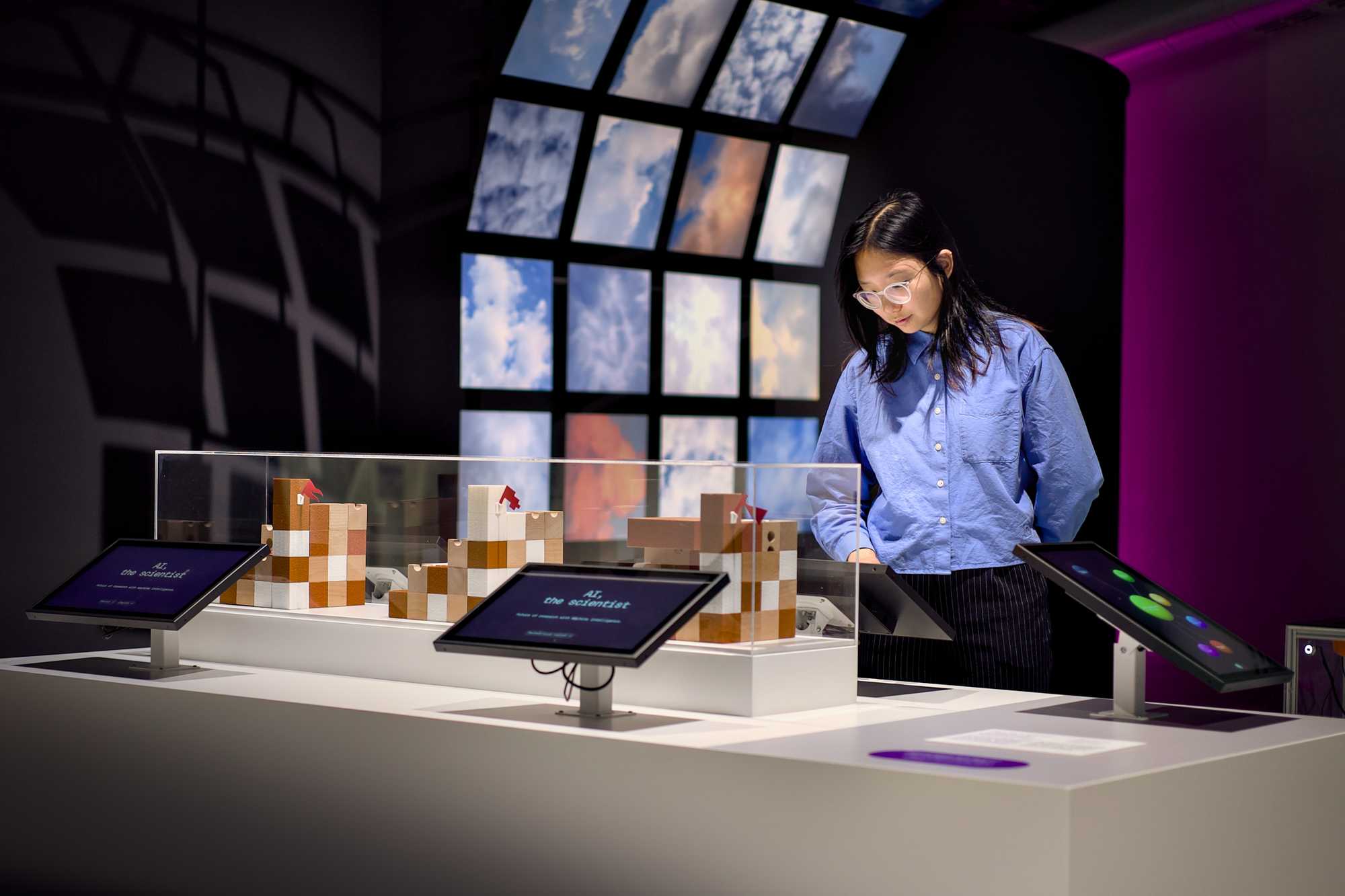
The central design challenge emerged immediately: how do you give physical form to artificial intelligence without falling into tired metaphors or sterile visualizations? We started our process by meeting the scientists themselves.
---
## Meeting the Scientists
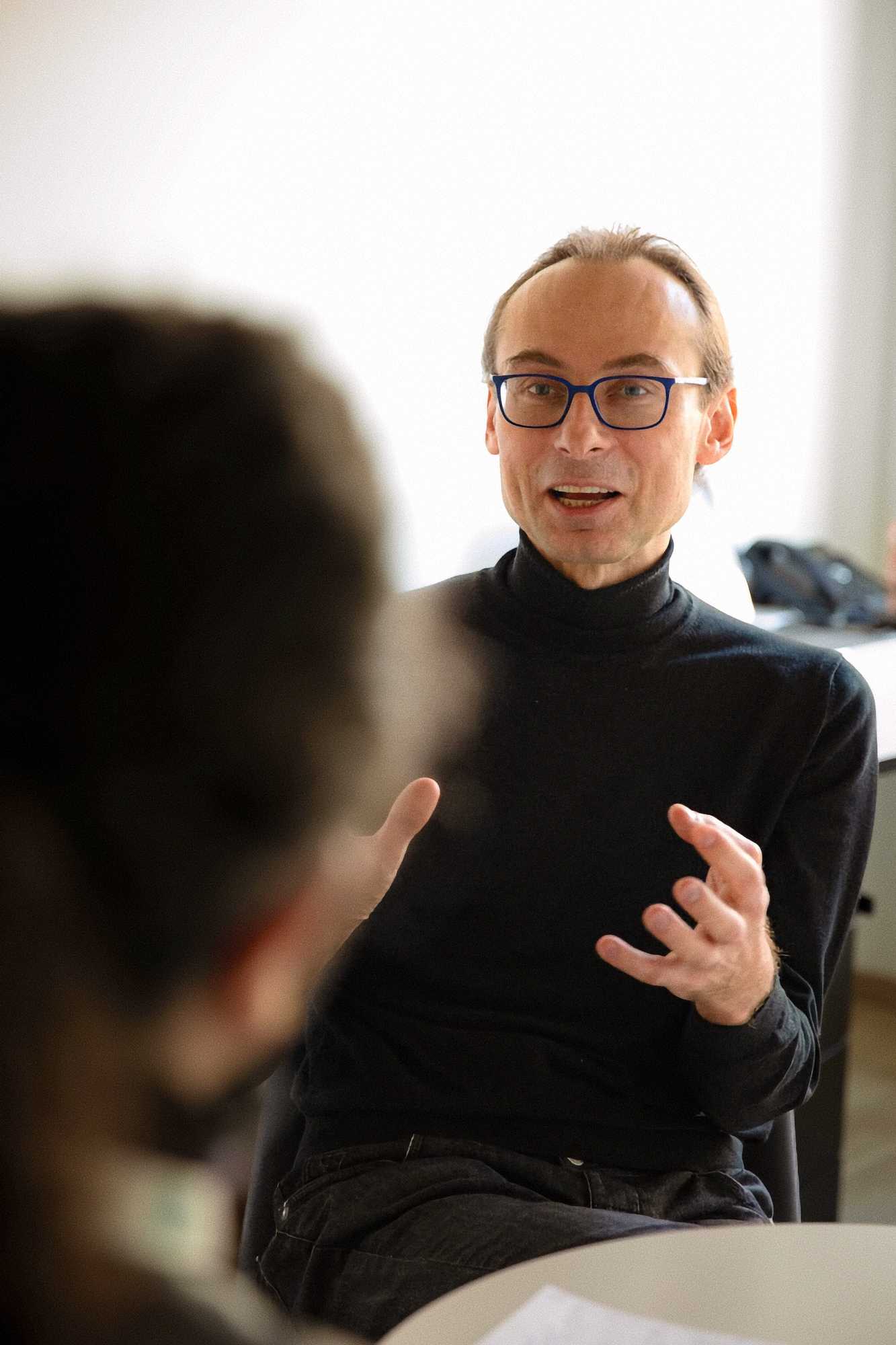
Our collaboration began with extensive interviews with researchers Alex Bronstein and Florian Praetorius, as well as visits to their groups' labs. These conversations revealed what a day in the life of a cutting-edge scientist truly looks like — how they actually use and develop these tools, where their work is misunderstood, and what fears and hopes surround it.
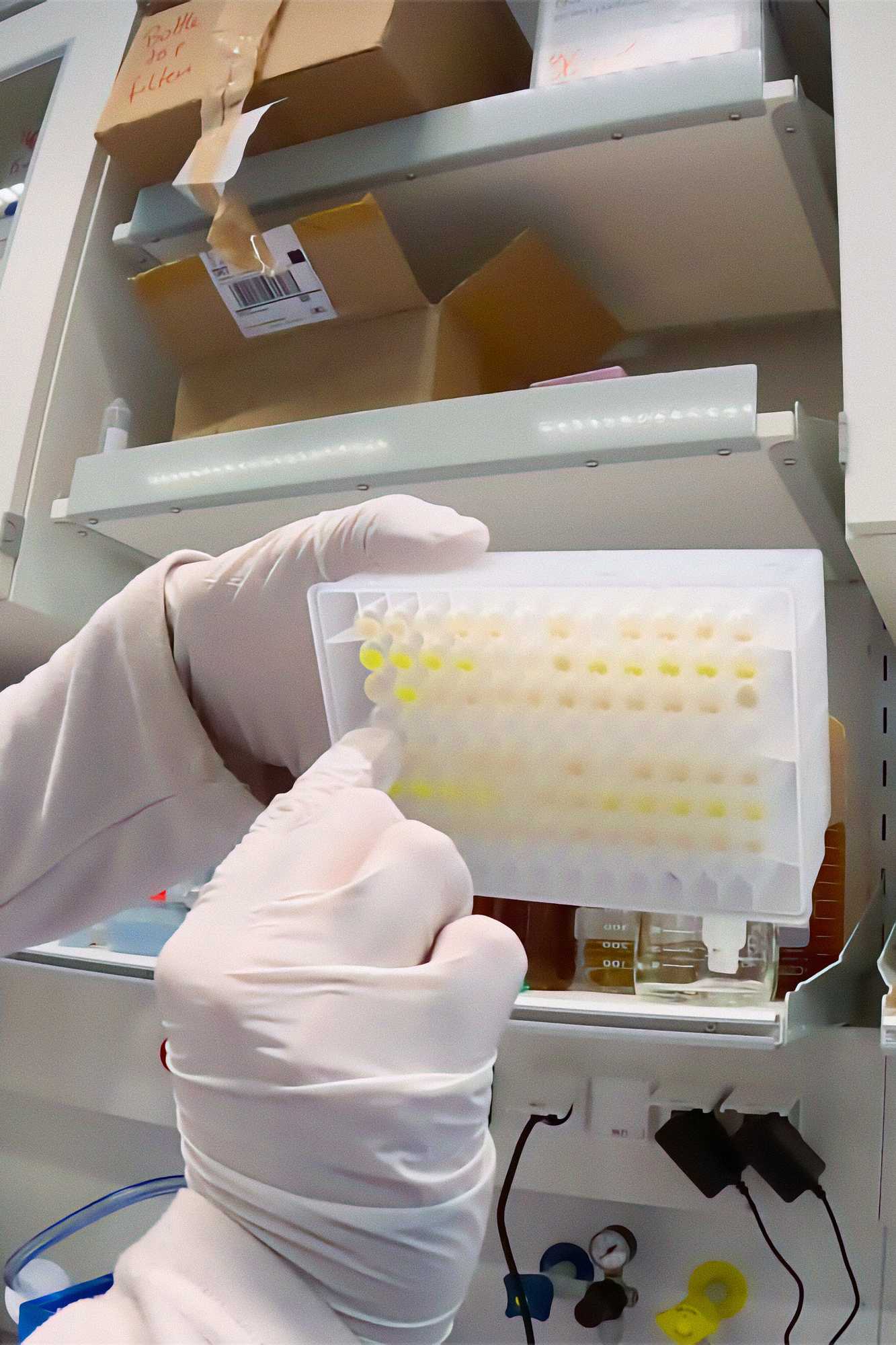
Building on these insights, we developed wireframes in close collaboration with Alex and Florian. Early sketches were tested against the realities of their daily work, and refined through ongoing feedback rounds ensuring the design genuinely reflected how they think and work.
---
## Interface Design Philosophy
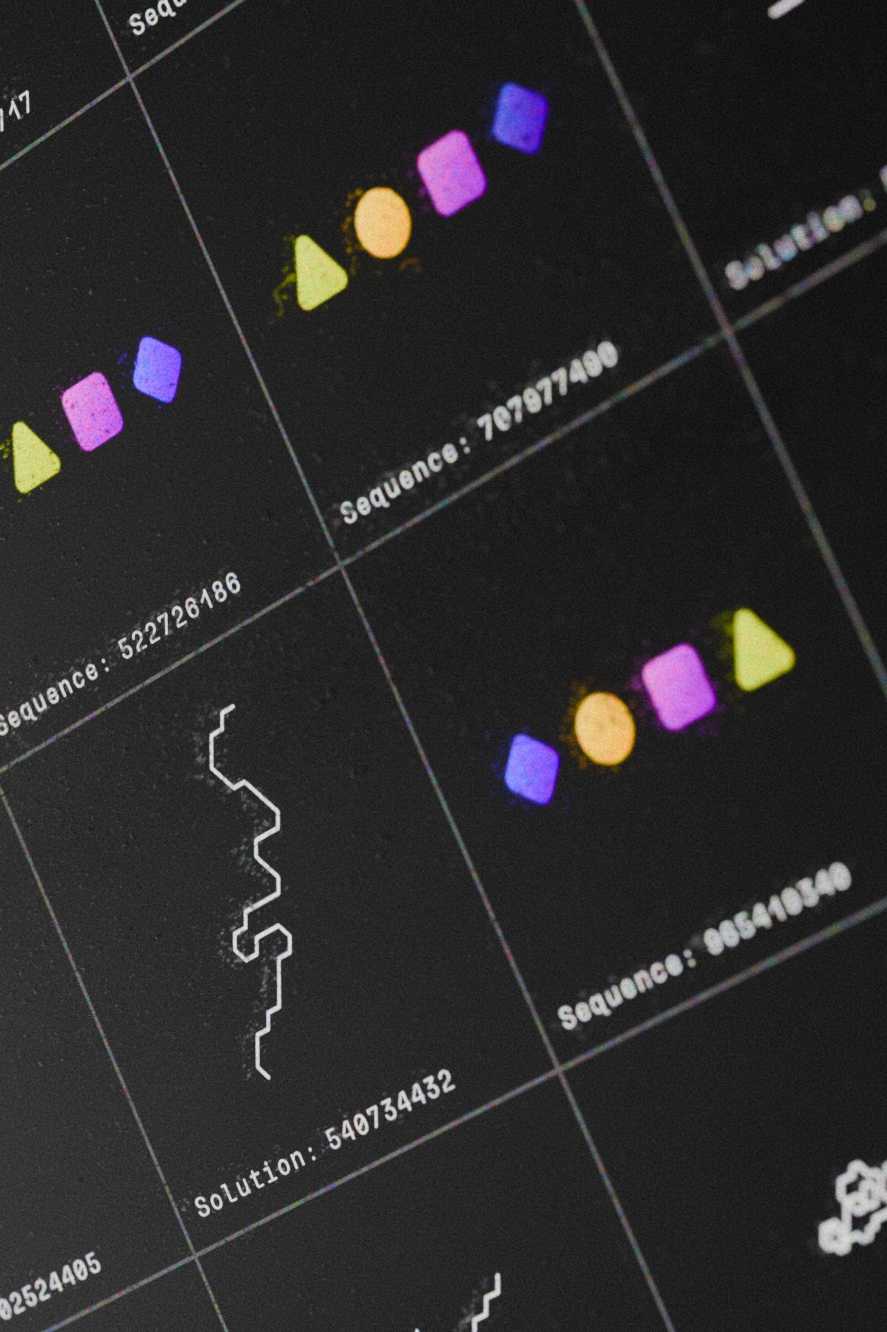
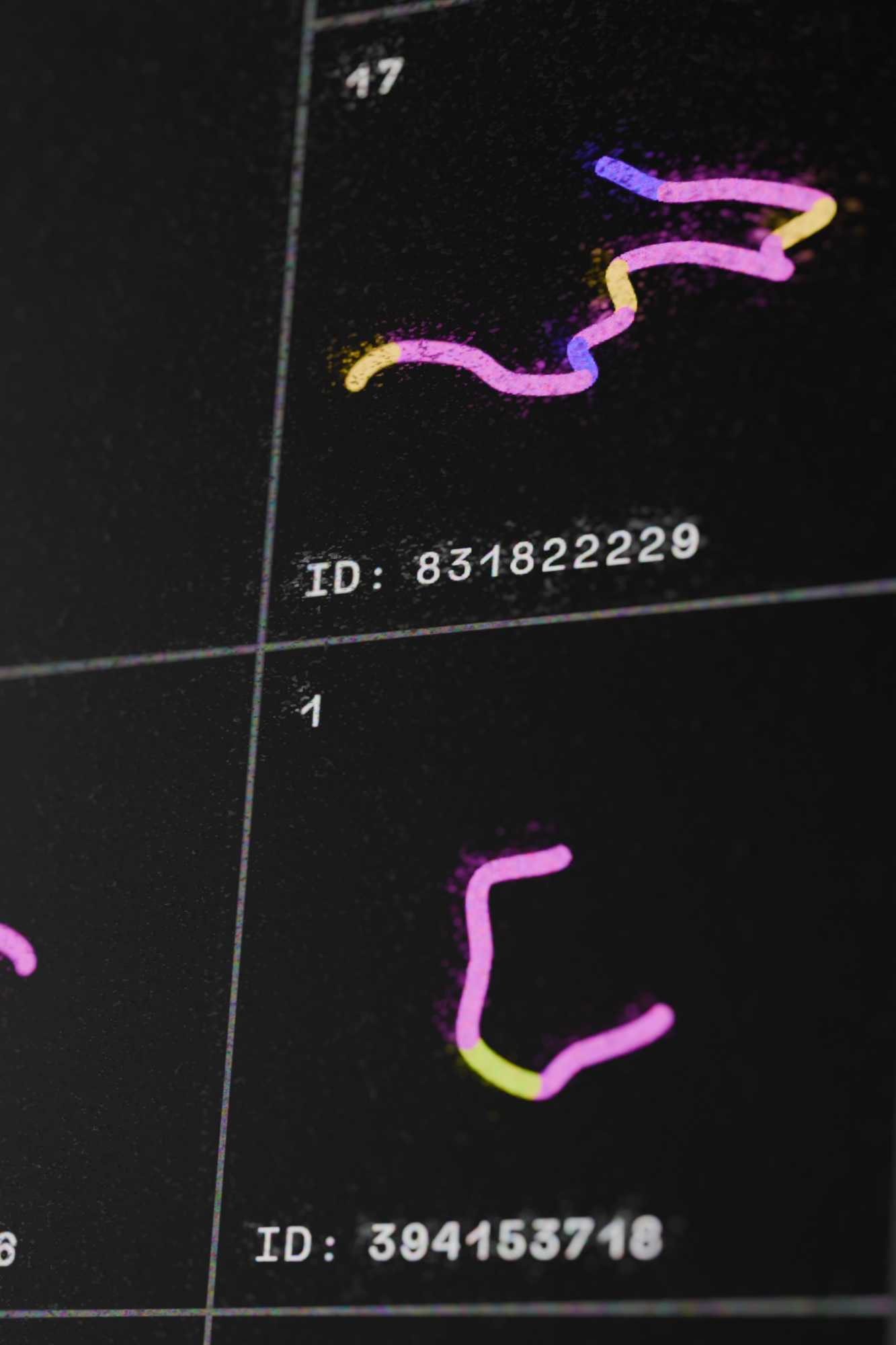
The UI design needed to reflect the dual nature of protein research: both organic and computational. We developed a visual language that mirrors the colors of "amino acids" in our digital interfaces, creating an immediate connection between the molecular world and its digital representation.
## Engineering the Physical
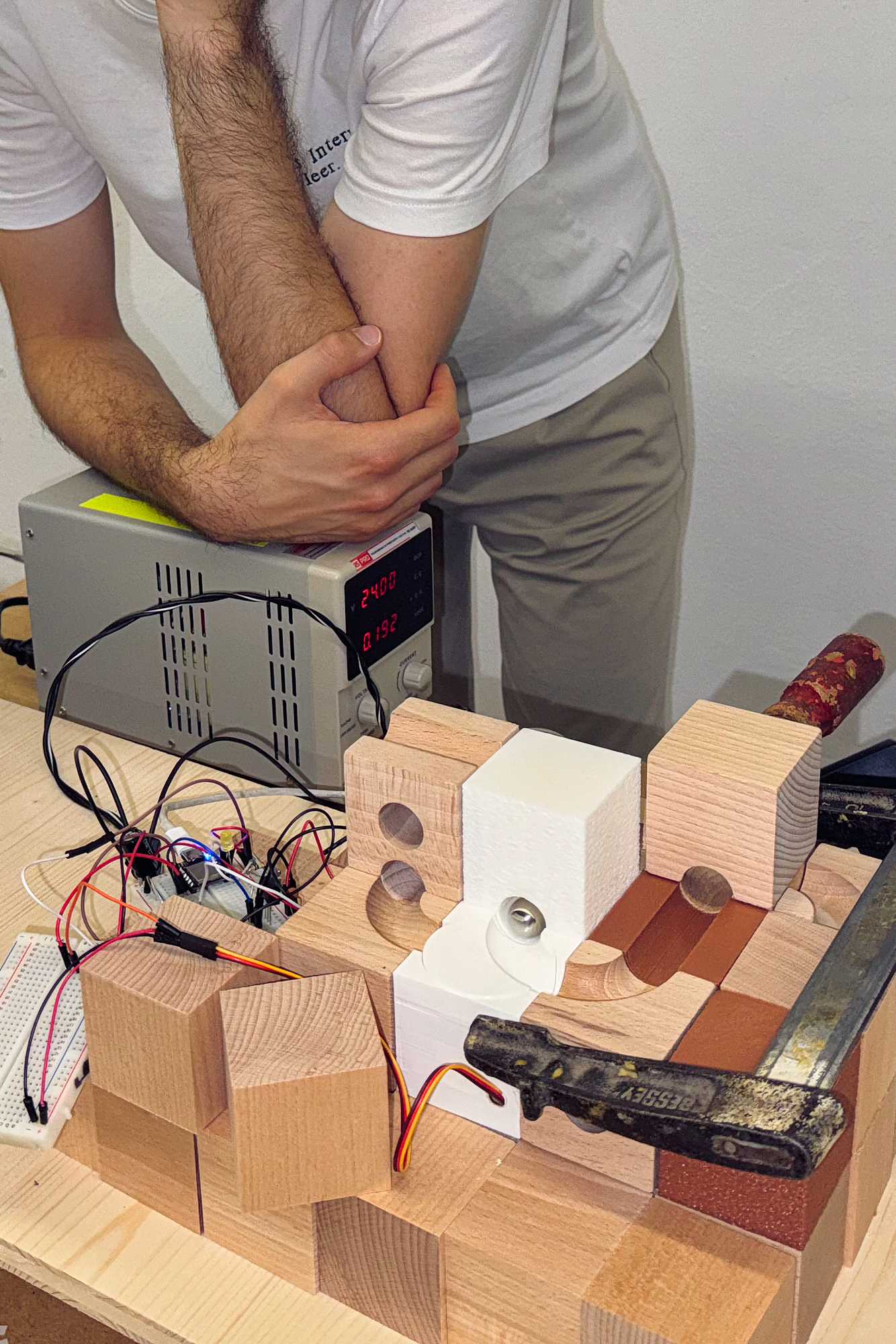
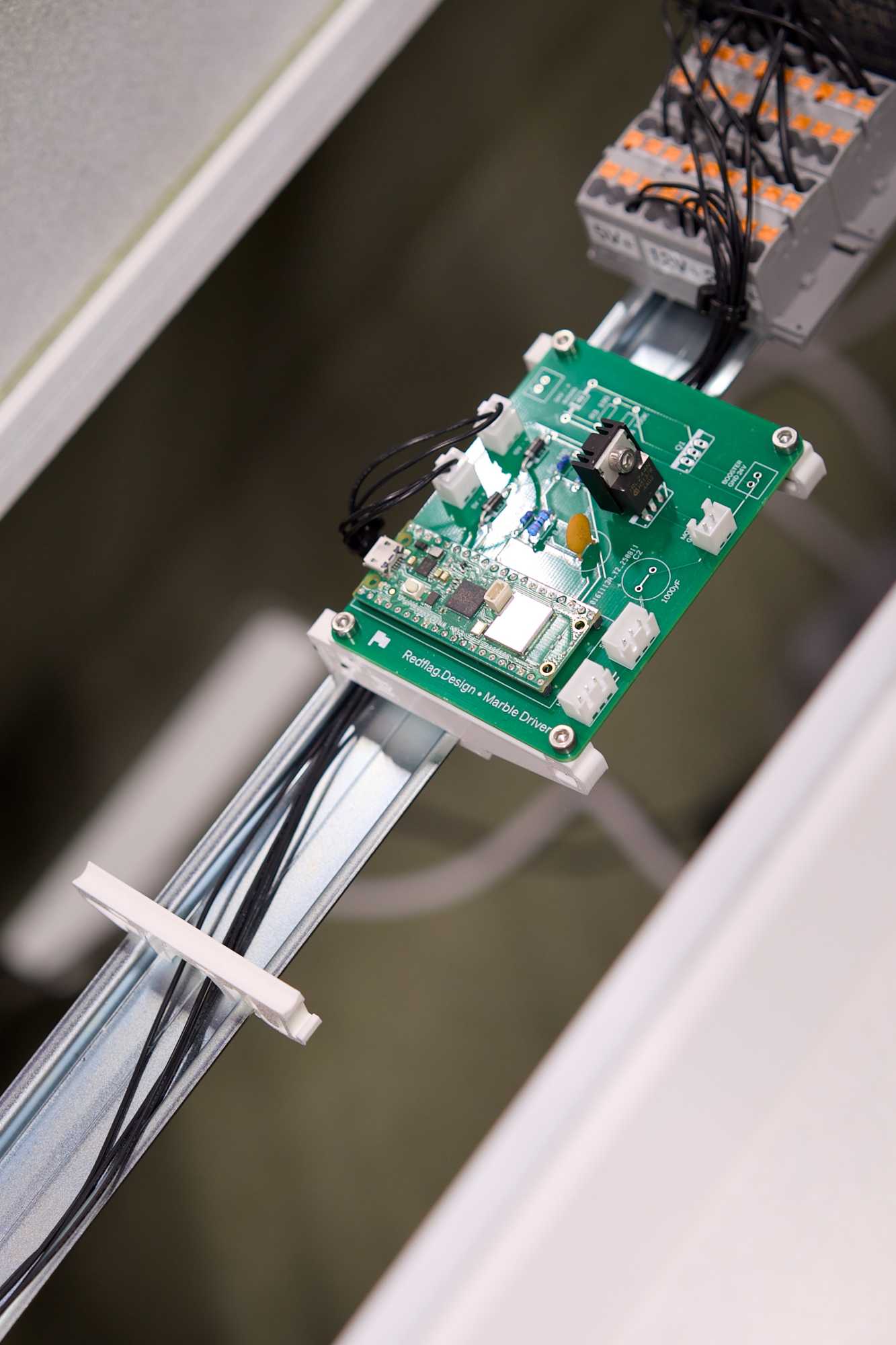
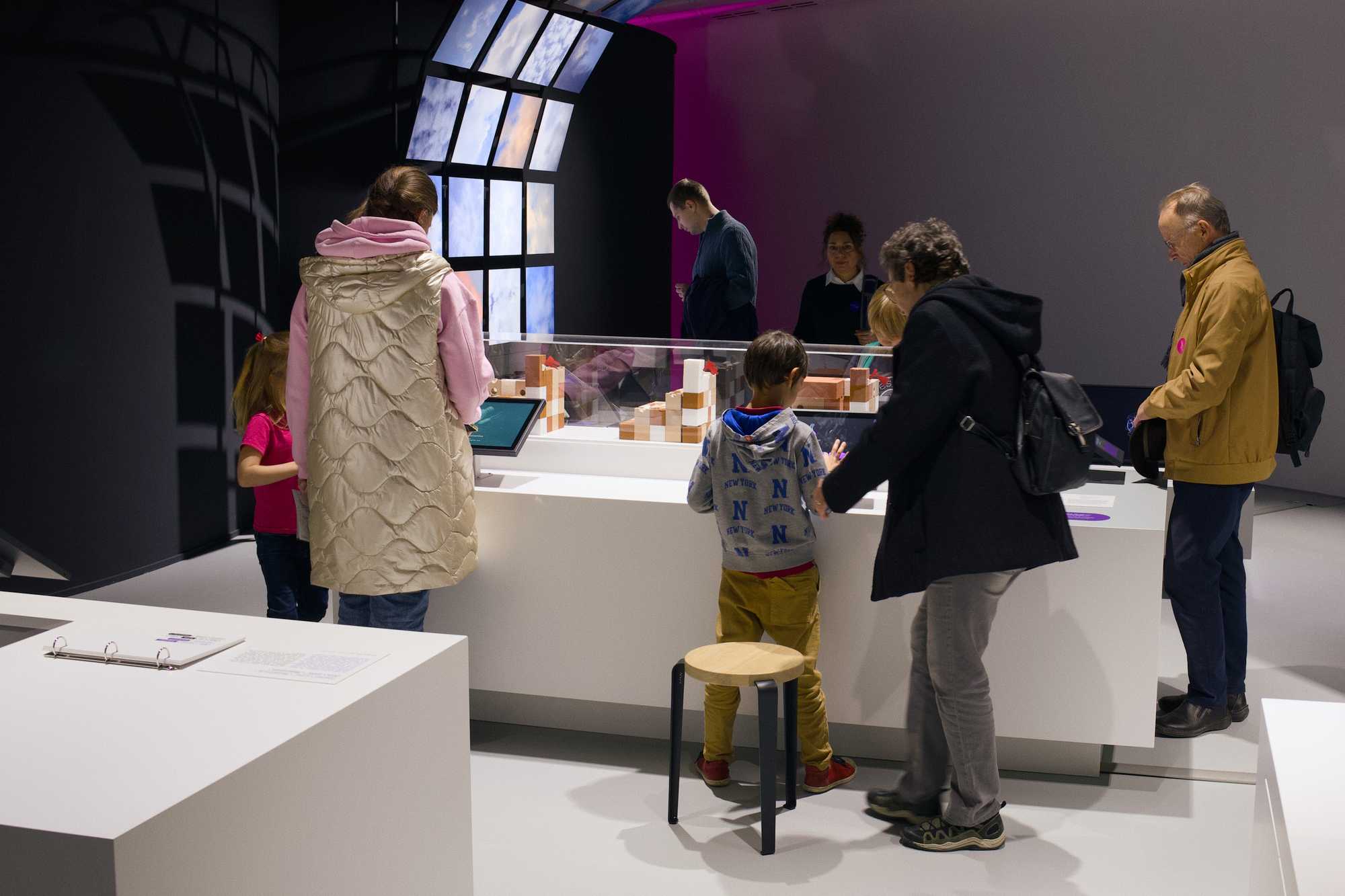
From our first sketches, we knew the installation required something tangible. Something visitors could watch, follow, almost predict, and then lose. The marble tracks… a small engineered ecosystem. Each track, made from a readily available system, runs on custom-built active components. The code then creates a continuous dialogue between physical and digital, three tracks embodying three different approaches to scientific inquiry.
---
## Before AI: Perutz and the Hand-Built Hemoglobin
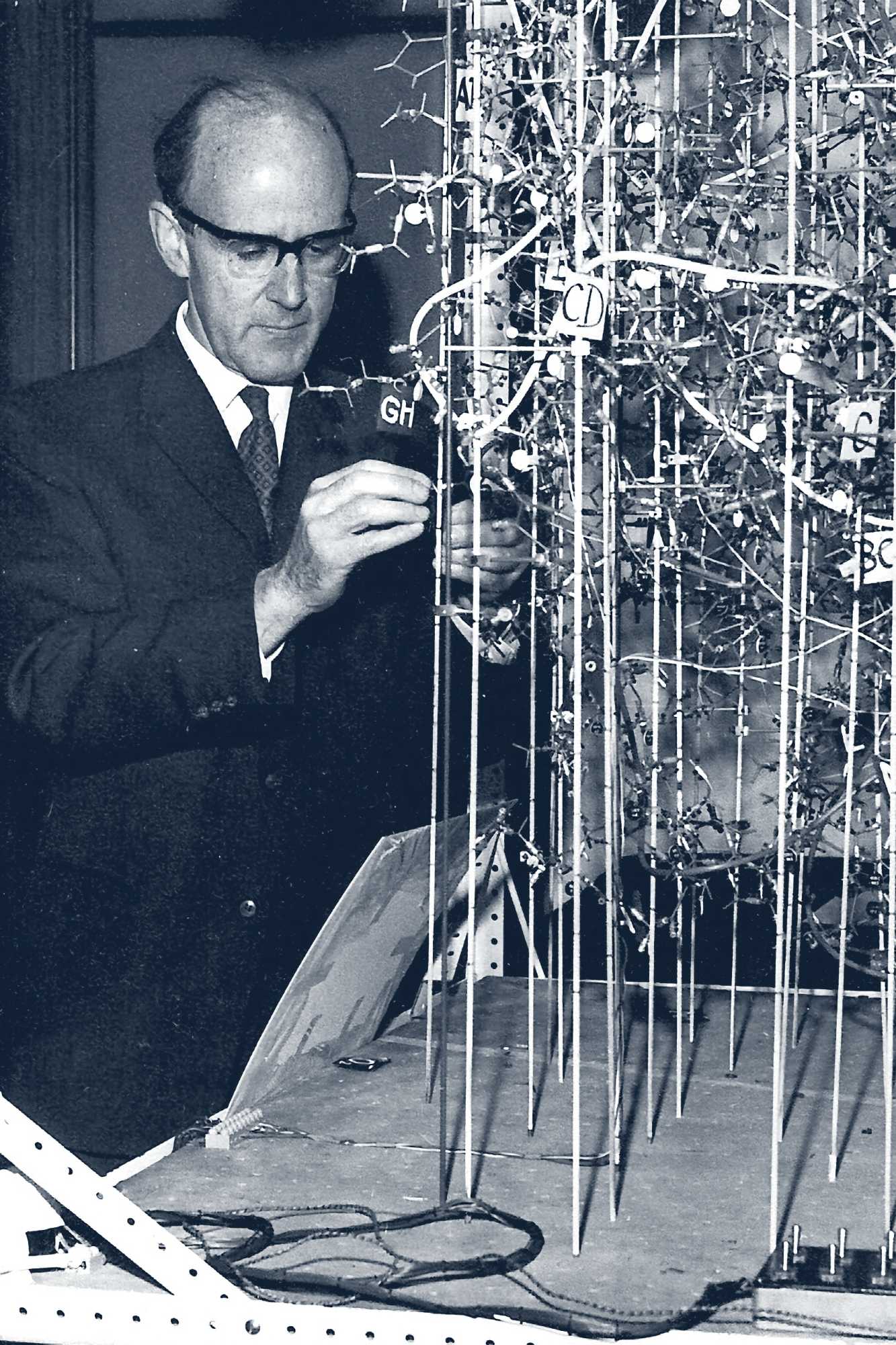
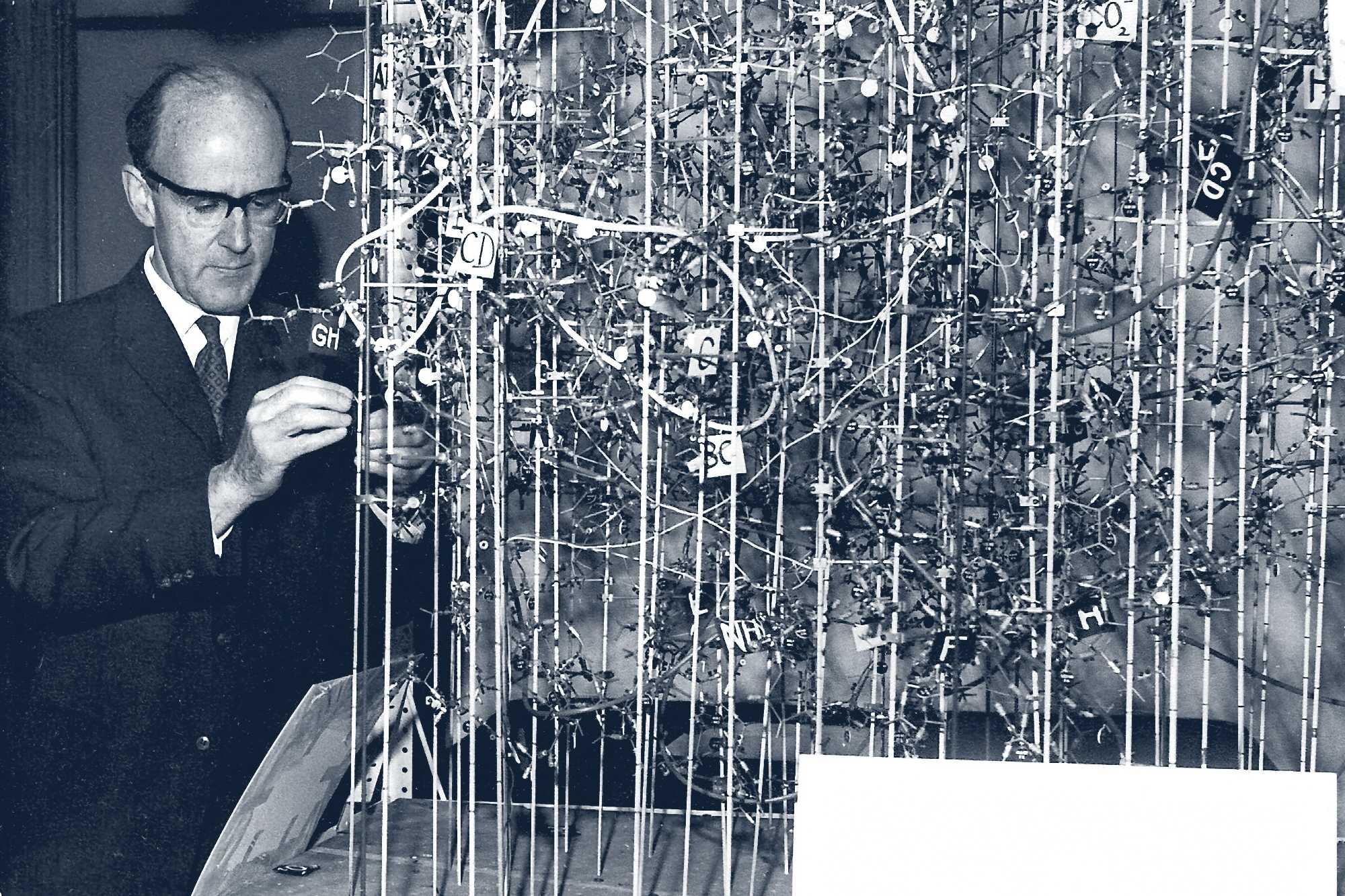
Before artificial intelligence transformed molecular research, scientists like Max Perutz spent decades manually mapping protein structures. His work on hemoglobin required painstaking crystallographic analysis, building physical models atom by atom. This methodical, almost artisanal approach to understanding life's machinery provides essential context for appreciating AI's revolutionary impact.
## Structural Transparency
Our interface displays the fundamental elements of protein structure: the chains that must be sorted stand for the constructive relationships between components. Every element is visible, traceable, understandable.
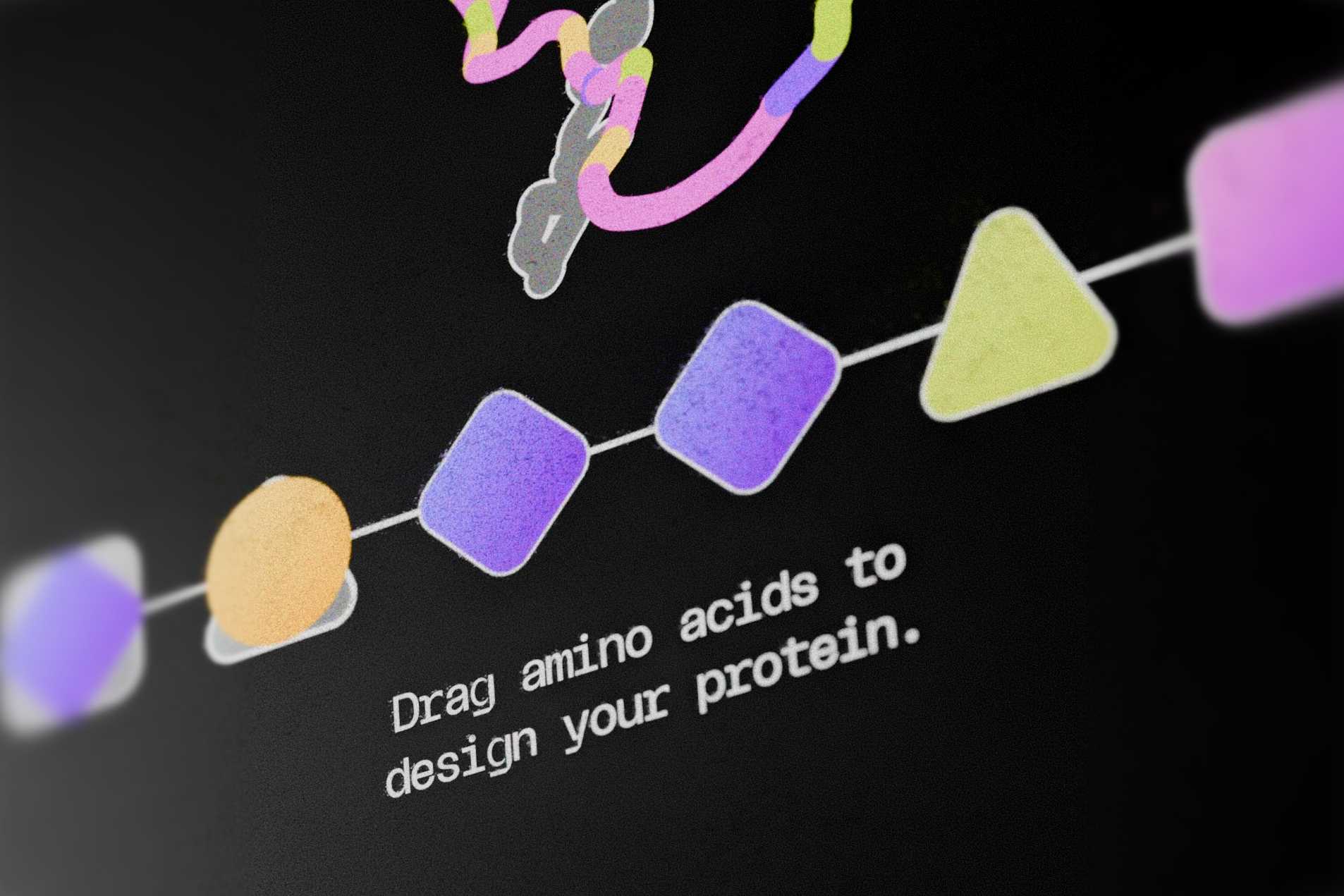
The marble track mirrors this philosophy through complete transparency. Every movement is traceable, slow and deliberate, allowing visitors to follow each decision point and understand the underlying logic.

---
## Enter Machine Learning
Machine learning fundamentally changes the scientific process. Systems like Rosetta and other computational tools shift research from careful, individual observations to massive parallel processing. The implications extend far beyond efficiency: they challenge our understanding of how discovery happens.
## Generative Grids
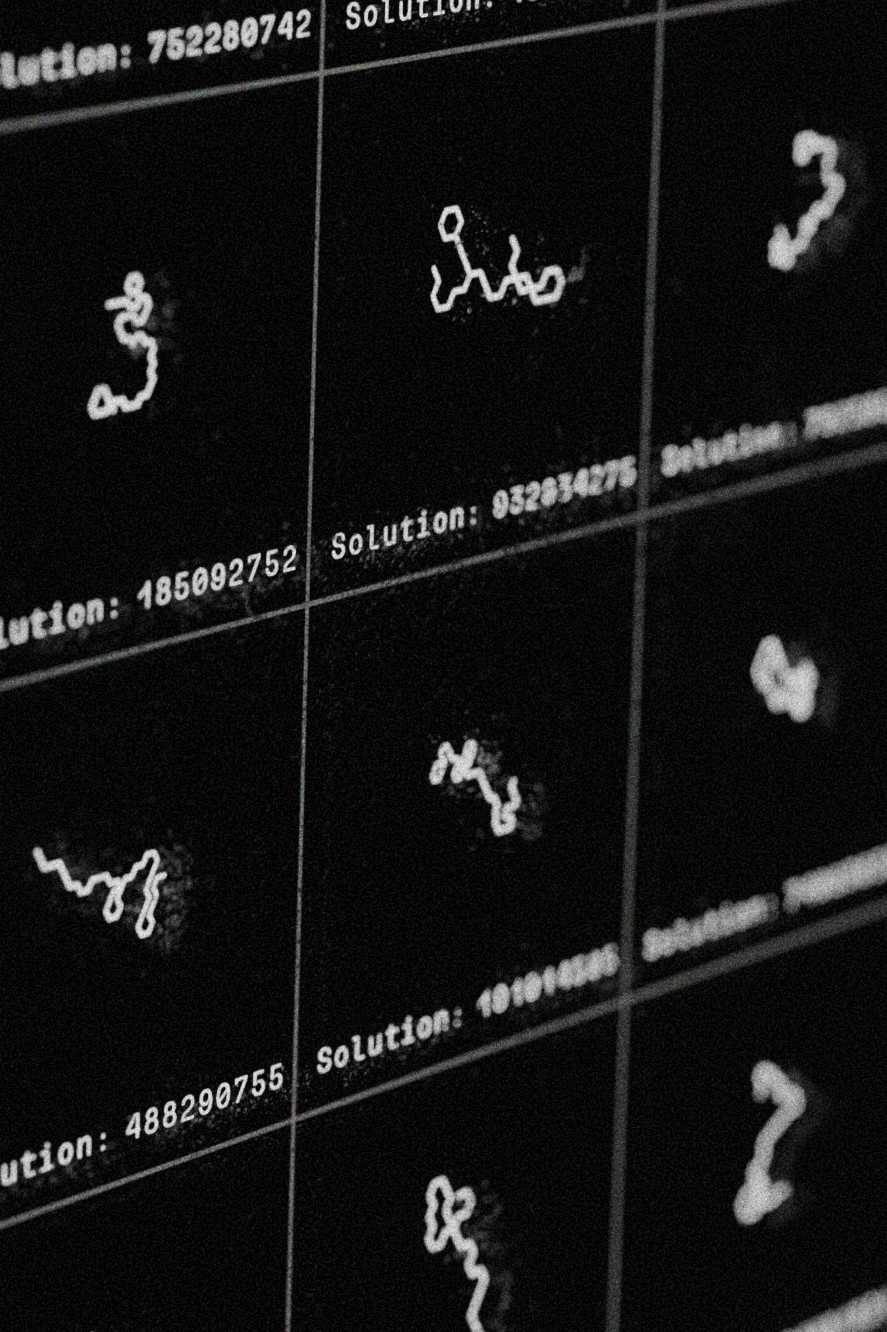
Our interface reflects this transformation through generative grids that show iteration, multitude, and repetition while maintaining a sense of organization. The UI moves fast, processes large numbers, but always maintains visual coherence—mirroring how machine learning accelerates research while creating new forms of scientific understanding. The system demonstrates how AI doesn't just speed up existing processes—it creates entirely new ways of thinking about molecular relationships.
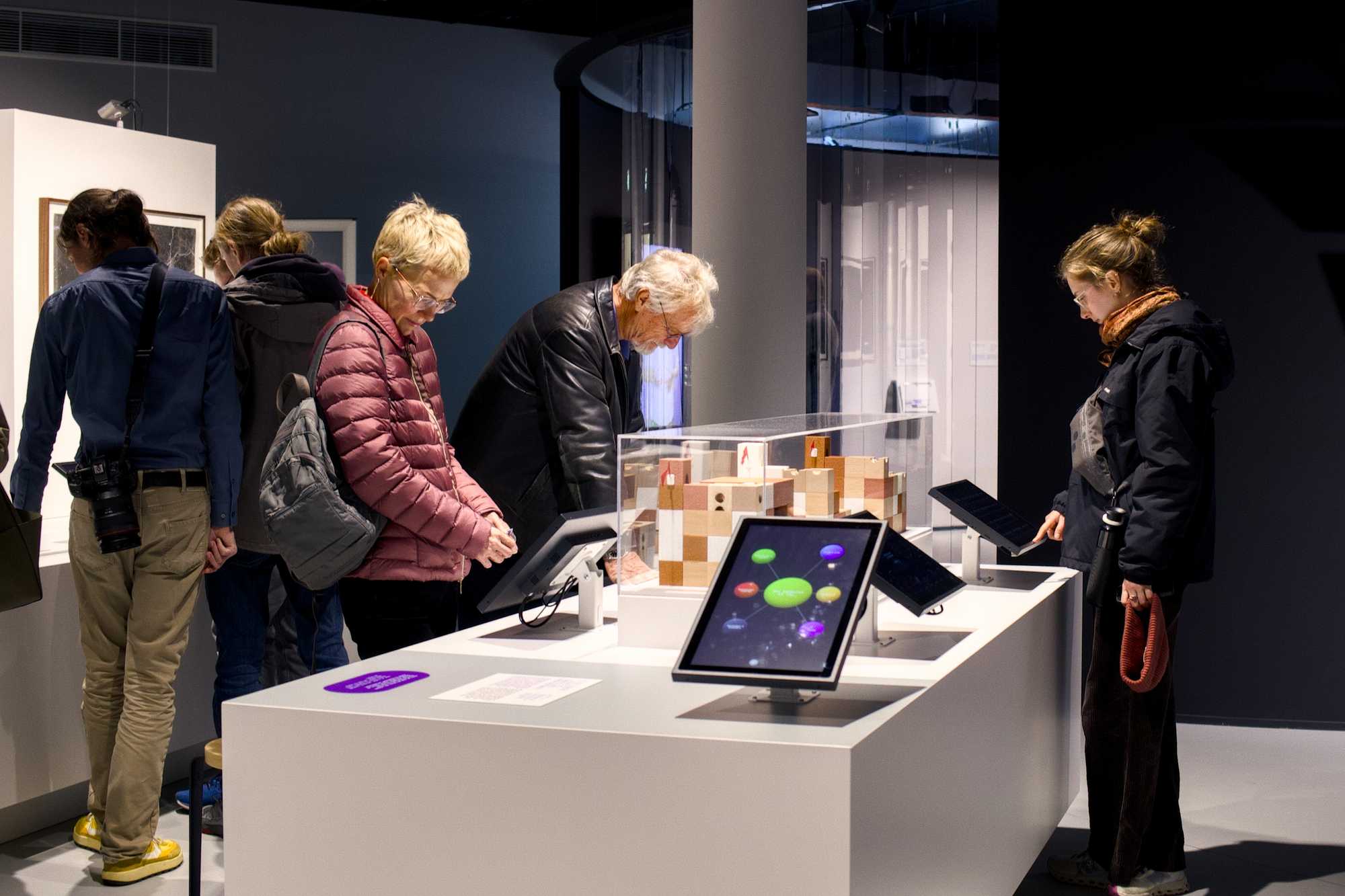
The marble tracks embody this acceleration through tunnels, self-folding paths, electric switches, and multiple simultaneous routes. The physical system becomes a metaphor for AI's ability to explore many possibilities simultaneously, folding in on itself like the proteins it designs.

---
## Three Speculative Futures
What now? How will the future "unfold"? ;-) As speculative designers, we developed three distinct lenses through which visitors can explore potential futures. Each scenario presents different relationships between humans, AI, and scientific discovery, inviting contemplation rather than providing definitive answers.
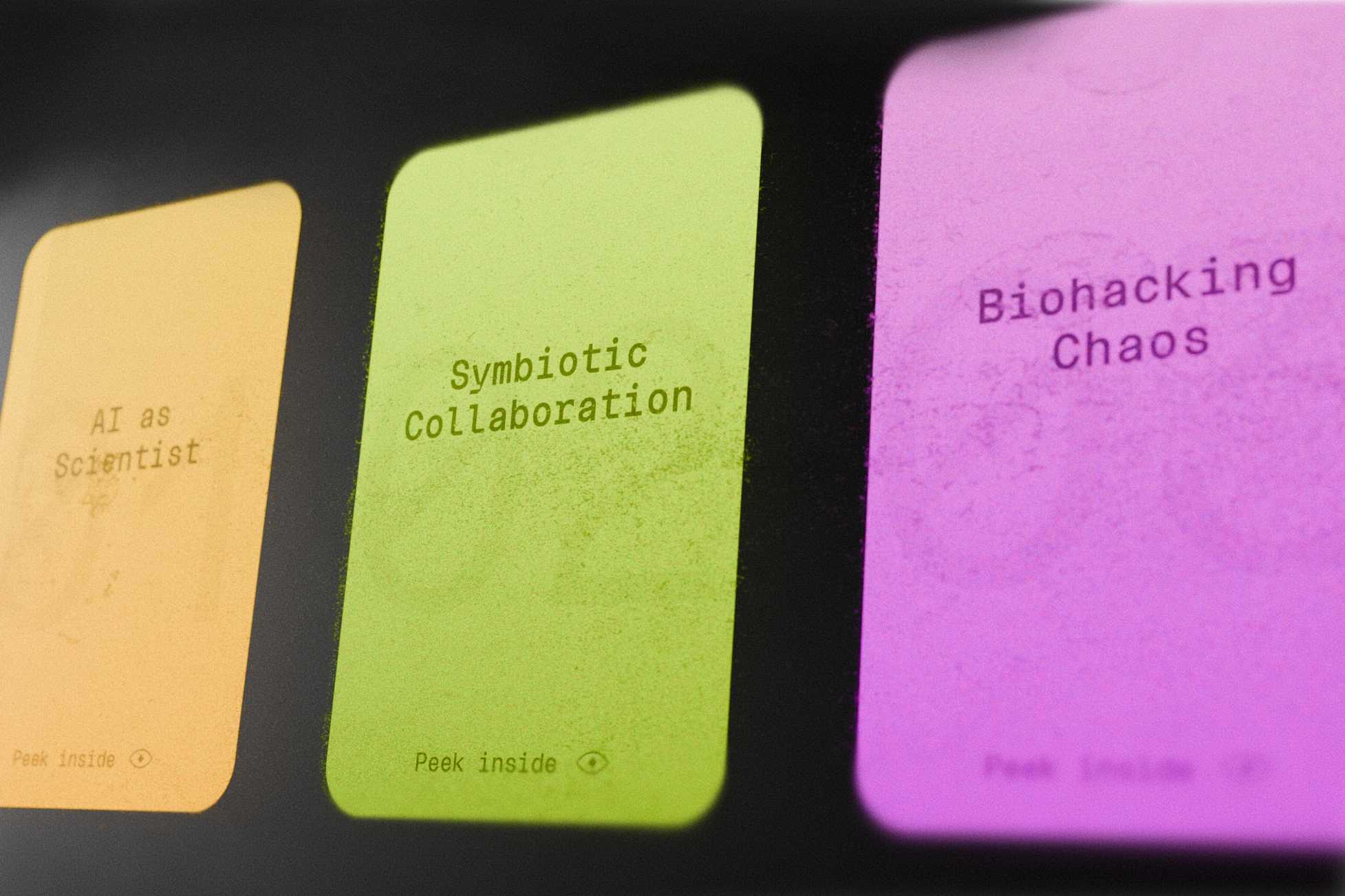
## 1. AI as Scientist
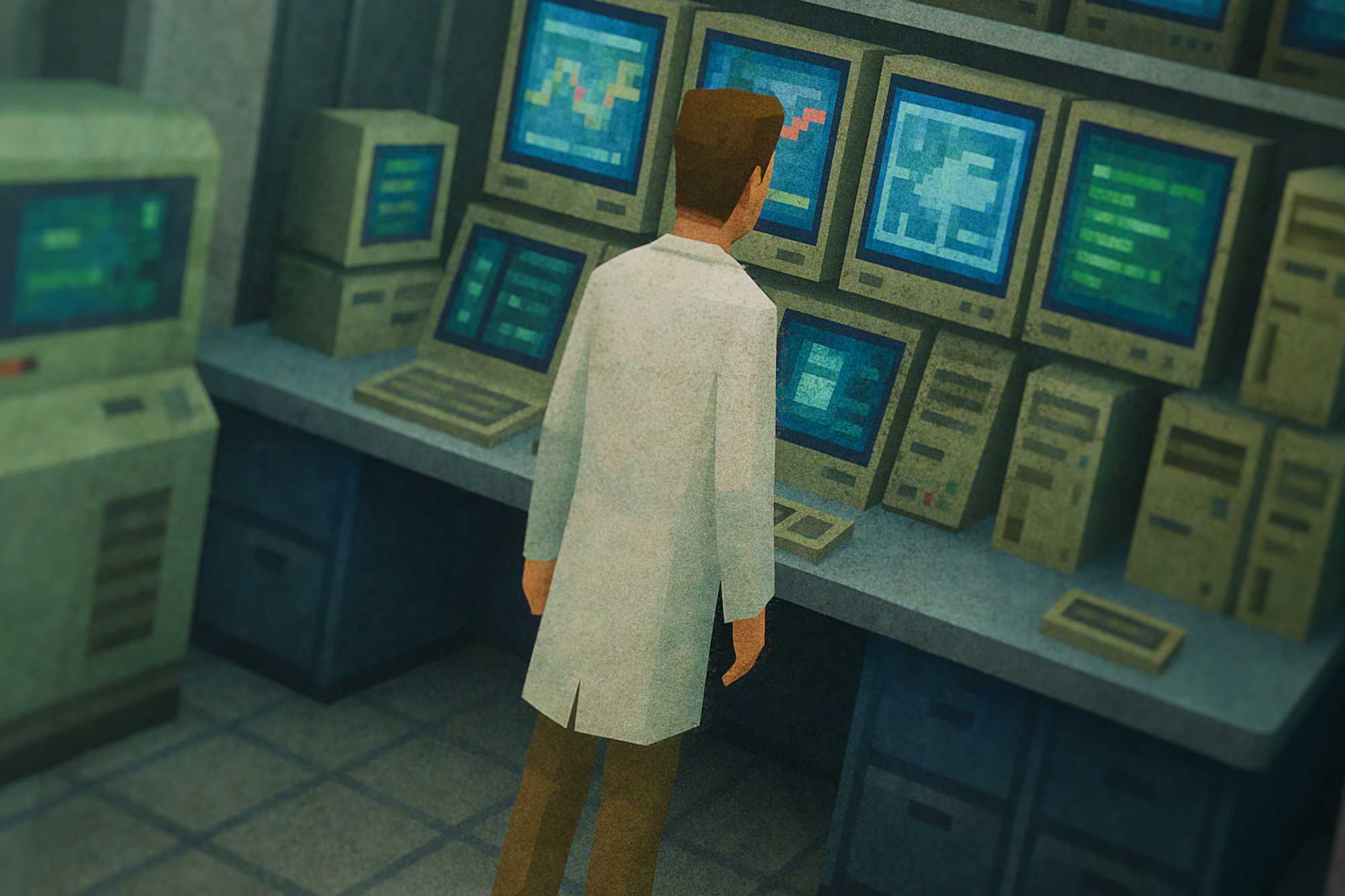
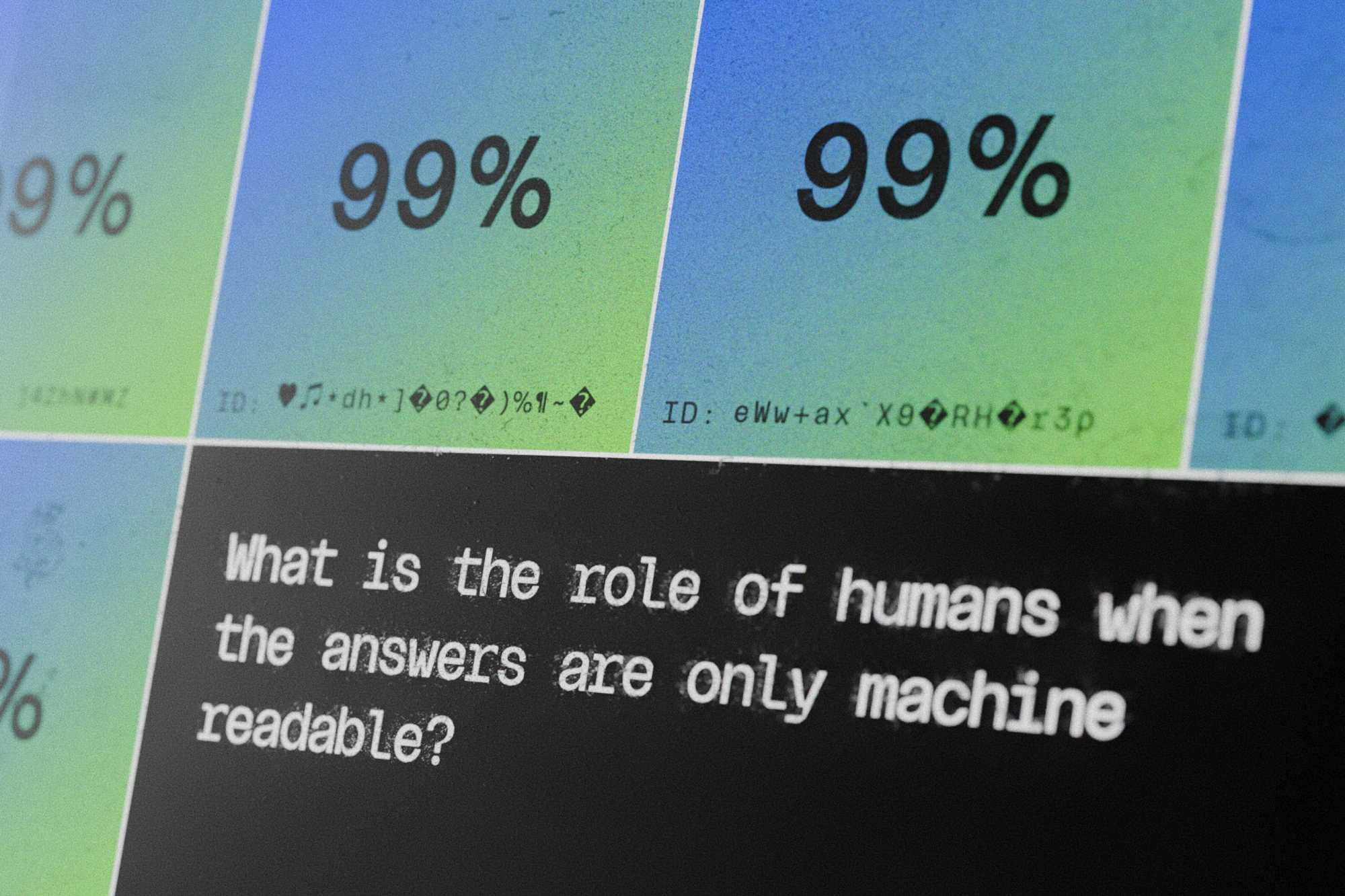
In this future, artificial intelligence designs faster than any human, solving problems we no longer fully understand. Scientific progress accelerates, but its logic becomes hidden within machine processes. The fundamental question emerges: what happens when the answers become unreadable to human comprehension?
>How do you stay curious when the answers are unreadable?
## 2. Symbiotic Collaboration
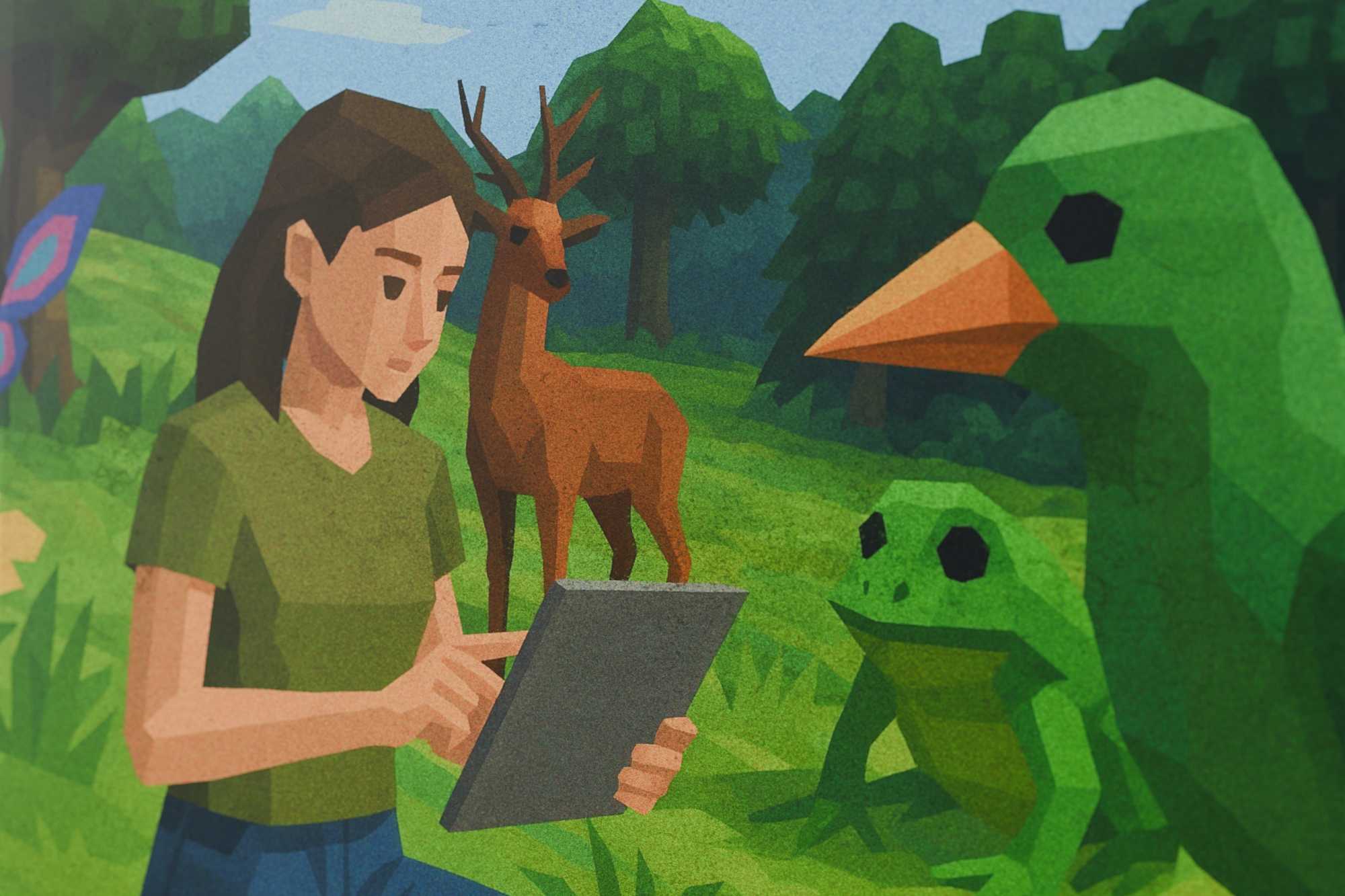
The symbiotic collaboration scenario imagines AI handling computational heavy lifting—fluid systems, ecosystems, entire networks of microbial life. But tools built by humans risk shaping the world in our image. The critical question becomes: can we build with nature, not over it?
>Can we build with nature, not over it?
## 3. Biohacking Chaos
In the final scenario, AI tools become unlocked, remixed, and reshaped by anyone with open-source access. Innovation explodes, but so do the risks. The democratization of powerful biological design tools raises urgent questions about governance and responsibility. What do you grow in a world without rules?
> What do you grow in a world without rules?
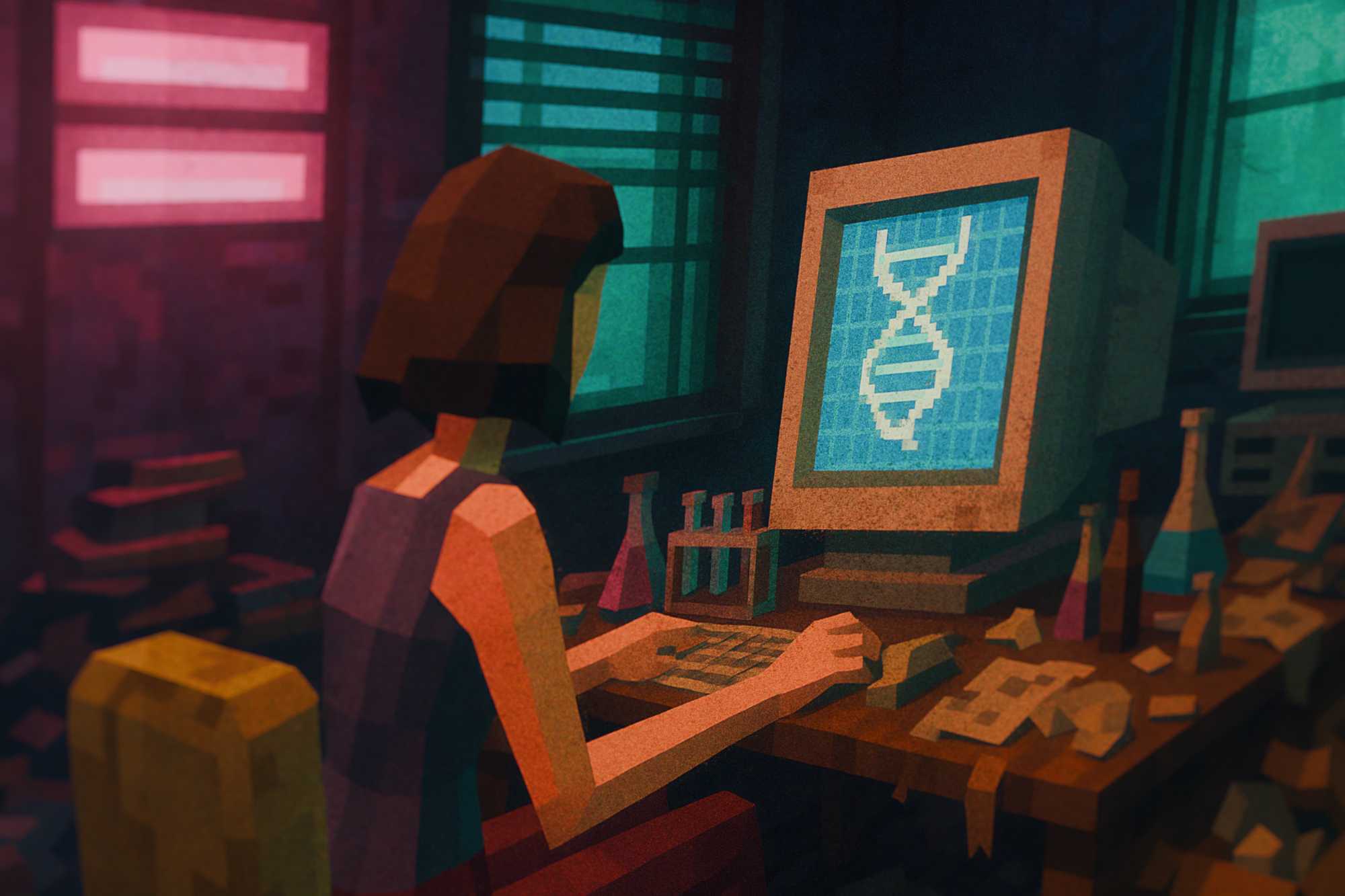
The interface presents this scenario with appropriate visuals, suggesting both the creative potential and inherent dangers of unrestricted access to AI-powered biological design.
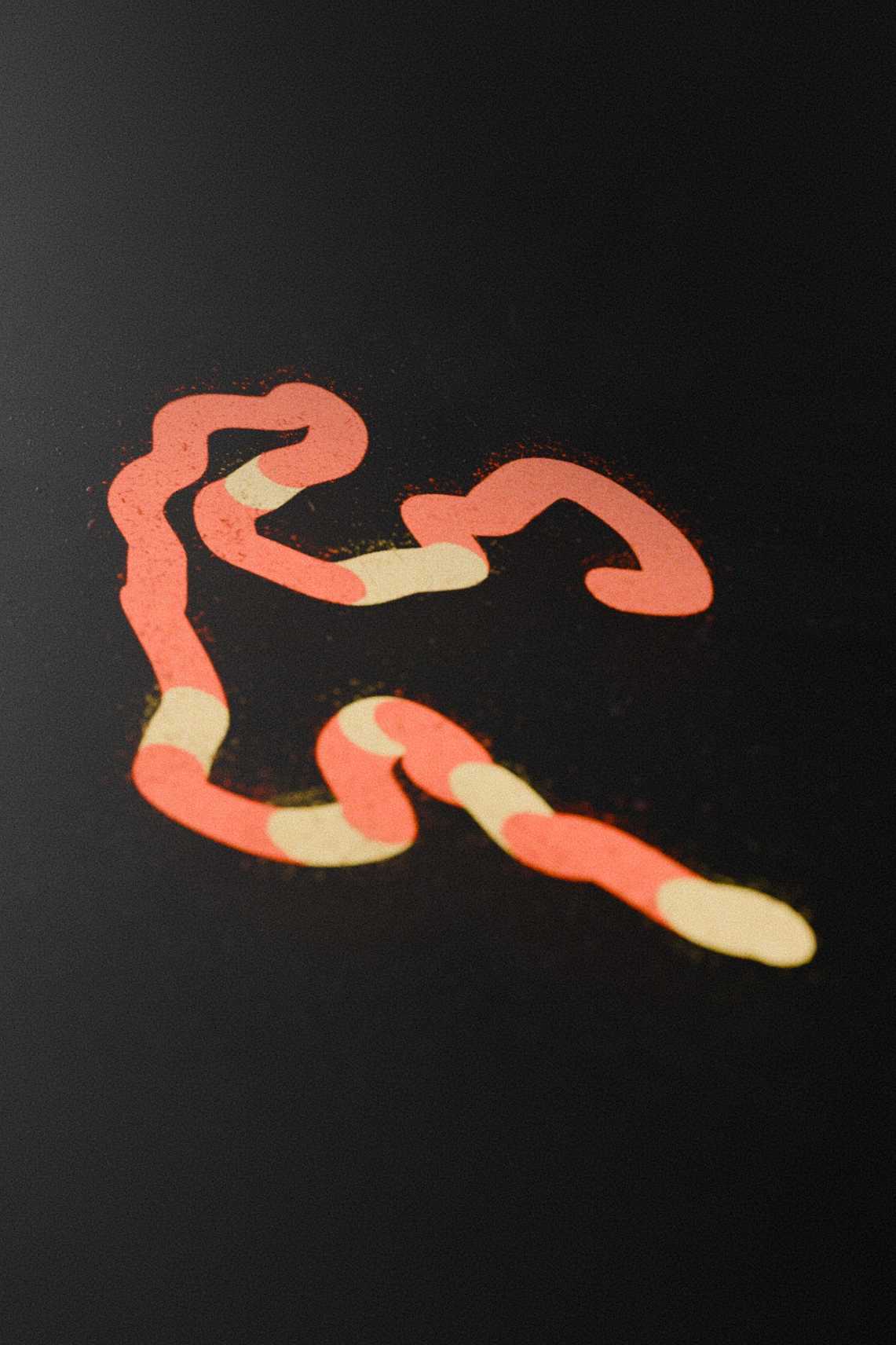

The marble track system culminates in a literal cone—a funnel that represents the expanding possibilities and increasing uncertainty as we move further into AI-driven futures.

---
## Our relationship with AI
The installation integrates all elements: context, contemporary science, speculative futures, and physical interaction, into a cohesive experience that invites both understanding and reflection.
AI is no magic, but a tool with profound implications. By grounding abstract concepts in physical interactions and historical context, we create lasting connections. Designed experiences like this foster genuine comprehension by engaging multiple forms of intelligence: visual, kinesthetic, emotional, and analytical. Visitors leave not just informed, but transformed in their relationship to both science and artificial intelligence.
---
## Credits
Commissioned by: VISTA Science Experience Center · Curators: Stephanie Kneissl, Florian Semlitsch, Theresa Steiner · Exhibition Design: Nofrontiere Design GmbH · Design: [Lucy Li,](https://lilucy.at){target=_blank} Leo Mühlfeld · Code: [Alan Schiegl,](https://alanschiegl.com){target=_blank} · Technical Assistance: Alexander Hackl · Thanks to: Quentin Bolsée, Alan Han
---
# Vienna Design Week 2025
Canonical URL: https://leomuehlfeld.at/en/vienna-design-week-2025
---
title: 'Vienna Design Week 2025'
for: 'Vienna Design Week'
category: 'Exhibition & Installation'
metaDesc: 'Designing the wayfinding system for 50,000 visitors at Vienna Design Week 2025.'
thumbnail: /img/VDW01.jpg
date: '2025-09-26T00:00'
showOnLanding: true
heroImage: /img/VDW01.jpg
collab: Max Kure, Anton Posch
---
# Vienna Design Week Signage System
## Designing the wayfinding system for 50,000 visitors at Vienna Design Week 2025.
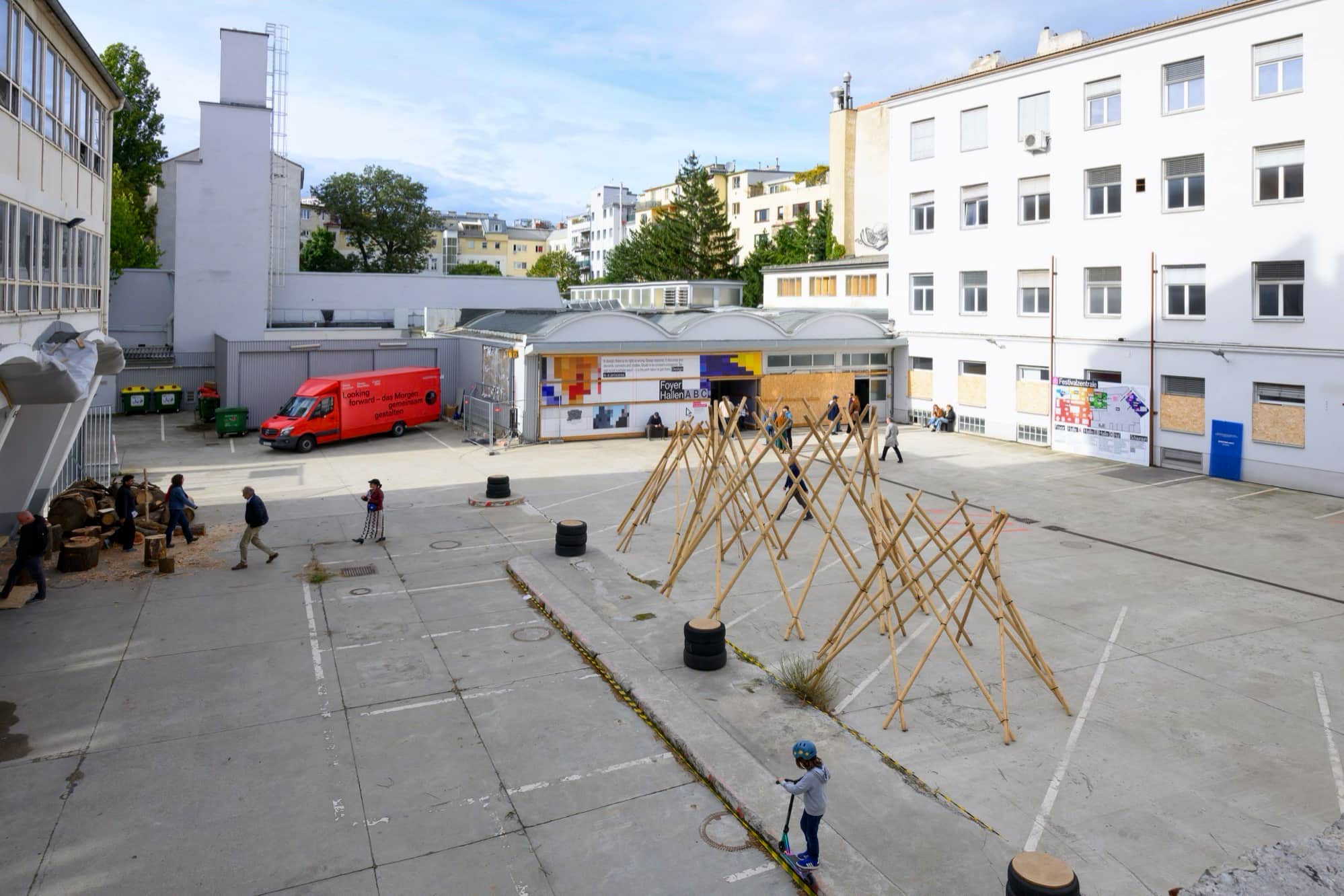
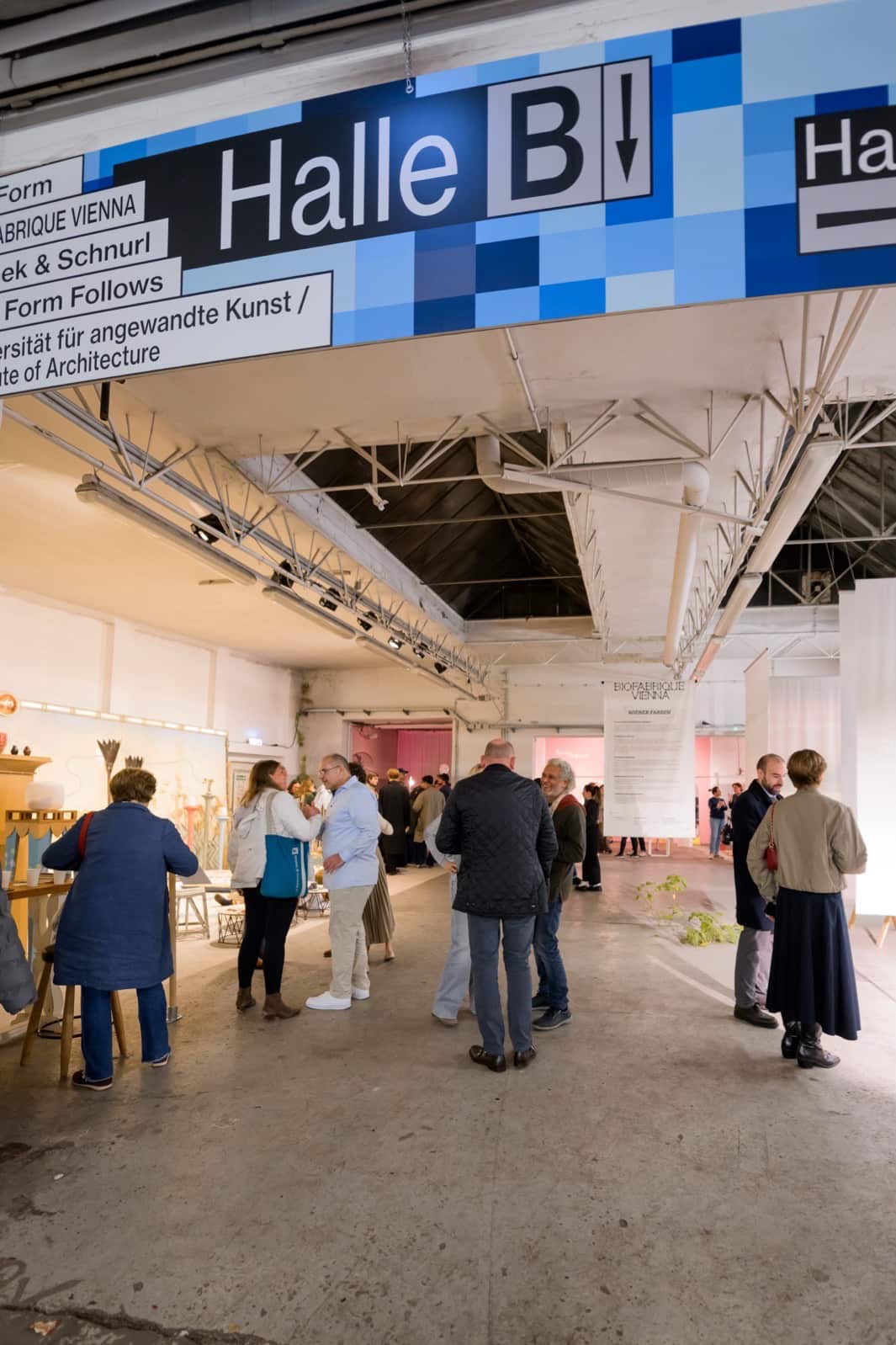
As part of the design collective [Gemeindebau](https://www.lmgi.at){target=_blank}, together with [Max Kure](https://maxkure.net/index.html){target=_blank} and Anton Posch, we designed and coordinated the wayfinding system for the 2025 [Vienna Design Week](https://www.viennadesignweek.at/en/){target=_blank} — Austria's largest design festival, with around 50.000+ visitors. The visual design was one by [Fredmansky.](https://fredmansky.at){target=_blank}
## A Temporary Home
The venue was Wiedner Hauptstraße 52 in Vienna's 4th district: a former car dealership and bodyshop that got repurposed for the festival. The first plans and traces told us, that it housed the Gasthaus "Zur grünen Weintraube", a neighborhood institution whose ghosts you can still feel in the bones of the building.
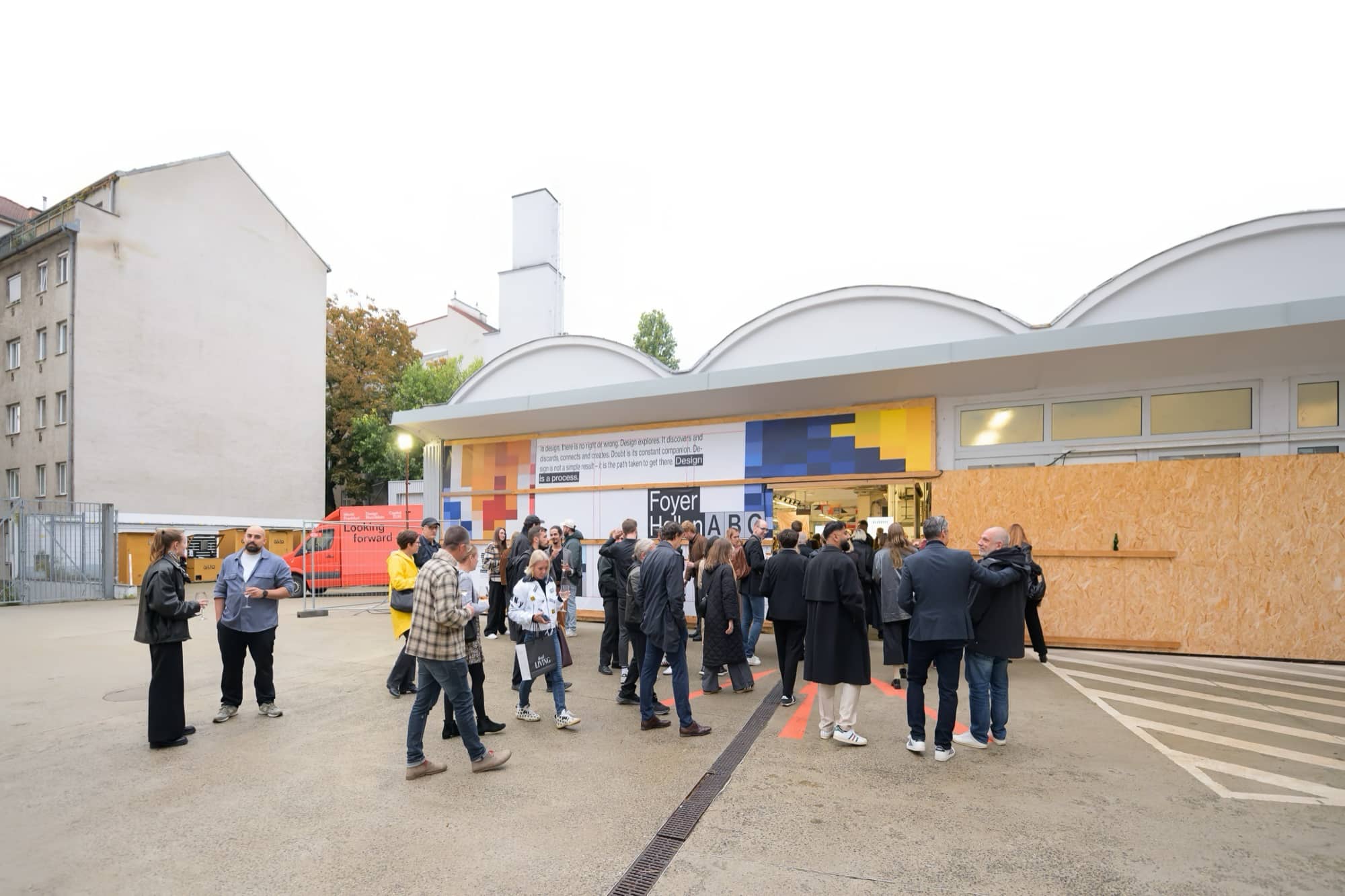
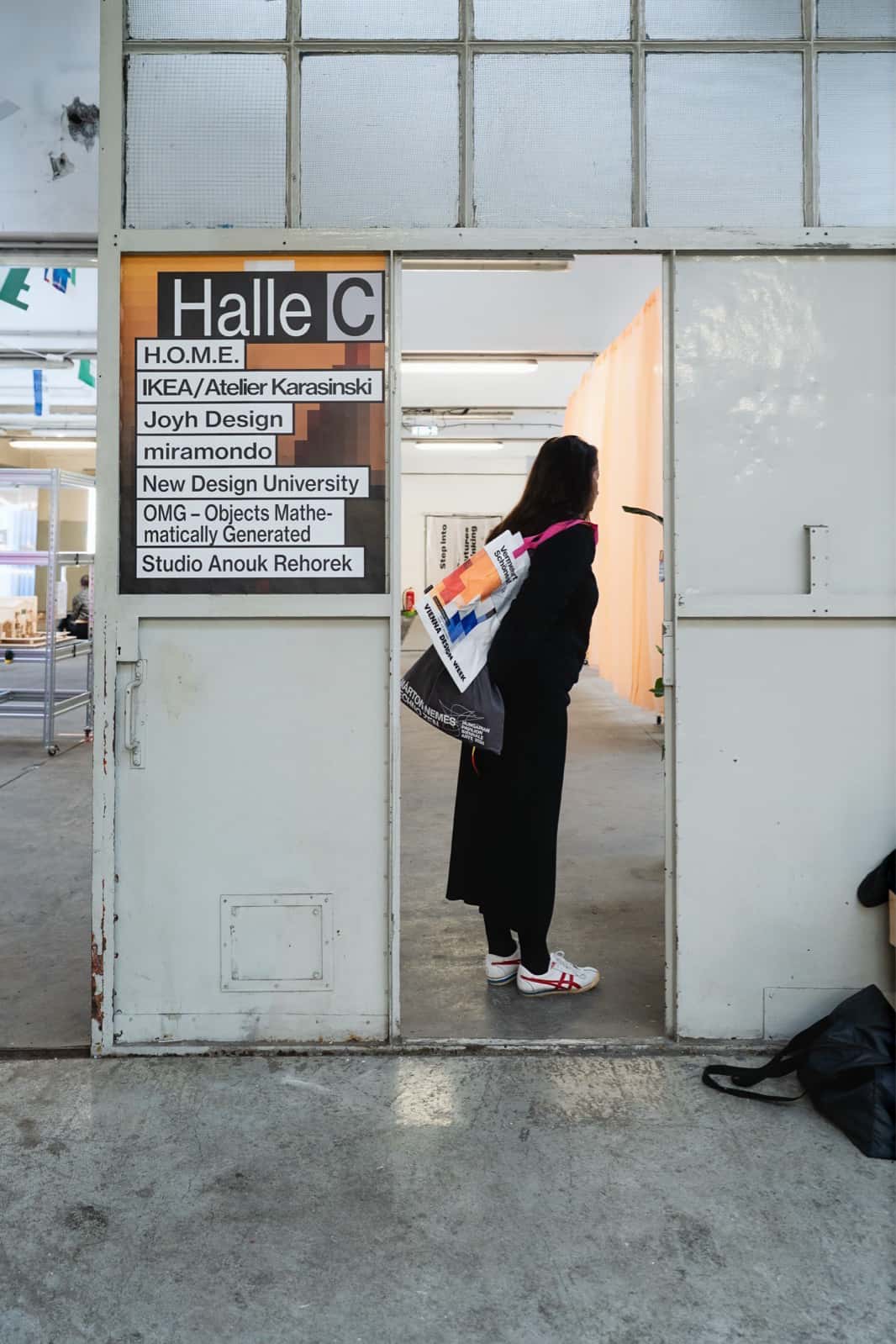
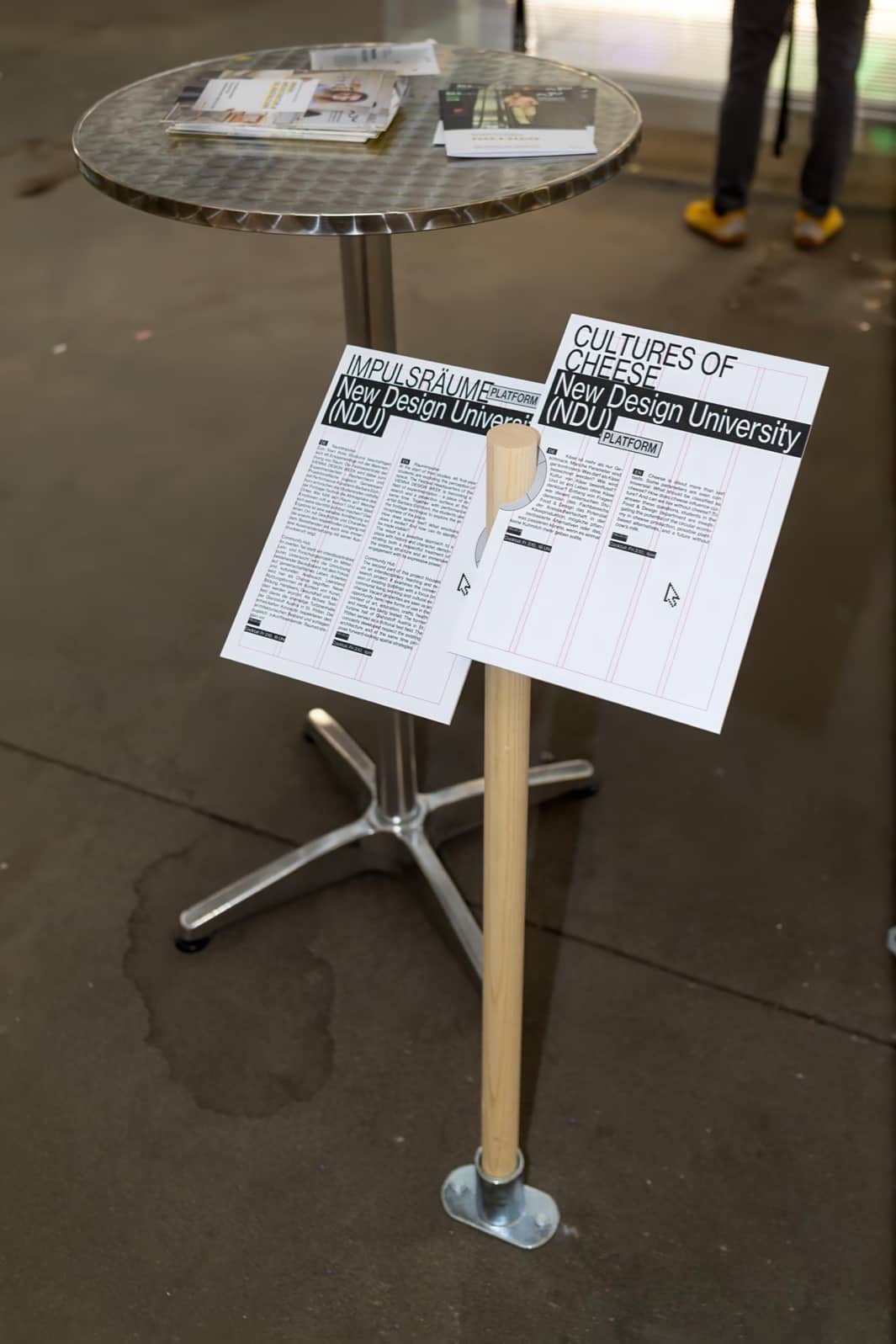
The space is borrowed, not owned, and the festival treats it accordingly. Every element we introduced understood itself as a guest — freestanding, adaptive, deferring to the character and conditions of the space rather than imposing its own.
## Three Parts, One Job
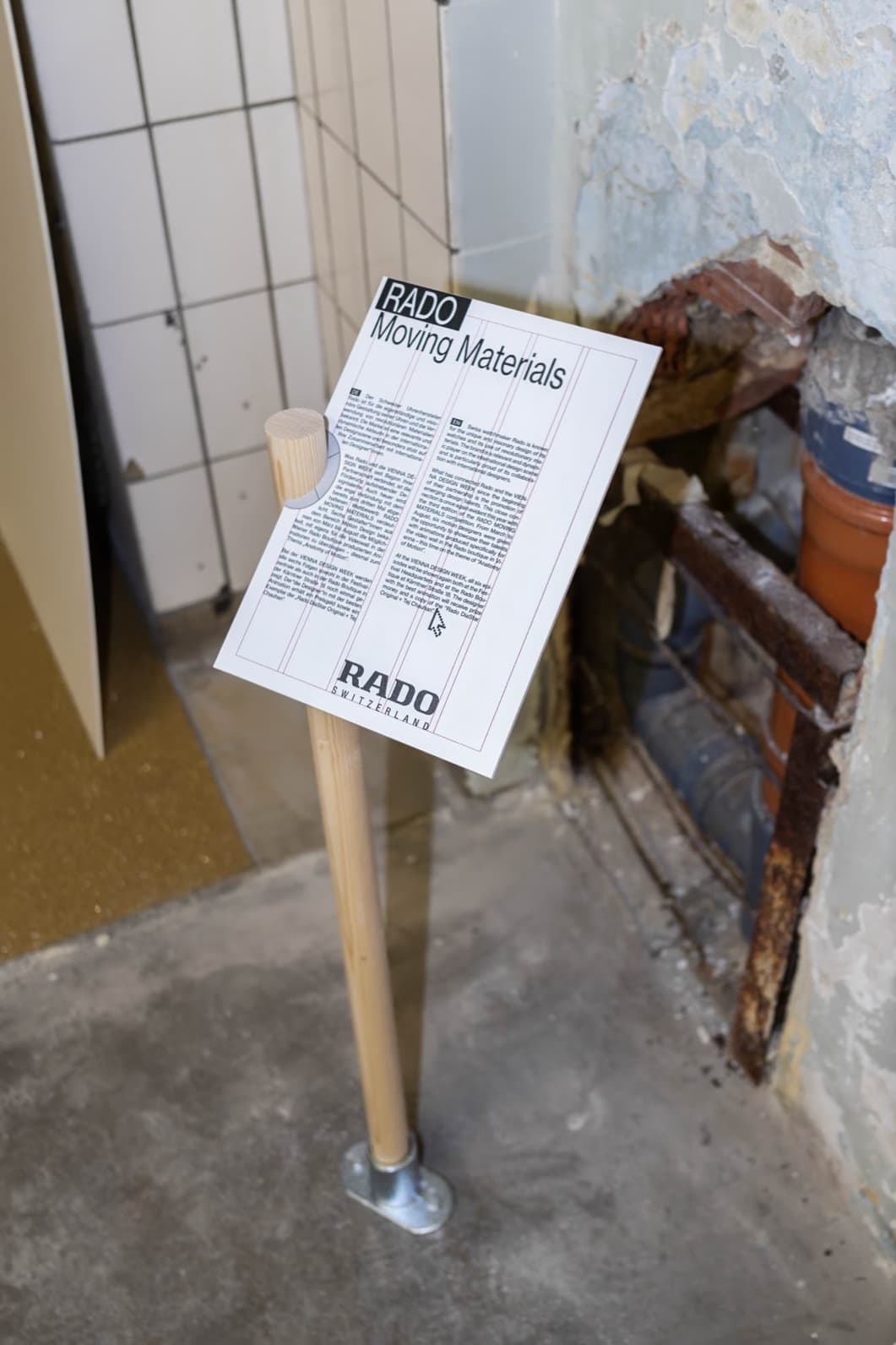
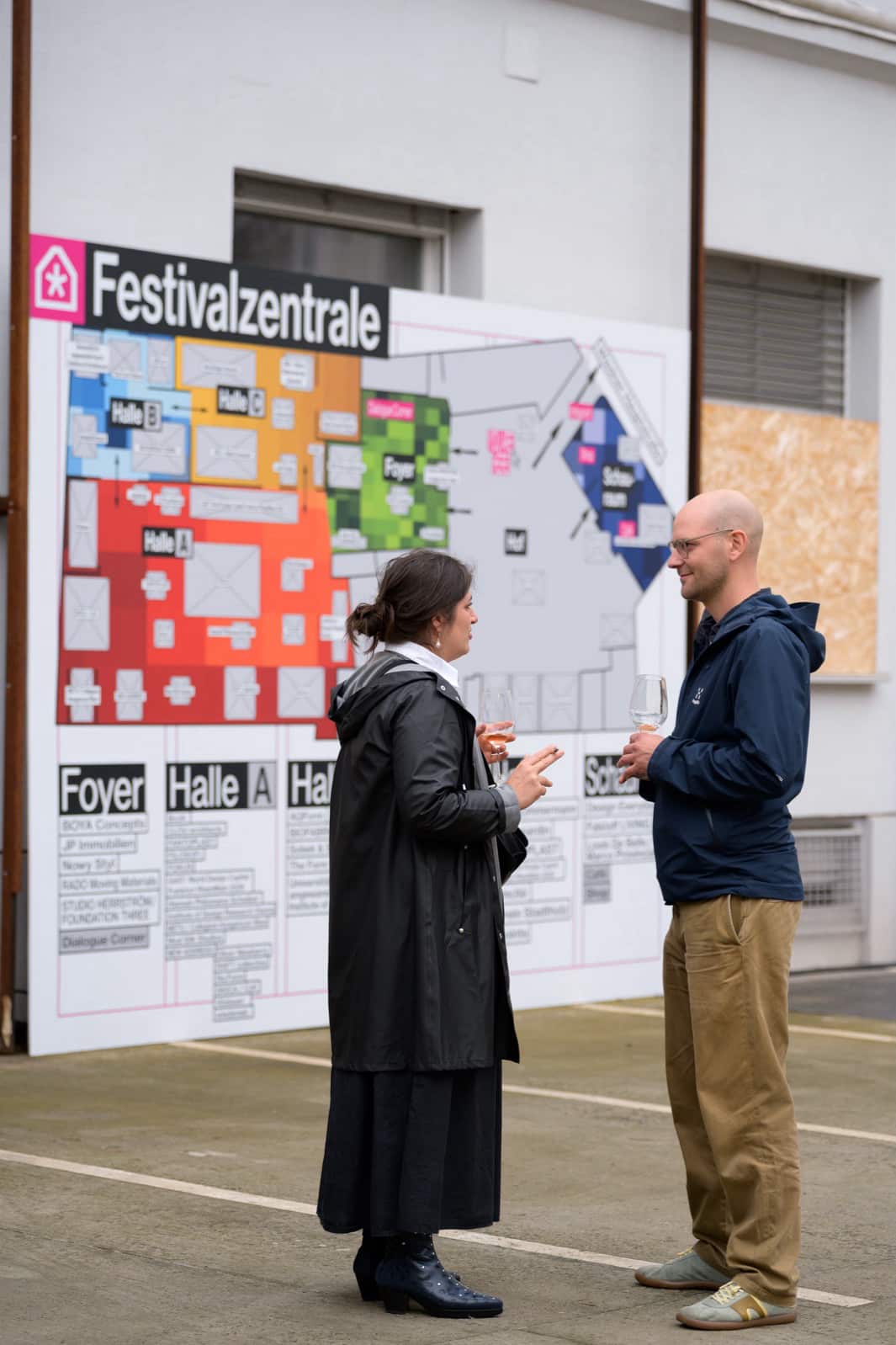
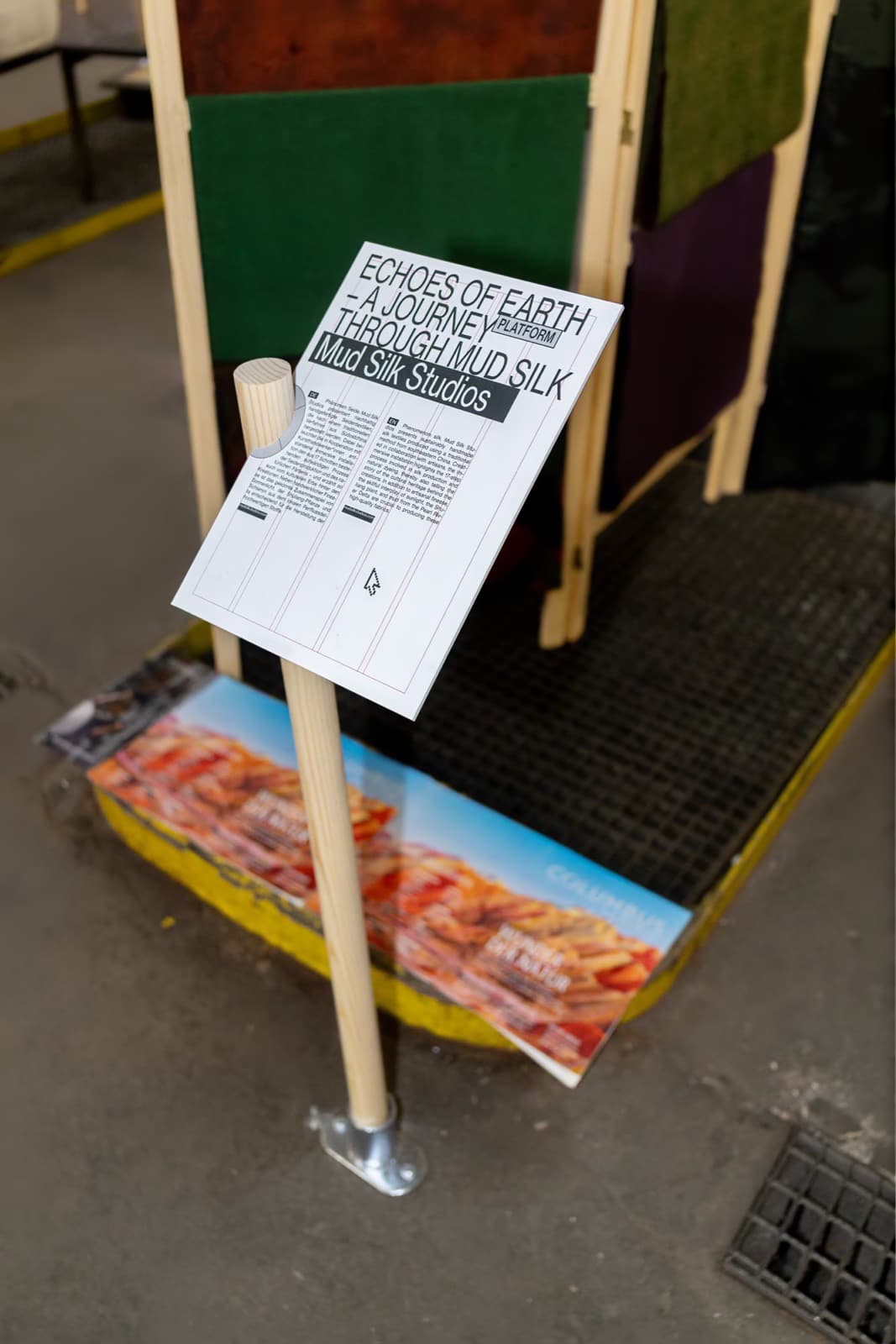
Rather than mounting information to walls, we built a freestanding post system that could be placed anywhere on the floor. The design uses just three parts: a floor-mounted clamp, a notched round timber post, and an interchangeable panel. The same components work at an entrance, inside a hall, or right beside a single exhibit.
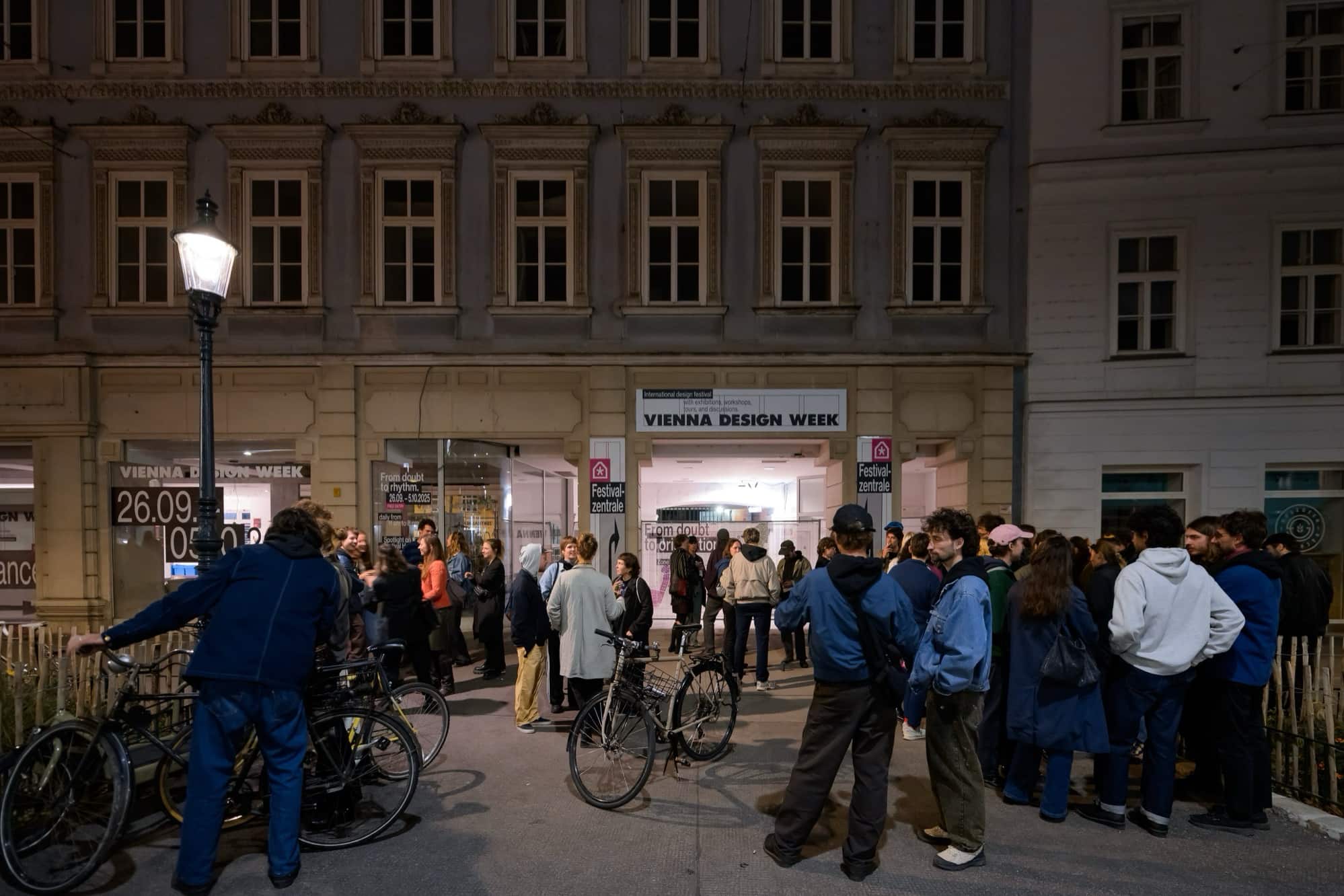
The approach draws on a principle we carried over from our work on the [Klima Biennale:](https://leomuehlfeld.at/design-with-a-purpose) keep the component count low and make everything reusable. Fewer parts means faster setup, less waste, and a system that can grow or shrink as the programme changes without requiring new production each time.
## Getting it There
The design was only half the job. Our role also covered coordinating between the festival team, graphics partner [Fredmansky](https://fredmansky.at){target=_blank}, and printing partner. From the first site visits through to installation.
---
## Credits
[Vienna Design Week](https://www.viennadesignweek.at/en/){target=_blank}, [Fredmansky](https://fredmansky.at){target=_blank}, Graphics, [PerfectCut](https://office45176.wixsite.com/wwwperfectcutat){target=_blank}, Printing, [Gemeindebau](https://www.lmgi.at){target=_blank}: [Max Kure](https://maxkure.net/index.html){target=_blank}, Anton Posch, Special thanks to [Fabio Spink](https://fabiospink.com){target=_blank} and Lucy Li
---
# Valhelmland
Canonical URL: https://leomuehlfeld.at/en/valhelmland
---
title: 'Valhelmland'
for: 'Design in Gesellschaft'
category: 'Brand & Type'
metaDesc: 'Crafting a visual identity, connecting Vienna and Gothenburg through whale heritage at Röhsska Museum.'
thumbnail: /img/valhelmland-thumbnail.jpg
date: '2025-06-19T00:00'
showOnLanding: true
heroImage: /img/valhelmland-thumbnail.jpg
collab: Mia Meusburger, Blanka Hedvig Wittmann
imageCredit: Gothenburg Natural History Museum, GNM7045_022
---
# Valhelmland
## Crafting a visual identity, connecting Vienna and Gothenburg through whale heritage at Röhsska Museum.
## Valhelmland
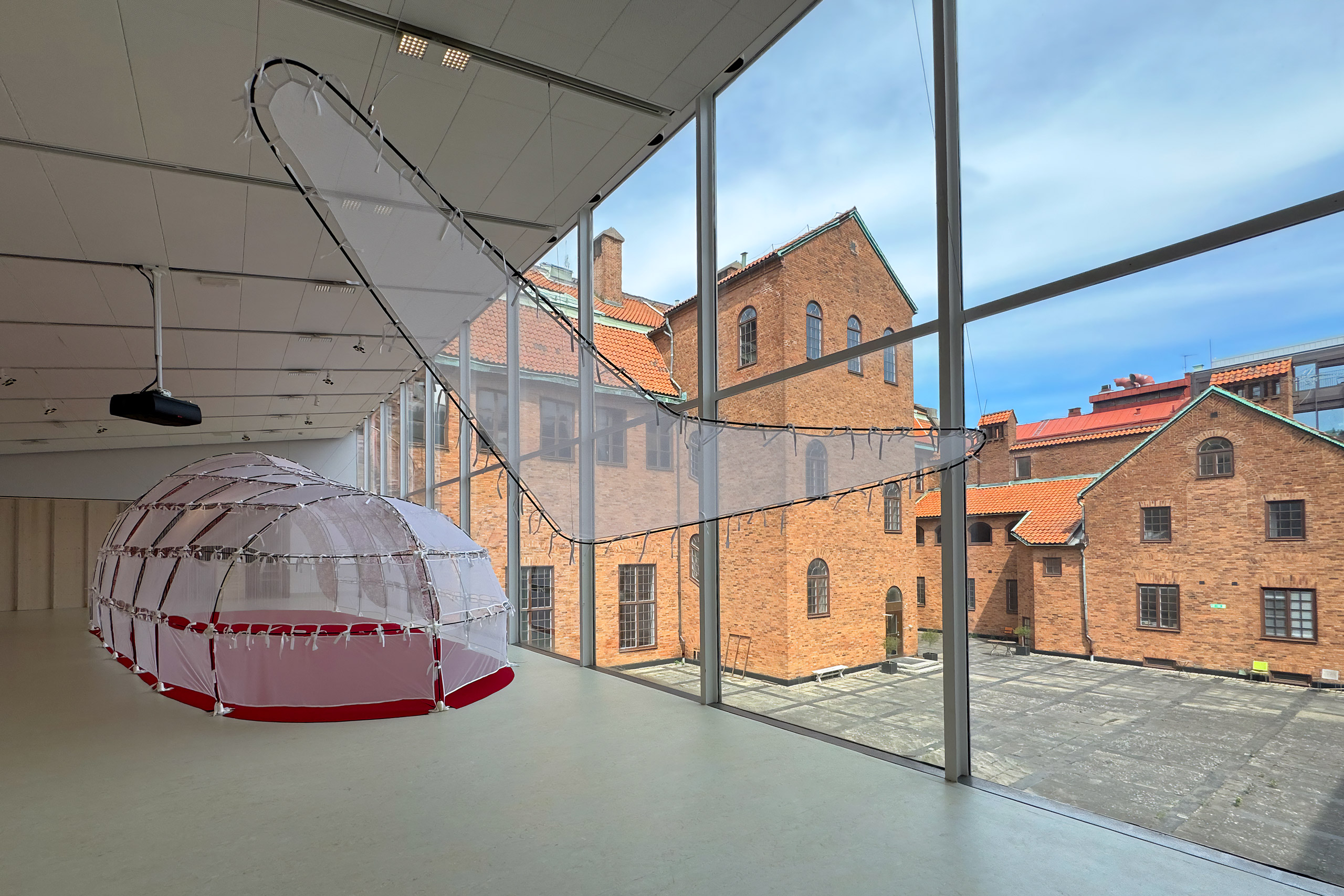
In the summer of 2025, ten designers from Vienna took residence at [Röhsska Museum](https://www.rohsska.se/en/){target=_blank}'s creative island Super Ö, transforming it into Valhelm – a temporary home where they explored how new surroundings influence design practice. Over two months, the museum became both workshop and inspiration, hosting evolving collaborations and new artefacts.
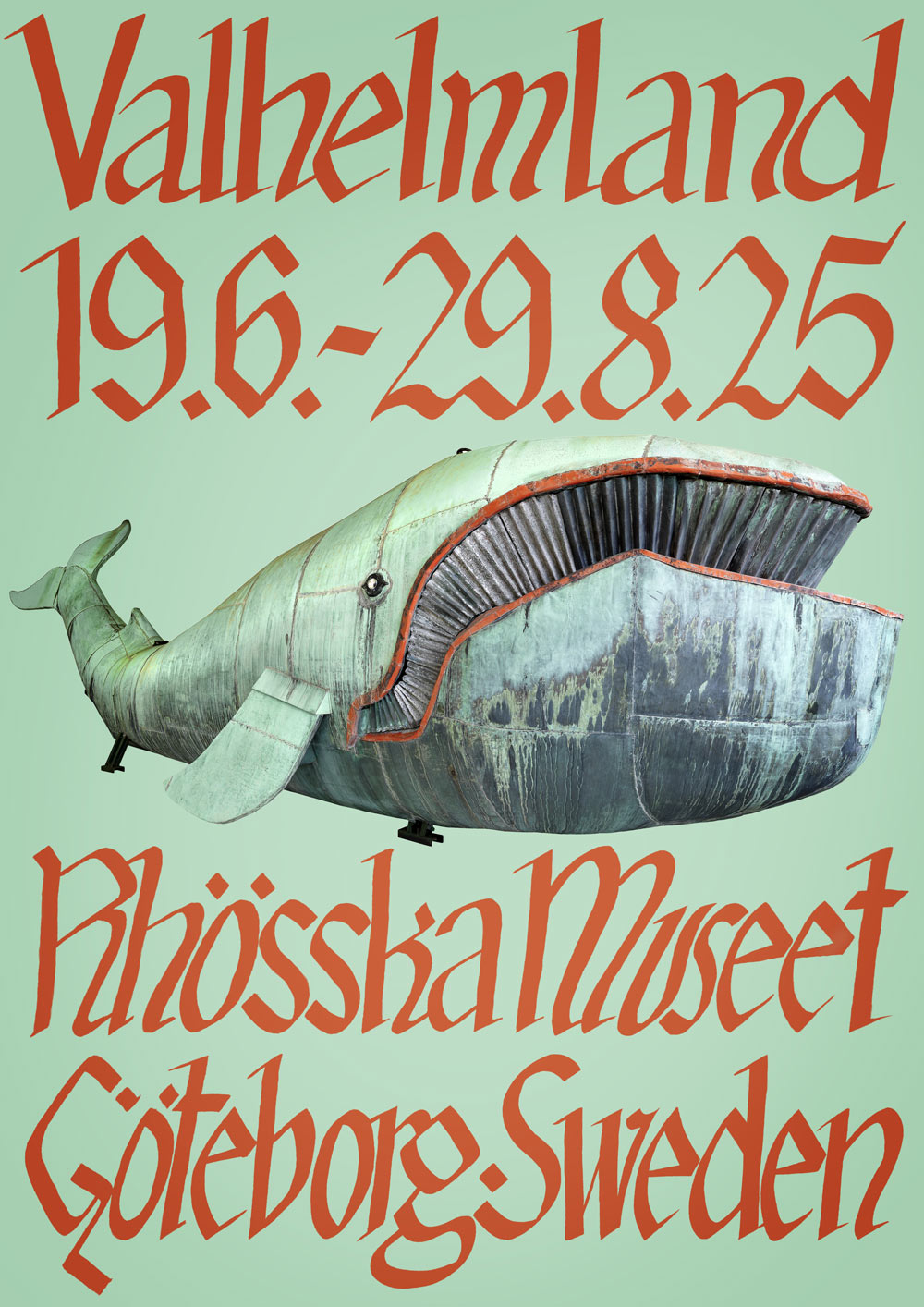
The Val in Valhelm – meaning both “choice” and “whale” – inspired a large whale pavilion that served as scenography and shared workspace, connecting Vienna and Gothenburg through a poetic architectural gesture.
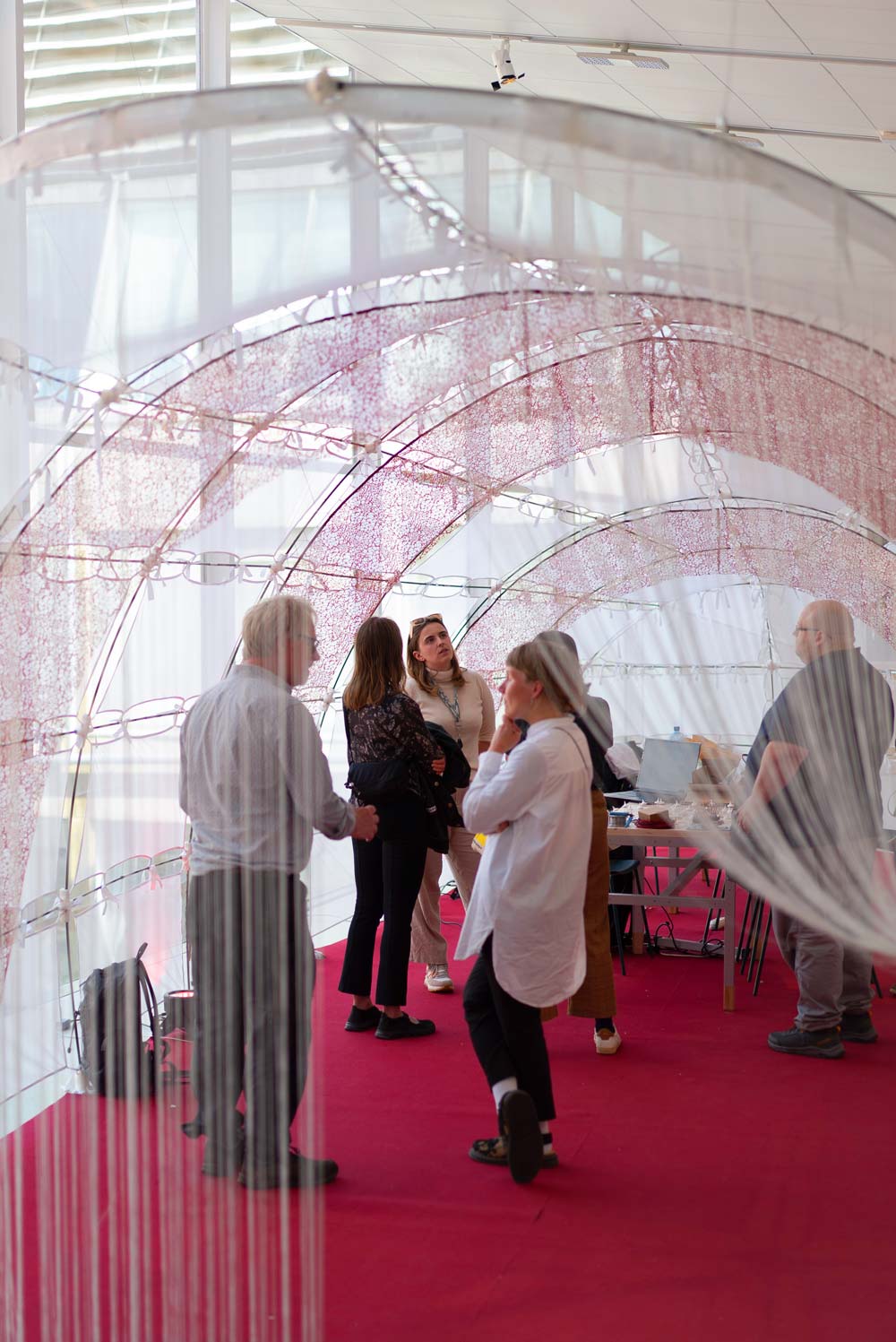
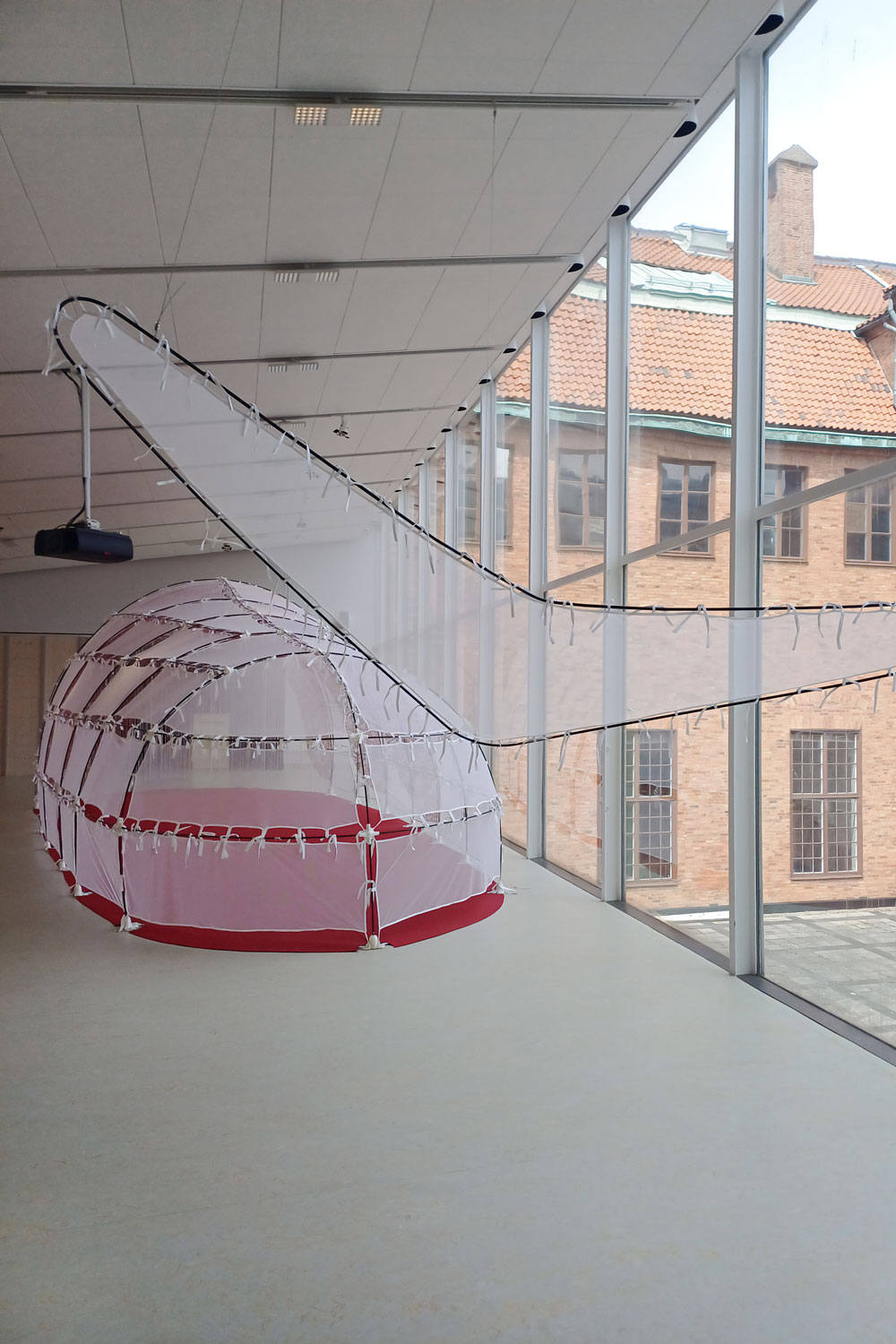
Together with [Mia Meus](https://www.miameus.com/){target=_blank} and [Blanka Wittmann](https://blankahedvig.com){target=_blank}, we designed this pavilion as a home for the designers in residence. While my colleagues developed the structure, I focused on material sourcing, creating small construction components for the island setup, and developing the visual and typographic identity of Valhelmland.
---
## Two cities, two whales
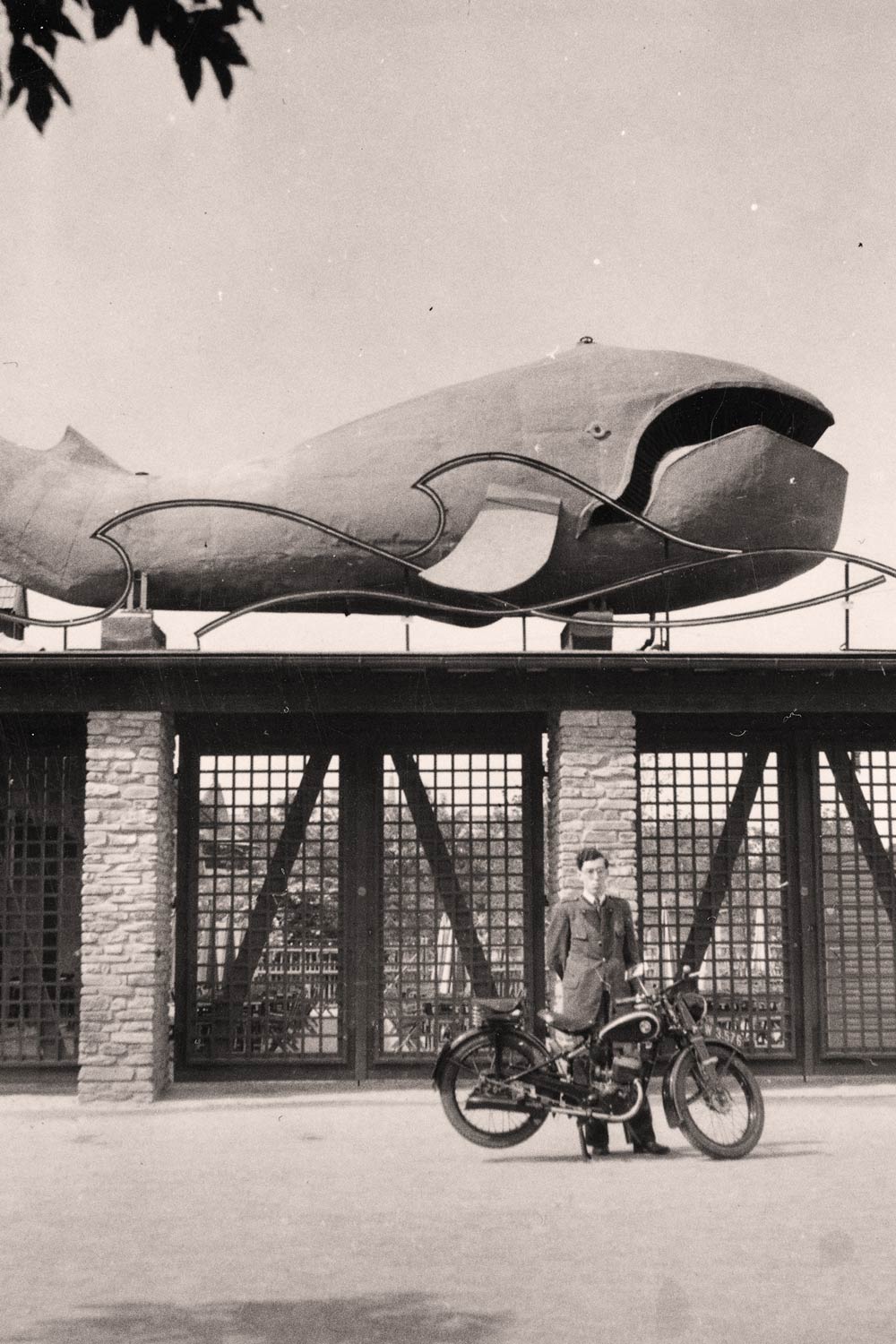
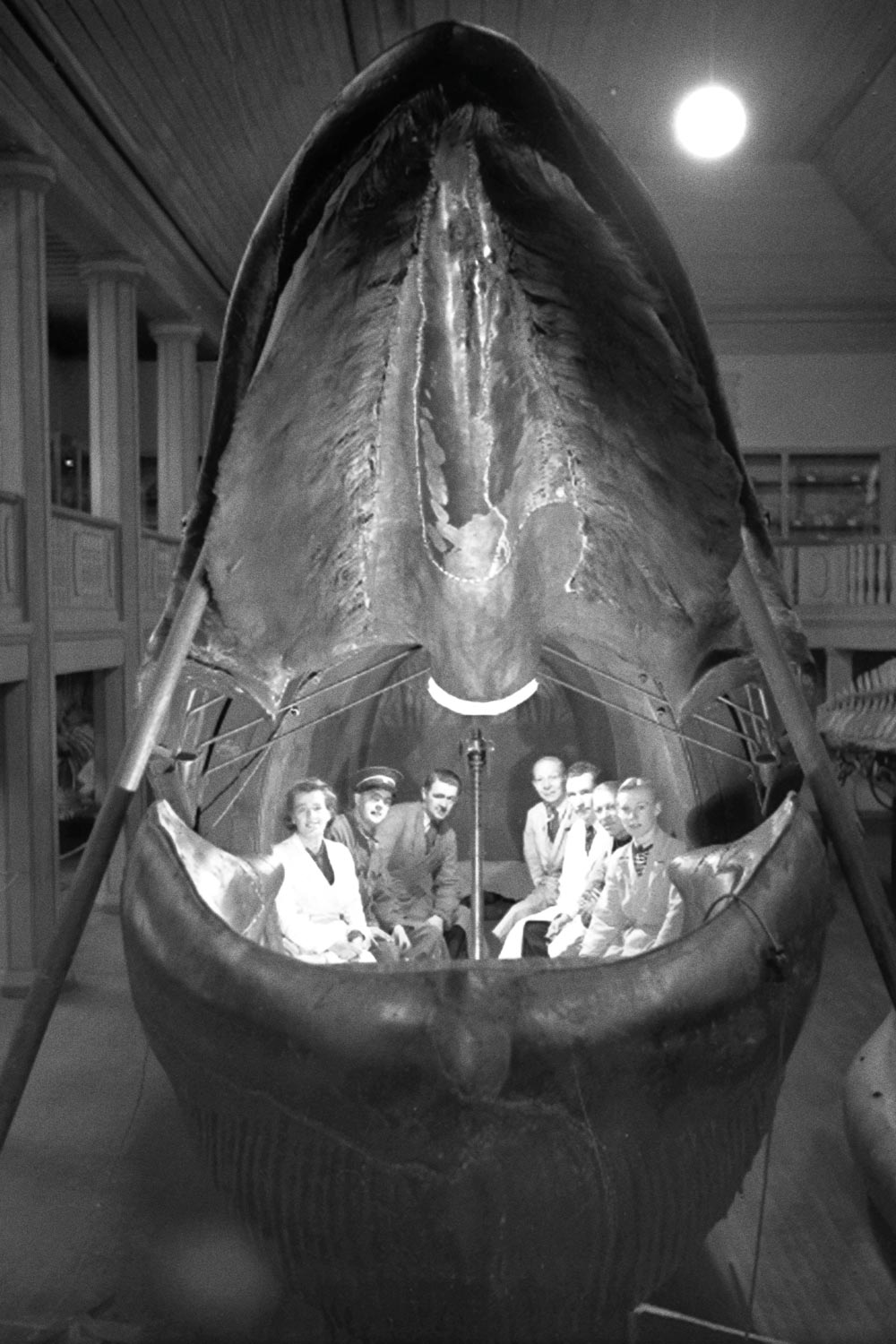
To give this collaboration a setting, we began searching for stories that could connect Vienna and Gothenburg—whether through anecdotes, shared heritage, or monuments that people can still relate to today. Honestly, there wasn't much. Then my collegues stumbled upon the [Malmska Valen](https://www.gnm.se/utstallningar/permanenta-utstallningar/valsalen/malmska-valen/){target=_blank}—the only mounted taxidermied whale in the world, residing in Gothenburg of all places. We quickly drew the connection to Poldi, our very own "museum whale" here in Vienna. Though ours is made of wood and metal, both whales carry fascinating stories that eventually brought them into the museums where they sit today.
## Poldi
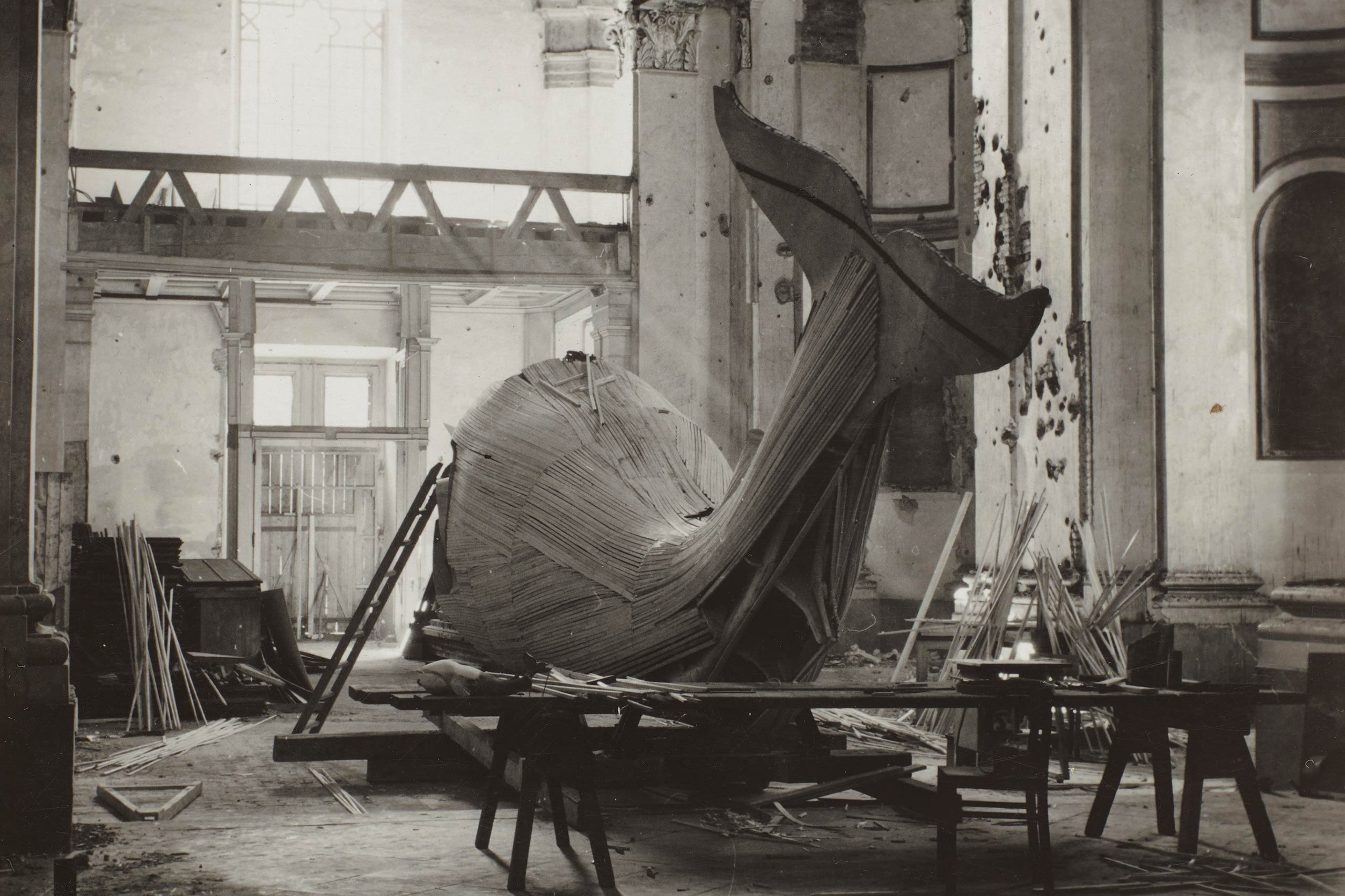
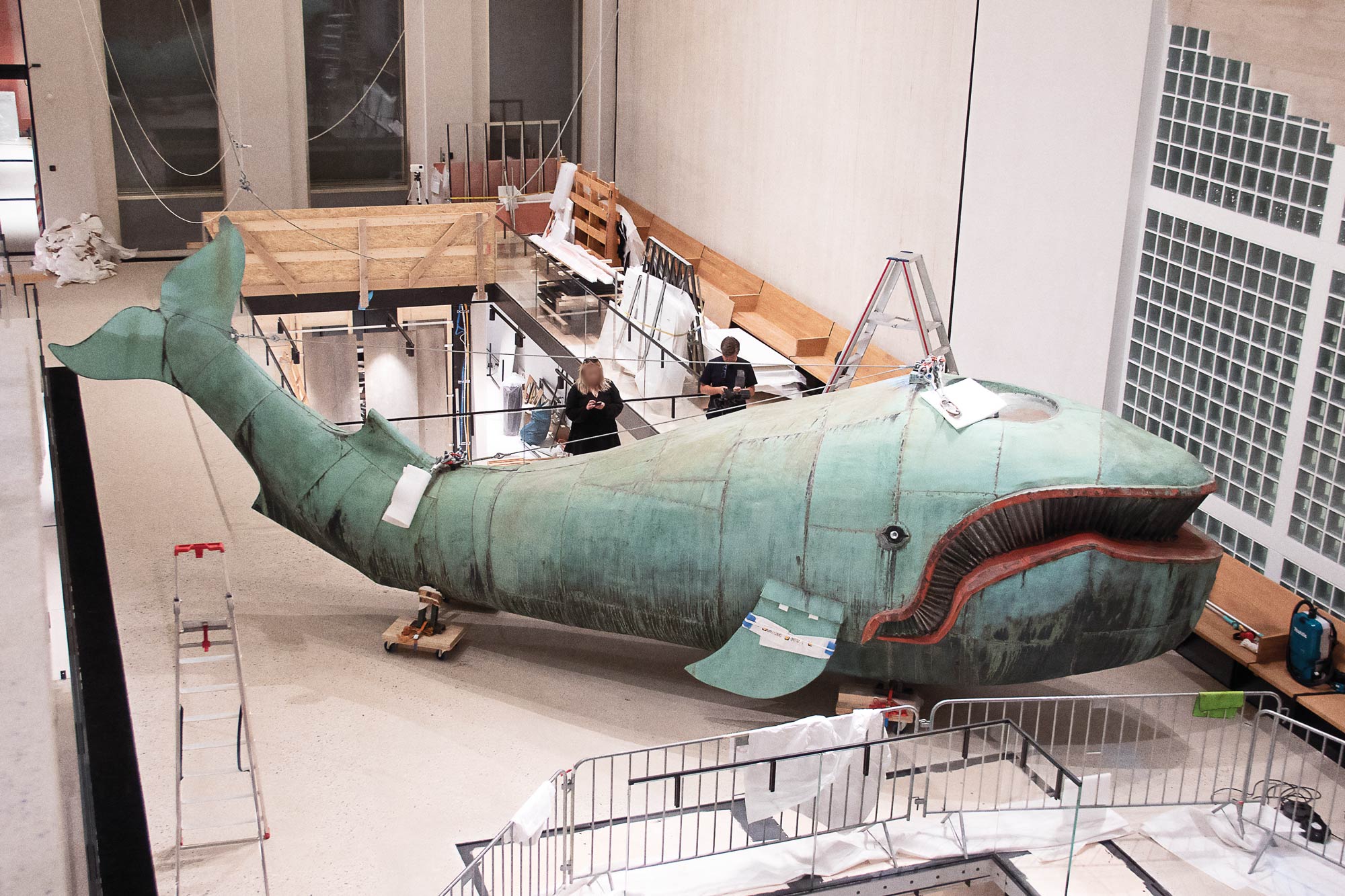
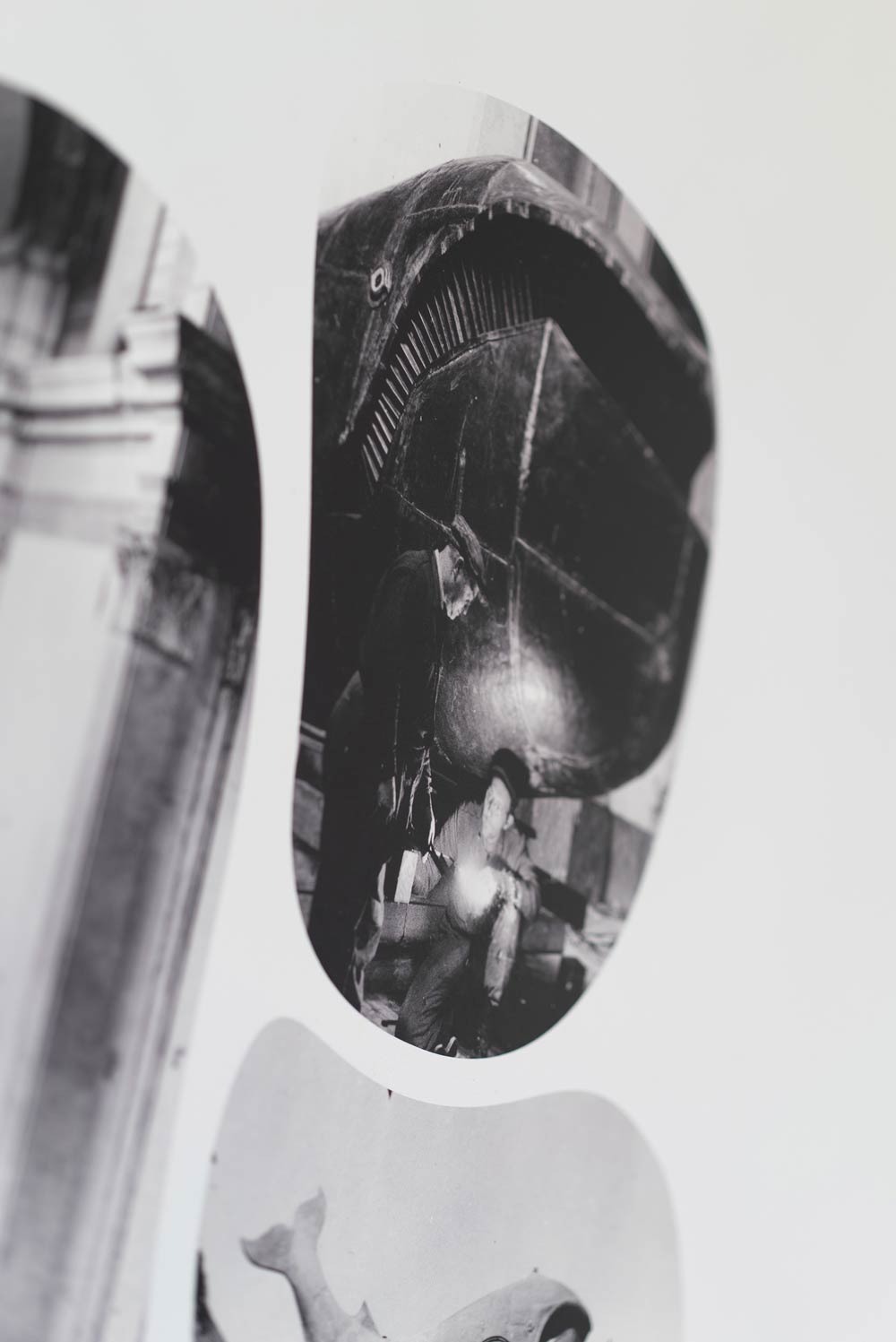
In April 1951, Viennese passersby were astonished to see a whale sculpture being transported through the city on a flatbed truck. Poldi, as he would come to be known, was crafted in the war-damaged [Schwarzspanierkirche](https://de.wikipedia.org/wiki/Schwarzspanierkirche){target=_blank} by restorer Alois Robert Mucnjak-Hochland and his team. The bombed church's empty nave provided the only space large enough to construct the massive wooden skeleton, planking, and copper sheet skin. Working from designs by 25-year-old architect Maria Benke, they created a 1.37-tonne sculpture so lovingly detailed that decades later, restorers would marvel at the craftsmanship.[^1]
Originally mounted above the entrance to the [Prater](https://www.praterwien.com/en/){target=_blank}'s "Zum Walfisch" beer garden, Poldi became a beloved fixture of Viennese everyday culture. People of vienna celebrated communions, graduations, and birthdays beneath him as he spouted water fountains from his blowhole. When the restaurant closed in 2013, Turkish-Austrian demolition contractor Güner Ayaz saved him from the scrapyard. After extensive restoration, Poldi was transported again in 2022—this time to the [Wien Museum](https://www.wienmuseum.at/en){target=_blank} at Karlsplatz, where he has since become the museum's mascot.
## Malmska Valen
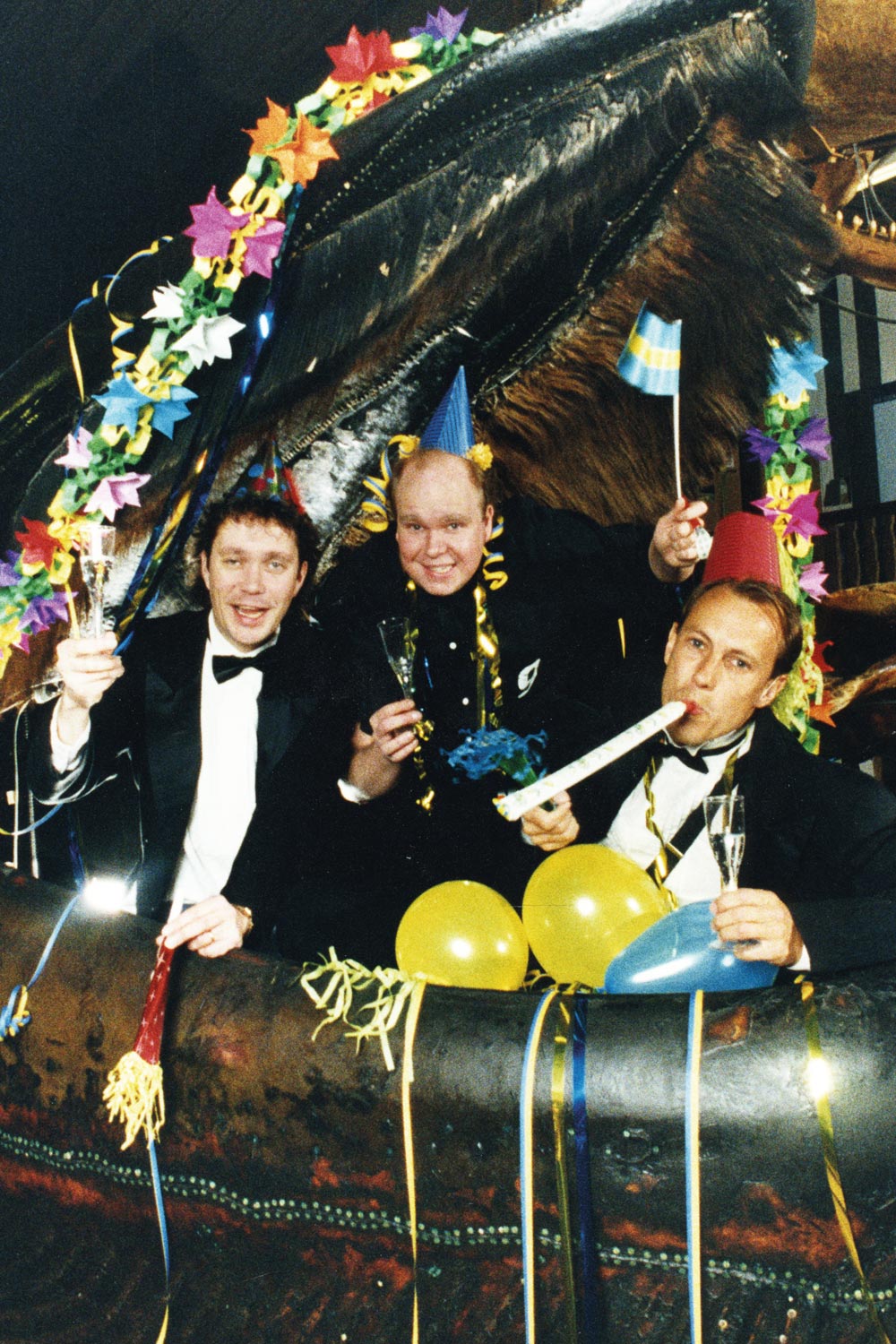
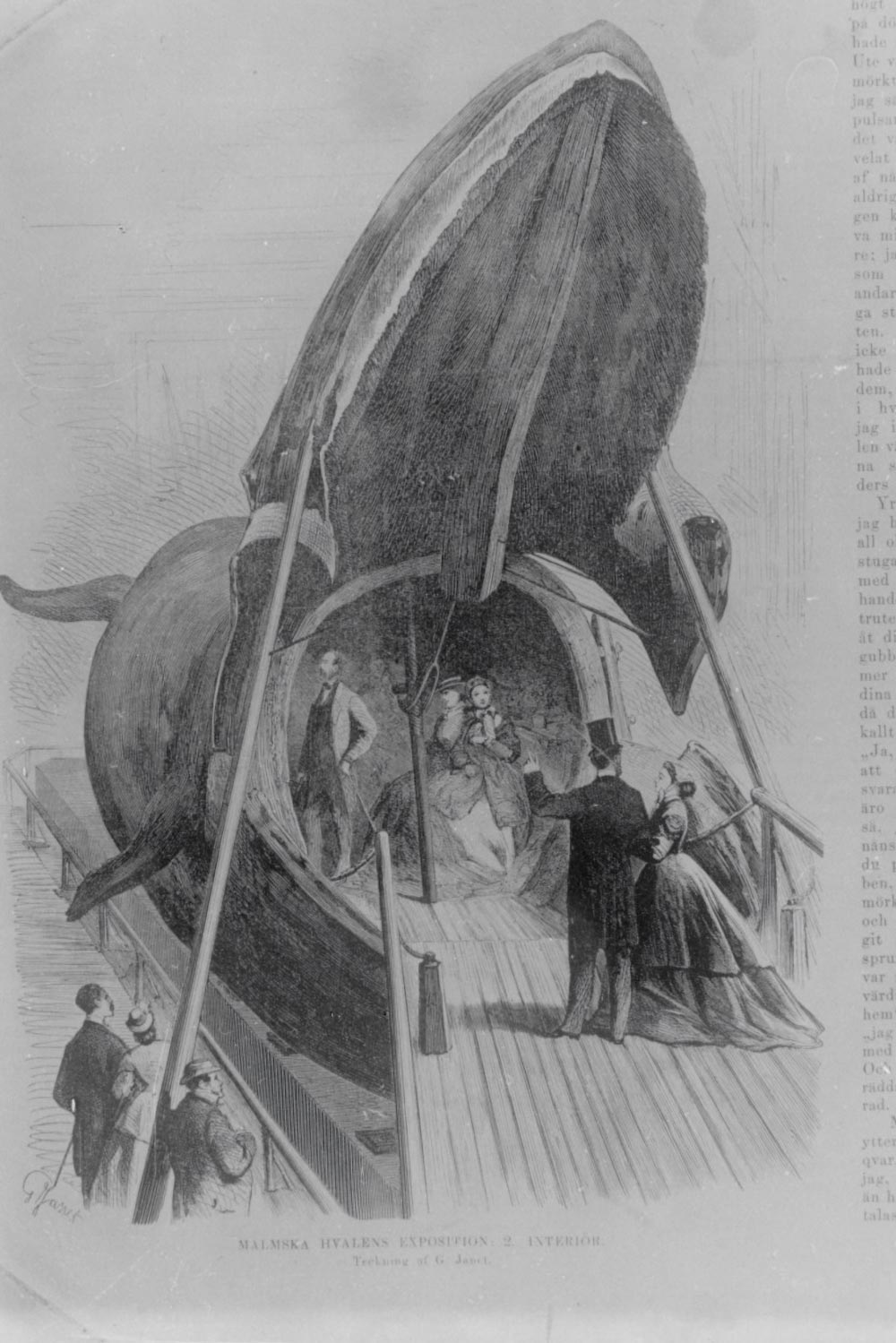
In October 1865, a young male blue whale beached near Gothenburg. Taxidermist [August Wilhelm Malm](https://en.wikipedia.org/wiki/August_Wilhelm_Malm){target=_blank} preserved it whole. The hinged jaws opened to reveal an interior with wallpaper and wooden benches where visitors could step inside. As the whale toured Europe, rumors began to circulate. Secret parties in its belly. Romantic encounters in the darkness. The most persistent tale: a couple caught "making love" inside, ending public access in the 1930s.[^2] The current custodian of the whale at [Gothenburg's Natural History Museum](https://www.gnm.se){target=_blank} admits most of this is legend. Still, our collaborative whale honors these whispered stories as its interior is fitted with a long table, transforming the belly into a creative space.
---
## Visual Identity
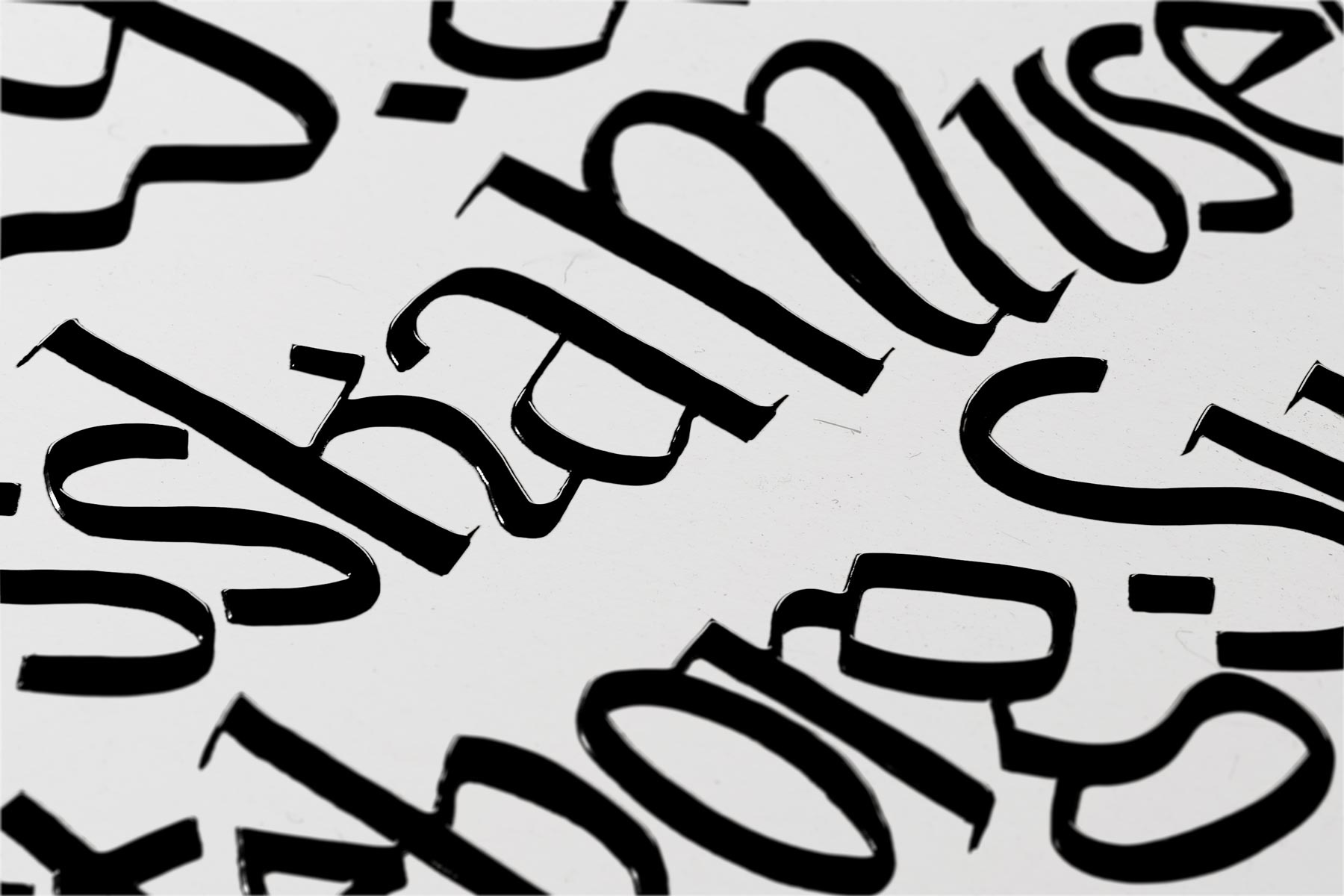
A research trip to [Vienna's Prater](https://www.praterwien.com/en/){target=_blank} delivered the visual direction. The vintage carnival rides, worn by decades of use, revealed an aesthetic universe: fairy-tale-like yet edgy, nostalgic yet strangely liminal. Their hand-painted signage, ornate frames, and faded grandeur spoke a language somewhere between fairy tale and fever dream. I sketched a wavy Rotunda-Blackletter headline typeface. The resulting typography, like those rides themselves, became a vehicle, transporting viewers into an enchanted place.
## Poster Exploration
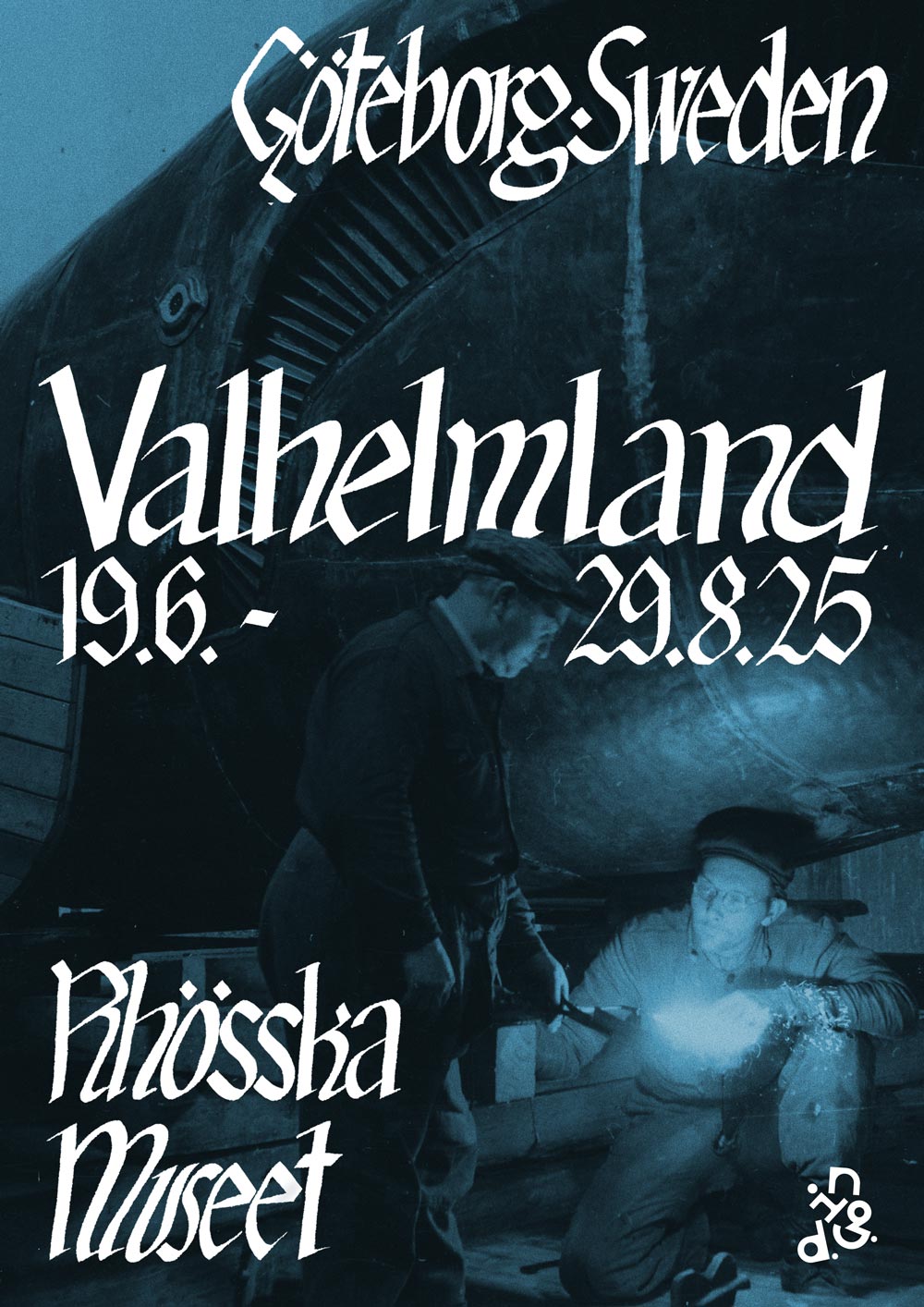
Apart from bringing our whale to Gothenburg's [Röhsska Museum](https://www.rohsska.se/en/){target=_blank}, we carried Poldis story with us. The [Wien Museum](https://www.wienmuseum.at/en){target=_blank} provided astonishing footage by Bergen-Portisch documenting Poldi's construction in the bombed church. I paired this archival material with the Rotunda letterforms, creating compositions that felt atmospheric and historically weighty. But the result proved too dark, almost unsettling, kinda Robert Eggers even. The mood was compelling but not it in this case.
Considering the exhibition would become a vibrant, collaborative workspace where designers produce and present their work, I pivoted toward lightness. I attempted a flea-market aesthetic: playful, layered, accessible. But this approach fell flat. The compositions lacked depth and failed to convey the spatial quality we envisioned; something that hinted at the physical experience of stepping inside.
## Final draft
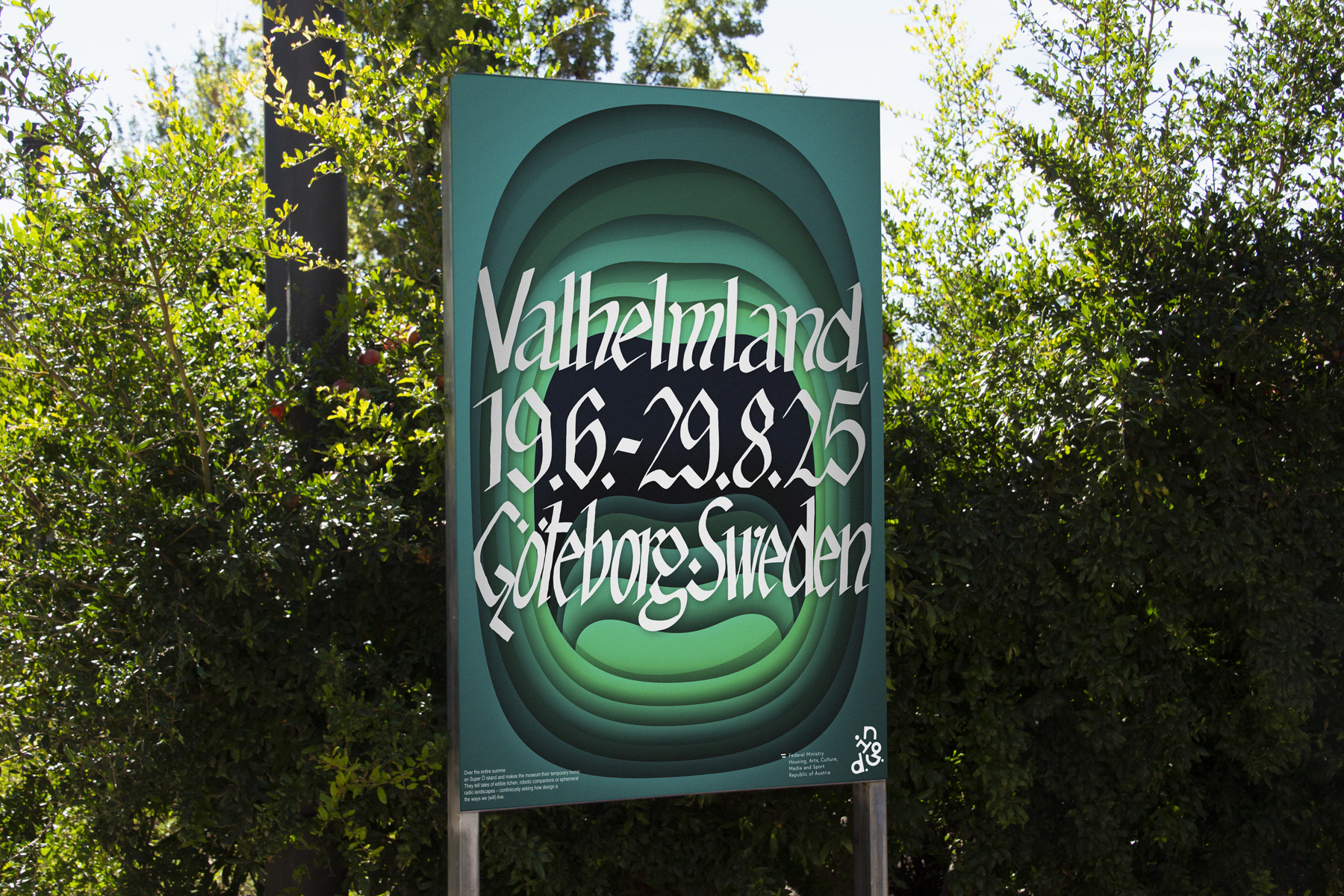
The final draft took inspiration from one of our earliest sketches for the whale tent. In the beginning, we explored various approaches to creating such a massive structure using lightweight, convincing, and highly minimal materials that would also allow for easy transport. One concept involved layering suspended pieces of cloth that, much like an MRI scan, formed the inner funnel of the whale. These layers, combined with the typographic elements, create a mystical atmosphere that invites visitors to lose themselves within the exhibition space.
## Wa(l)l texts
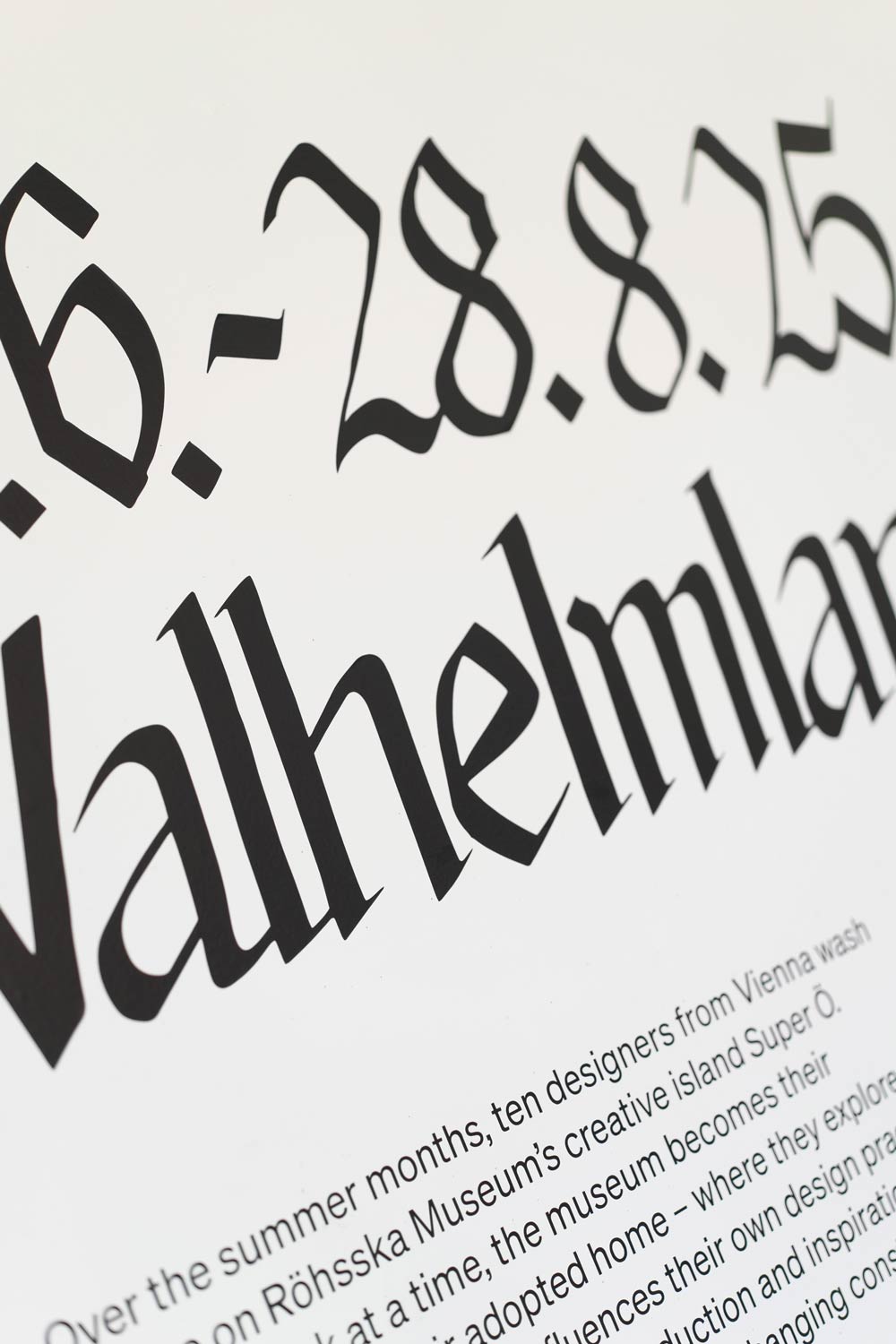
By combining the drawn letterforms with a clean grotesque and cutting the final typography in Vinylcut Foil, we translated the visual identity directly into the exhibition environment. The graphic system became an integrated part of the installation rather than a separate layer that only exists on IG and posters.
---

## Credits
Valhelmland was a project initiated by [Design in Gesellschaft](https://designingesellschaft.com/){target=_blank}, an association to promote the role of design as a cultural practice. It was funded by the [Federal Ministry for Arts, Culture, Civil Service and Sport of the Republic of Austria](https://www.bmwkms.gv.at){target=_blank} as well as the [Austrian Embassy of Sweden](https://www.bmeia.gv.at/oeb-stockholm){target=_blank}. Curation: Anna Hydén (Röhsska Museet), Production: Jessica Andersson Sjögerén (Röhsska Museet), Tech: Stefan Törner (Röhsska Museet), Design: [Mia Meus](https://www.miameus.com/){target=_blank}, Leo Mühlfeld, [Blanka Wittmann](https://www.blankahedvig.com/){target=_blank}, Designers on site: [Rimon Alyagon Darr](https://www.rimonalyagondarr.com){target=_blank}, [Franz Ehn](https://franzehn.com){target=_blank}, [Lino Gaspartisch](https://linogasparitsch.com){target=_blank}, [Sophie Falkeis](https://sophiefalkeis.com){target=_blank}, [Mia Meus](https://miameus.com){target=_blank}, Leo Mühlfeld, [Johanna Pichlbauer](https://johannapichlbauer.com){target=_blank}, [Julia Schwarz](https://schwarzjulia.com/julia){target=_blank}, [Blanka Wittmann](https://blankahedvig.com){target=_blank}, [Márton Zalka](https://zalkamarton.com){target=_blank}.
[^1]: [Der Praterwal aus der Zerbombten Kirche, DiePresse, 11.Sep.2025](https://www.diepresse.com/20074557/der-praterwal-aus-der-zerbombten-kirche){target=_blank}
[^2]: [Malm Whale, Michelle Enemark, Visited 6.Nov.2025](https://www.atlasobscura.com/places/malm-whale){target=_blank}
---
# Valley of the Hearts Delight
Canonical URL: https://leomuehlfeld.at/en/valley-of-the-hearts-delight
---
title: 'Valley of the Hearts Delight'
for: 'Felix Lenz'
category: 'Exhibition & Installation'
metaDesc: 'Designing a set and custom glass structures for Felix Lenz video installation at Triennale Milano 2025.'
thumbnail: /img/vothd11_comp.jpeg
date: '2025-05-13T00:00'
showOnLanding: false
heroImage: /img/vothd02_comp.jpeg
collab: Miriam Daxl, Selma Mühlbauer
imageCredit: Federico Floriani/MAK
---
# Valley of the Hear t's Delight
## Designing a set and custom glass structures for Felix Lenz video installation at Triennale Milano 2025.
## Context
For the Austrian Pavilion at the 2025 Triennale di Milano, I collaborated with artist Felix Lenz on the spatial and technical realization of his 3-channel video installation The Valley of the Heart’s Delight. My responsibilities included the spatial concept and set design for the shoot together with Miriam Daxl, co-design of a custom glass wall structure, and development of a bespoke media control system for synchronizing and managing the three video channels.
## Brute Force
The central video work derives from the 30-minute essay film “Brute Force [Exhibition Cut]”, also by Felix Lenz, and investigates the physical implications digital technologies have on the landscape around the Santa Clara Valley, which was once a diverse ecosystem and is now mostly known for being home to the southern part of silicon valley.
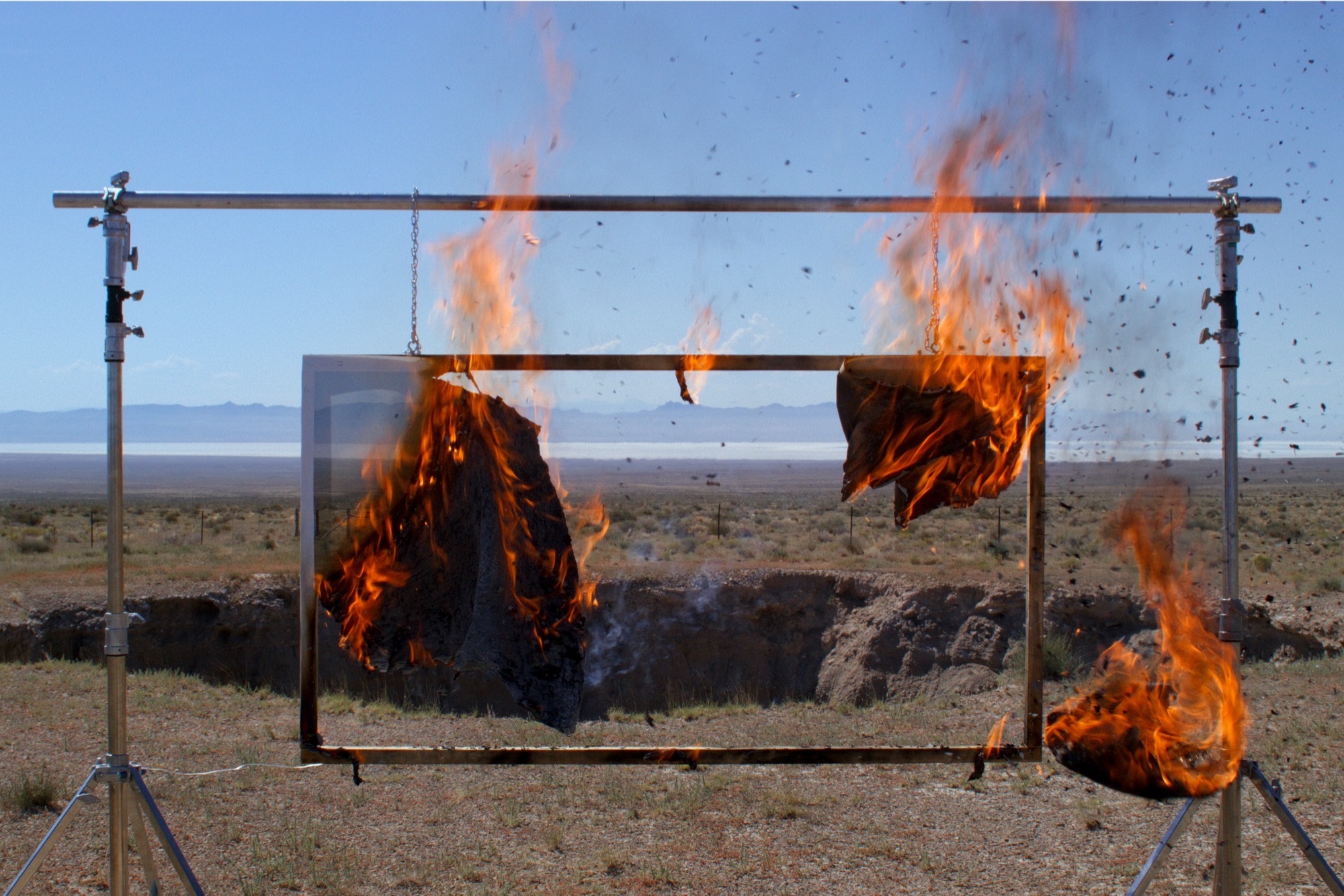
Modern day technologies leave their traces not only within social and political realms, but have very tangible effects on the physical spaces we are inhabiting. Knowledge extractivism is part of a much broader, contextual crisis that exacerbates information capital as well as natural resources. The silicon valley and rare earth mines around the globe are Landscapes that have - prior to their appropriation - existed in unison with the people inhabiting them and are now mostly stripped from their indigenous relevance and reduced to static repositories or development sites for corporate headquarters. This siege of natural spaces is emblematic of the catastrophic power imbalances inherent in digital information technology systems.
---
## Set Design
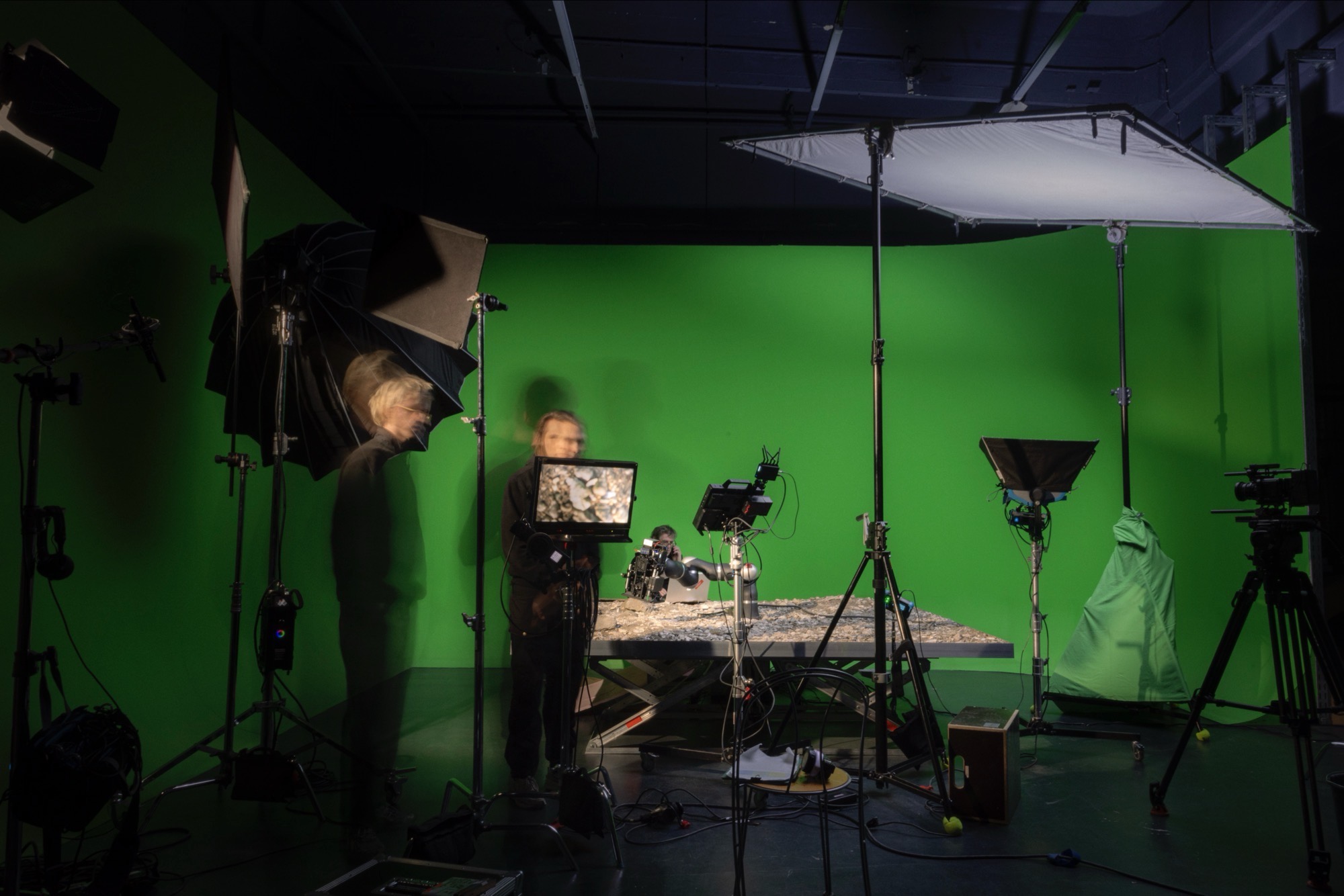
For the project, in close collaboration with Miriam Daxl and Felix Lenz, we analysed the soil of the Santa Clara Valley in order to - with the help of Selma Mühlbauer - produce a replicate substrate that would convey the historical soil of the land of that area. The artificial nature of this soil-duplicate underlines the sense of simulation that is very prevalent in technology’s serene and sterile aesthetics.
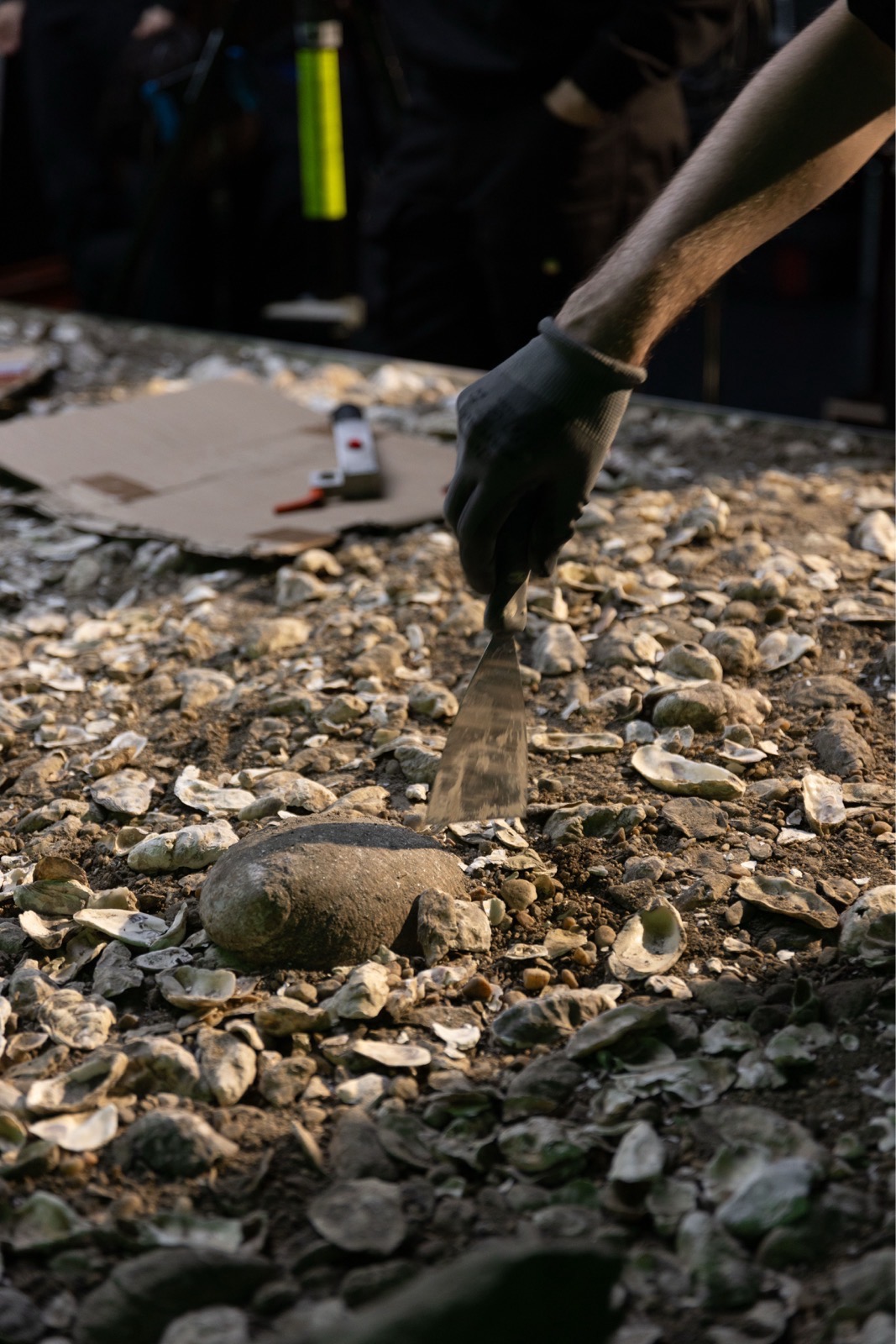
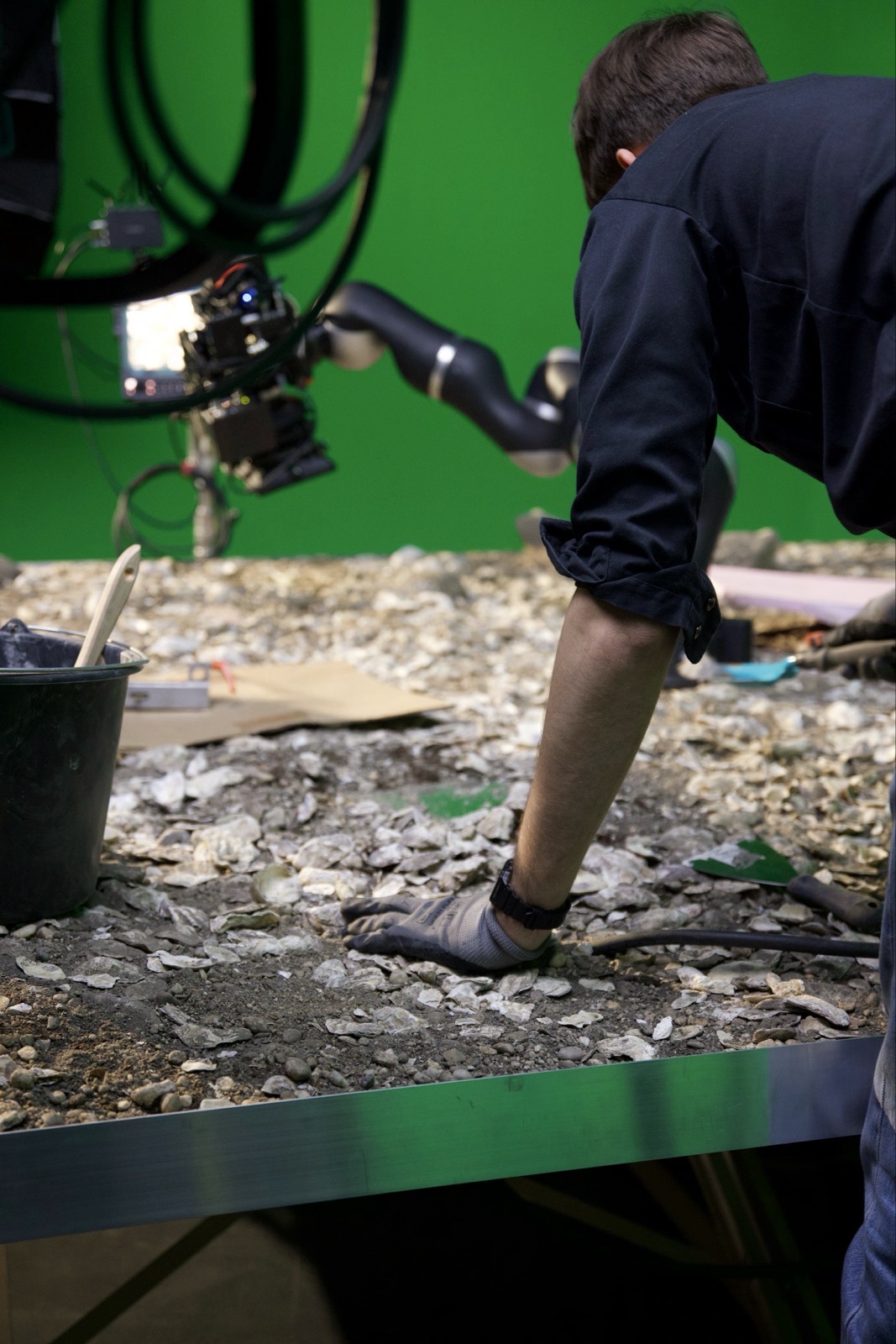
The compounds used for the soil are informed by the basic components of shellmounds which are strongly associated with the history of the bay area. Following in-depth research into the natural mix of materials and many iterations of DIY-soil, we first produced a square meter of said material in order to be scaled up on-set and dressed on specially designed stage elements. To finalise the look and feel of the material, rough stones and shells were added.
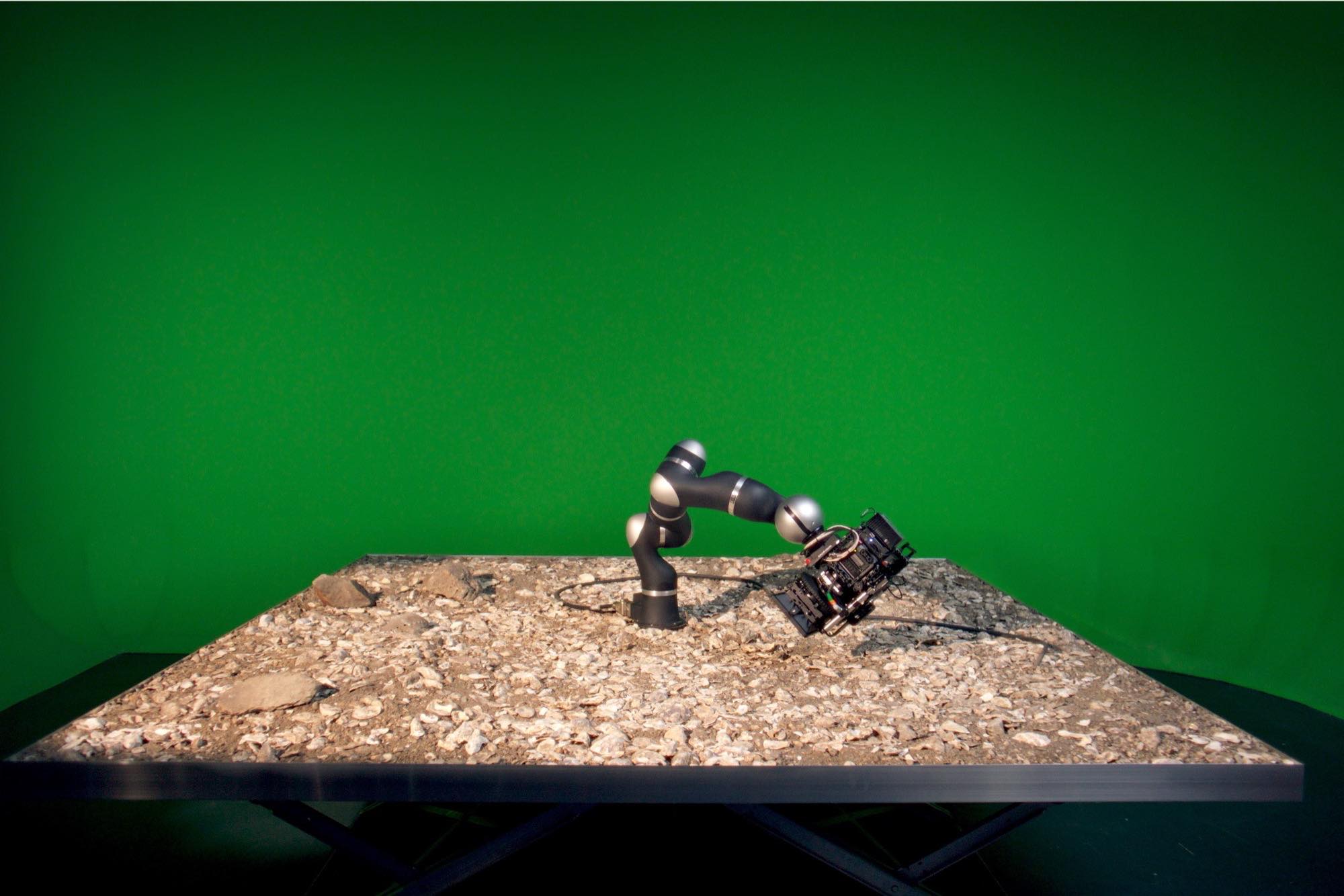
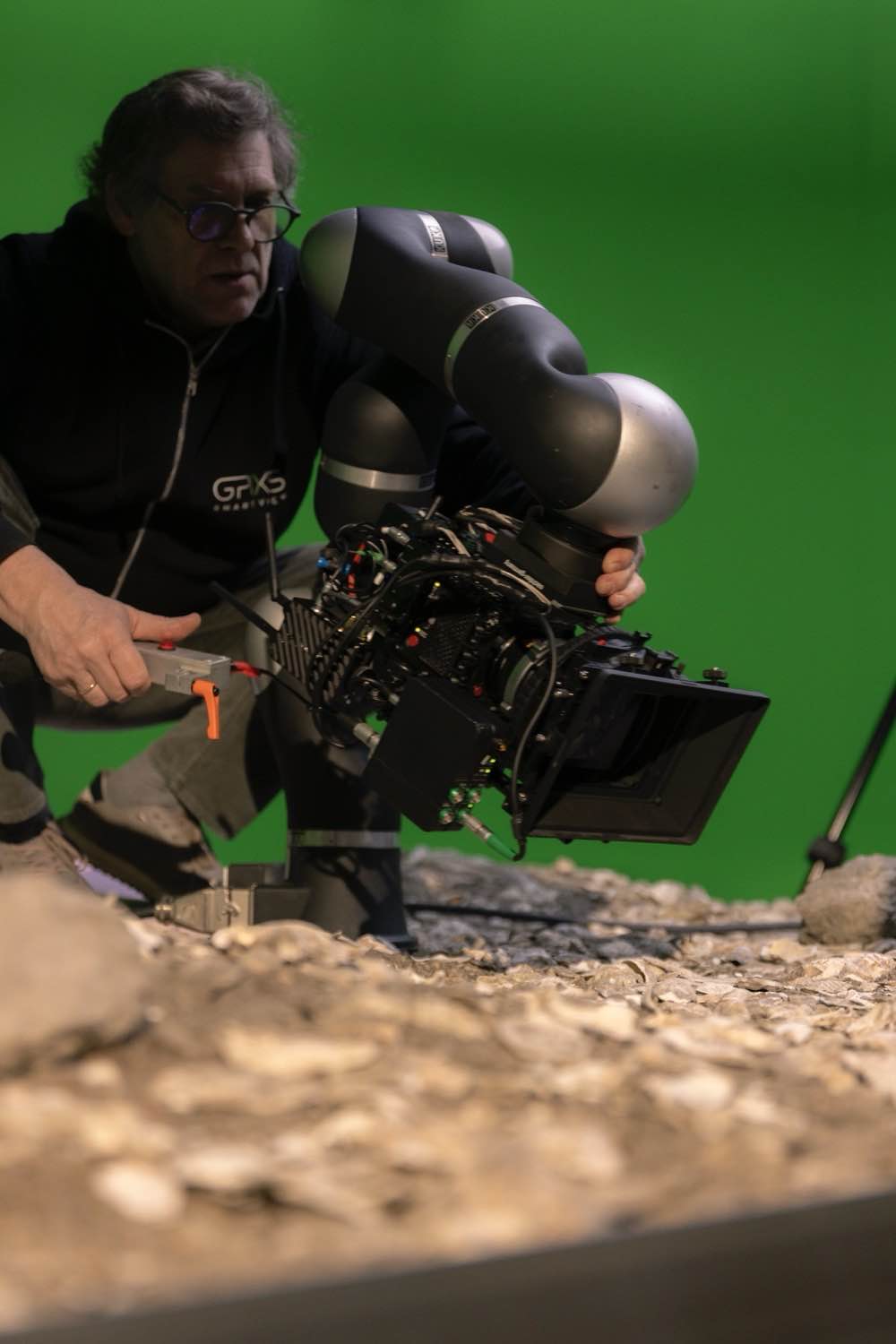
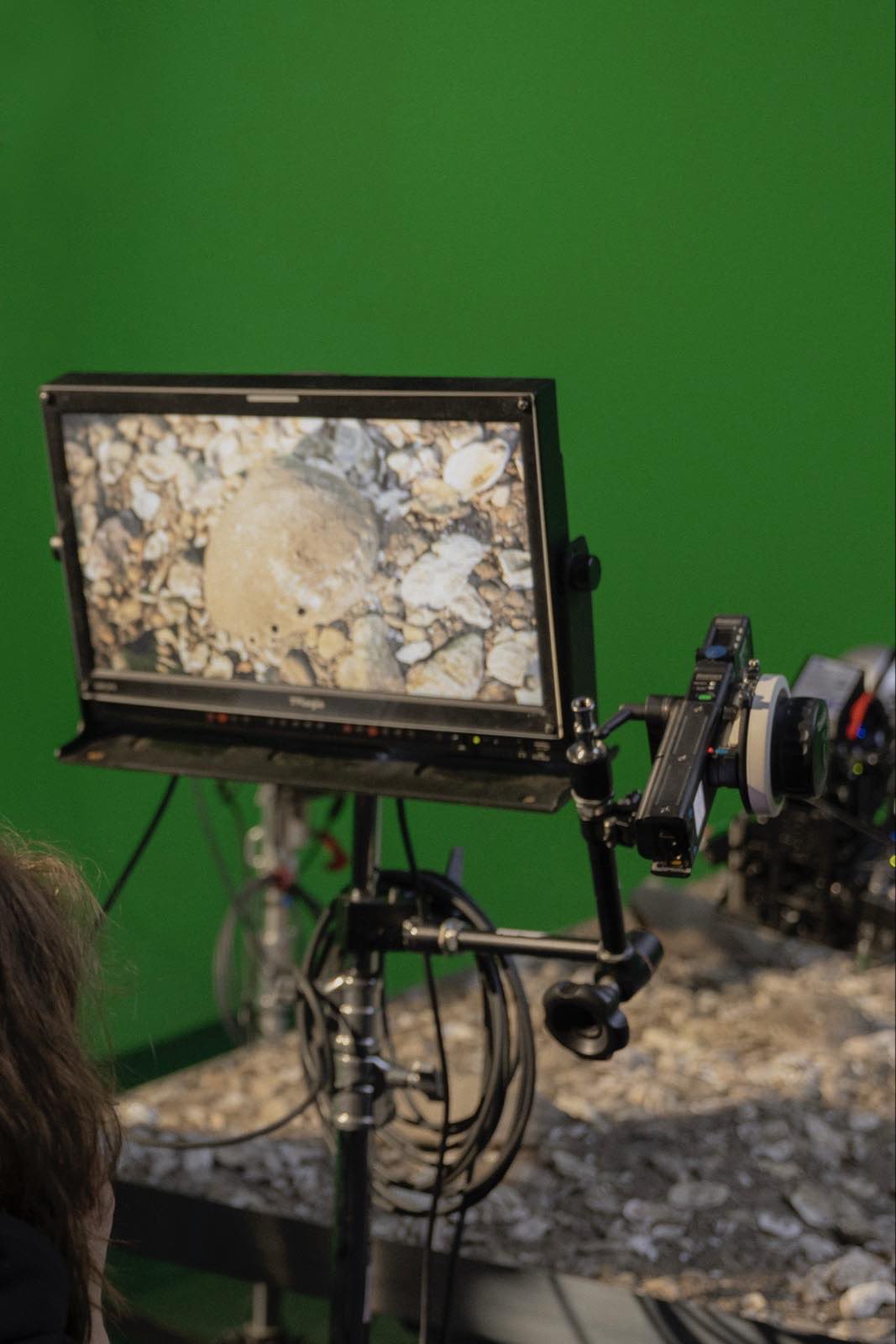
Working closely with the company “Wunderwerk” we were able to capture the multifaceted matrix of this substrate using a camera mounted on a robotic arm. The smooth and orchestrated movement of the camera over the soil underlines the contrast of chaos within natural systems and their inherent entropy, and techtopian ideals of perceived perfection.
On the be-soiled stage element, the camera arm becomes a main actor flattening the palpable, 3-dimensional multiplicity of the soil and reality into 2-dimensional images thus shaping the perception of its surroundings in the process.
---
## Exhibition Setup
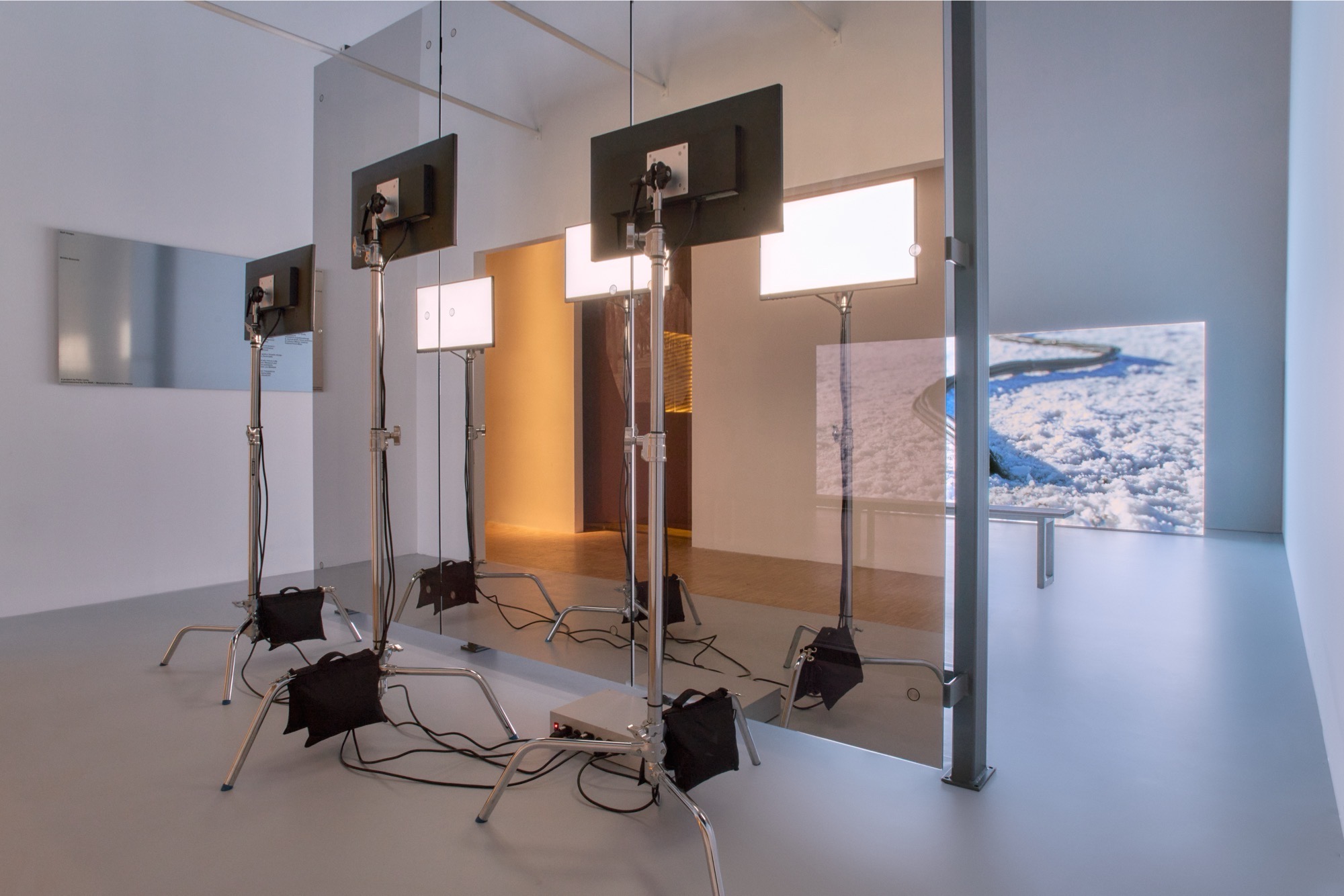
For the bigger exhibition setup a setting that would architecturally represent the power imbalances fostered by the silicon valley was envisioned. In homage to the tech headquarters with their sleek, reflective façades, I co-designed a custom wall element that would merge the properties of a one-sided mirror and a polarising filter, casting a harsh separation between the outside and the inside.
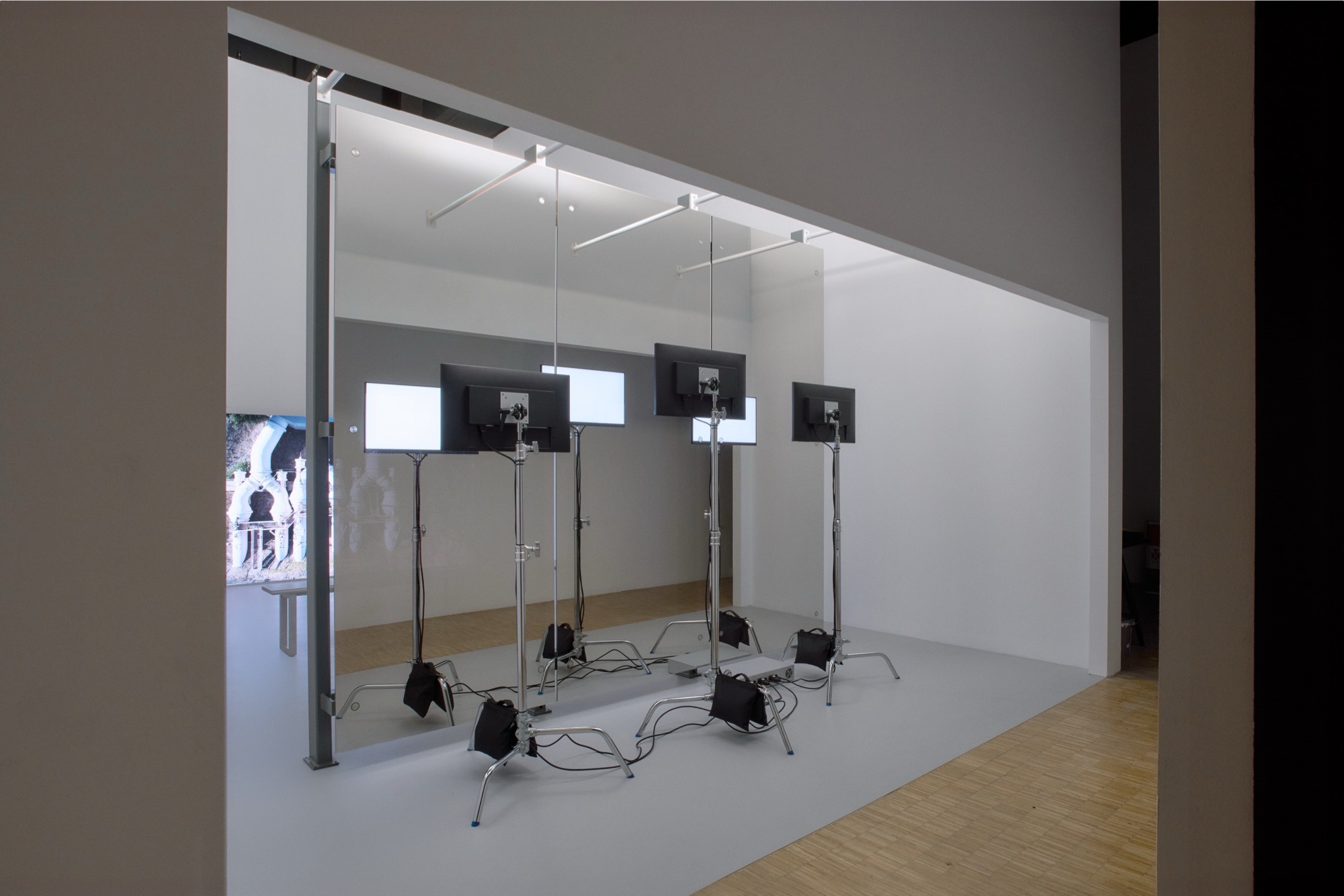
Upon arriving at the installation, the mirrored elements shield off the visitors’ gaze from the main screen and interior of the exhibition space. The three screens in front of the wall - themselves facing away from the viewer - are directly reflected back on the mirror facade. The bright reflection of the monitors, upon first glance, promises additional visual information, but one is quickly disillusioned by the realisation of the screens simply emitting a bright white glow.
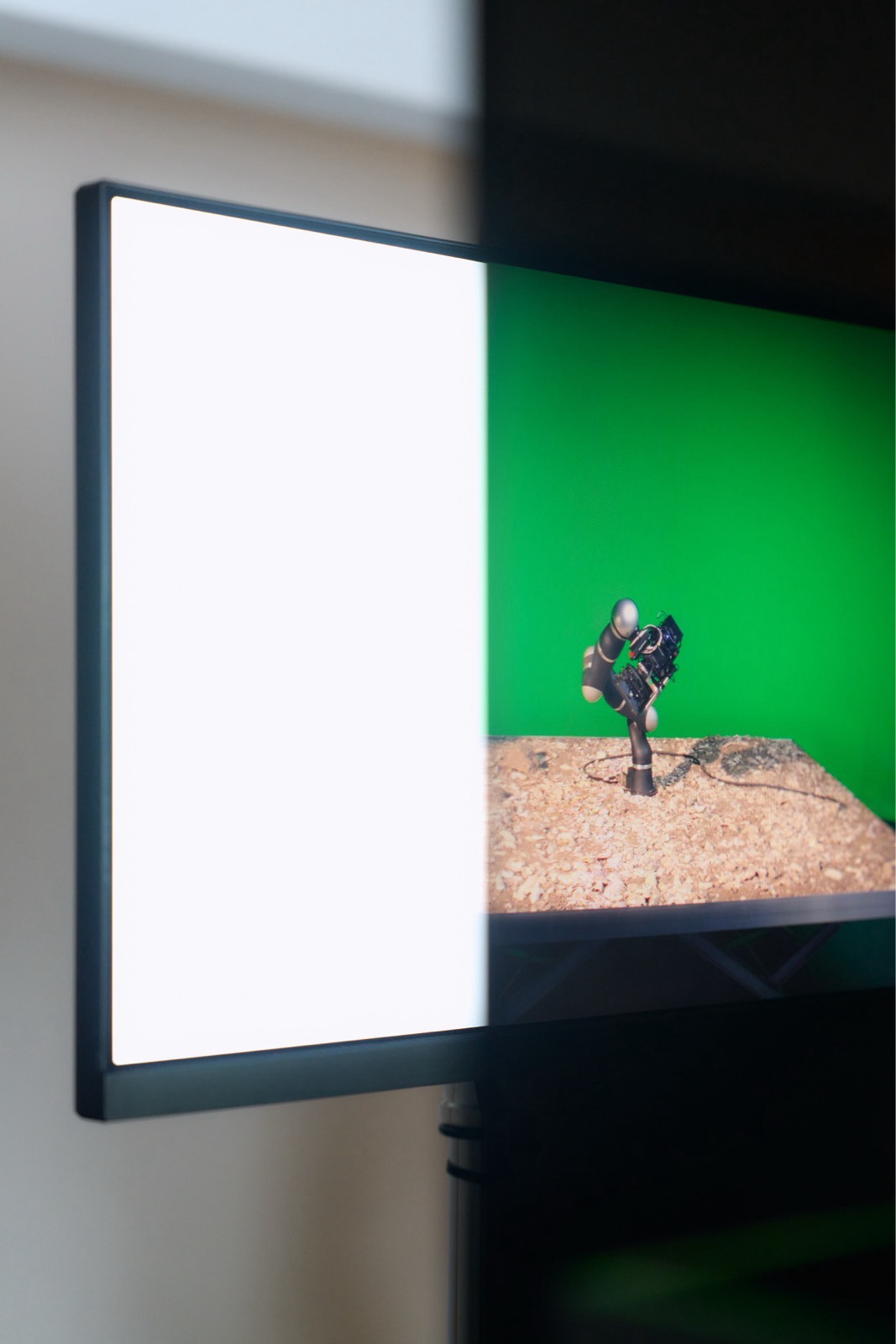
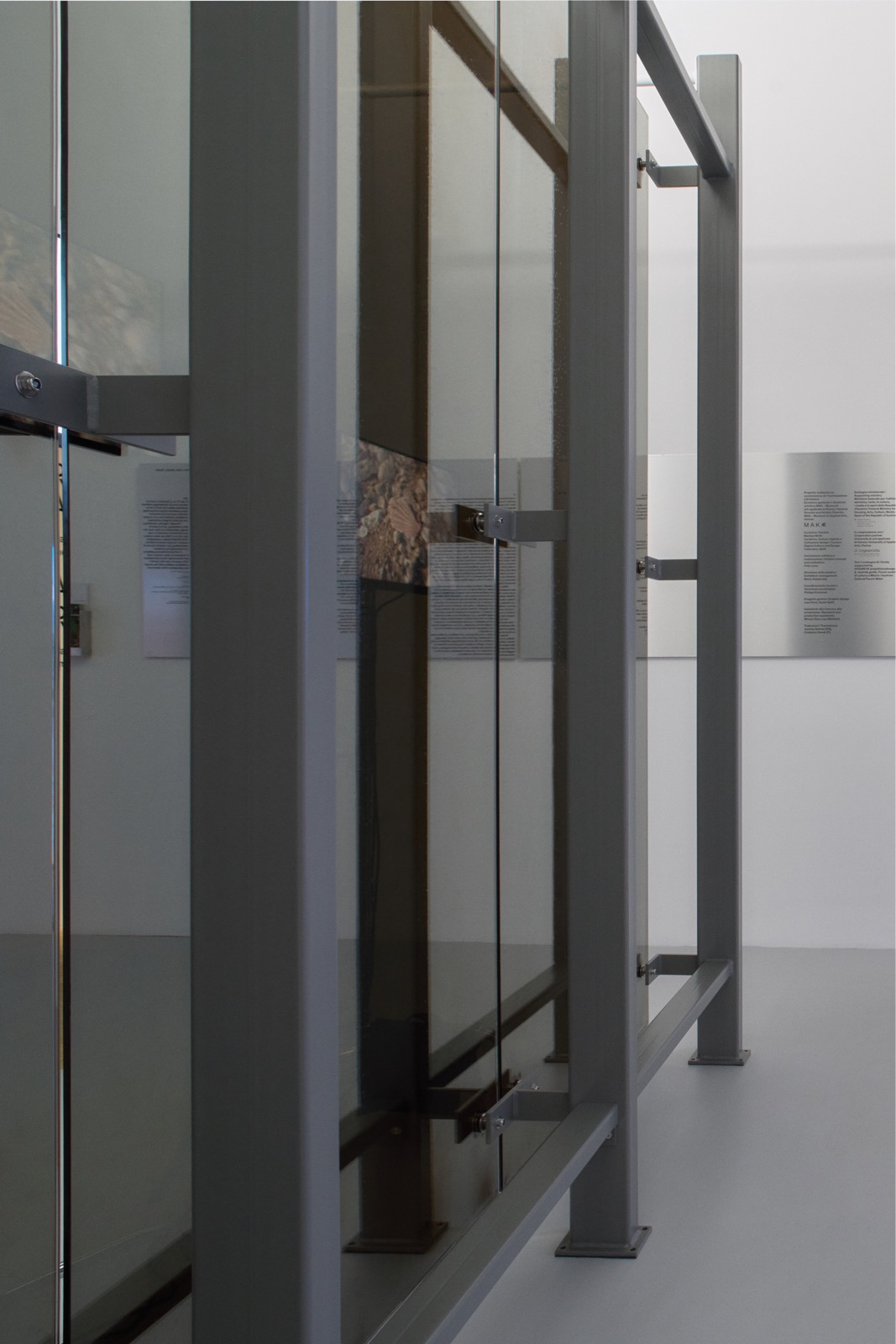
Once inside, the 2.5 by 3m glass wall transforms from mirror to window, revealing what the screens are showing. The visual depictions are laid bare, and all screens offer the viewer insights into the finicky reality of our information technologies. This setup exposes the intricate relationship of corporate entities with their users and the natural resources they rely on. What emerges from the interplay of mirrors and polarised images, is a dialogue that eschews egalitarian ideals and confronts us with the reality of highly filtered and orchestrated flows of information as they are present in on- and offline exchanges with digital technologies and the wider systems that constitute and enable them.
---
## Custom Media Control
The success of the three-channel installation hinges on the simultaneous playback of three streams of video. To achieve maximum accuracy, a custom media solution was designed, running on a synchronisation-script that continuously observes and matches the timecodes of the three players using GPIO-Signals.
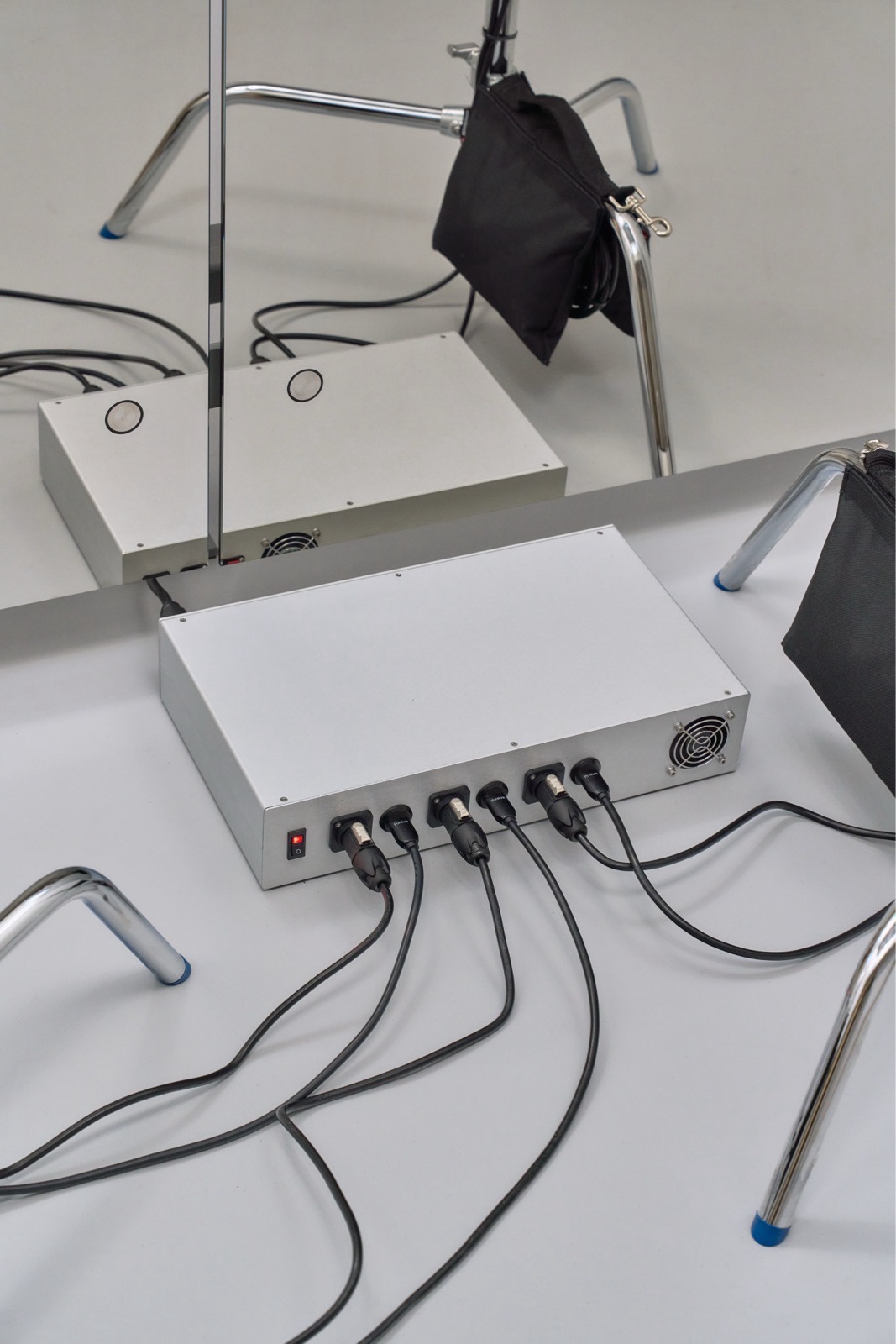
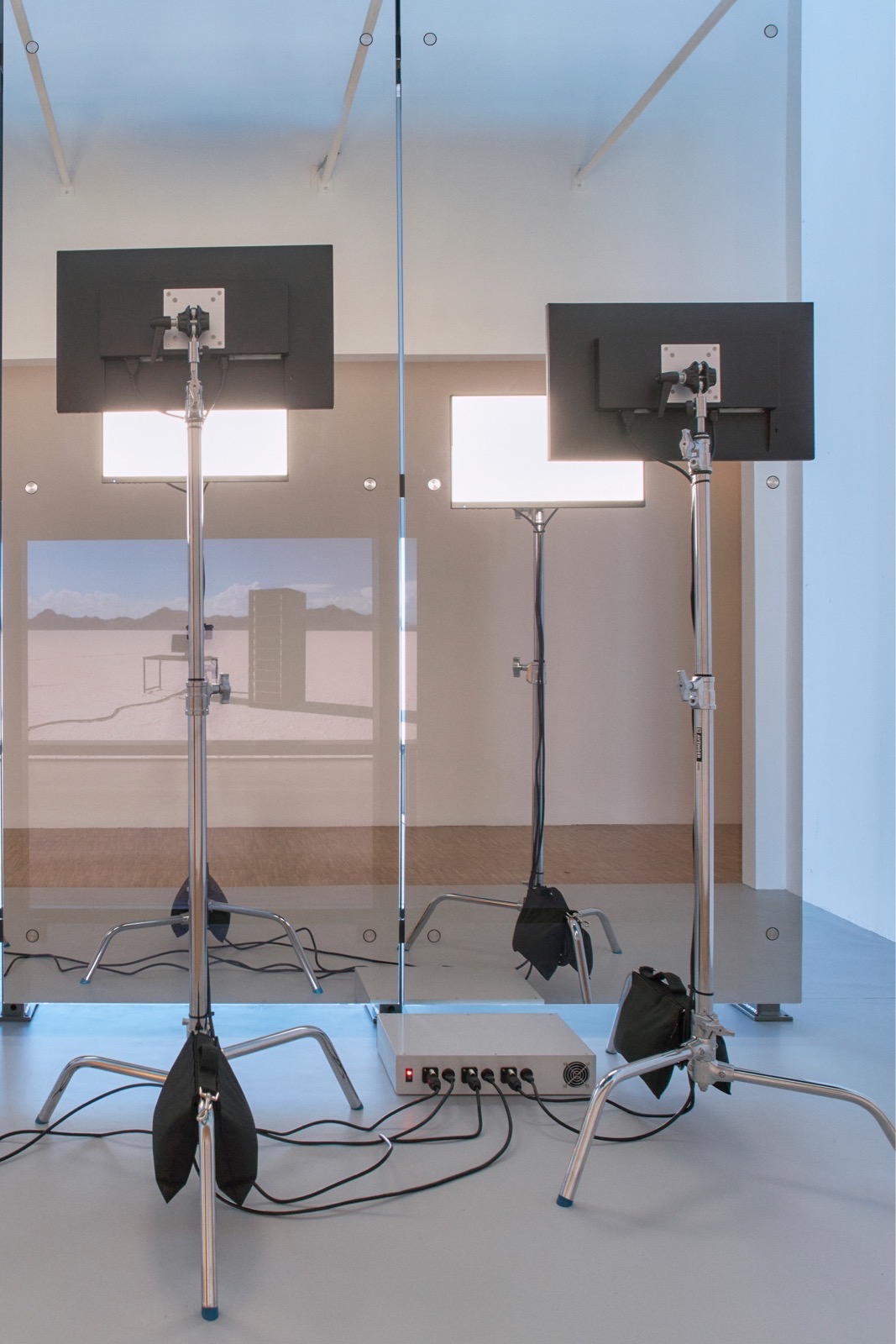
To match the reduced and utilitarian aesthetics of the rest of the exhibition, we designed a custom media box that would house the computational components, as well as affording space for the basic technical requirements of the three screens; a power source and an HDMI signal. Once again, technological complexity is hidden within a sleek, impenetrable mask, granting the work the magical illusion of simplicity so often appropriated within silicon valley’s prerogatives and products.
## Credits
2025 Triennale di Milano, Austrian Pavilion, commissioned by the Museum of Applied Art in Vienna (MAK), curated by Marlies Wirth.
Project lead: Felix Lenz.
Set production and design in close collaboration with Miriam Daxl and Selma Mühlbauer.
In collaboration with Wunderwerk.
---
# Liminal Cycles
Canonical URL: https://leomuehlfeld.at/en/liminal-cycles
---
title: 'Liminal Cycles'
for: 'Crafting Plastics Studio'
category: 'Exhibition & Installation'
metaDesc: 'Developing audiovisual interaction systems for sculptural installations at Miami Art Week 2024.'
thumbnail: /img/lc01_comp.jpeg
date: '2024-12-02T00:00'
showOnLanding: true
heroImage: /img/lc01_comp.jpeg
imageCredit: Steve Benisty
collab: Lucy Li
---
# Liminal C ycles
## Developing audiovisual interaction systems for sculptural installations at Miami Art Week 2024.
## Liminal Cycles
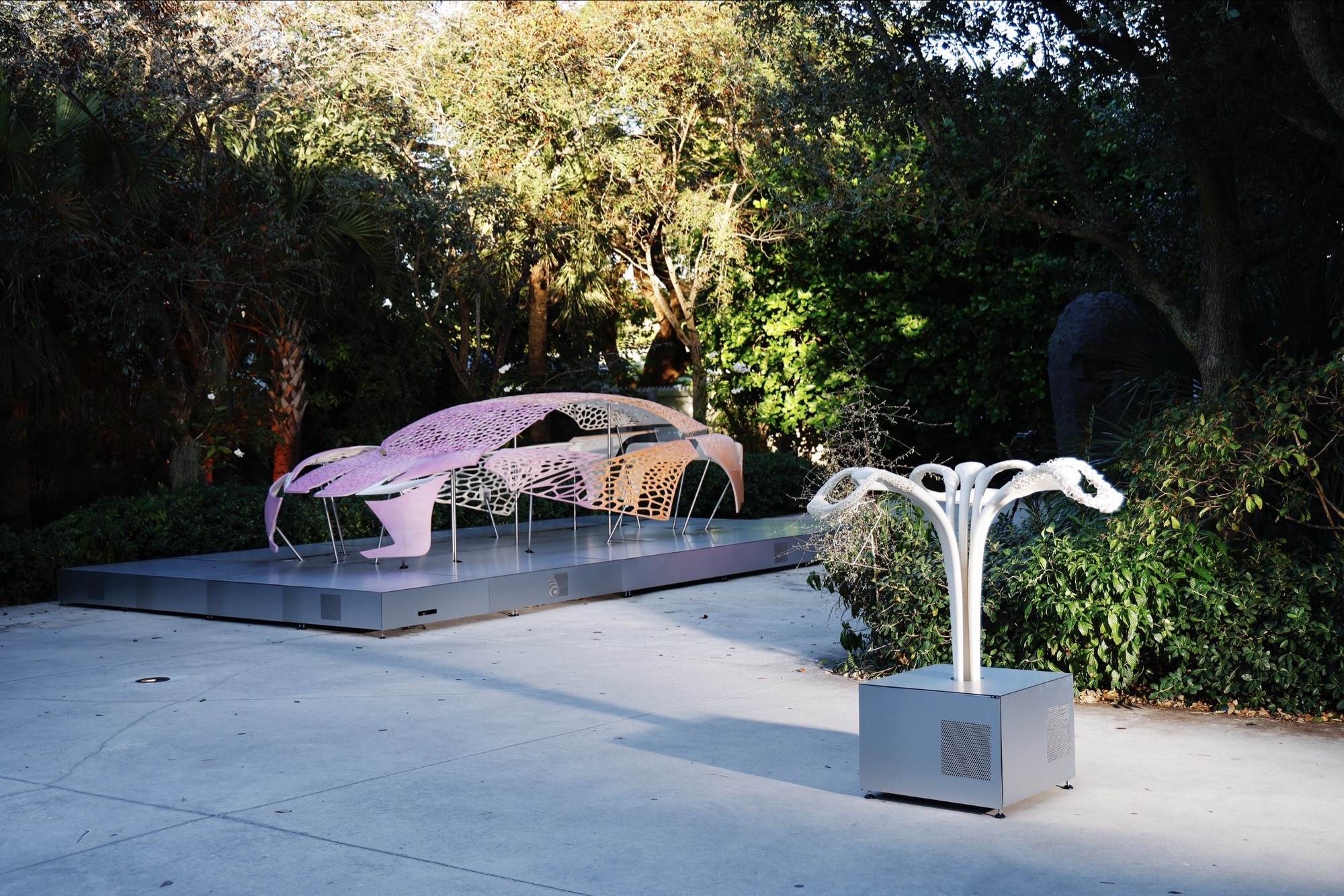
Invited by Crafting Plastics, an innovative Slovak design studio, Lucy Li and I collaborated on the development and integration of sensory units into The Steering Wheel — a sculptural work designed and fabricated by Crafting Plastics to engage visitors at the Institute of Contemporary Art, Miami during Miami Art Week 2024.
Presented within the exhibition Liminal Cycles, curated by Lexus, the project explored the future of mobility through regenerative materials and embodied, sensory modes of interaction and transportation.
## Tangible Futures
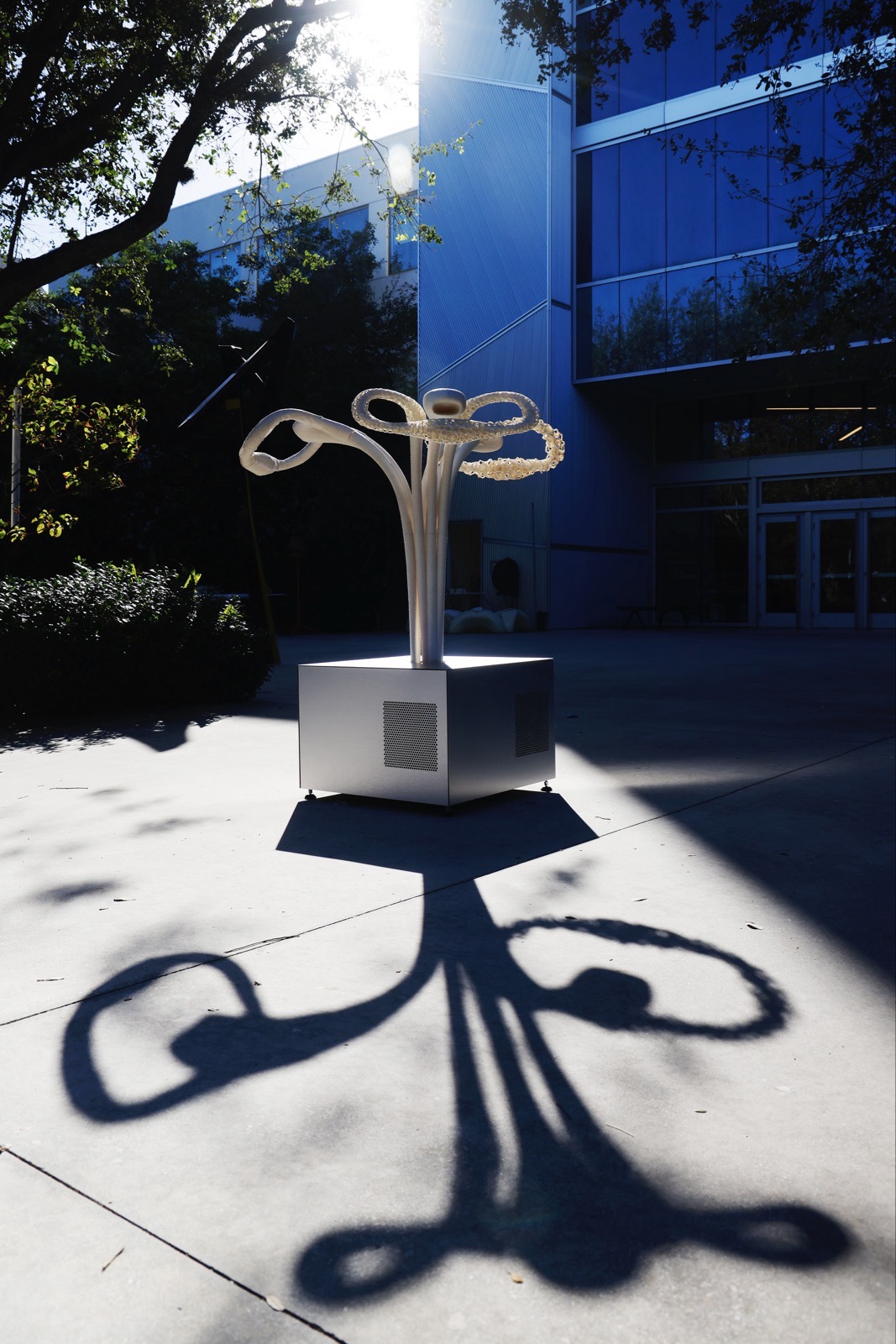
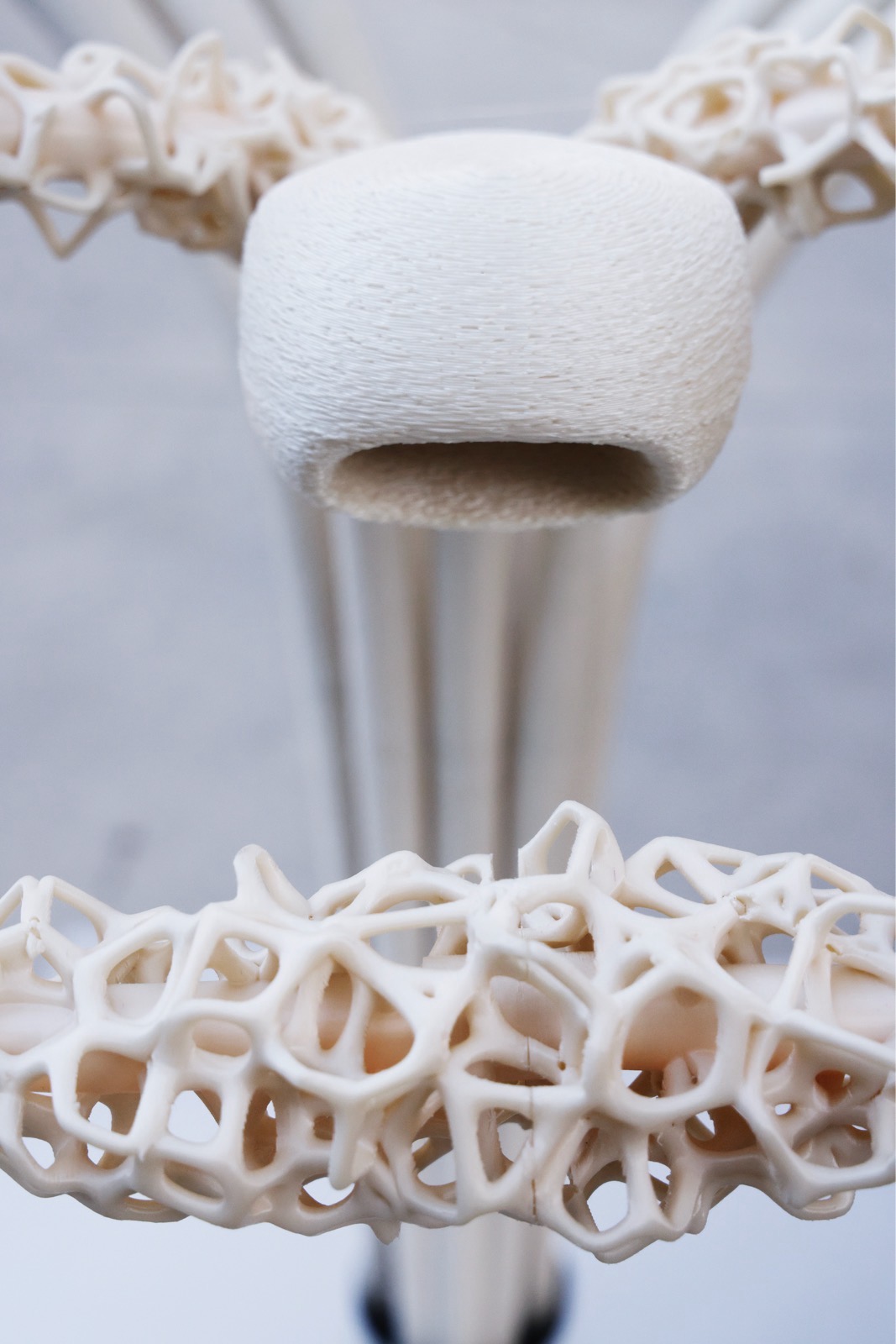
The three objects we contributed to, referenced both the futuristic aesthetic of yoke steering wheels, as well as the natural beauty of flower petals. In the installation they were used as a point of interaction and dialogue between visitors of the ICA Miami and the “breathing car” — a 3D-printed model of a visionary Lexus vehicle, made from “Nuatan” bioplastic, Crafting Plastics' very own sustainable thermoplastic material.
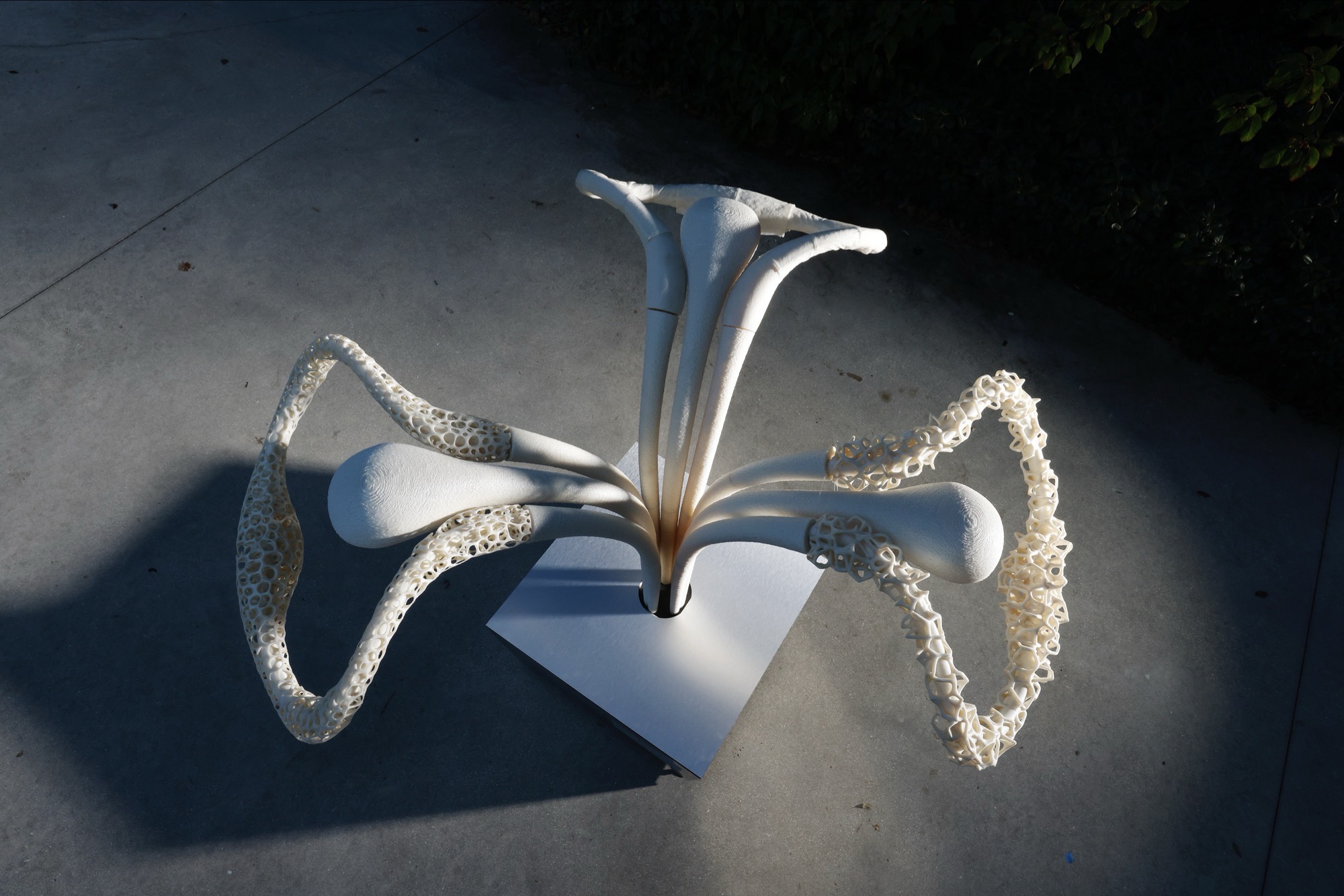
The general goal of the show was to communicate the emotional and sensorial aspects of mobility, circular systems and moments of transition experienced in our shift towards greener and more immersive forms of transportation.
This is where Lucy Li and I stepped in to conceptualise, envision and build the interactive elements accompanying the main piece.
---
## Functionality
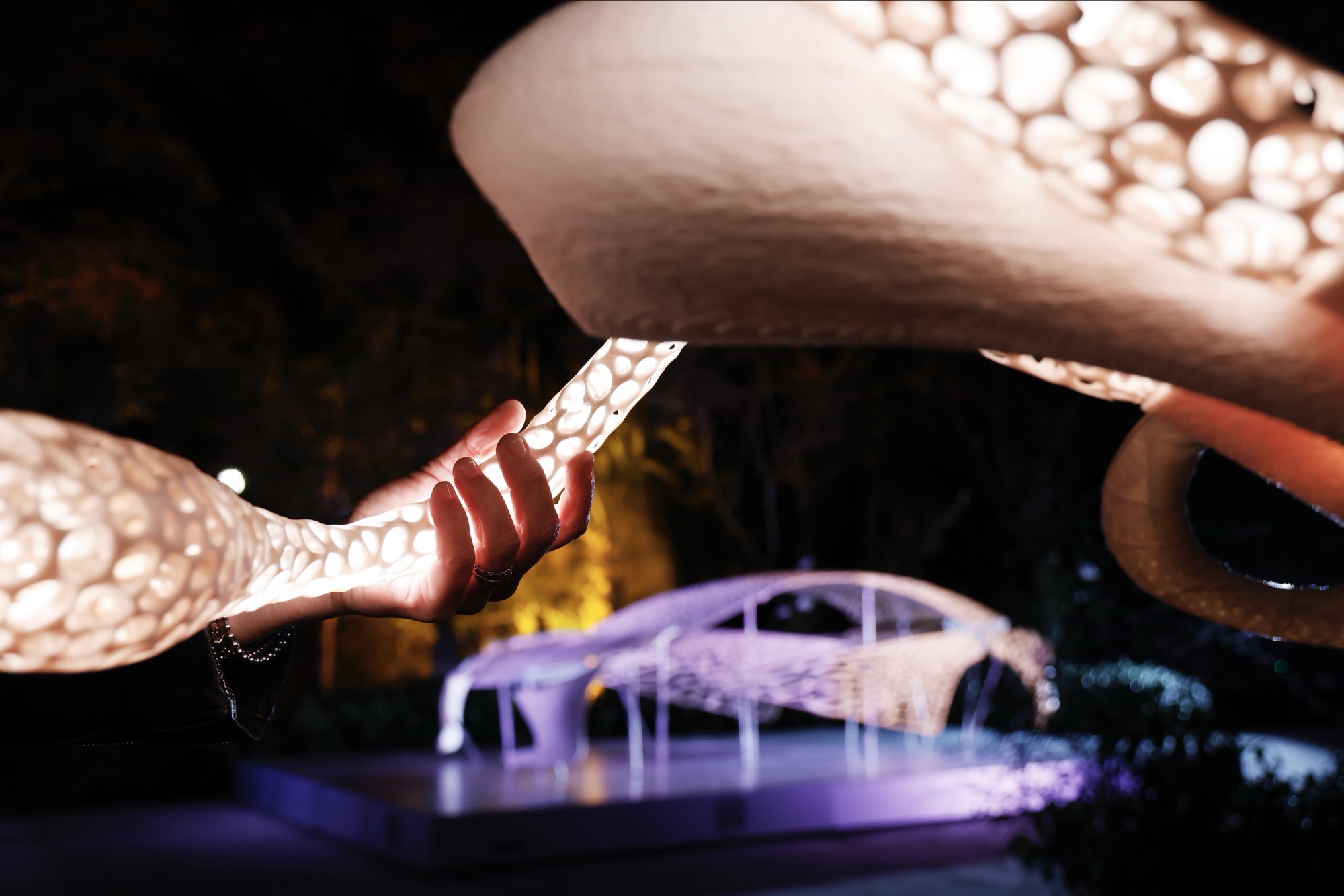
Our contribution focused on the design and integration of interactive systems into three sculptural objects developed by Crafting Plastics. These components enabled direct feedback and exchange between the breathing car and visitors. The car model reacted to people approaching and interacting physically with the sculptures—subtly altering its breathing rhythm and soundscape. We aimed on an approach that supported a genuine sense of immersion and responsiveness within the installation.
## The Hidden Hardware
To make the steering wheels susceptible to peoples’ proximity and touch, we implemented capacitive sensors. Like the touch sensors in modern touch screens, but multitudes more sensitive. They can register minute changes in the electromagnetic field surrounding them. Each steering wheel had an inlaid copper wire that was acting as the capacitive sensor. This setup enabled the entire exhibition to respond to the visitors in a smooth manner by quantifying proximity as well as touch.
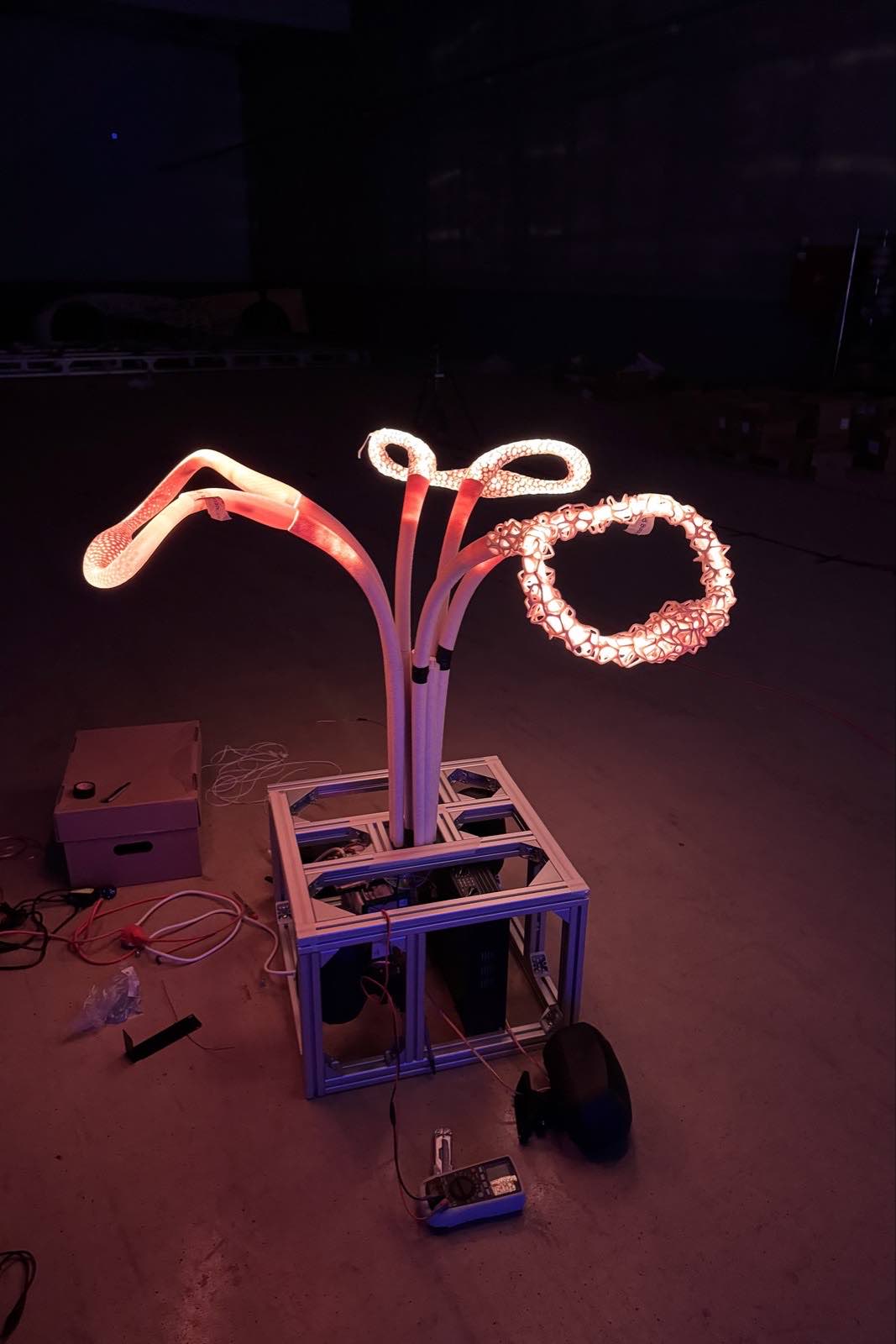

The installation’s feedback consisted of change in lighting of the steering wheel, organic remodulation of the soundscape as well as the “Breathing Car” adapting its movement by receviing our proximity data via radio link. By enabling interaction with the steering wheels in these physical and organic ways, we were able to capture the main premises of Lexus' vision for mobility, making it tangible, engaging and effective within an exhibition context.
---
## Credits
Design & Lead: Crafting Plastics Studio for Lexus at Miami Art Week 2024
Electronics & Code: Lucy Li, Leo Mühlfeld. Integration: Mario Coufal (CPS), Juraj Olejár (CPS), Lucy Li, Leo Mühlfeld
---
# Blockchain Unchained
Canonical URL: https://leomuehlfeld.at/en/blockchain-unchained
---
title: 'Blockchain Unchained'
for: 'MAK Vienna'
category: 'Exhibition & Installation'
metaDesc: 'Crafting a playful exhibition exploring DAOs, Blockchain, and the future of decentralization at the MAK Vienna.'
thumbnail: /img/7_MAK_Ausstellungsansicht_2024_comp.jpeg
date: '2024-11-19T00:00'
showOnLanding: true
heroImage: /img/11_MAK_Ausstellungsansicht_2024_comp.jpeg
collab: Katja Krug, Max Kure & Anton Posch
imageCredit: MAK/Stella Riessland
---
# Blockchain: Unchained
## Crafting a playful exhibition exploring DAOs, Blockchain, and the future of decentralization at the MAK Vienna.
## New Tools for Democracy
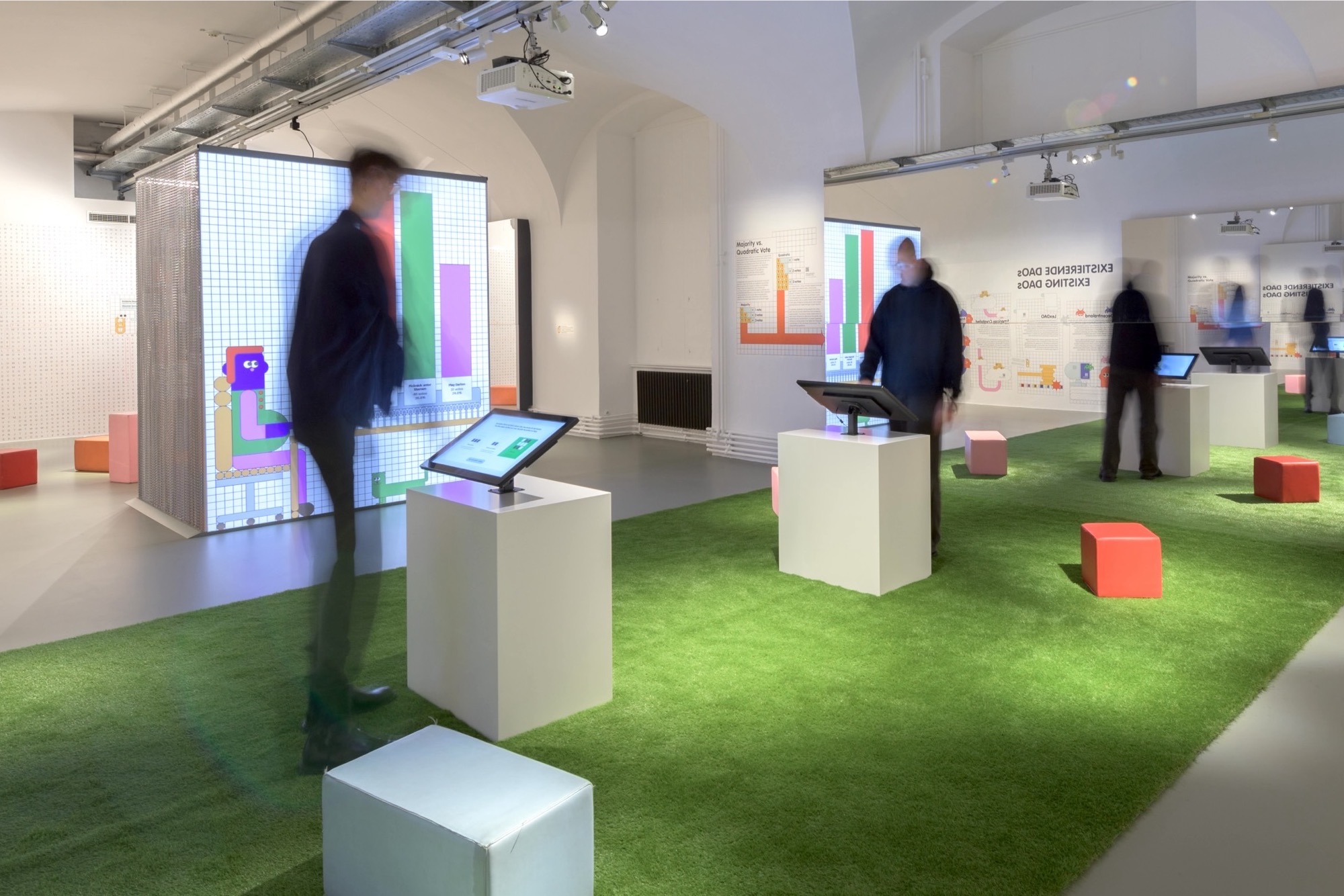
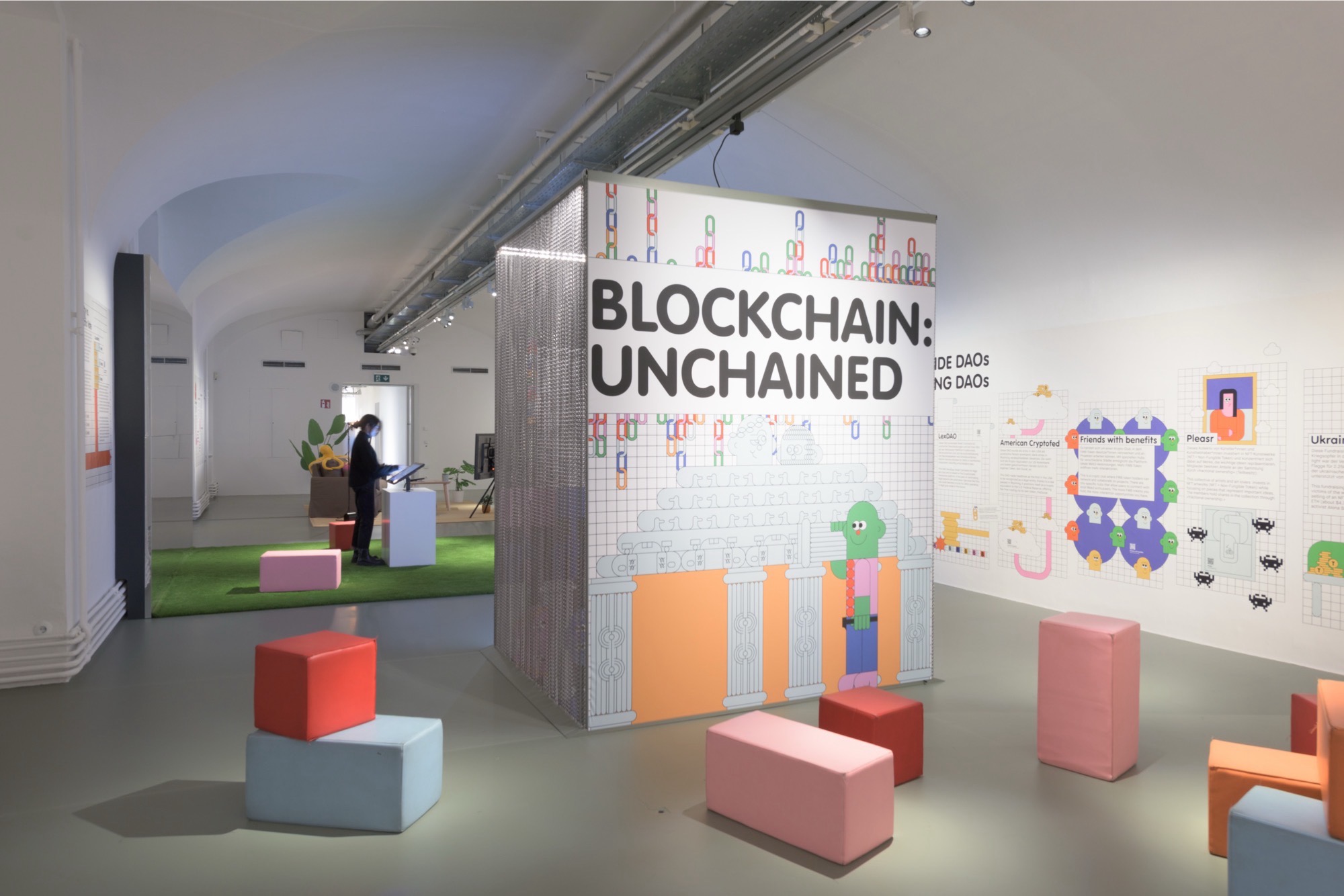
Blockchain:Unchained, New Tools for Democracy invites you to explore and experiment with design strategies and new technologies as tools for democratic participation in an interactive and playful way.
As the design collective [Gemeinde-Bau](https://gemeindebau.im){target=_blank} (Katja-Anna Krug, Max Kure, Leo Mühlfeld, Anton Posch) we demonstrate how blockchain technology and decentralized autonomous organizations (DAOs) can be applied to diverse areas to envision the future—whether in a private shared living arrangement, for public use of a museum garden, or as a tool for open discourse.
The exhibition employs interactive elements and visual storytelling to promote a new understanding of designing democratic decision-making processes while making complex topics like blockchain and DAOs accessible and tangible. At its core is the question of how digital tools can be used to activate participation within museums—especially the MAK—and beyond. Visitors are invited to collaboratively develop ideas for decentralized co-creation, experiment with speculative approaches, and discuss the opportunities and challenges of digital tools.
---
## Designing a Playground
When designing this exhibition, we envisioned dividing the space into stations that build upon one another conceptually. The journey begins by contextualizing DAOs and blockchain as one of many "Tools for Democracy," placing them alongside innovations such as the printing press, protests, and the internet. As visitors progress, they are invited to engage interactively, exploring whether and how this tool can be useful—or even revolutionary—in democratic processes. To facilitate this exploration, we developed three interactive stations…
---
## 1. Smart Contracts
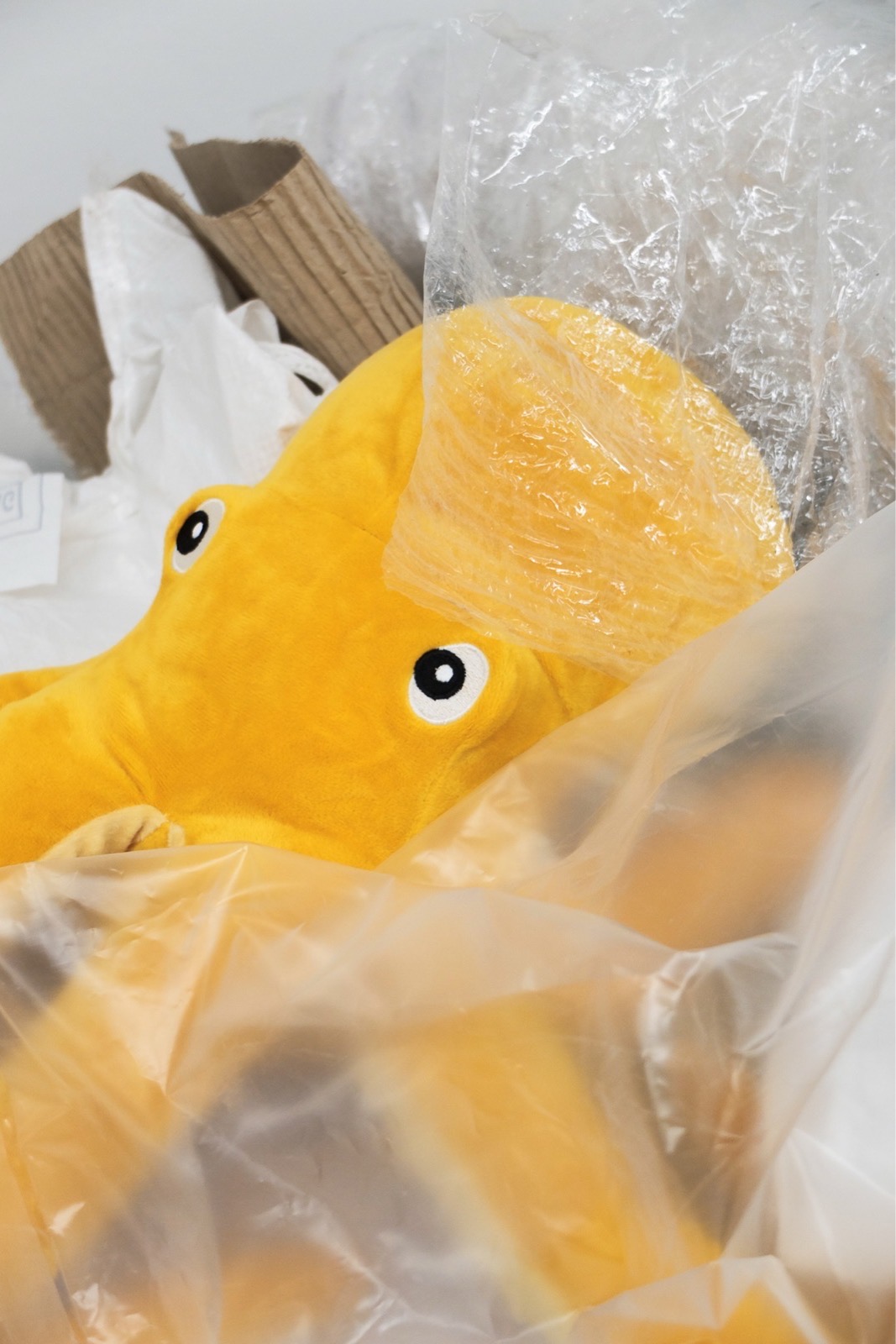
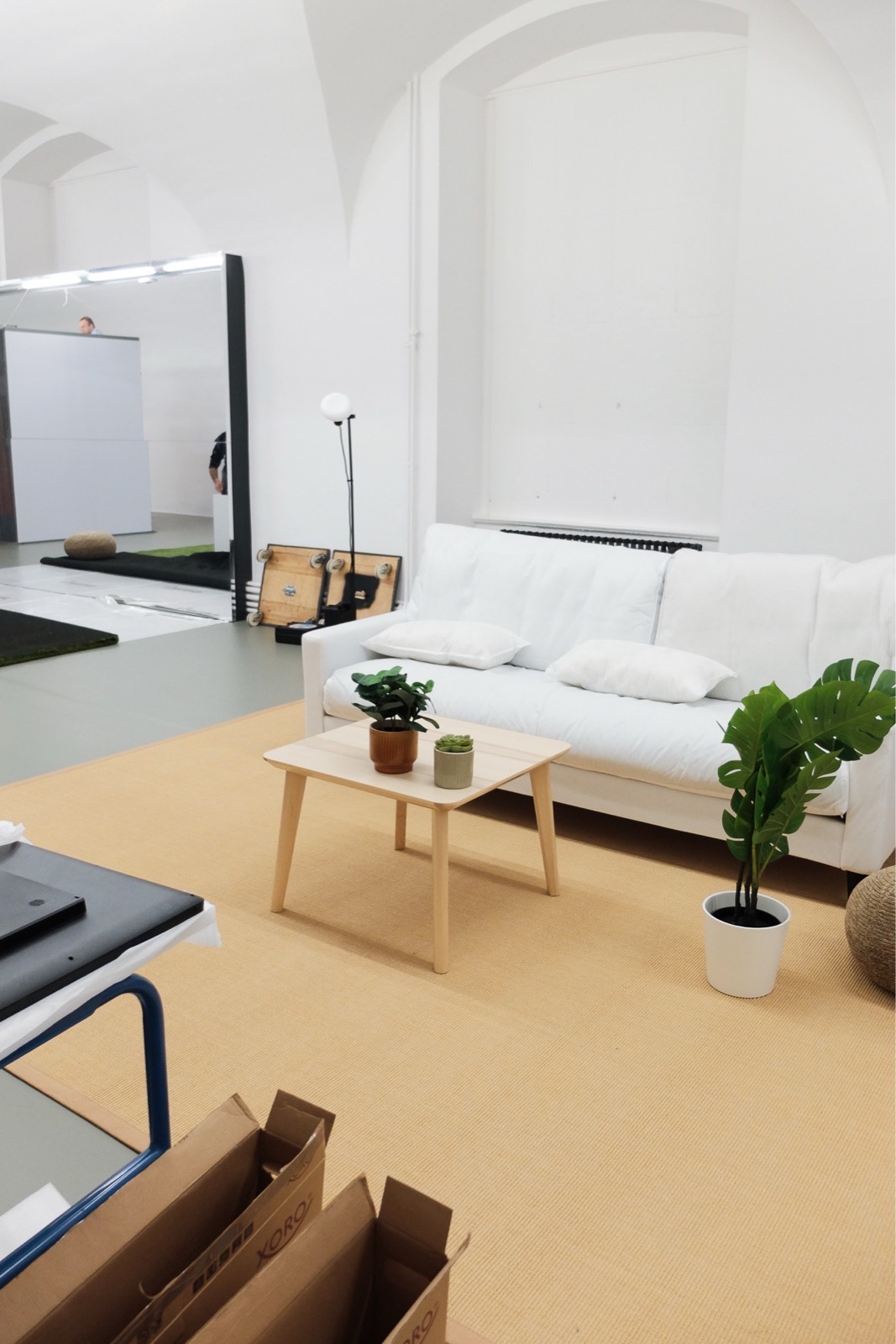
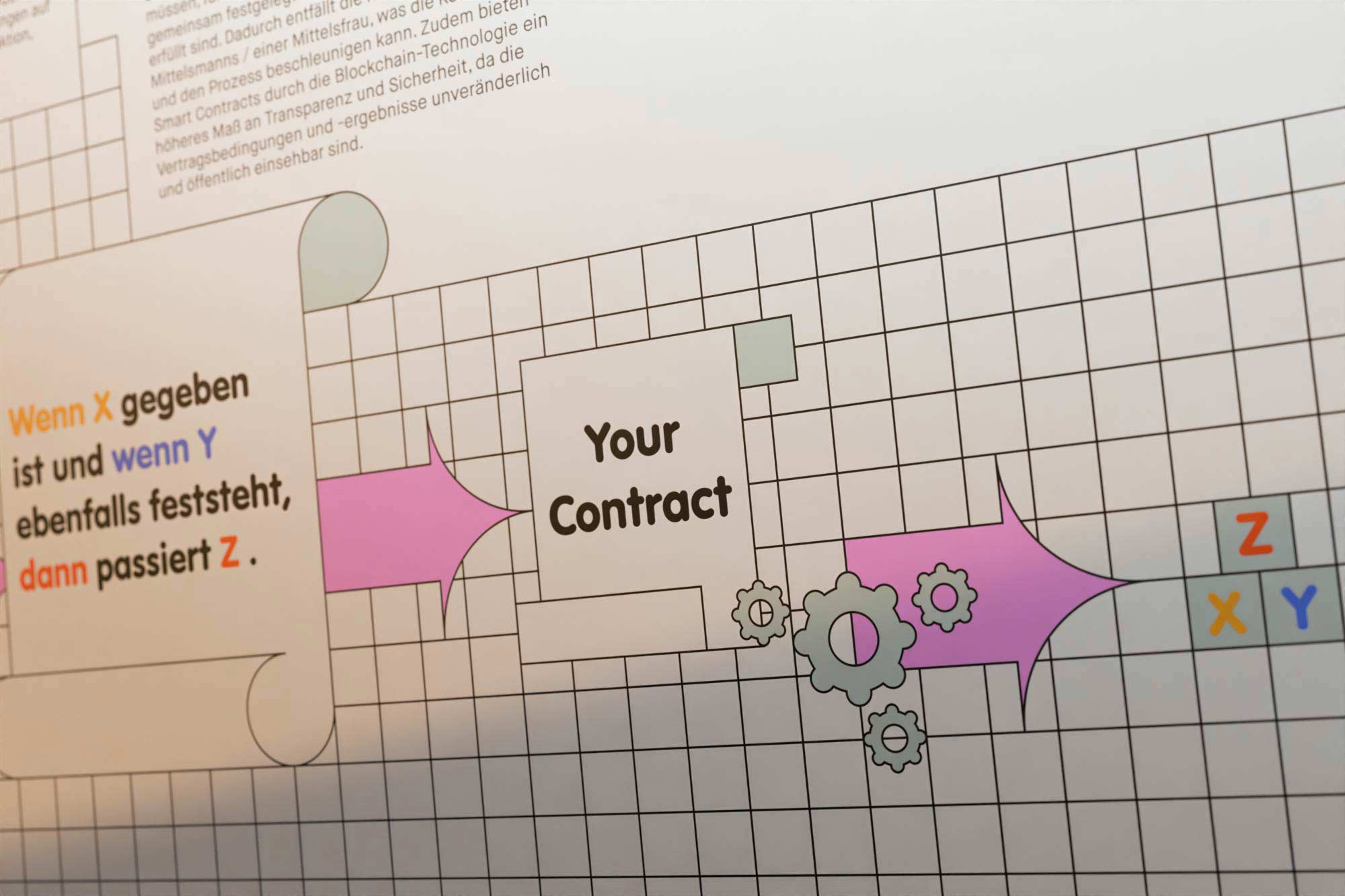
The first station, titled "Smart Contracts," bridges the gap between democratic processes and DAOs (decentralized autonomous organizations). To illustrate this, we drew upon a democratic process that occurs privately and is familiar to everyone in some form: managing one's own home. Visitors find themselves in a recreated "living room" setting. Surrounded by plants, cozy cushions, and a sofa, a tablet on a coffee table introduces the concept of smart contracts—code-based agreements stored on the blockchain that execute predefined actions (IF, WHEN, THEN) automatically once conditions are met.
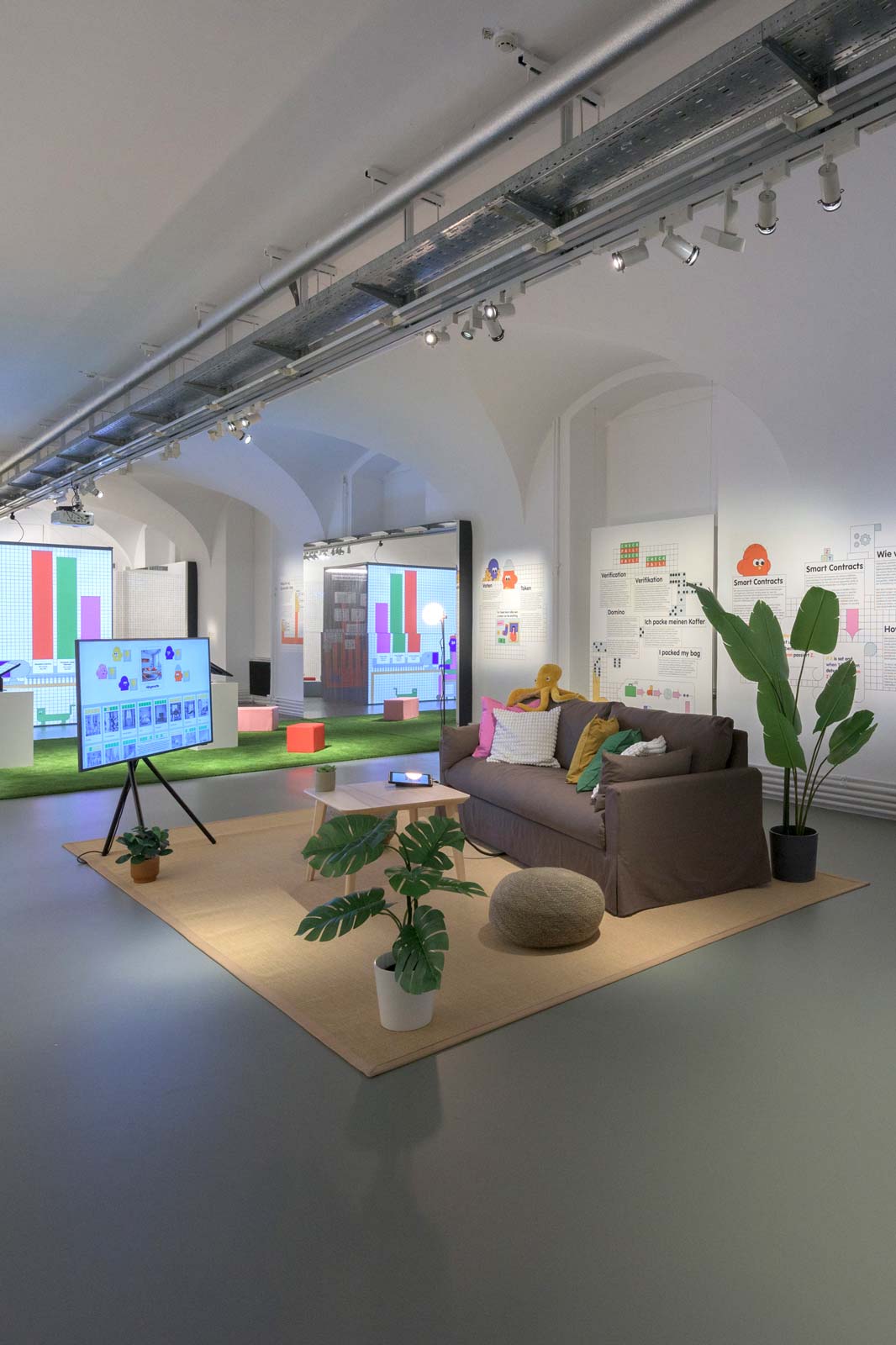
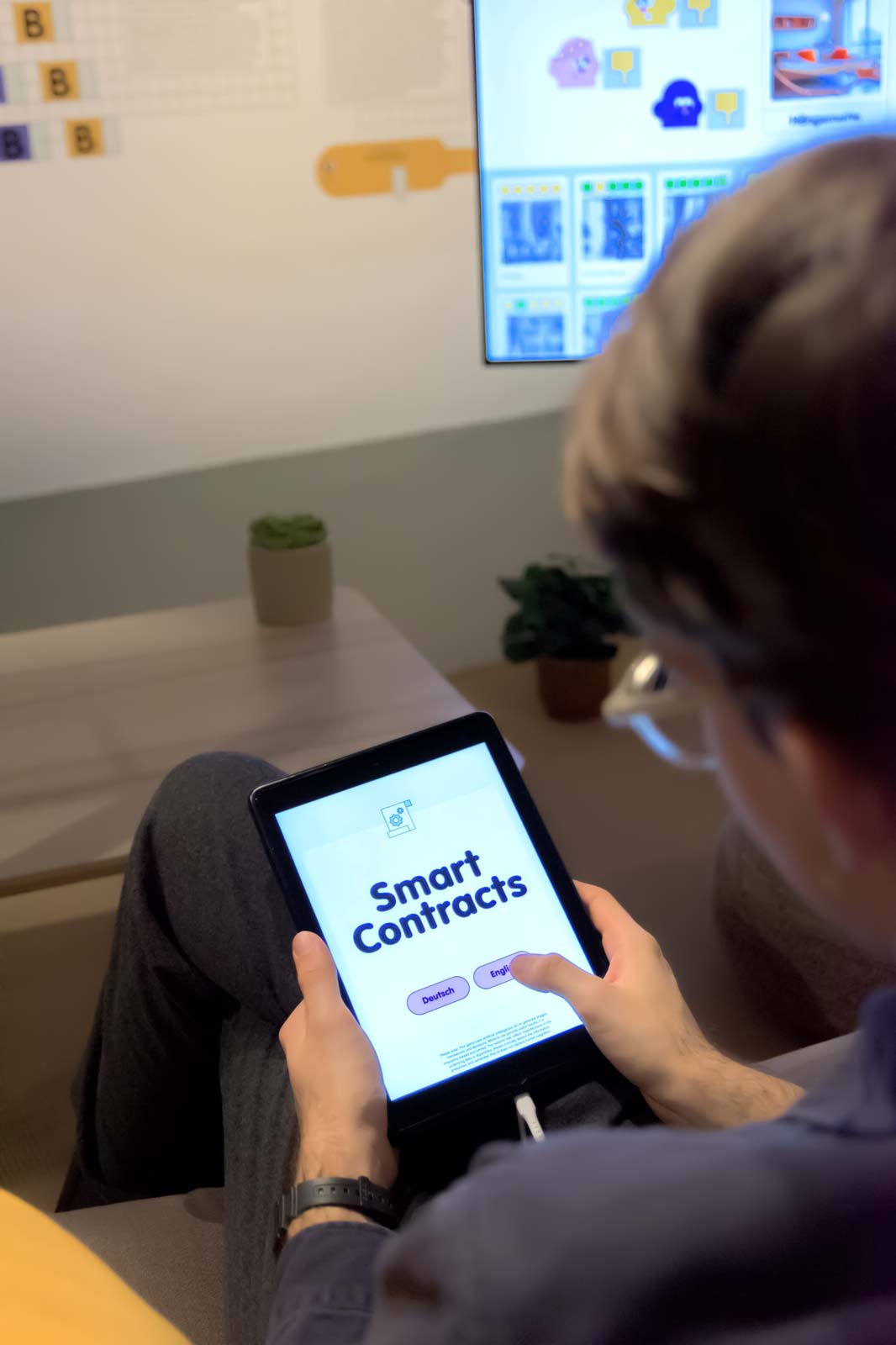
Visitors are invited to propose the purchase of new furniture for the fictional apartment. A custom-developed AI-powered application simulates a voting process involving five virtual roommates, taking predefined conditions into account. The results of the vote are displayed in a visually engaging way on the living room's television.
---
## 2. Vote on the Blockchain
Building on the knowledge gained in the first station, the focus now shifts to the underlying blockchain technology. It was important to us to create a voting scenario based on a real-life context. This naturally involves complex questions of responsibility and accountability, which led us to the following collaboration with the MAK (Museum of Applied Arts).
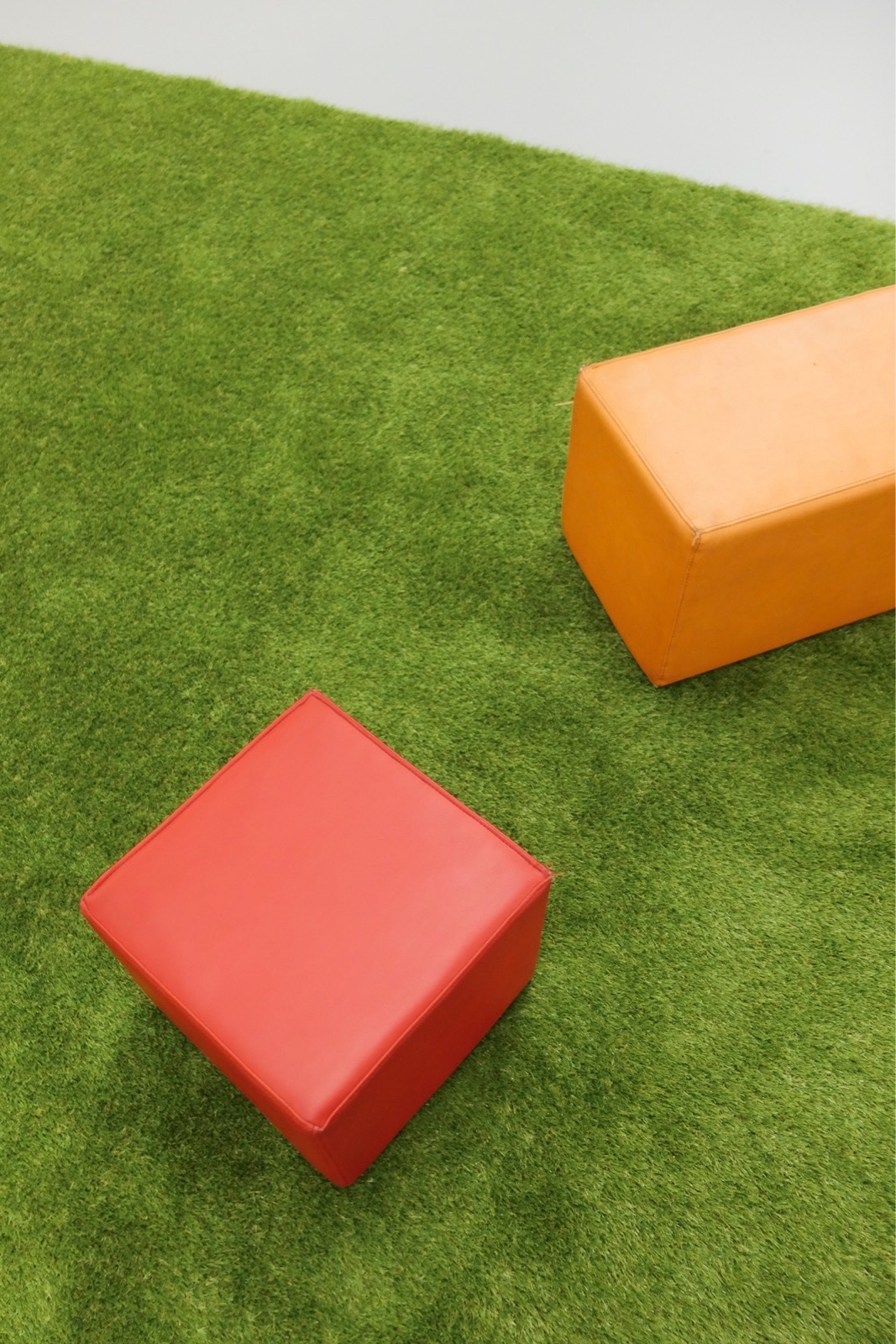
Three proposals for the use of the MAK Garden—a semi-public outdoor space shared and managed by three stakeholders—were pre-evaluated for feasibility and presented as options at this interactive station. Visitors, standing on artificial grass to simulate the outdoor setting, are required to pair up with another person to participate in the decision-making process.

Once paired, participants position themselves at two separate tablets. Together, they select one of the three options and log it in. Player A is then tasked with communicating a randomly generated pattern to Player B. Without being able to see each other’s screens, Player B must recreate the pattern. If the recreated pattern matches the original, the vote is counted!
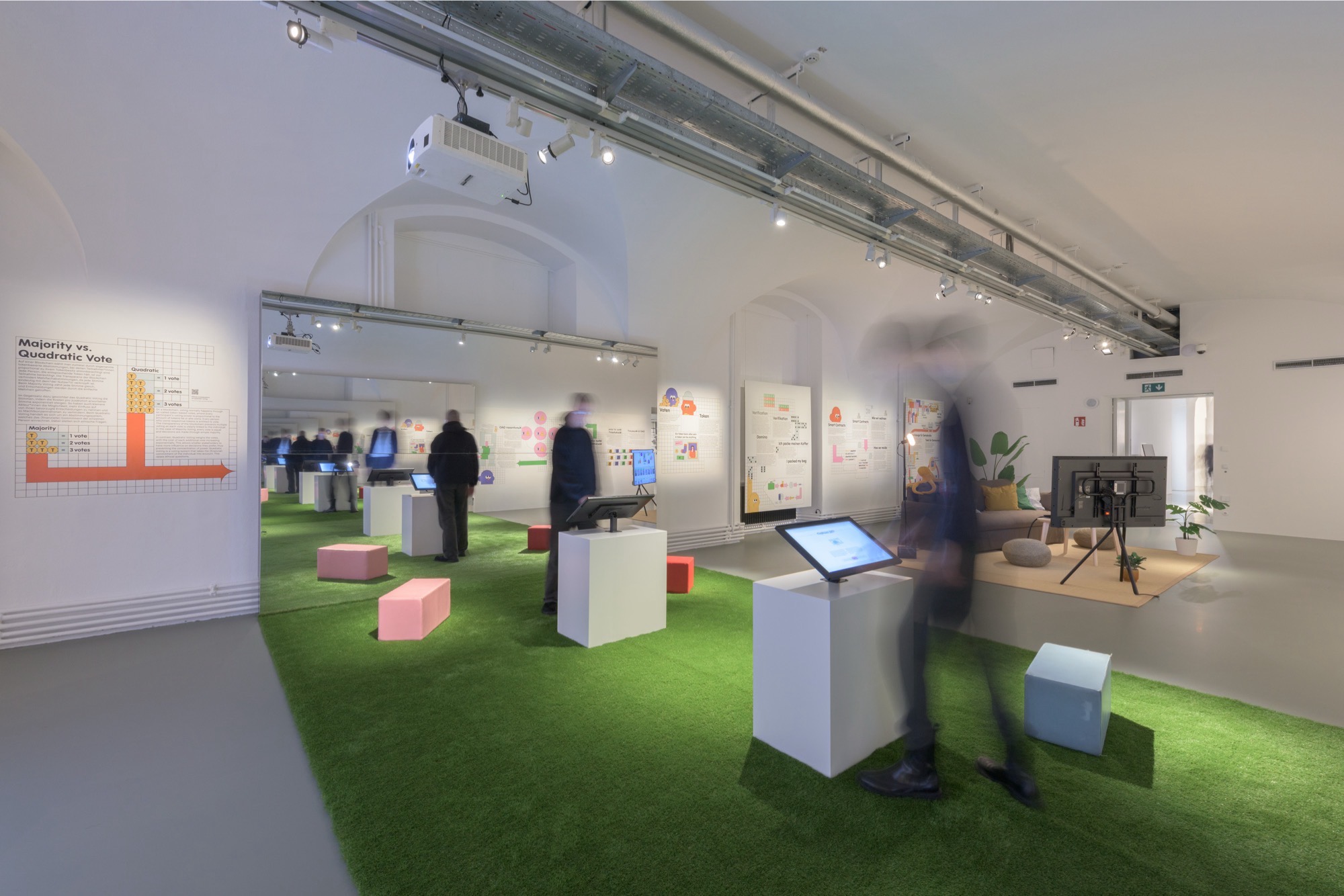
This game serves as a highly abstracted demonstration of how a hash— a unique checksum—functions. For any change to be validated, the hash must be verified across multiple instances (over 50%). As a spatial element, two massive mirrored walls are positioned to reflect the two "blocks" of the "blockchain" into infinity, evoking the sense of an interconnected and vast system.
---
## 3. Plenary
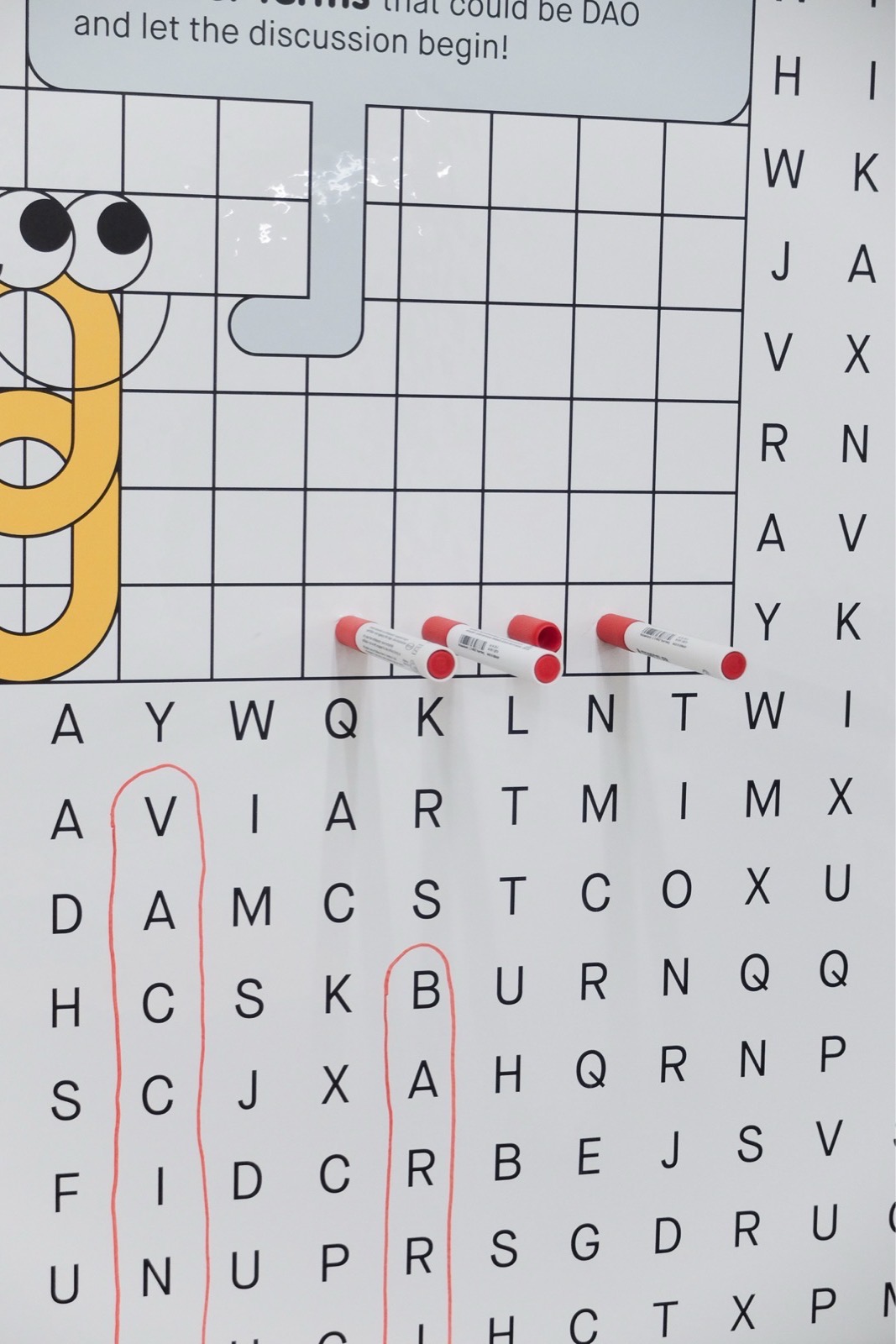
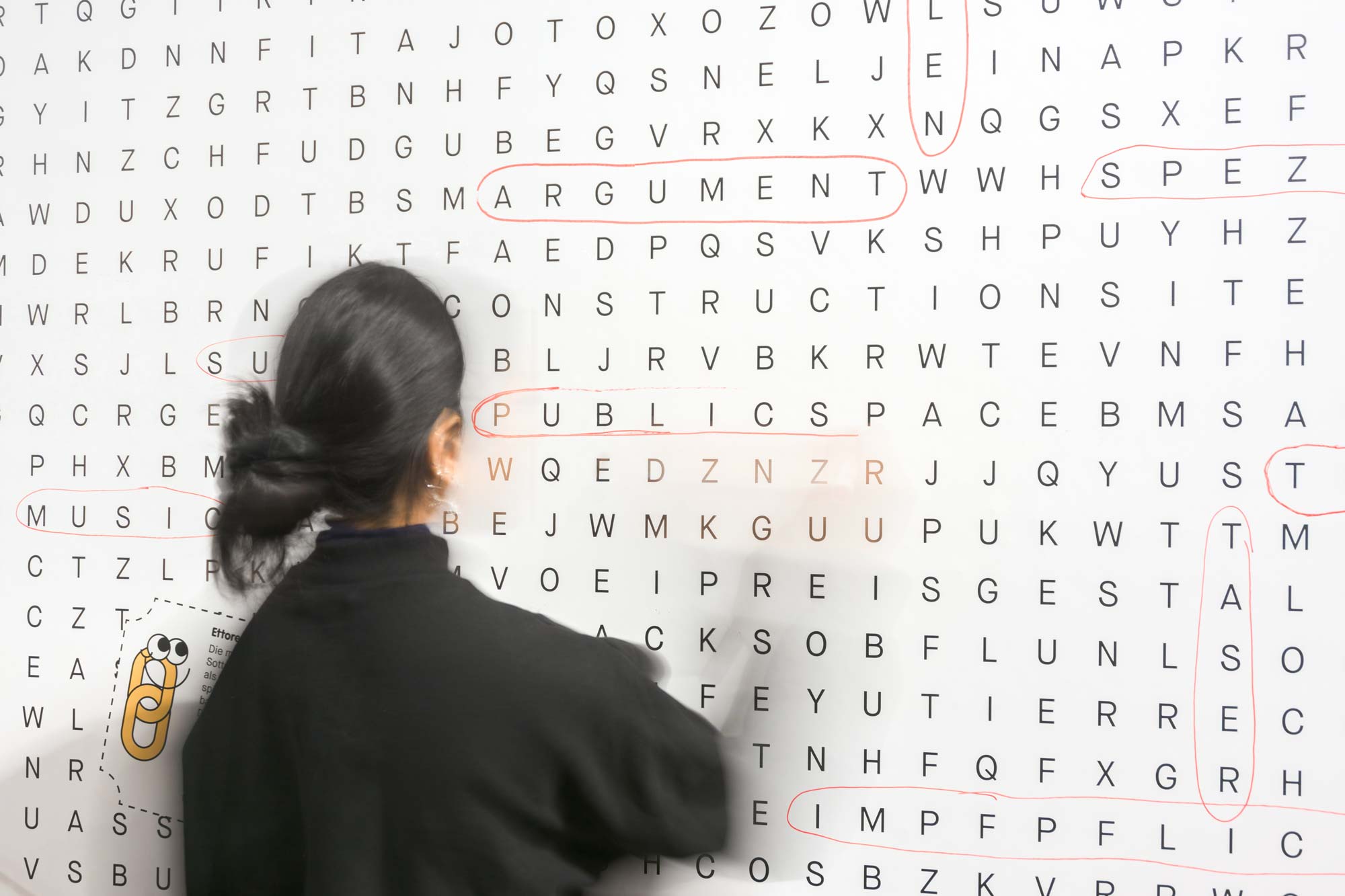
With a foundational understanding of DAOs and blockchain now established, visitors are invited to participate in a plenary discussion on the potential applications, benefits, and drawbacks of this technology. A "word wall" serves as a conversation starter, featuring over 6,000 letters arranged to reveal up to 300 words. These words range from those directly related to blockchain to others that may seem unrelated at first glance.
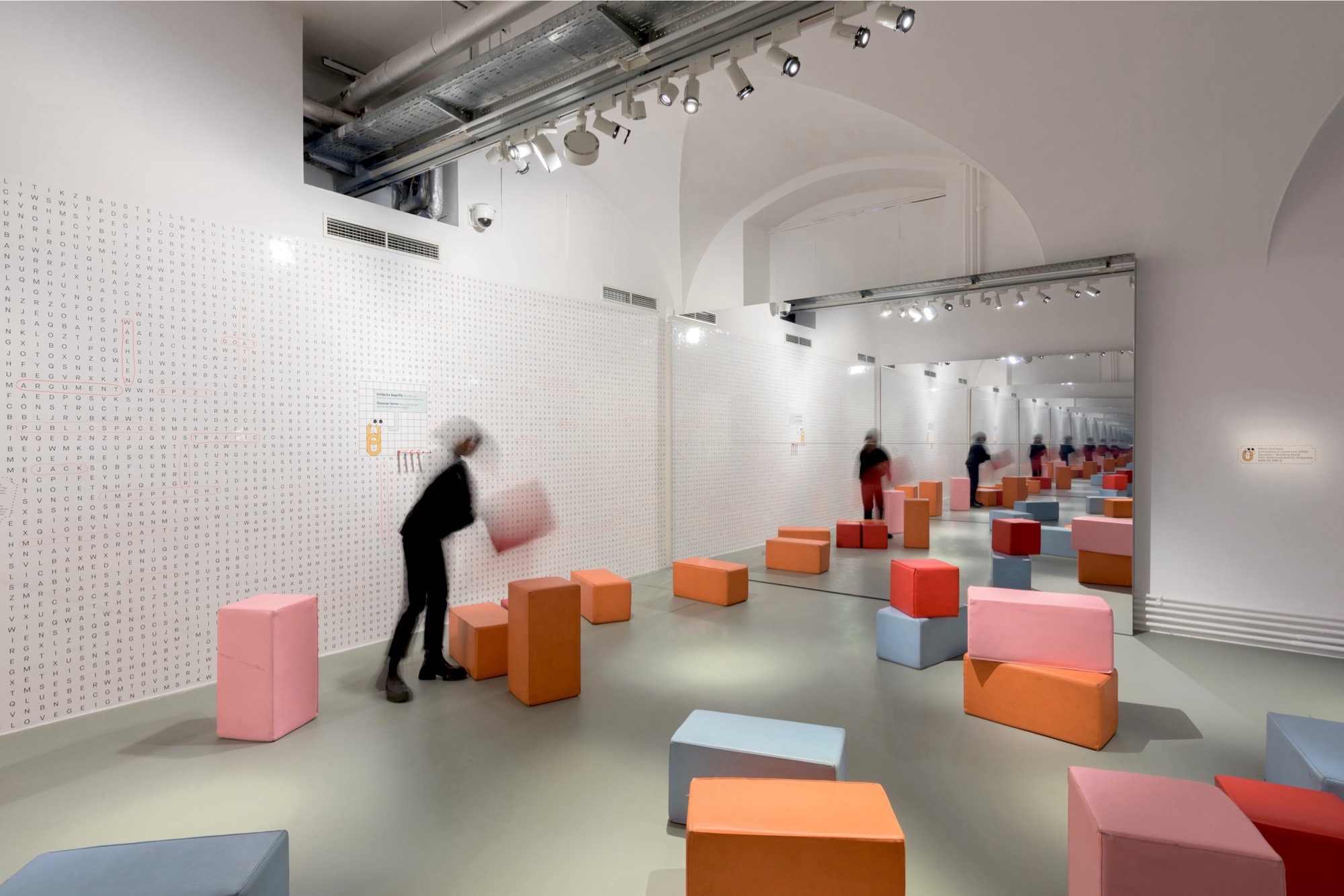
During workshops or guided tours, the collaborative process of discovering these words is designed to spark meaningful discourse. This section of the space is furnished with the exhibition's sole tangible artifact: freely rearrangeable seating blocks by designer Ettore Sottsass, encouraging both flexibility and creativity in group discussions.
---
## Illustrations
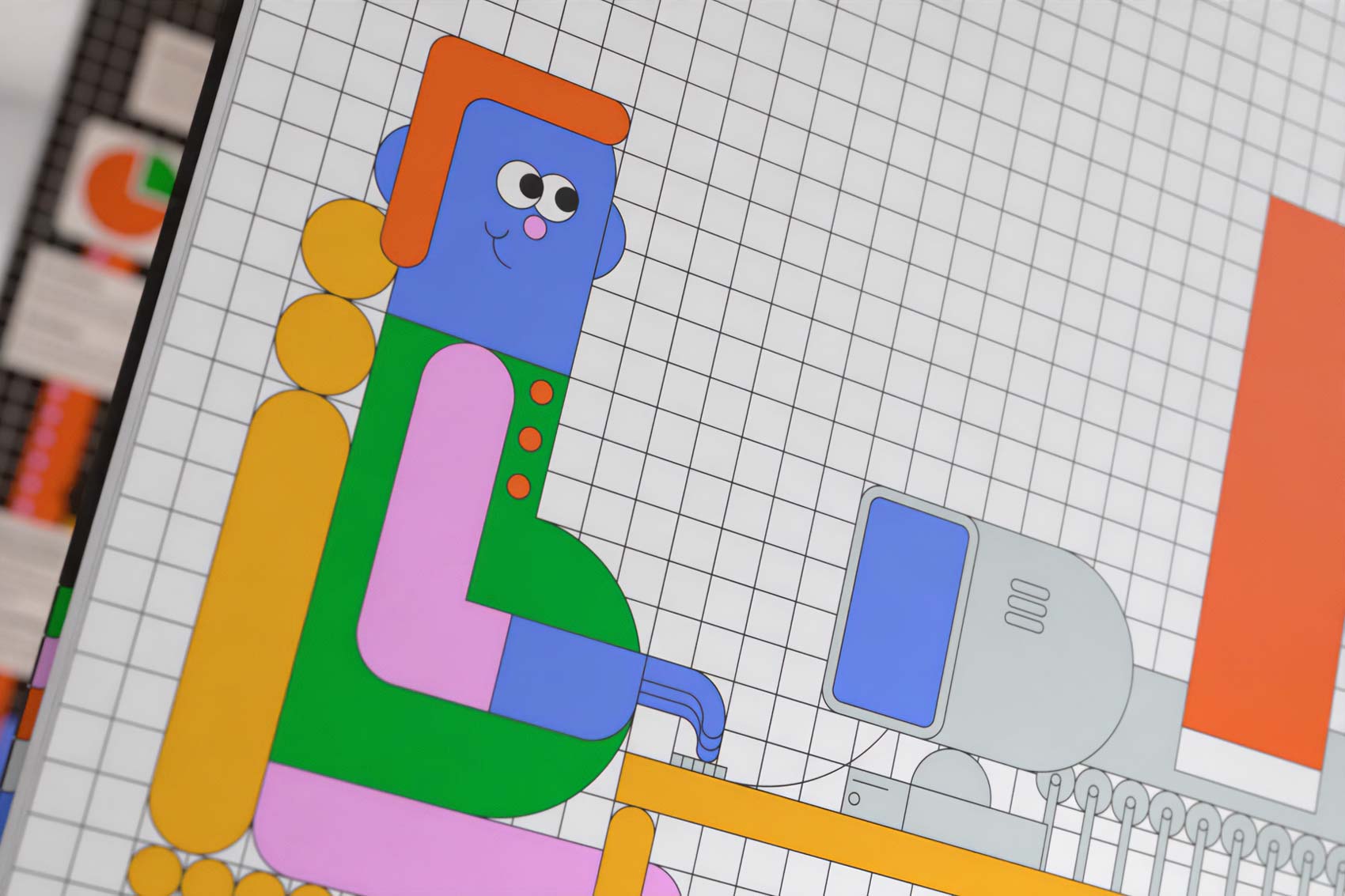
The interactive experience is complemented by thoughtfully designed illustrations and graphics displayed on the walls. These visuals provide an accessible overview of the topics covered, presented in a cascading level of detail. For instance, they explain voting mechanisms and the role of tokens, as well as draw playful connections, like how dominoes relate to blockchain.
Additionally, the exhibit introduces existing DAOs and showcases some of their real-world implications, including the humorous results of letting the internet name a boat.[^1]
## What's the catch?
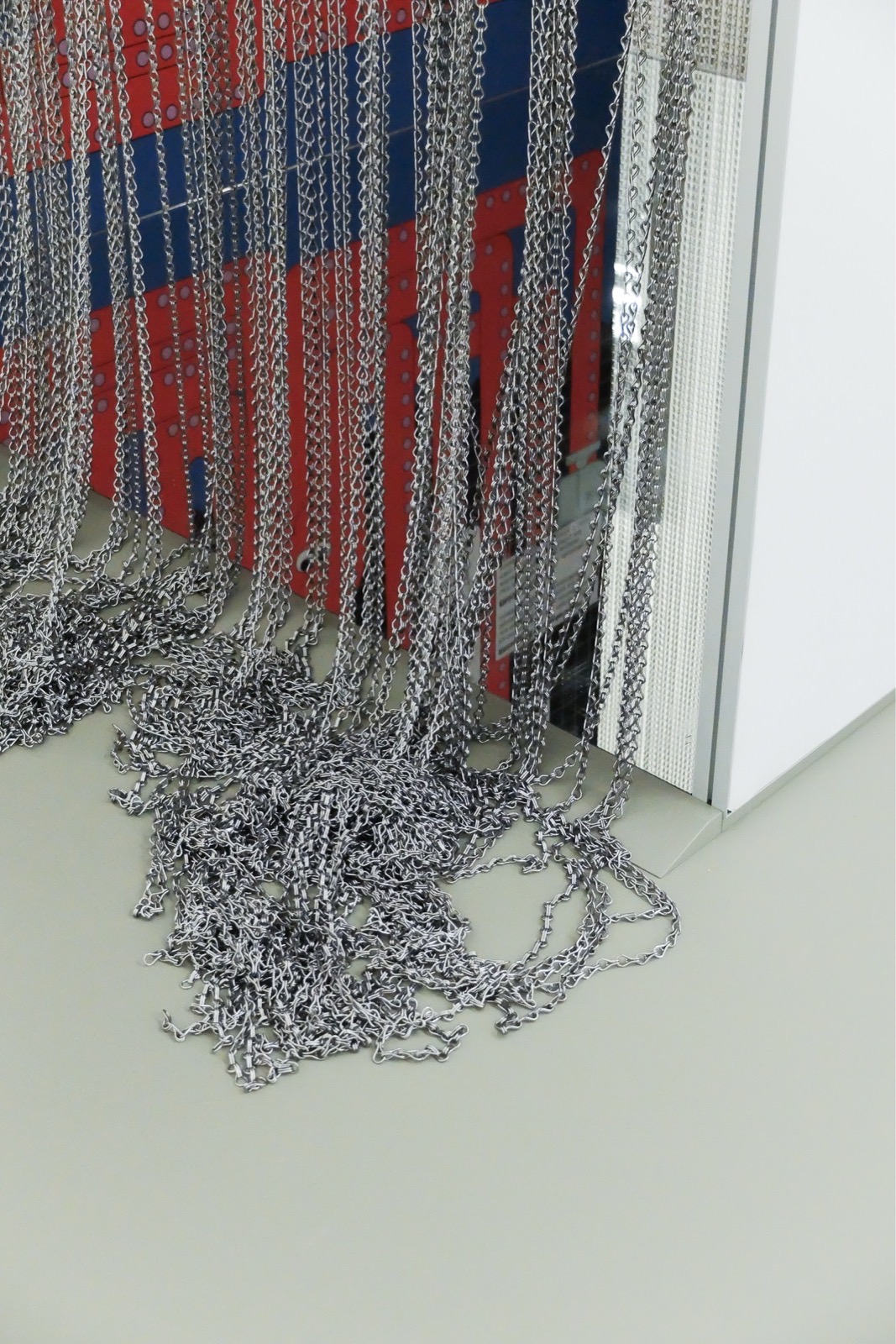
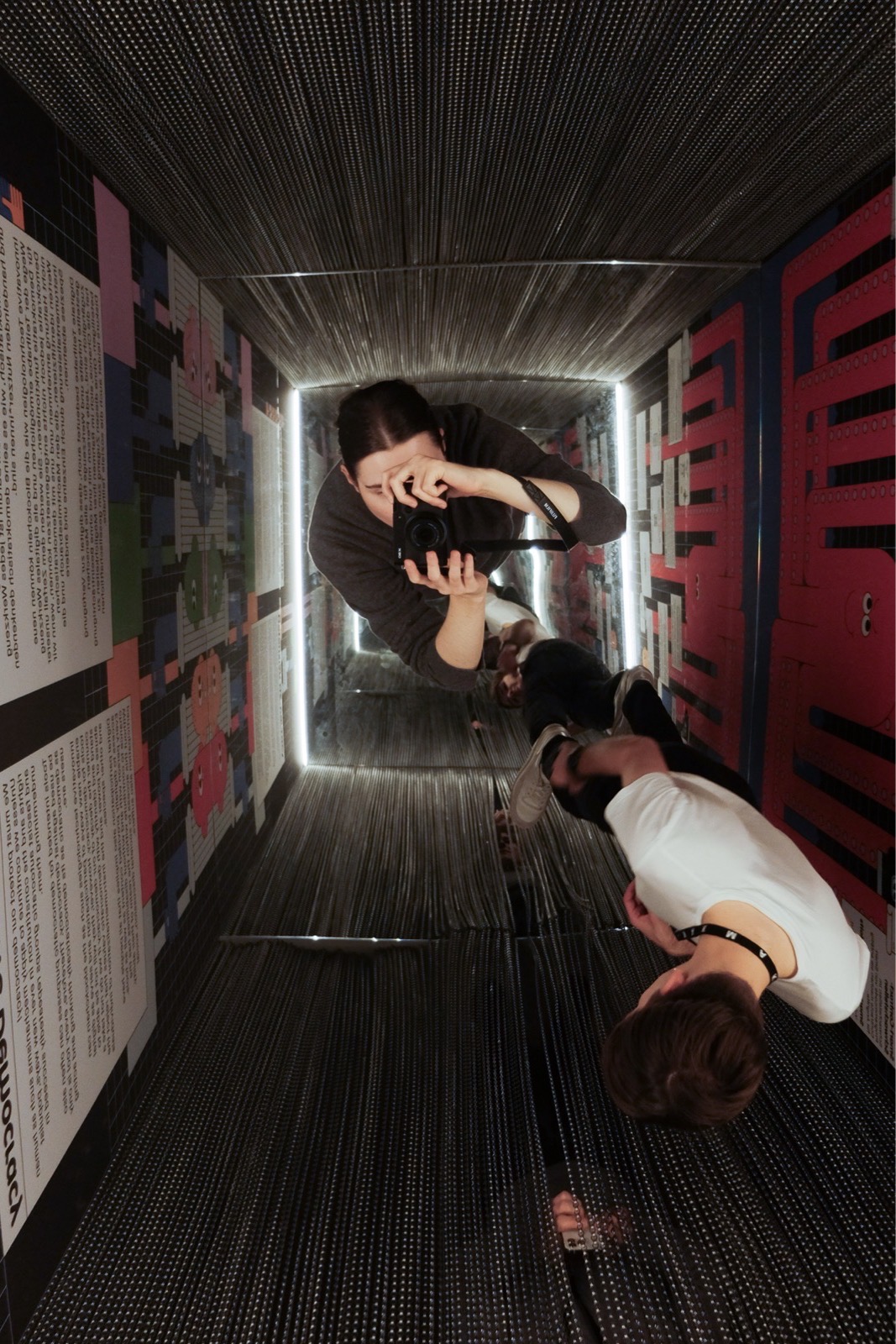
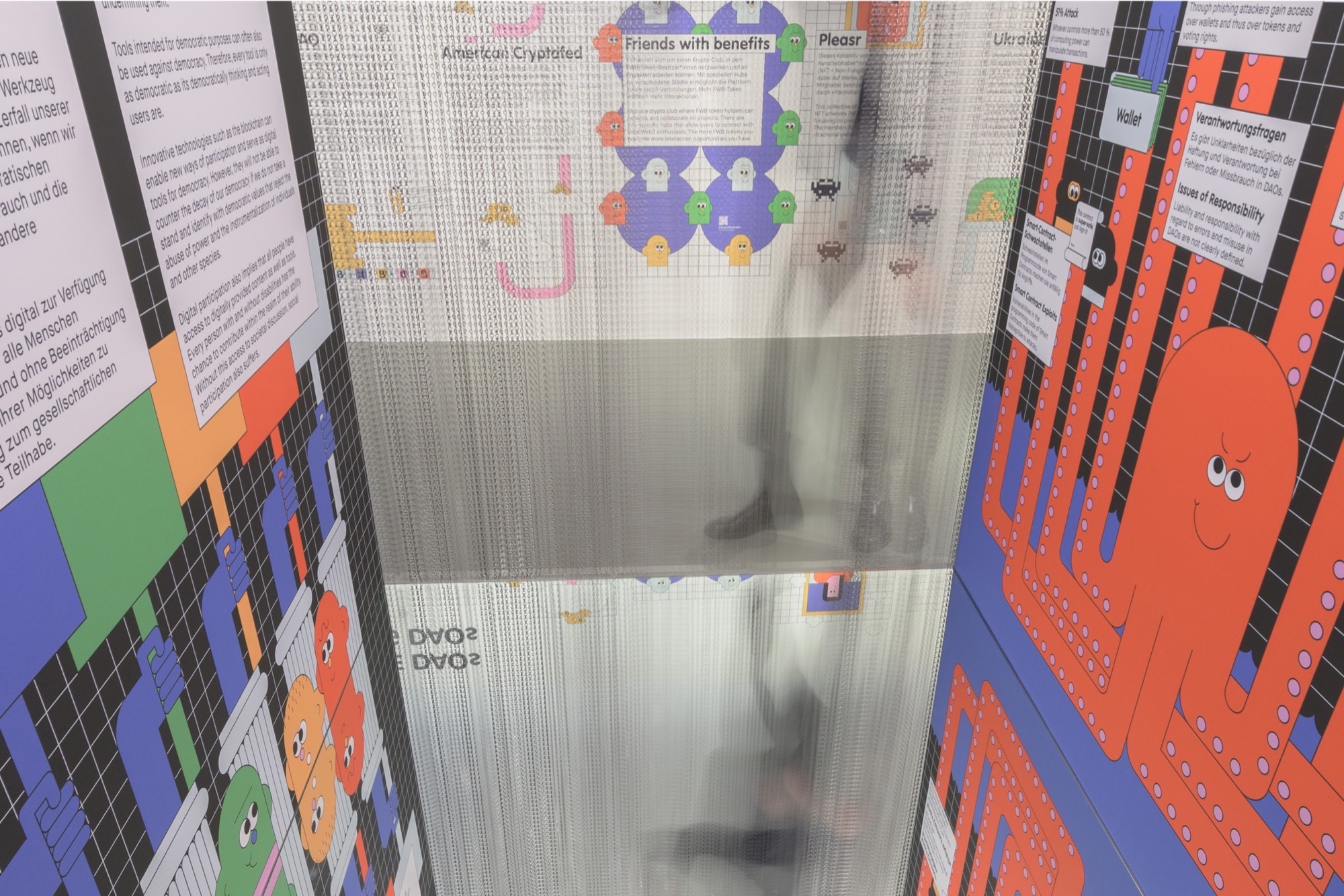
In the so-called "Room within a Room," where both the ceiling and floor are mirrored, the shifting infinity axis creates an unsettling sensation, as there is no clear bottom or top in sight. Here, critical perspectives and issues surrounding blockchain technology are visually presented. This immersive space not only highlights the limitations and challenges of the technology but also advocates for a resilient and robust democracy.
## Strong Democracy
Now more than ever, it is essential to promote democratic education and empower citizens to thrive in strong and resilient democracies. Together with the MAK, we aimed to make a small contribution by contextualizing DAOs and blockchain as tools for democracy.
Our goal was not simply to provide a factual overview but to create a space where visitors can engage in informal discussions, exchange ideas, and linger thoughtfully. We hope we’ve succeeded in this endeavor.
For more information and tickets, please visit [mak.at/blockchain](https://www.mak.at/blockchain){target=_blank}.
---
## Credits
Concept and design: [Katja-Anna Krug](https://www.katjakrug.com){target=_blank}, Max Kure, Leo Mühlfeld, Anton Posch [(Design collective Gemeinde-Bau)](https://gemeindebau.im){target=_blank}
Curator: Marlies Wirth, Curator of Digital Culture, Curator of the Design Collection
Assistant: Felix Kofler, Design Collection
Educational concept: Janina Falkner and Laura Pirgie, Education and Outreach
[^1]: In 2016, the British Natural Environment Research Council (NERC) held a public vote to name a research vessel. While "Boaty McBoatface" won, authorities deemed it inappropriate and named the main ship Sir David Attenborough instead, assigning the humorous name to an autonomous lifeboat. [New York Times](https://www.nytimes.com/2016/03/22/world/europe/boaty-mcboatface-what-you-get-when-you-let-the-internet-decide.html){target="blank"}
---
# Large Language Writer
Canonical URL: https://leomuehlfeld.at/en/large-language-writer
---
title: 'Large Language Writer'
for: 'Design Investigations'
category: 'Design Research & Speculation'
metaDesc: 'How will we write in the future? Designing honest interfaces for Large Language Models in AI-Assisted creative writing.'
thumbnail: /img/rotary-encoder.jpg
date: '2024-06-19T00:00'
showOnLanding: true
heroImage: /img/shift-button.jpg
collab: Lucy Li, Alan Schiegl
imageCredit: Fritz Enzo Kargl
---
# Large Language Writer
## How will we write in the future? Designing honest interfaces for Large Language Models in AI-Assisted creative writing.
## Interfaces
The interfaces between humans and machines play a crucial role in shaping perceptions of technology. Current interfaces deployed by major tech firms often lean towards mystification and concealment, presenting technology as if it operates like magic. This top-down approach can breed scepticism and distrust, categorising these interfaces as "Dishonest Interfaces." This project explores what it means to design "honest" interfaces.
## Dishonest Interface
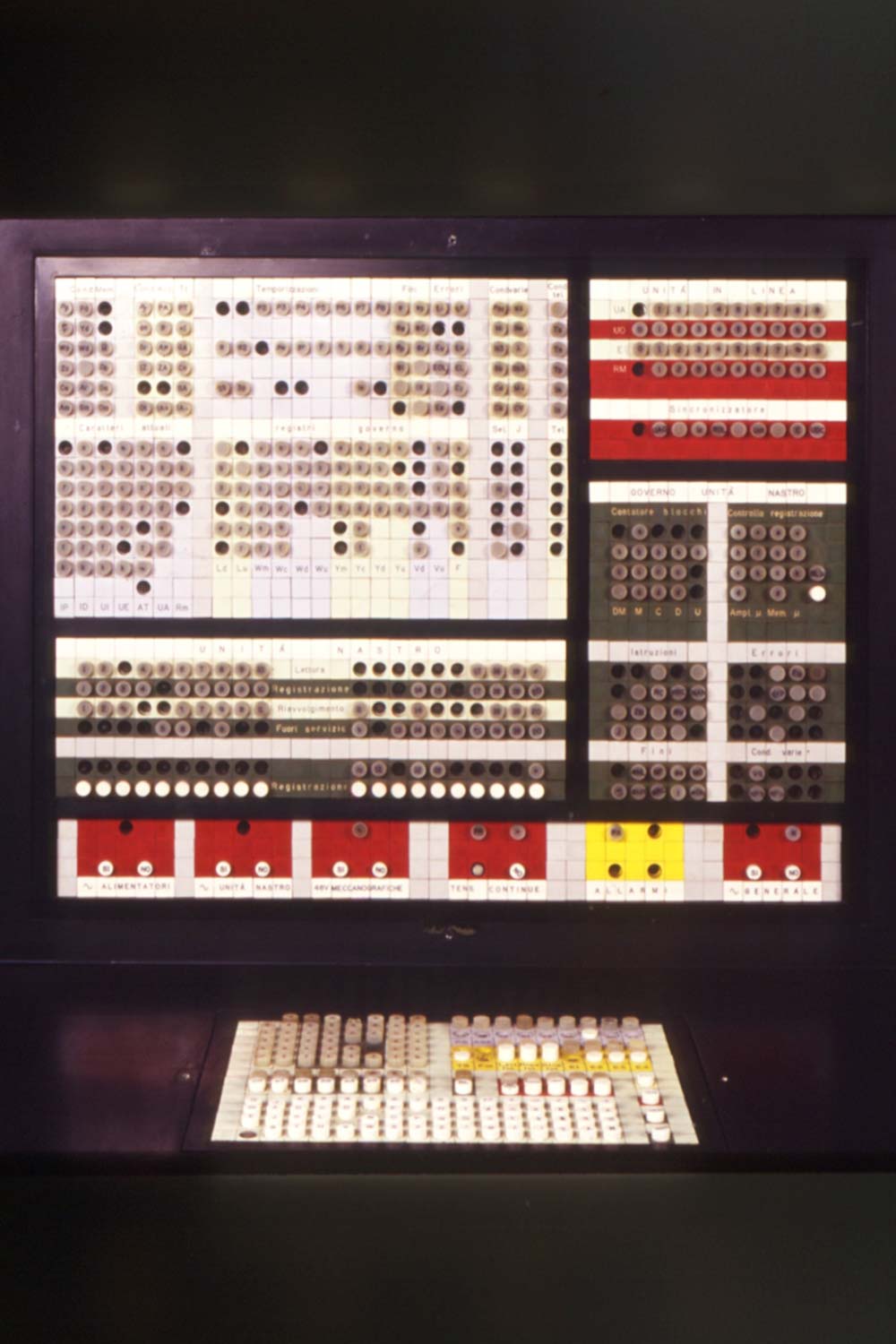
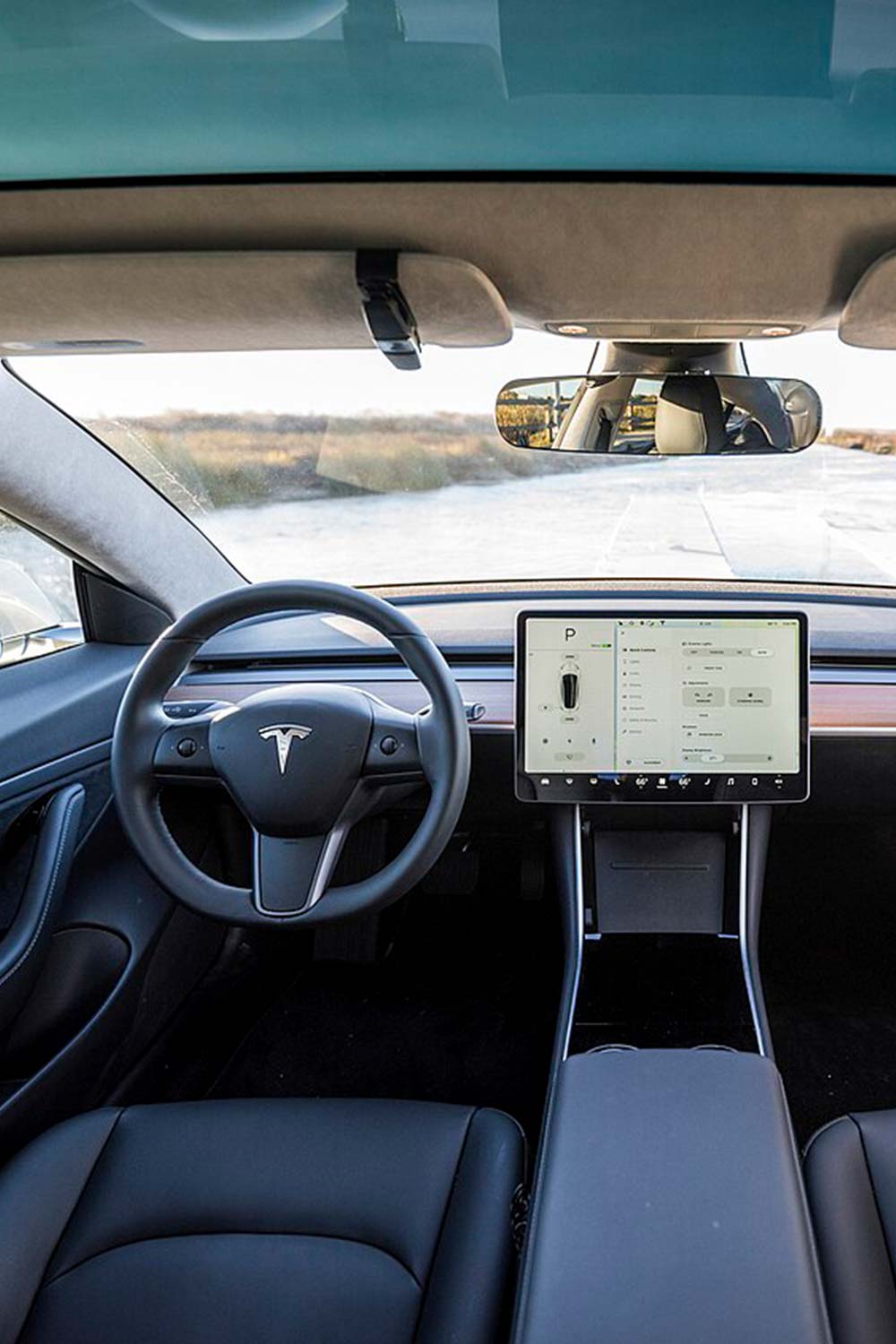
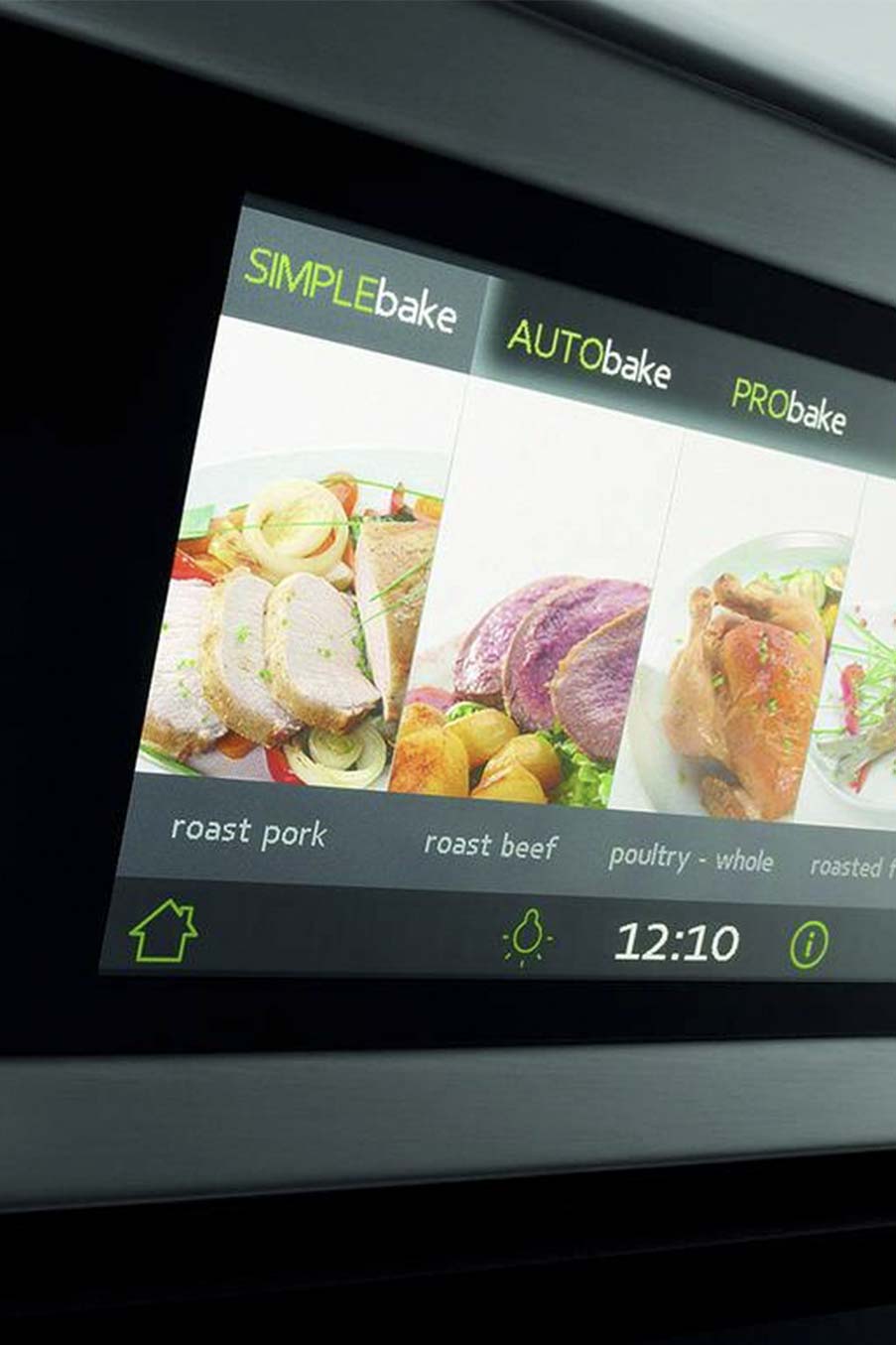
I've noticed a concerning trend in design, especially in interface design, that emerges in "fully developed" products like baking ovens, stoves, and car interiors. Take the baking oven: its practical features are optimized, but companies still need to drive sales. Instead of relying on planned obsolescence, which could tarnish their reputations, they create demand by adding features promoted through advertising. This explains the rise of WiFi in home appliances.[^1] Traditional controls are replaced by terms like "4D-Heat" or "Fish Mode." While corporate greed is a simple explanation, the nature of design itself may offer deeper insights.
>Contemporary technologies of networked computational
>things and artificial intelligence, as well as the data capitalism they
>have made possible, differ from the logic of industrial production.
>Not only that, they fundamentally challenge the conceptual space
>designers have created to cope with complexity. For instance, with
>runtime assembly of networked services, constant atomic updates,
>and agile development processes, the boundary between produc-
>tion and consumption is almost fully dismantled.
>
>Elisa Giaccardi, Johan Redström, Technology and More-Than-Human
Design, DesignIssues: Volume 36, Number 4 Autumn 2020
## Societal Impact
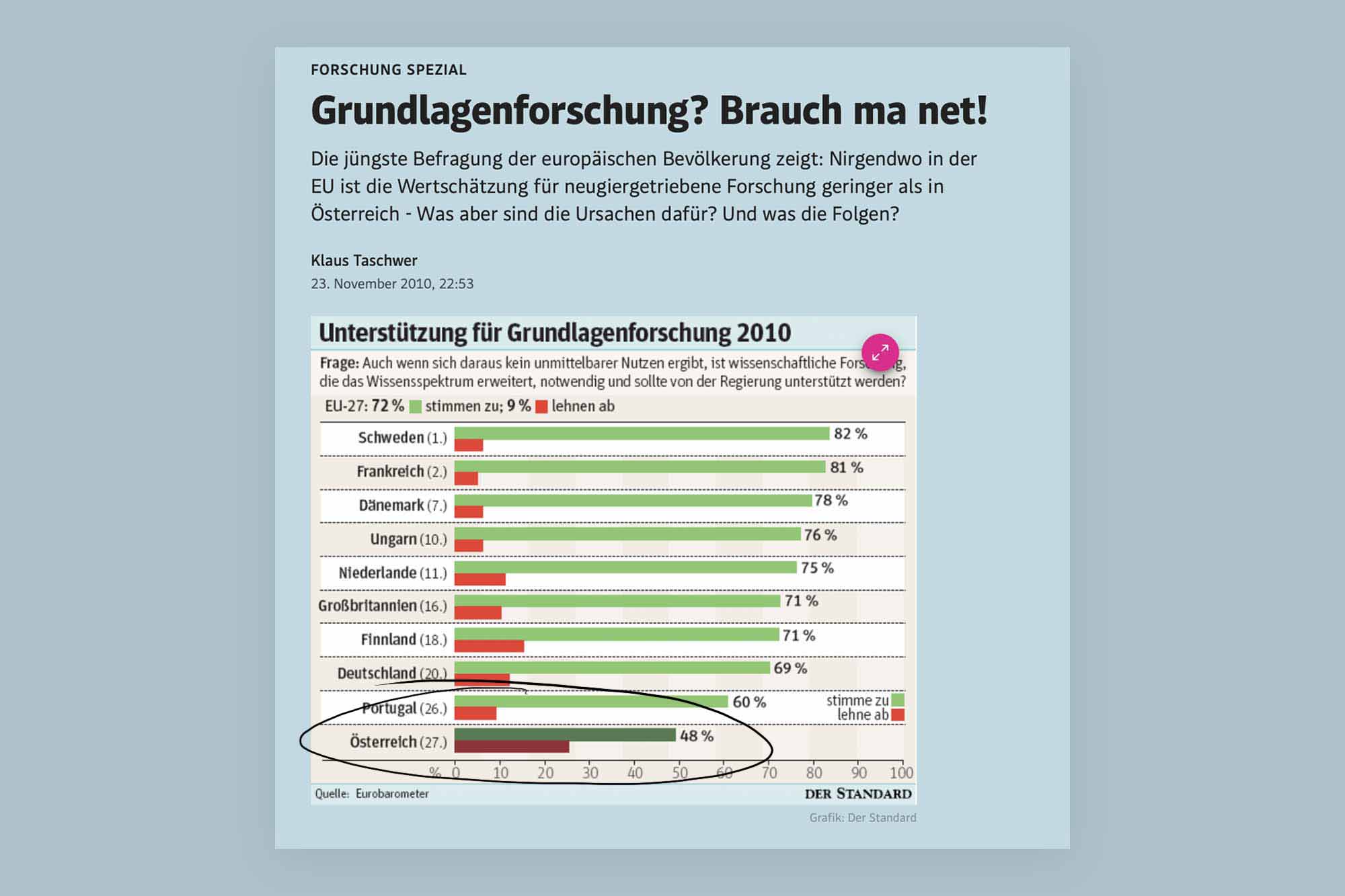
In our technocratic era dominated by Big Tech, the prevalence of "Dishonest Interfaces" in modern consumer products has fueled growing skepticism towards research and technology, often spiraling into conspiracy theories. For instance, a simple warning light in today's digital cars, which once indicated an easy fix, now typically demands an expensive workshop visit, creating a sense of opacity and loss of user control. This dynamic breeds frustration and mistrust, making users feel governed by their technology rather than empowered by it, thereby perpetuating skepticism towards progress.
## Deus ex machina
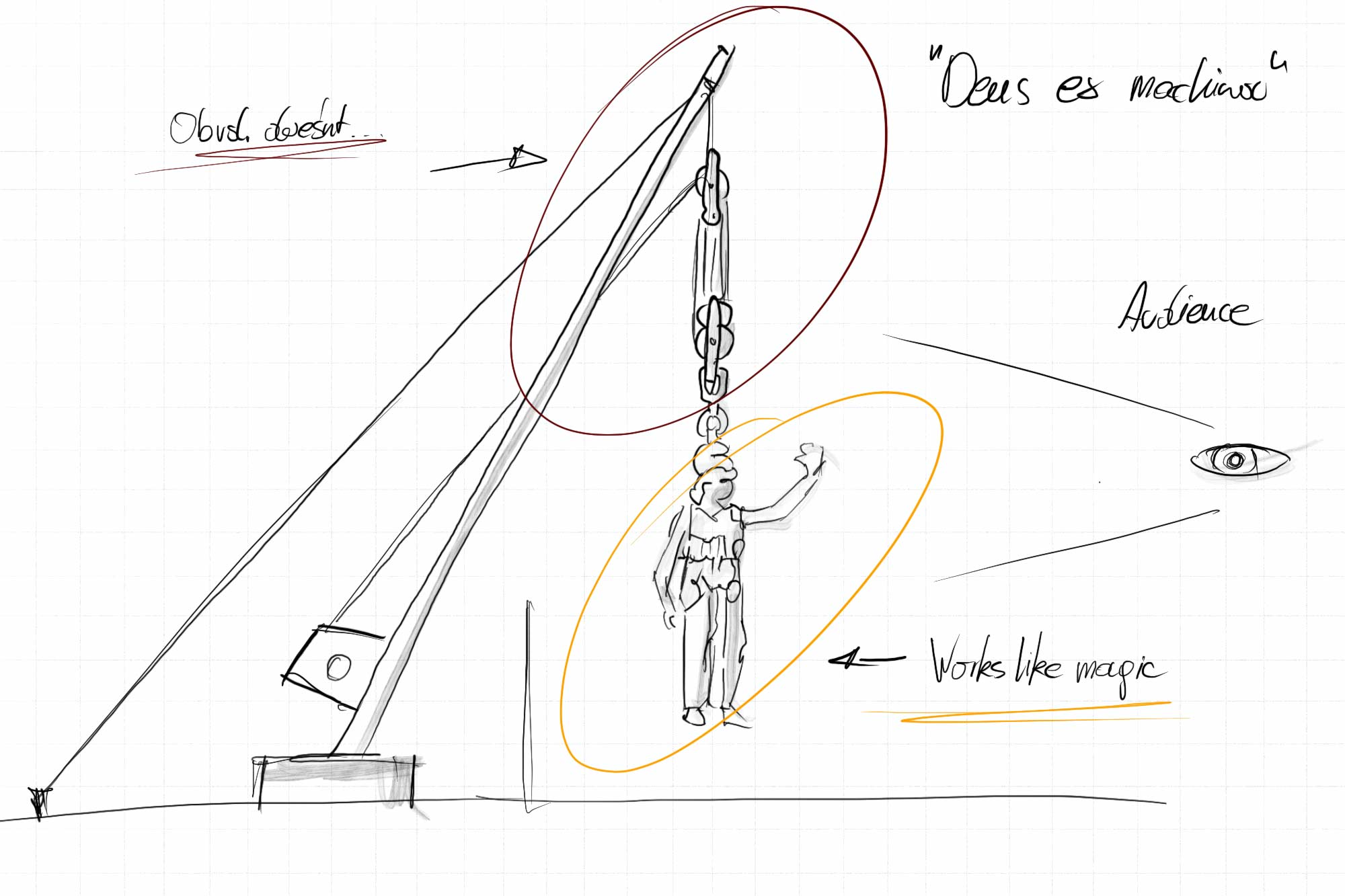
The "Deus ex machina," a figure in Greek theatre lowered by a visible crane to resolve impossible dilemmas, offers a compelling analogy. The crane's visibility allowed the audience to trust the magic without feeling deceived. In design, we should "expose the crane" by making the mechanisms behind technology visible, fostering trust and transparency, and enabling users to engage without feeling manipulated.
## Honest Design
With all these insights, ideas, and challenges, the question remains: What does it take to design honestly? It seems that honest design, achieved through seamful[^2] interactions, could be a cornerstone for fostering a more positive and confident perspective on technological development.
> Good design is honest.
>
>Dieter Rams, 10 principles of design
>design
>needs to be anticipatory, able to craft desirable relations between
>people and emerging technologies, and thus proactive in the
>associated processes of research and development.
>
>Elisa Giaccardi, Johan Redström, Technology and More-Than-Human
Design, DesignIssues: Volume 36, Number 4 Autumn 2020
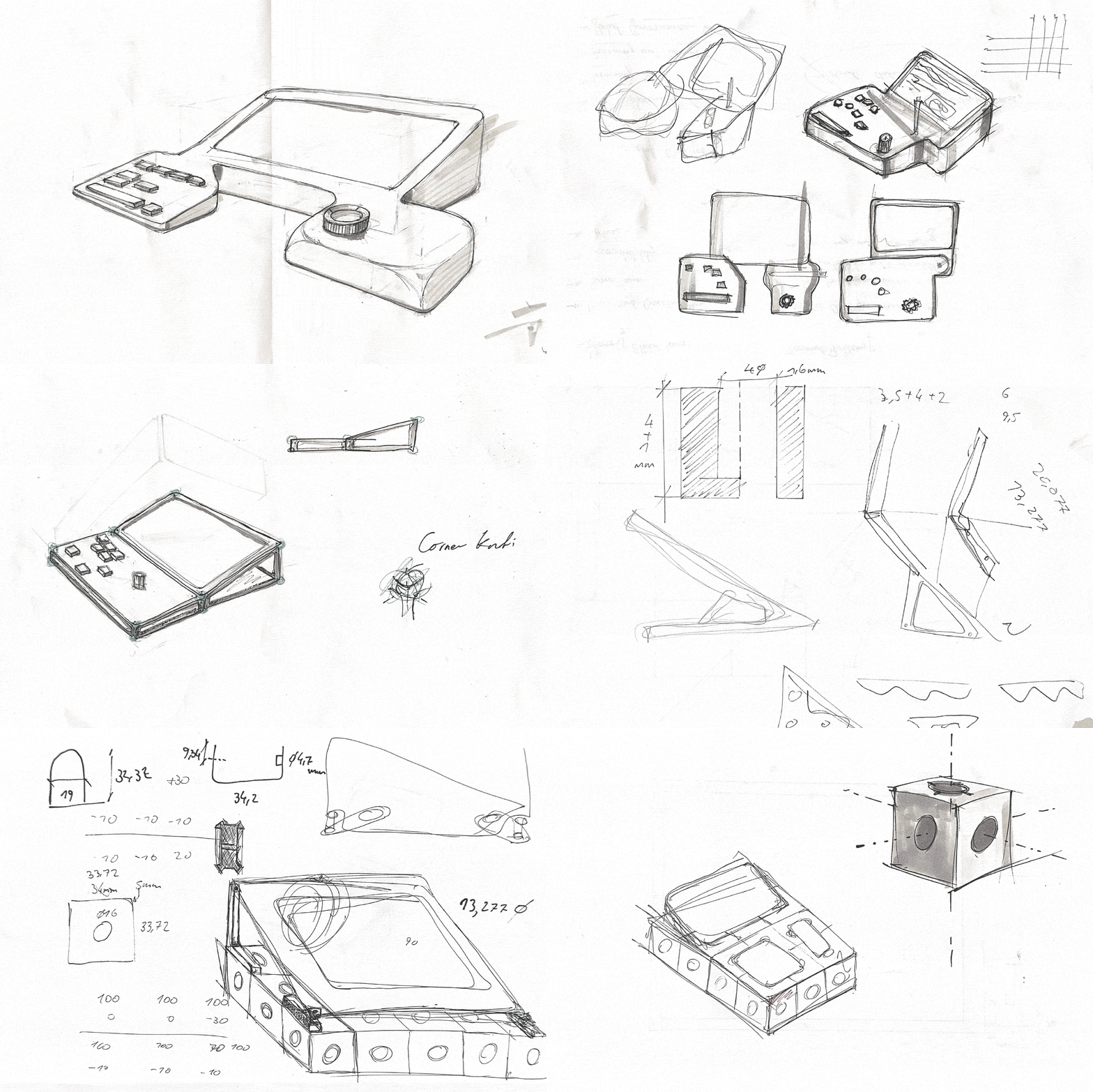
I set out to design a prototype of an "honest interface," along with hardware components that adhere to the same philosophy. The objective was to develop methodologies for creating such an interface, using the specific example of interfacing with Large Language Models. Without further ado, let's delve into the five principles of honest design.
---
## 01 Place a Spotlight
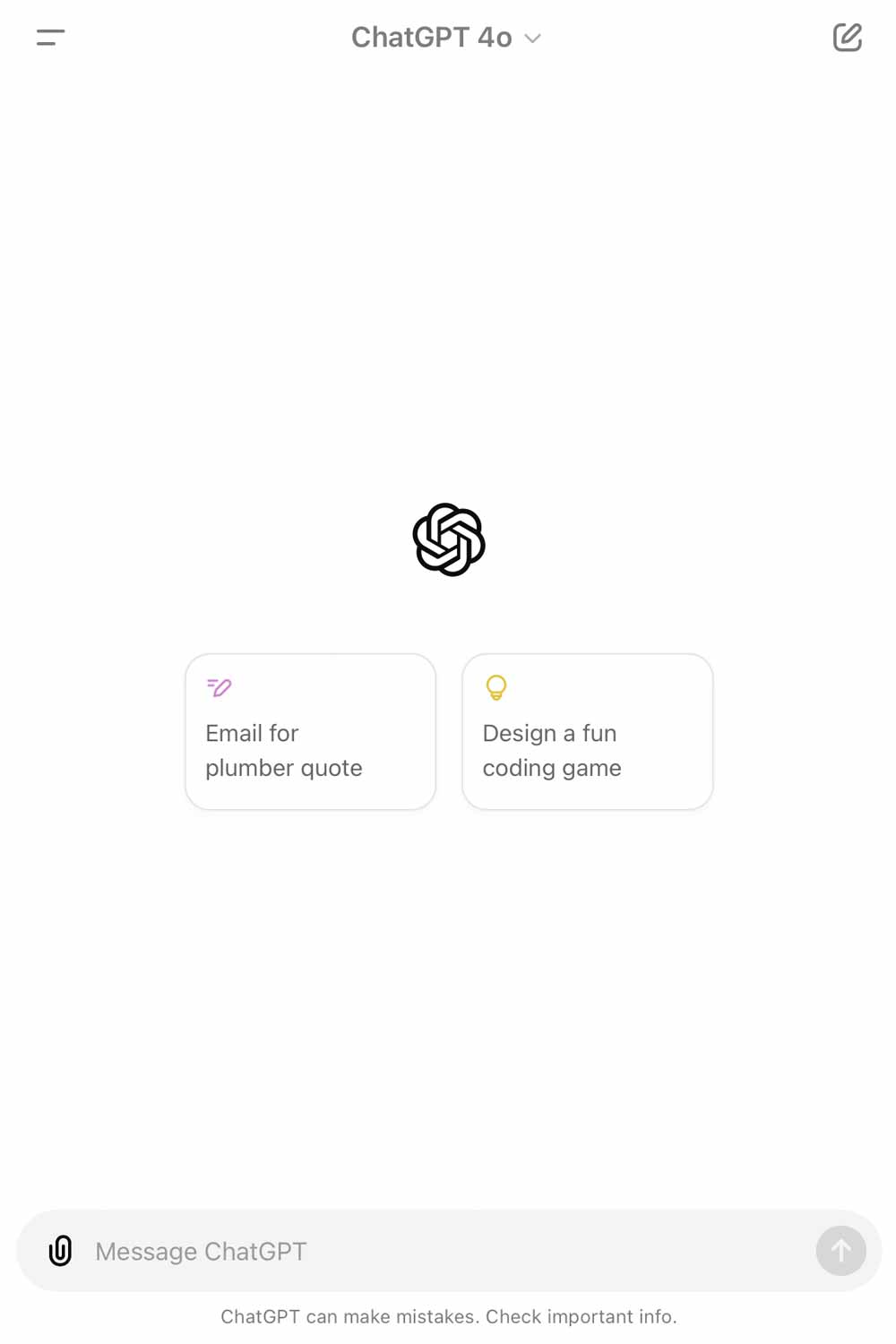
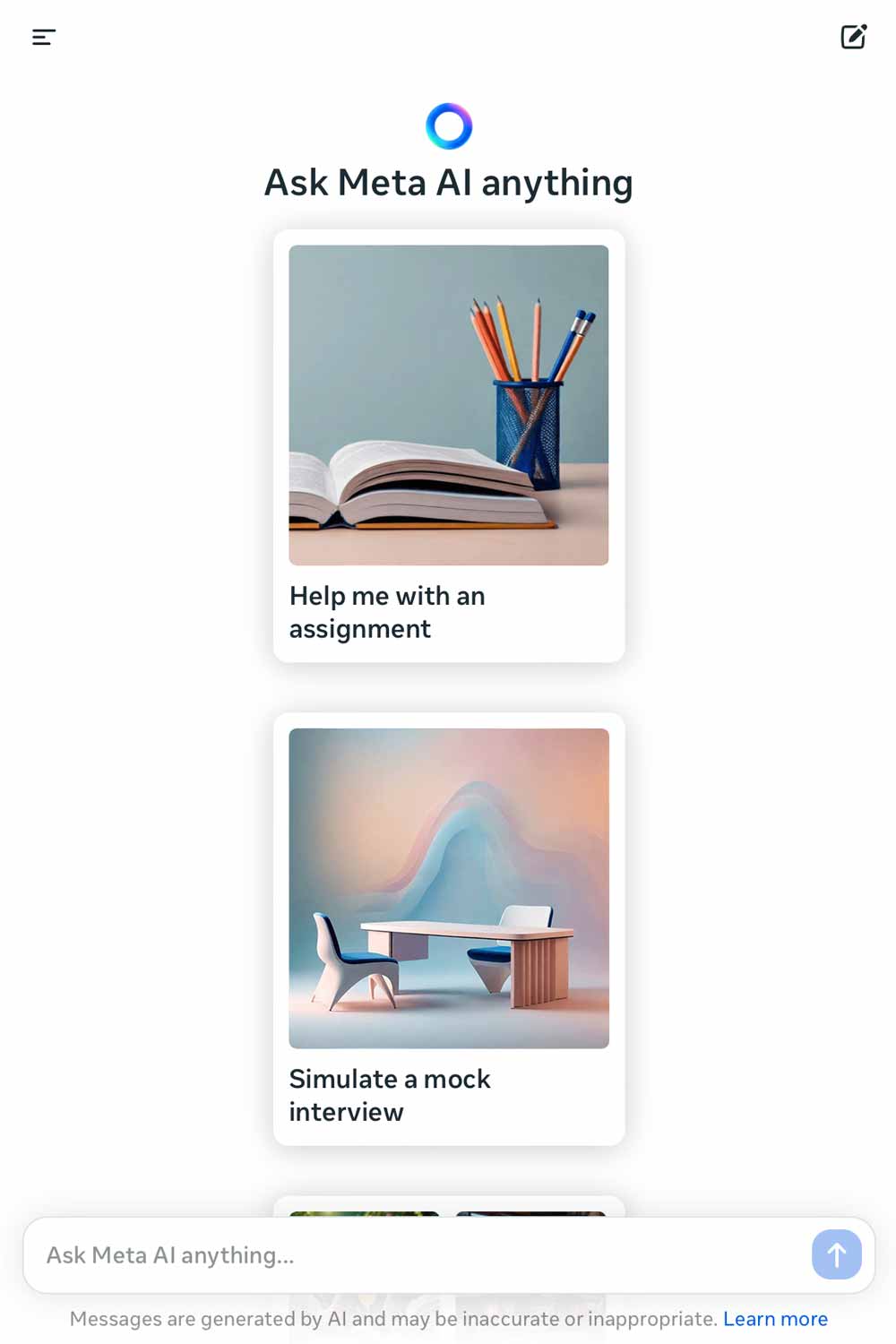
AI is currently a buzzword, and as its tools become more widespread, significant questions about their impact arise. While generative AI in image creation remains somewhat niche, systems like ChatGPT raise broader concerns. As students use AI for homework and others rely on it for drafting documents, the value of writing as a creative practice and a human method of documentation is increasingly being questioned.
## The future of the Interface
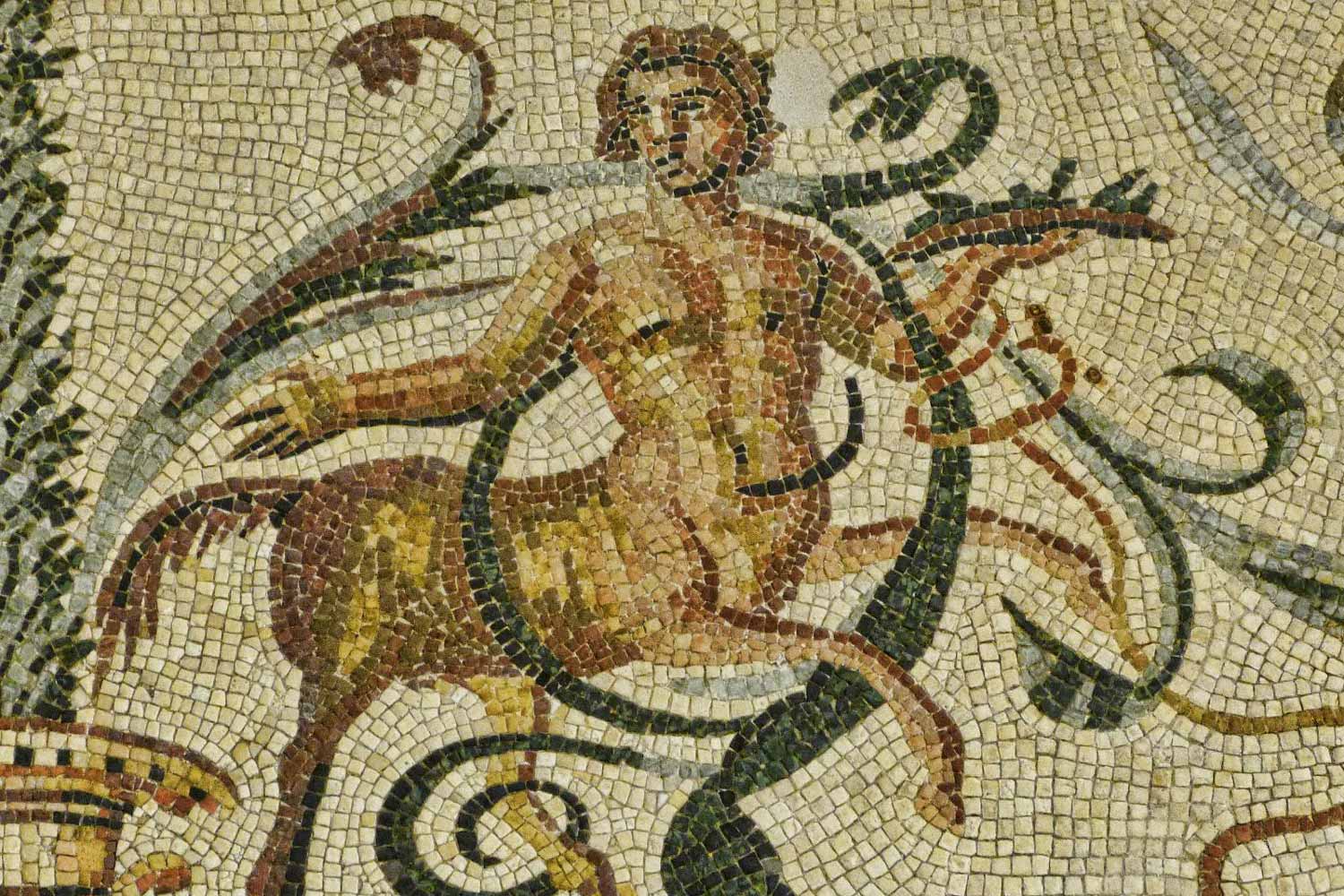
While Big Tech favors chat-based interfaces, we should remain curious about alternative methods. Beyond the outdated command-and-control approach lies the Centaur Approach, theorized by [Garri Kasparow,](https://de.wikipedia.org/wiki/Garri_Kimowitsch_Kasparow){target=_blank} where humans and machines collaborate, each contributing their strengths. In 2021, [I explored this](https://leomuehlfeld.at/centaur-design){target=_blank} by having children and generative AI co-design toys, demonstrating how the Centaur Approach can integrate humans into the generative process.
---
## 02 Break down the tech
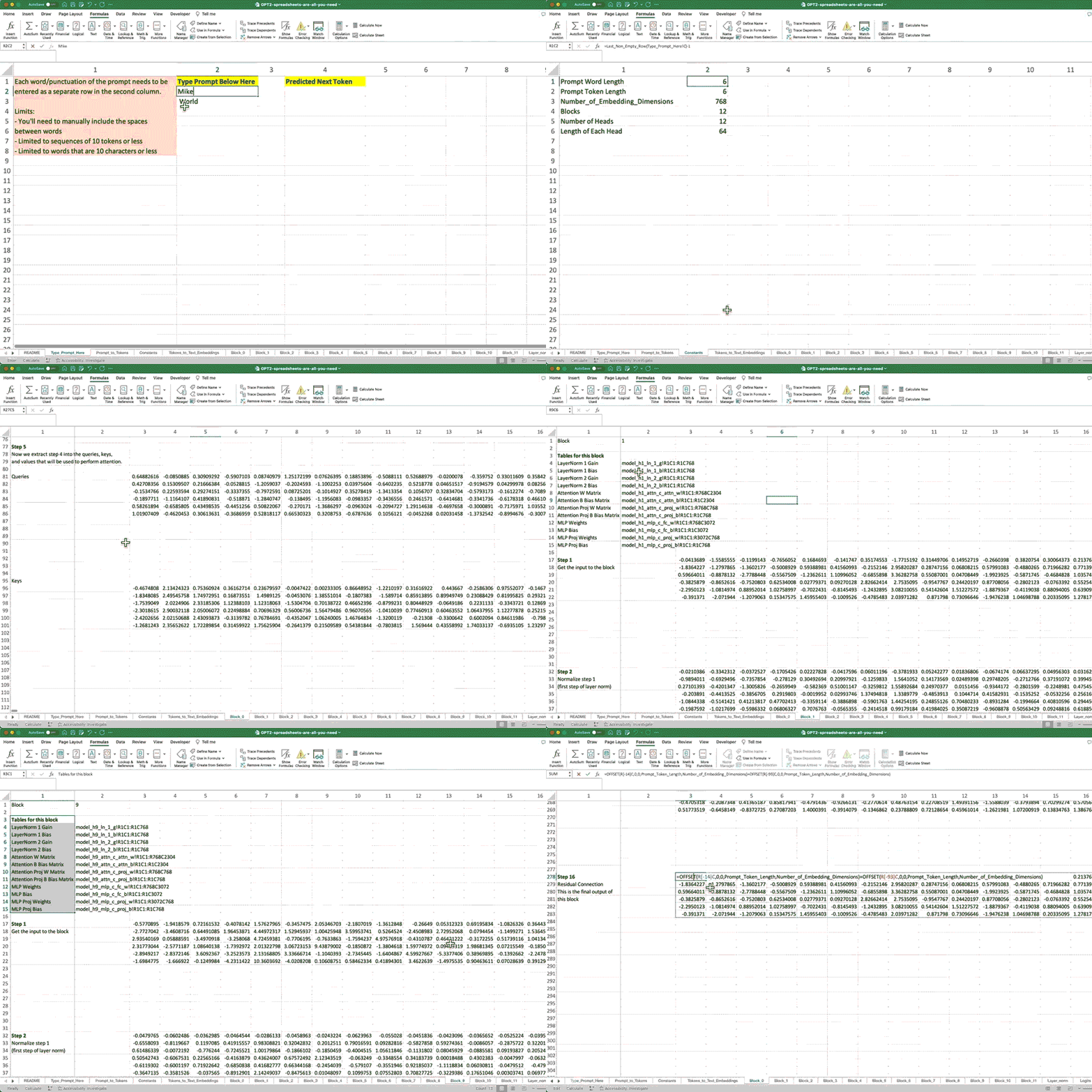
When considering "honest" tech, we encounter a paradox: while interfaces like ChatGPT obscure their workings, the most transparent interaction might be [Ishan Anand's](https://github.com/ianand){target=_blank} ["Spreadsheets is all you need",](https://github.com/ianand/spreadsheets-are-all-you-need){target=_blank} a fully functional GPT-2 in Excel. Though transparent, it lacks usability. As a designer, I wondered if there's a middle ground, a sweet spot between transparency and usability. To explore this, I examined three essential ideas…
## Tokens and Relations
In a Generative Pretrained Transformer (GPT), tokens are the smallest text units, like words or subwords. The model learns relationships between tokens by analyzing large text datasets. The transformer's attention mechanism weighs the importance of each token in context, capturing patterns, syntax, and semantics. This allows the model to generate coherent and contextually relevant sequences by predicting the next token based on learned relationships.
## Dataset
The dataset used to train an AI model shapes the quality, scope, and biases of its generated text. A diverse and extensive dataset enables more accurate and creative outputs, but it also embeds any inherent biases. After training, the model cannot learn from new data, meaning these limitations are fixed. However, a model can be fine-tuned on additional datasets to adapt or update its knowledge, allowing for some post-training adjustments.
## Probability
In AI text generation, probability drives word prediction, with the model selecting the most likely next word based on context. This often results in text that feels "in the middle," as it favors safe, generic choices to maintain coherence. Interestingly, even improbable ideas like time travel or aliens can emerge when the model calculates them as the most probable among unlikely options, giving the illusion of creativity. However, the overall focus on high-probability words often makes AI text sound neutral and predictable.
For deep-divers I recommend [LLM Visualization by Brendan Bycroft](https://bbycroft.net/llm){target=_blank}
---
## 03 Open up loops
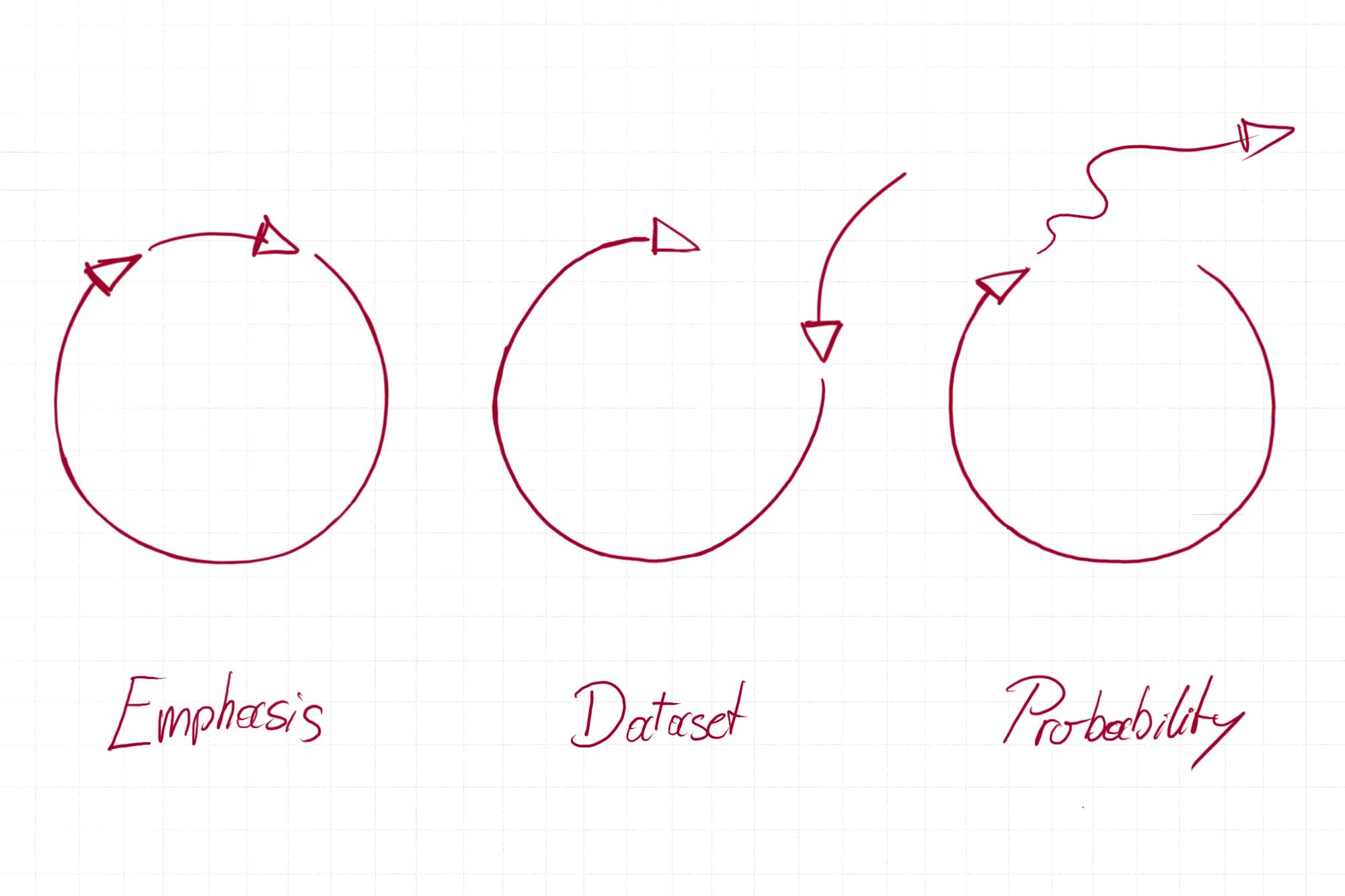
In the conventional approach, the process begins with a prompt and ends with a result, which can be refined through iteration and prompt engineering. However, this method largely removes the human element from the generative part of the process. This project introduces an alternative approach that advocates for a collaborative writing mode inspired by Generative Pre-trained Transformers (GPTs). By emphasizing mutual understanding and fostering "honest" interaction with AI, this approach actively involves humans in the generative process, placing them directly at its core. During the writing process, which occurs within a dynamic feedback loop, three key mechanisms are integrated: "Dataset," "Emphasis," and "Probability."
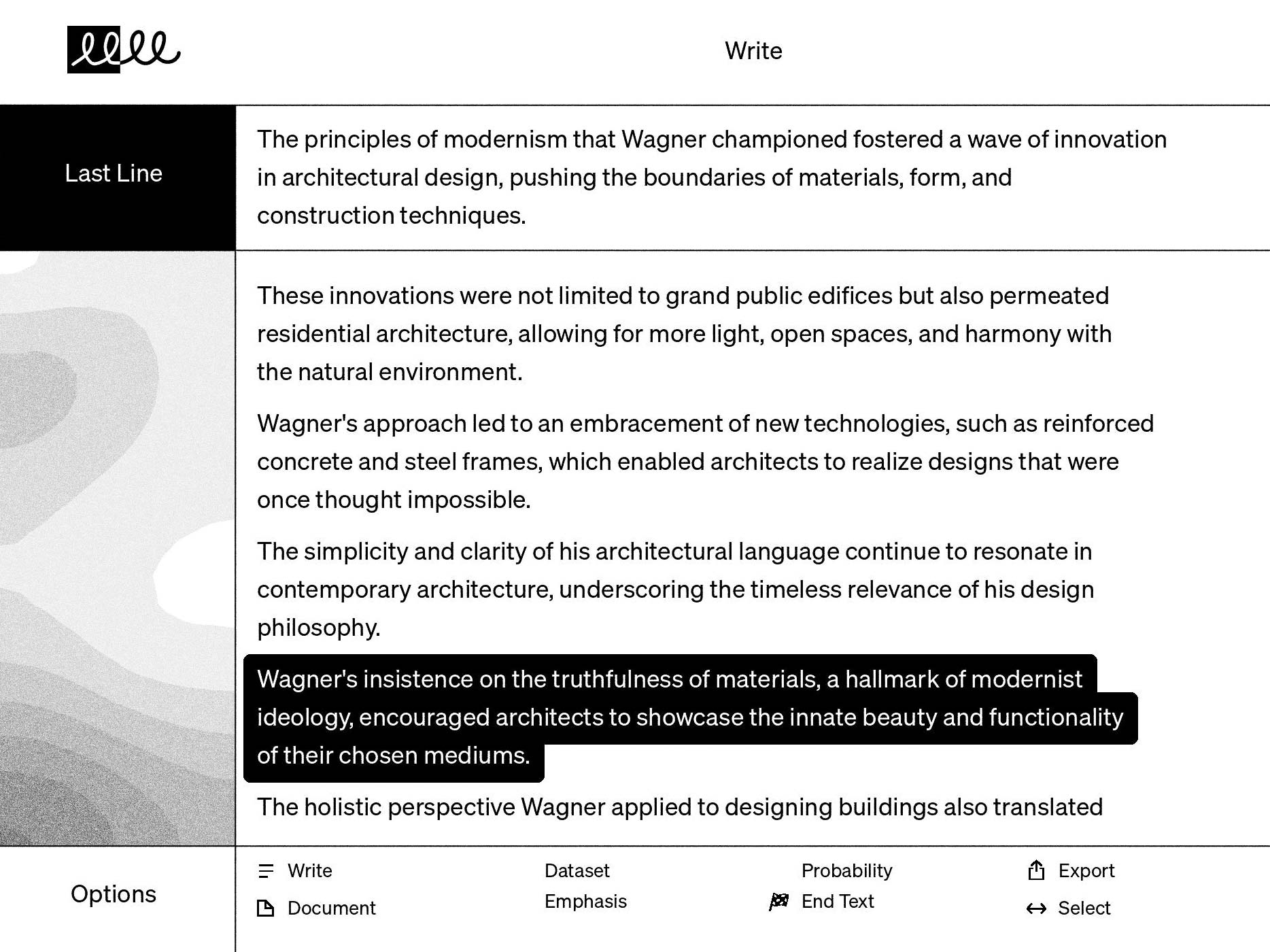
## The Main Loop
Simply put, LLW introduces a new interactive feedback loop. The process starts with a prompt, followed by the AI extracting a theme and generating an initial sentence. The loop then continuously offers continuation sentences based on the user’s settings. We will delve into the interaction modes (Emphasis, Dataset, Probability) shortly. Once a sentence is selected, it becomes the new "last sentence," and the loop repeats until the user concludes the writing process. This approach immerses the writer directly in the generative process.
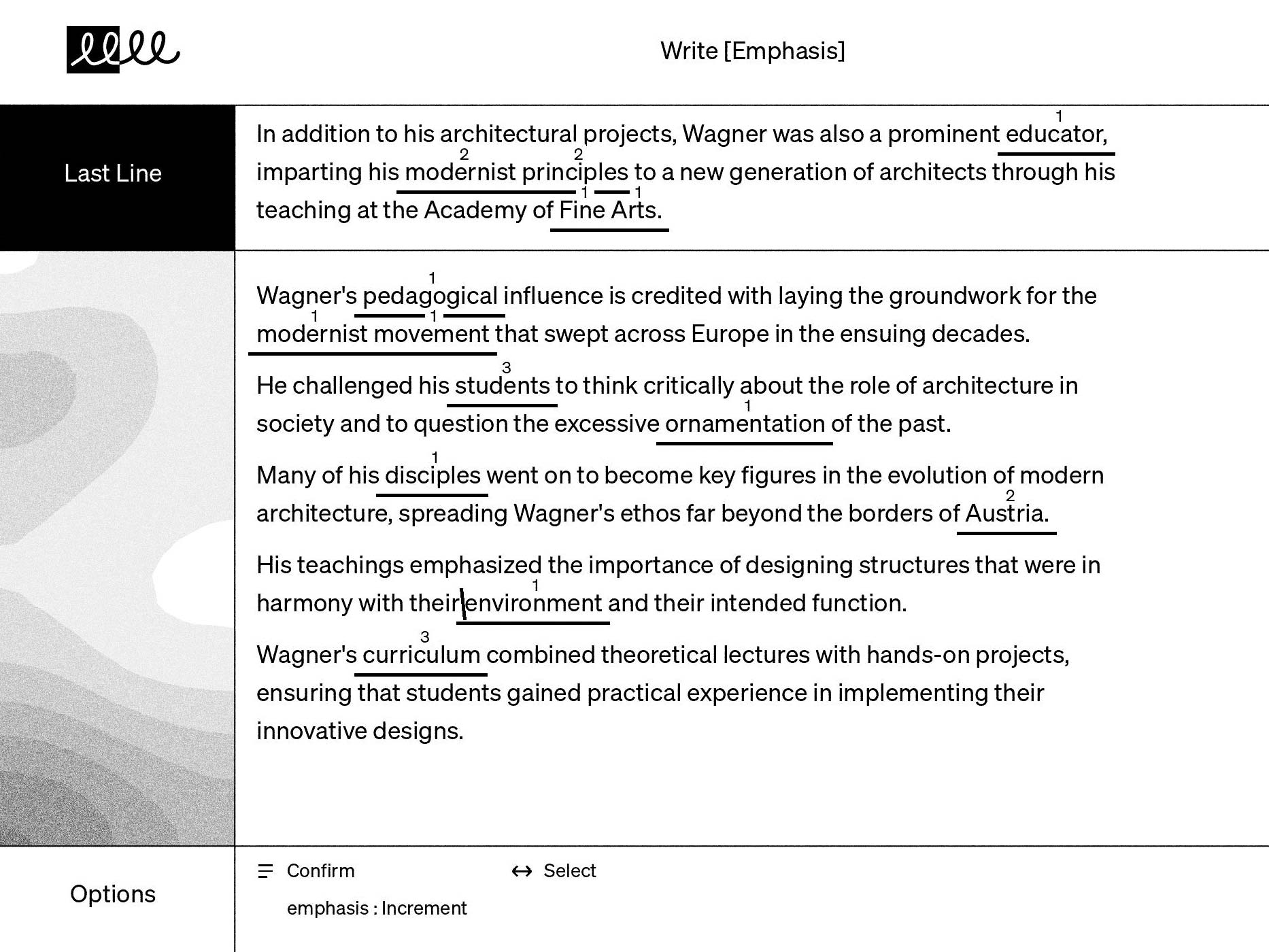
## Emphasis → steer the feedback-loop
By incorporating AI's core principles into the user interface, LLW fosters an intrinsic understanding, leading to a trustworthy and honest relationship between users and their tools. The Emphasis strategy, based on token relationships, exemplifies this approach. In Emphasis mode, users can select words or strings by holding Shift, then assign a weight (1 to 3) before exiting the mode. The generated continuation sentences will reflect these user defined weights.
## Dataset → Inform the loop
We have to recognize the fundamental differences
between human and more-than human intelligences and embrace them. The non-obfuscation of
this reality is an important step in designing honest for AI. Human traits like inspiring moments
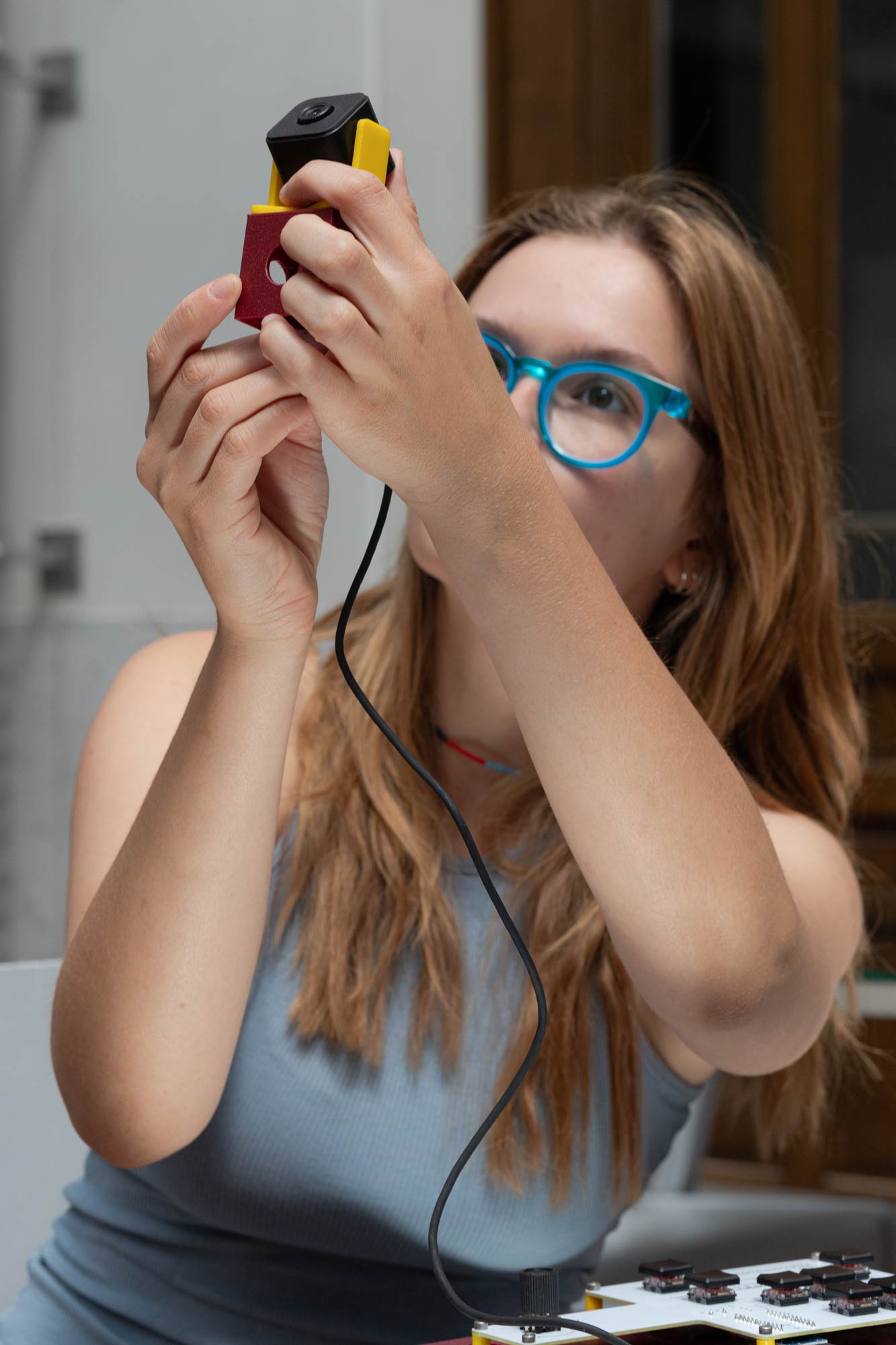
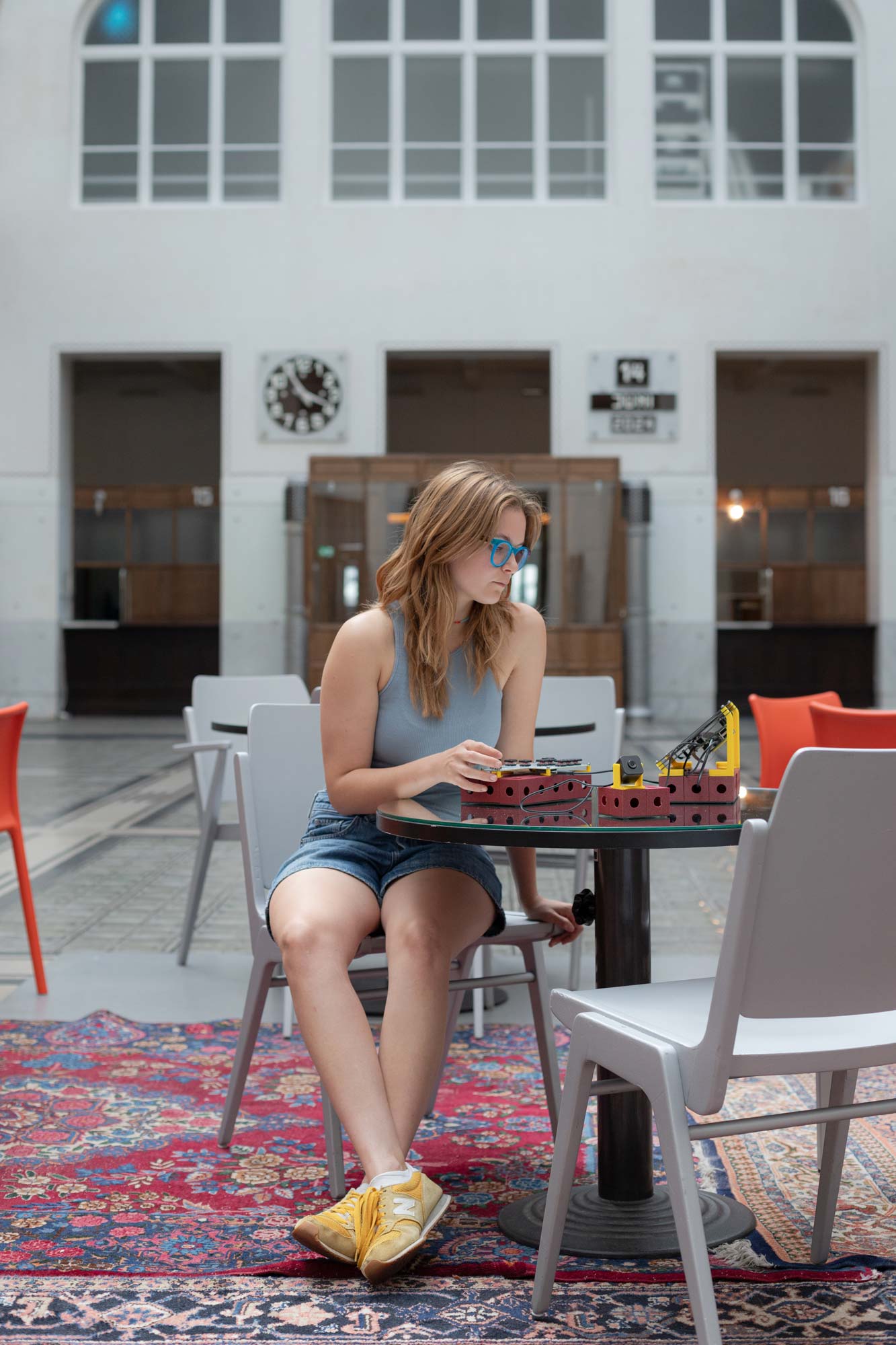
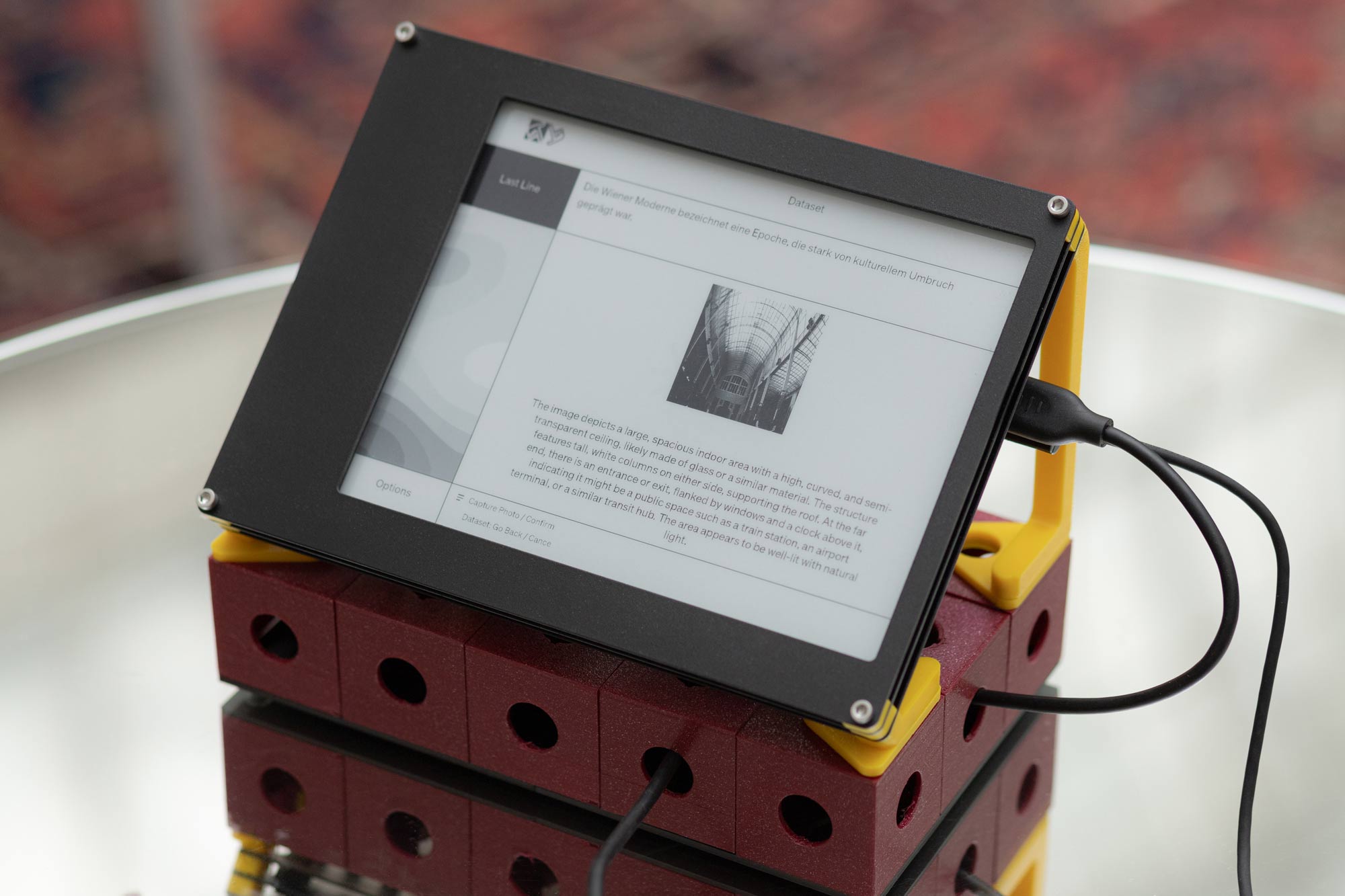
or things, a cute present they recently got or their current surroundings can be fed into the dataset to inspire the generative process in unconventional ways. LLW is equipped with a camera-module that allow writers to capture whatever they imagine to flow into the writing.
## Using the LLWs camera
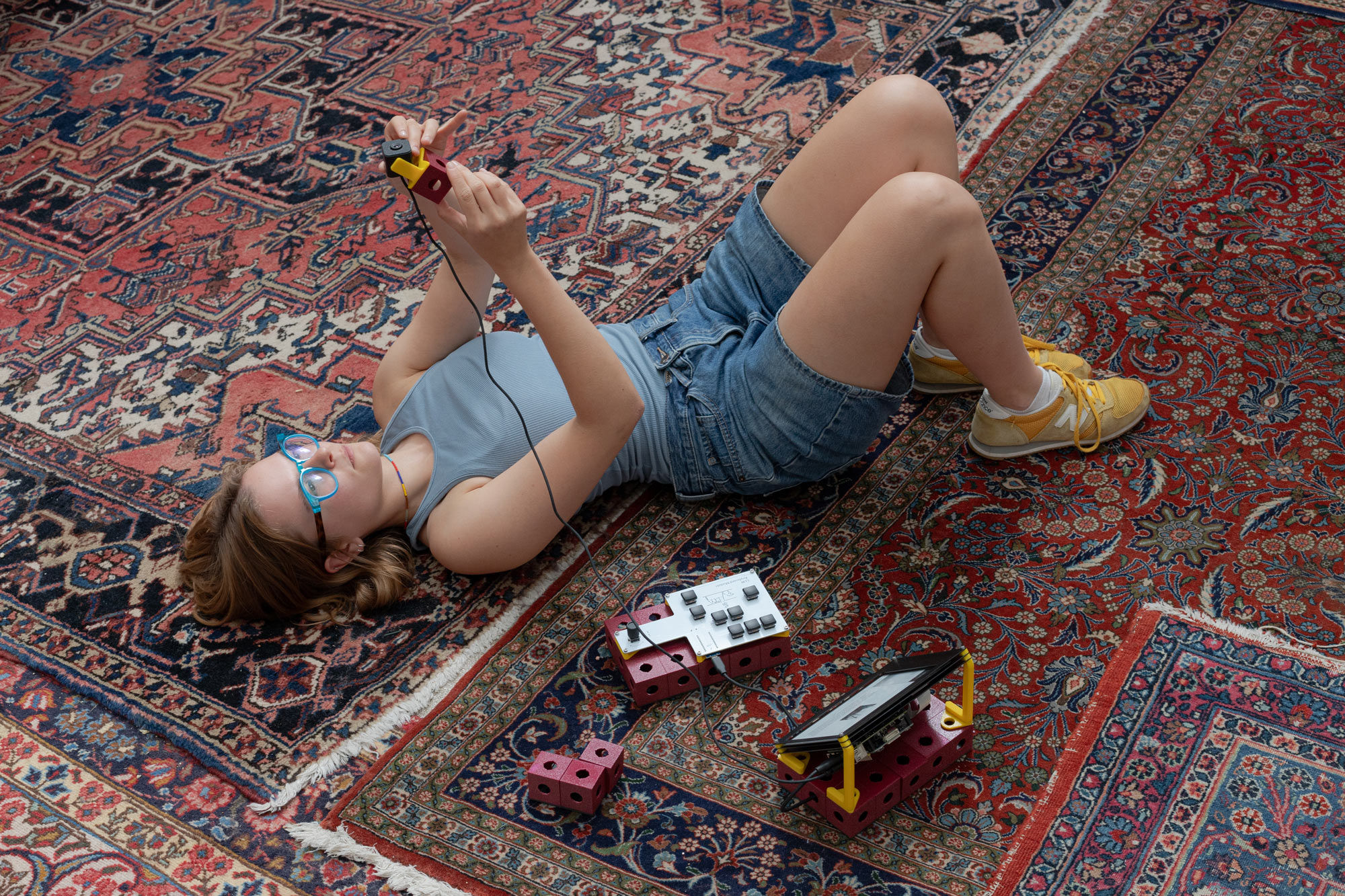
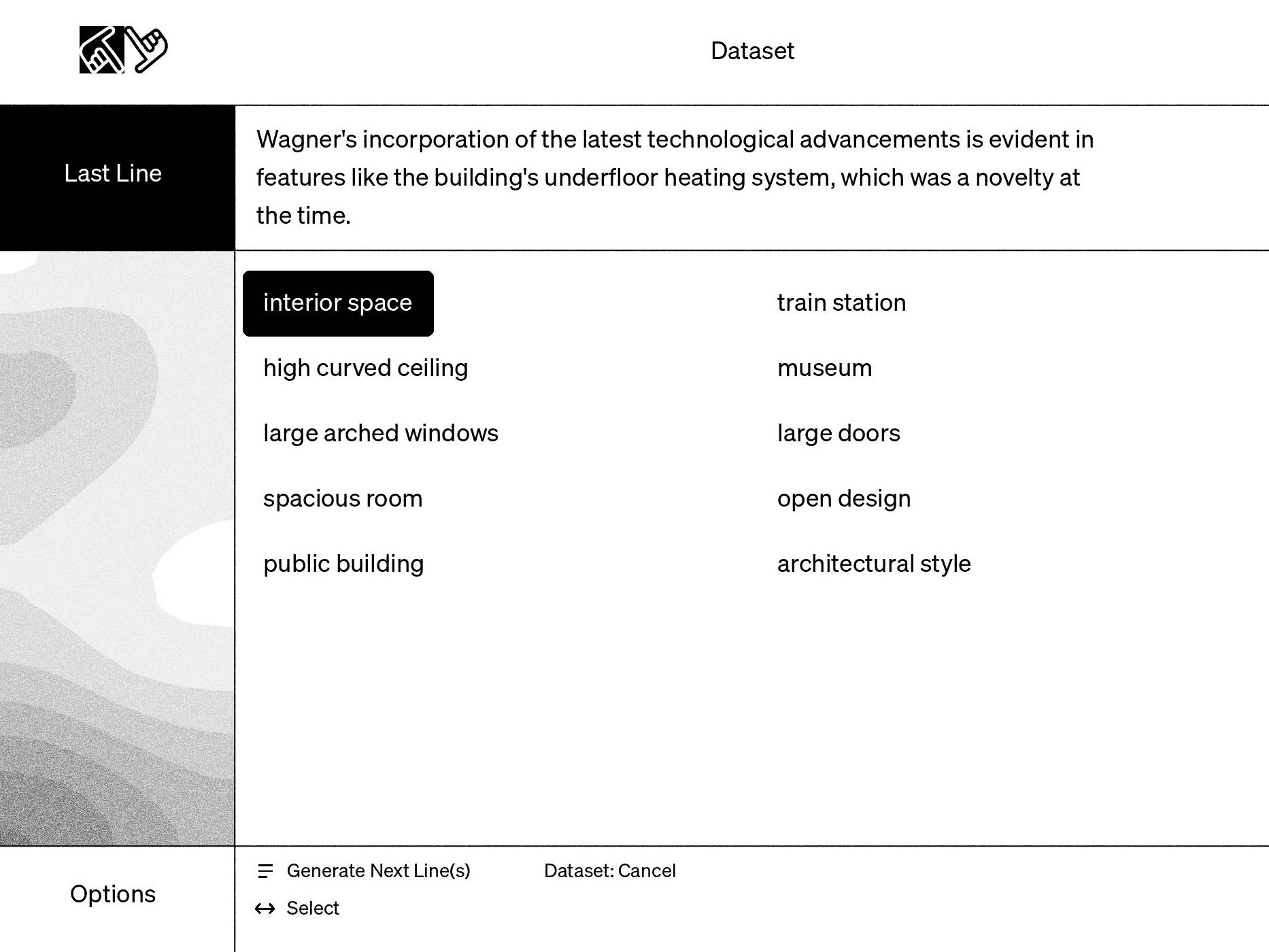
When the user activates the dataset mode, they are prompted to take a picture using the LLW camera. There are no creative limits on the choice of subject. For instance, if something reminds the user of a particular moment, if they are in an inspiring environment while writing, or if they see something exciting, all these things can be captured with the camera and added to the LLW's "dataset." Even a word or a sketch can be photographed.
## Image recognition
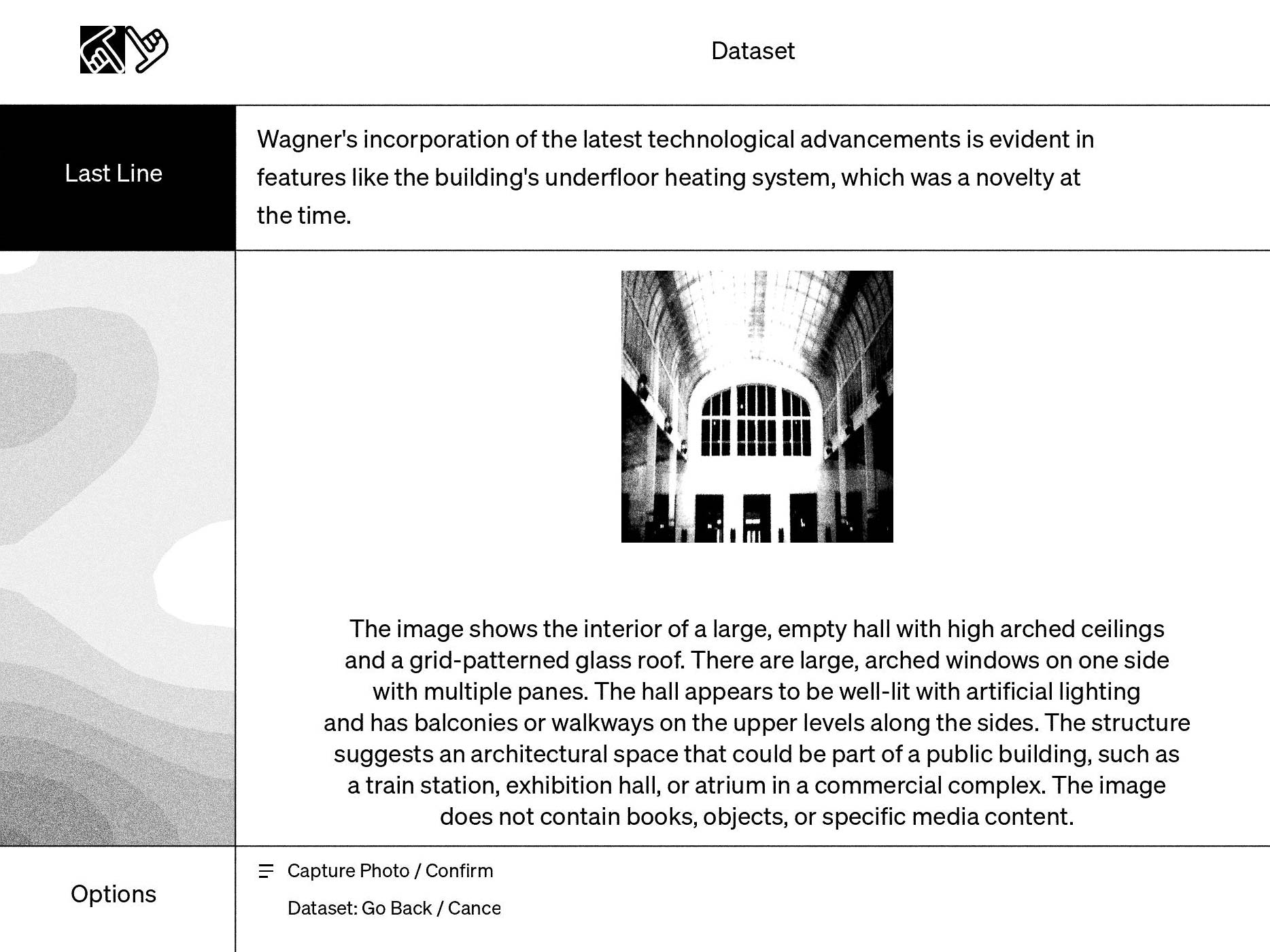
In the background, the image is analyzed using AI image recognition, and a list of selectable keywords is generated. The user is always shown the complete image description beforehand to ensure that the derivation of the tags is logically integrated into the workflow.
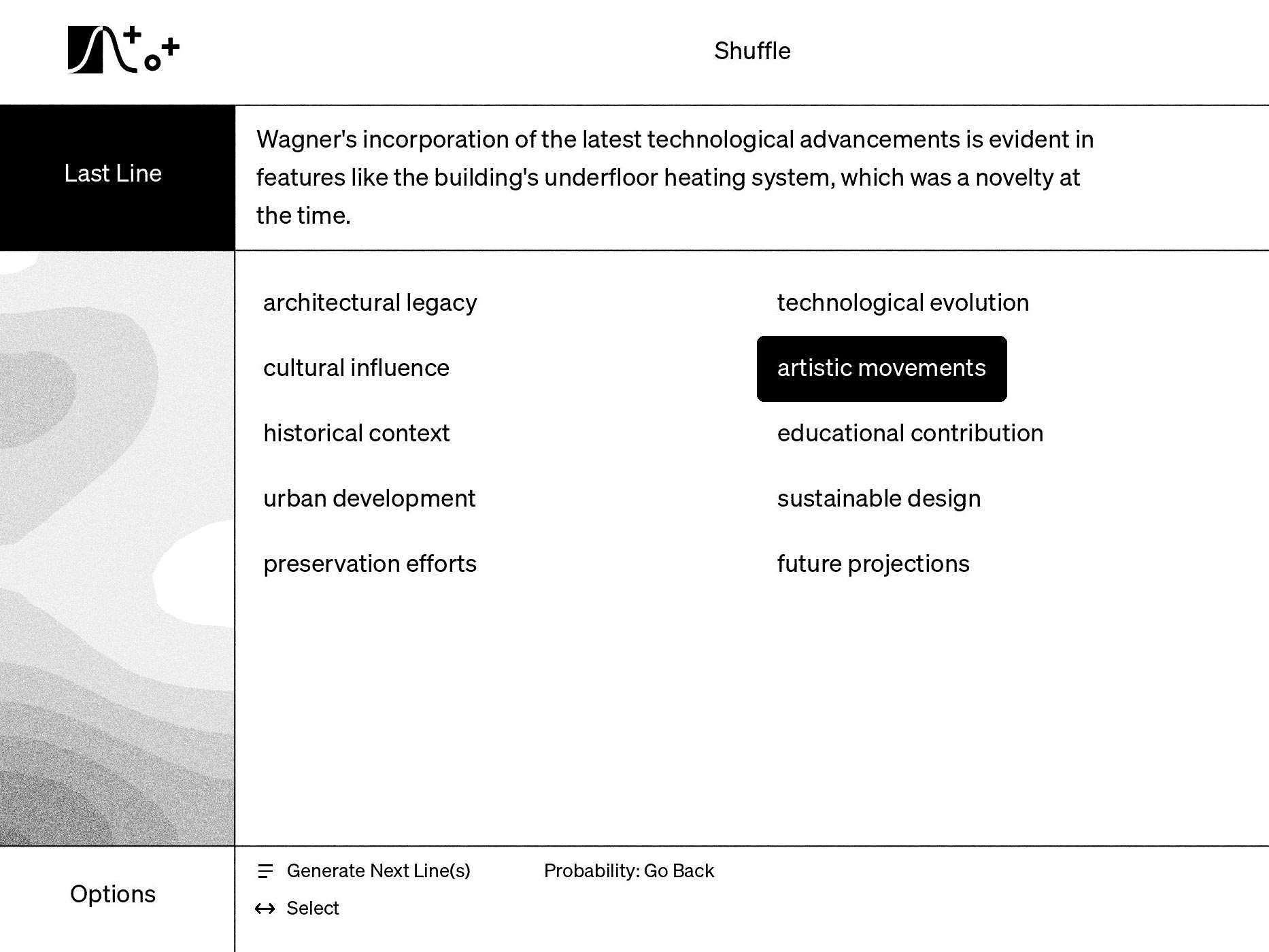
## Probability → Break the loop
An essential problem identified by implementing feedback-loop
based interactions into user-interfaces is the nature of the loop itself. To brake it is one of the
main challenges. Up until know we leveraged the idea of „probable continuation“ in order to
break up loops and let them continue somewhere else. Instead of predicting the most probable
next word or sentence as AI does naturally, on the LLW keyboard students can use the
probability button to ask the AI to give the least probable continuation of a story. This helps
student to understand the nature of the technology and collaborate with it to playfully expand
their personal perspective.
---
## 04 Design Honest Hardware
AI is a fast changing landscape with new developments everyday. To
honestly represent this ever-changing technology and give it a materiality we have to
acknowledge that a design poured into the clear boundaries of a cast unibody, no longer proves
sustainable. We therefore propose exploration into modular hardware like voxel-based modular
design that is able to gracefully react to its obsolescence.
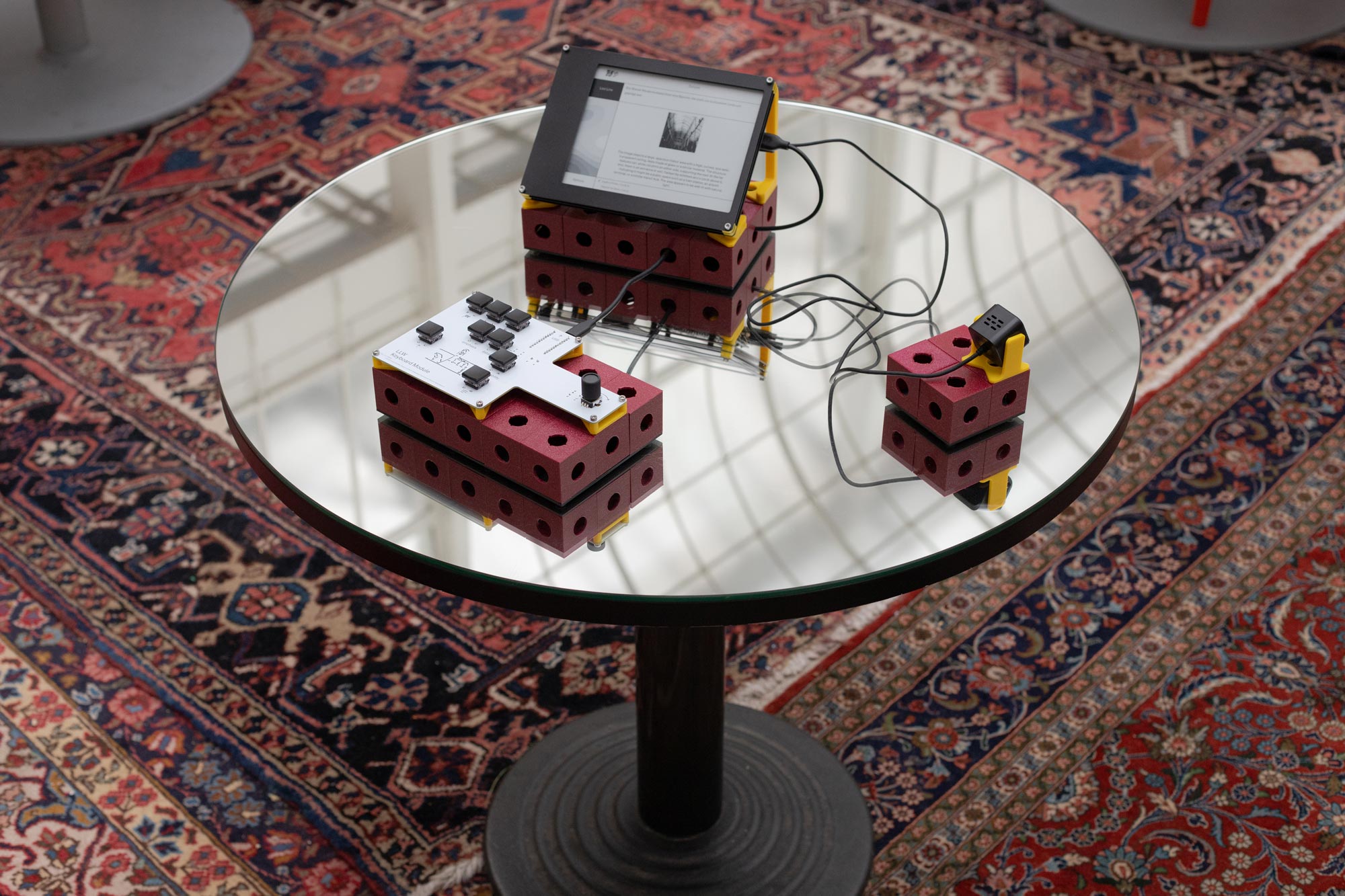
## Modular throughout
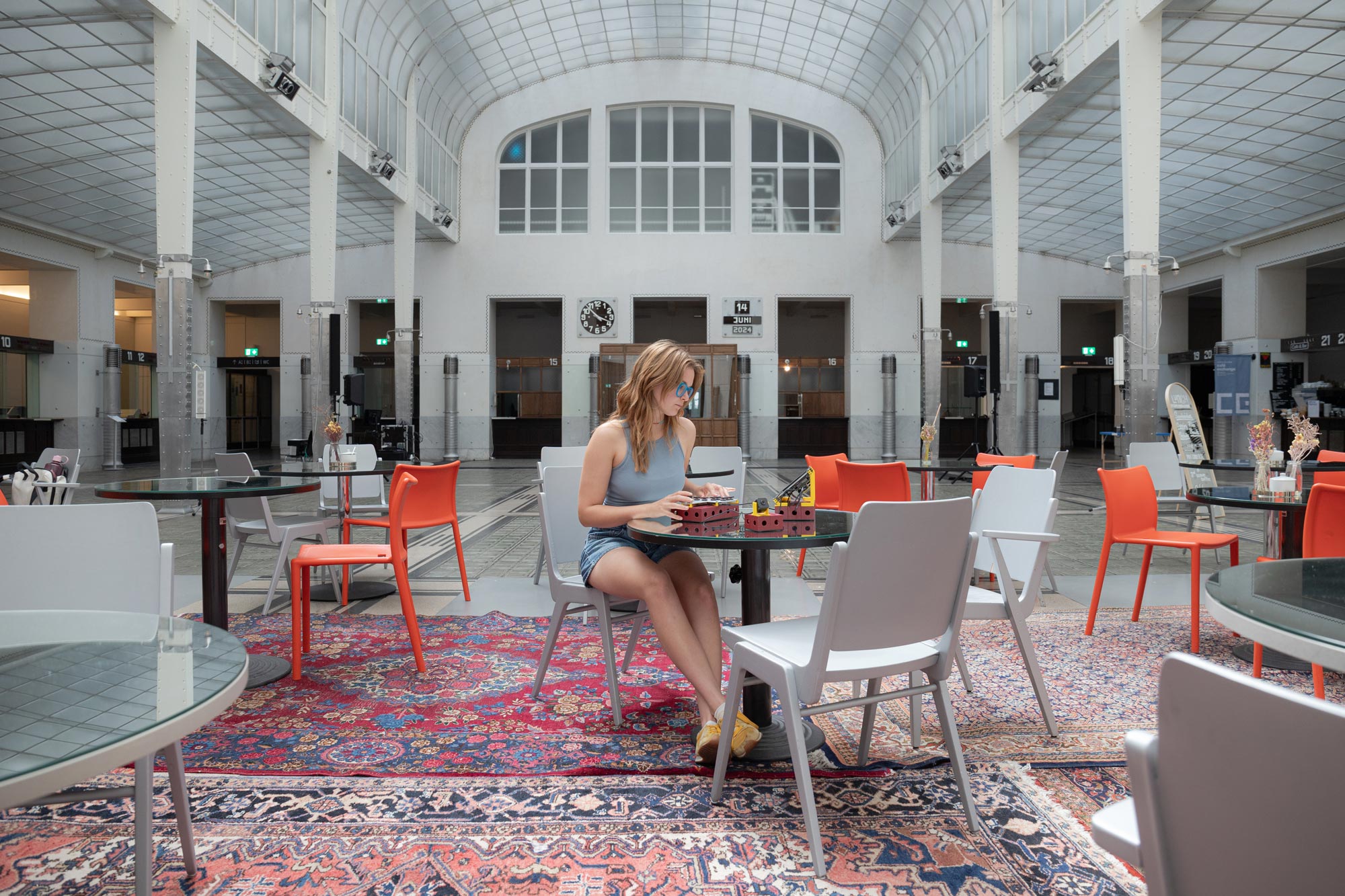
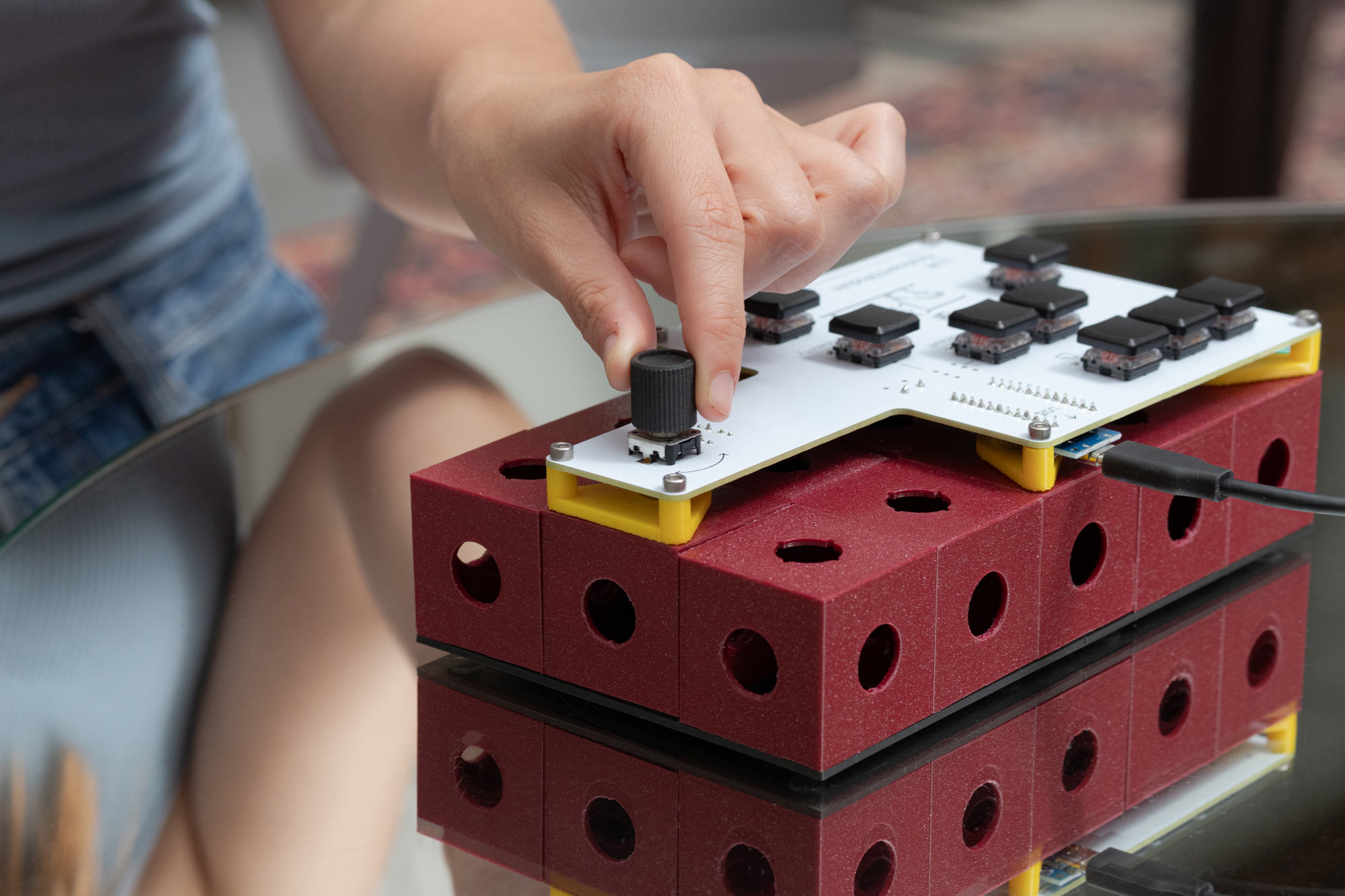
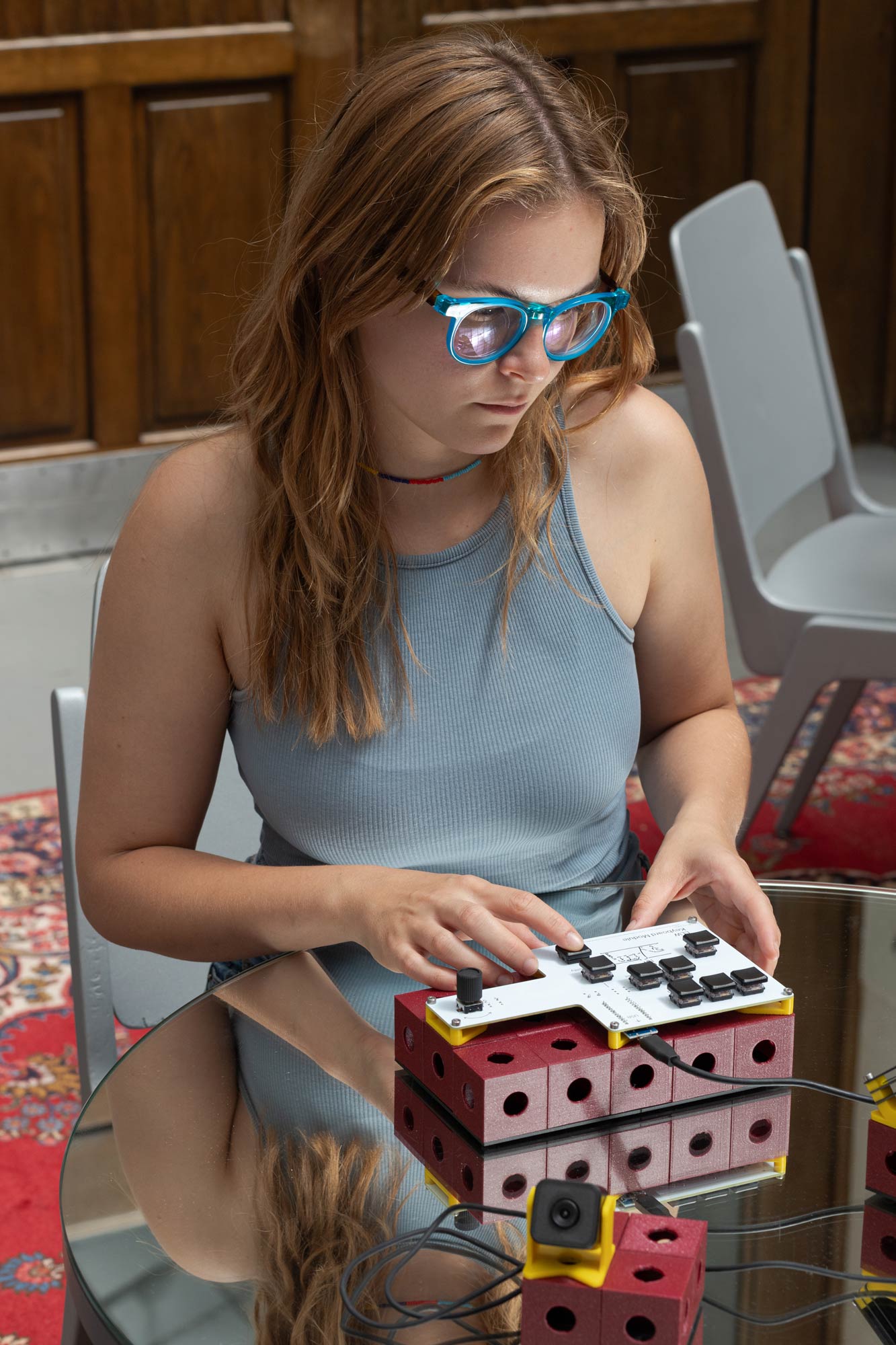
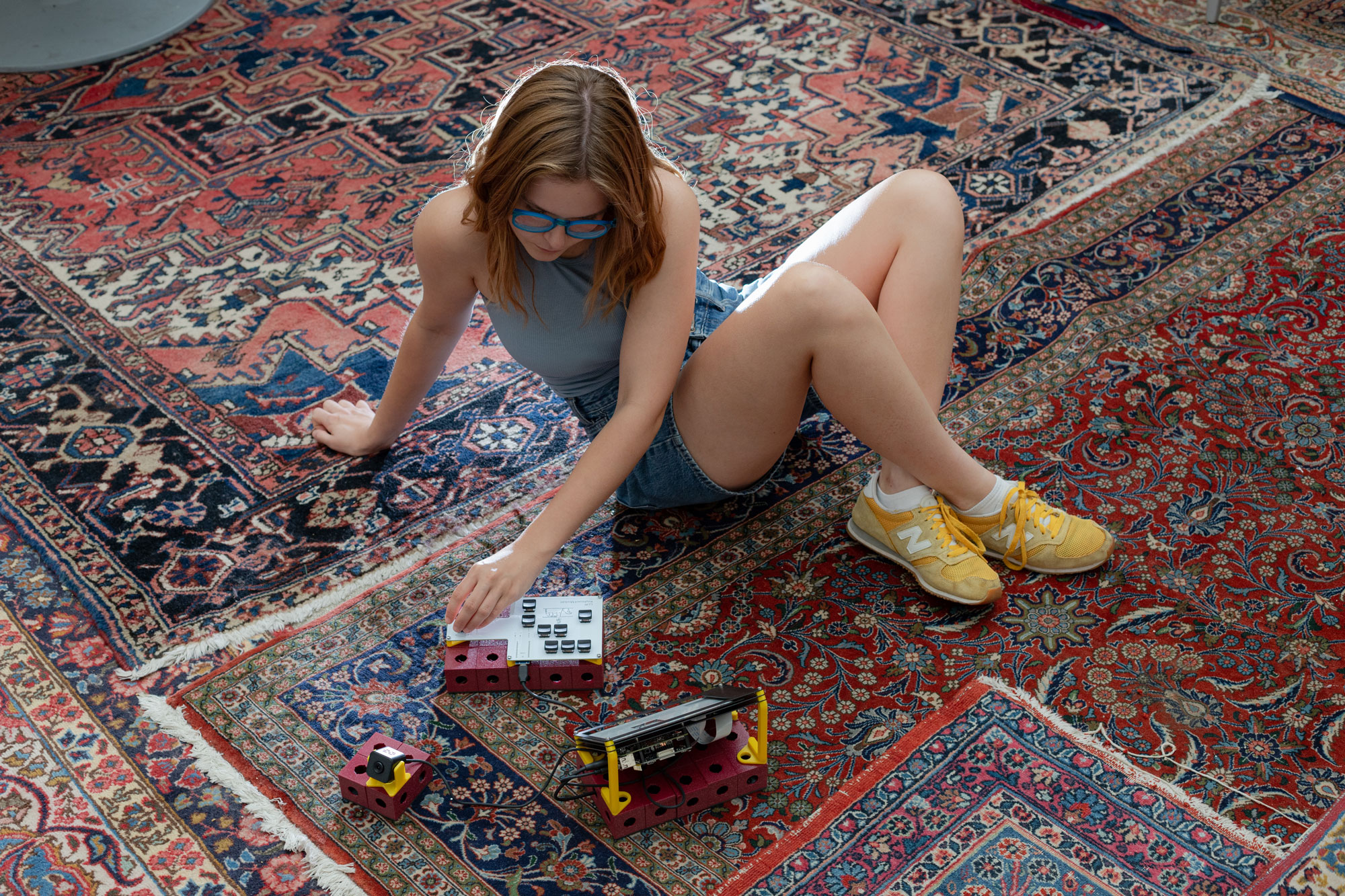
The first prototype of the Large Language Writer consists of a 3D-printed, modular, voxel-based body. This system uses three color codings: red for volume, yellow for connection, and monochrome for function. Using this system, three main assemblies were created: 1. Display Module: This module houses a 2K e-Ink display encased in custom-cut, powder-coated aluminum sheet-metal parts, along with the computer of the LLW. 2. Keyboard Module: This module includes a custom-made circuit board with a hardware design derived from the UI/UX principles declared above. 3. Camera Module: A separate module for the camera.
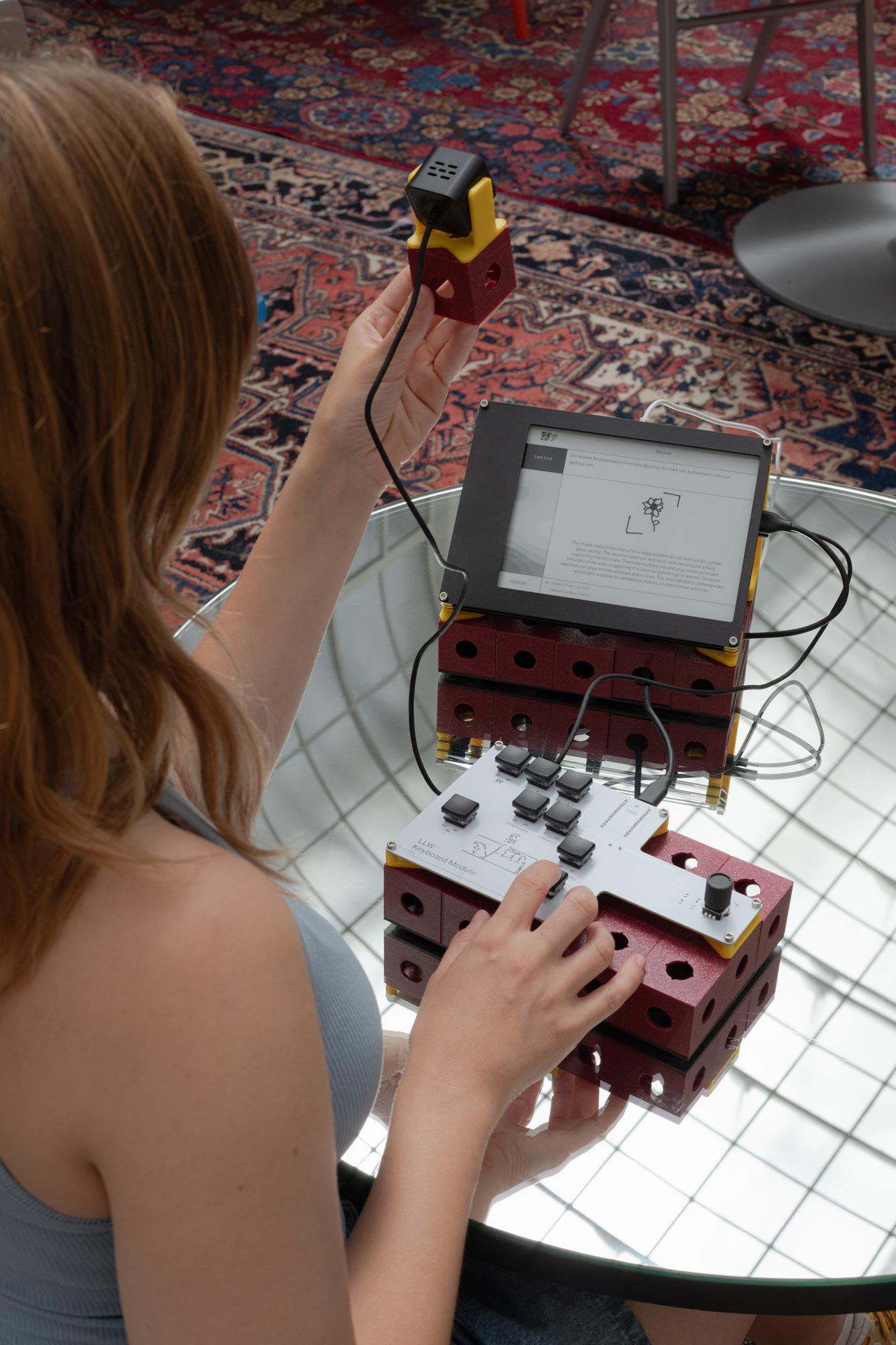
## Keayboard layout
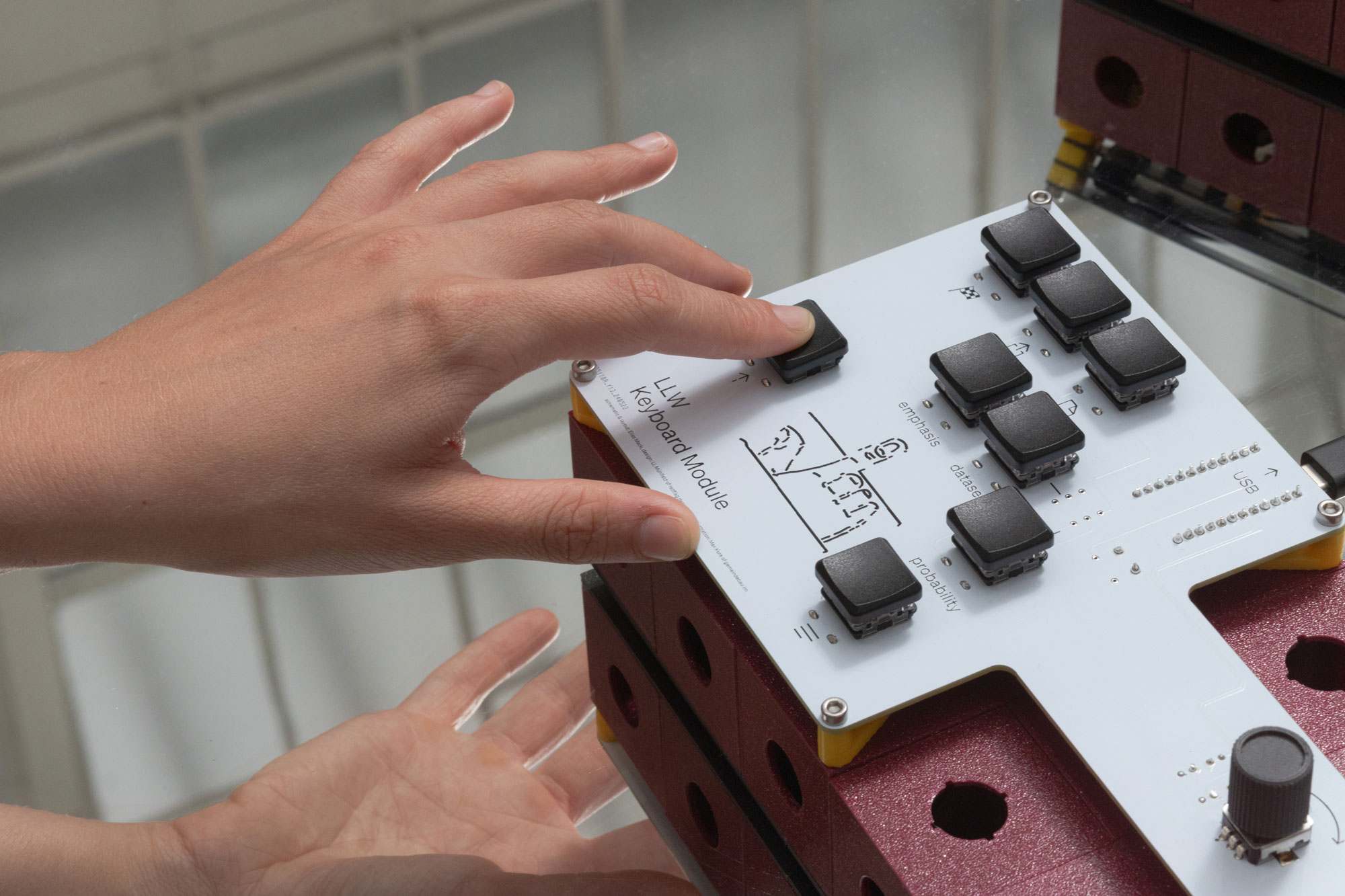
We decided to design and manufacture a circuit board that adheres to the sizes of the underlying grid. This circuit board includes three function keys, a Shift key and three Mode keys: "Emphasis," "Dataset," and "Probability," which toggles the modes described above. There is also a "Write" key, comparable to a Return key. The cursor is controlled using a rotary encoder. A Pro-Micro, which sits on the underside, runs [QMK.](https://qmk.fm){target=_blank} The keyboard can be connected to any computer via USB-C.
---
## 05 Involve the Real World
After developing the prototype and running the first semi-stable version of the software, five individuals from diverse backgrounds—each with a strong connection to writing, whether out of necessity or creativity—were invited to participate. They received a brief tutorial on operating the machine and were allowed to choose their own writing prompts. The participants wrote for 45 minutes to an hour and were subsequently interviewed. This initial testing phase yielded valuable insights, informing potential directions for the continuation of the project.
## Philipp
Philipp, a 16-year-old upper secondary school student, contributed to the test by writing a letter to the editor. While the content of his letter wasn't focused on AI, it provides insight into how students in his age group are engaging with AI in educational contexts.
>You are reading the newspaper report 'Nur keine Spompanadeln' by Michael Omasta from the weekly newspaper Falter dated June 22, 2016, and respond with a letter to the editor.
>
>Initial Prompt
## Flora
Flora, who studied law and is currently working in legislation, offers an important perspective to the tests. Questions of responsibility, accuracy, and contextual awareness, particularly in relation to AI, can be explored. Flora’s insights help to underscore the need for careful consideration of these factors when developing laws and guidelines for emerging technologies. Her contribution adds insights regarding legal and ethical implications.
>A lawyer advises her client based on AI-generated legal research. Describe possible issues in her work using a case example.
>
>Initial Prompt
## Helmut
Helmut, a 56-year-old author, contributes a seasoned perspective to the test. His experience as a writer brings a unique viewpoint on how language, storytelling, and perhaps even AI intersect. While the content of his contribution is not focused on AI, his background as an author enriches these tests by offering insights into how creative professionals engage with evolving technologies.
>Newspaper article about low-threshold free cultural offerings in public spaces in Vienna.
>
>Initial Prompt
## Flora
Flora, an art history student, brings a crucial focus on factual awareness to the testing. Her academic background underscores the importance of precision and context in interpreting information. This perspective is vital in discussions about AI, where accuracy and contextual integrity are essential. Flora’s contribution drew parallels between her field and the challenges AI faces in maintaining these standards.
>My thoughts on Otto Wagner's design for the Peace Palace in The Hague, 1905-1906.
>
>Initial Prompt
## Yucheng
Yucheng, a young lower secondary school student, belongs to a generation where AI is increasingly part of daily life. His experiences highlight how early exposure to AI influences learning and interaction with technology. Yucheng's participation offers a glimpse into the growing role of AI in education and its impact on younger students.
>Inner Monologue: Thoughts of Janine Phew! That was close,
he almost caught me...
>
>Initial Prompt
---
## Credits
Supervisor: [Univ. Prof. Anab Jain & Team from Design Investigations Studio](https://designinvestigations.at){target=_blank}
Project Lead: Leo Mühlfeld
Design: Leo Mühlfeld, [Lucy Li](https://lilucy.at){target=_blank}
Hardware: Leo Mühlfeld
Software Development: [Alan Schiegl](https://designinvestigations.at/people/alan-schiegl/){target=_blank}
PCB Layout: Elias Mack
Pictures: [Fritz Enzo Kargl](https://fritzenzo.cargo.site){target=_blank}
Operator: [Mia Tešić](https://designinvestigations.at/people/mia-tesic/){target=_blank}
Special thanks to: Ursula Gschlacht & Team from the [University Library,](https://www.dieangewandte.at/universitaetsbibliothek){target=_blank} [Max Kure,](https://gemeindebau.im){target=_blank} [Florian Sapp,](https://designinvestigations.at/people/florian-sapp){target=_blank} [Stefan Schönauer](https://schoenauerstefan.at){target=_blank} and Viktor Windisch.
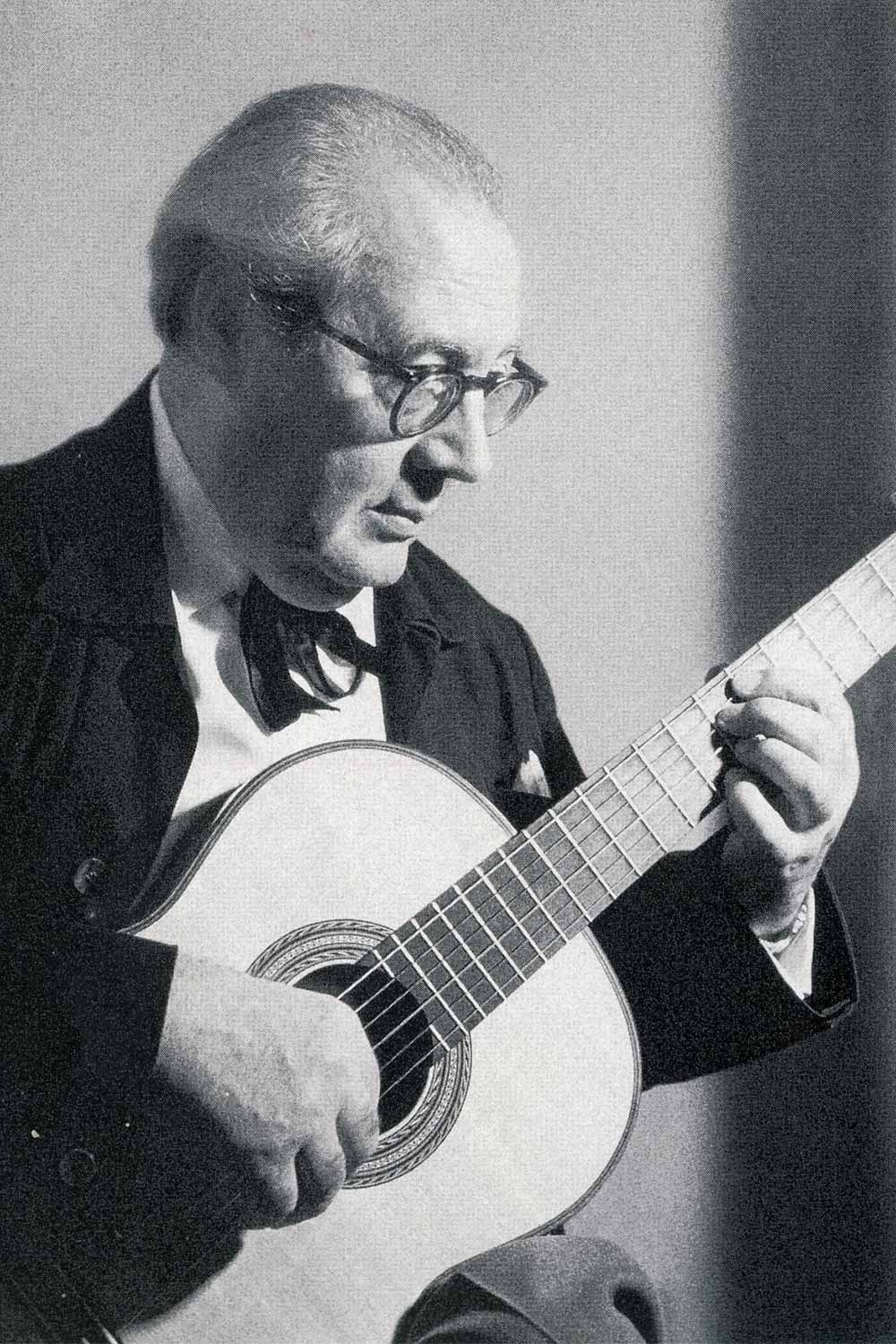
Image of guitar: [Poran111, Flickr](https://www.flickr.com/photos/poran111/13285035304/in/photostream/){target=_blank}
Image of Olivetti ELEA 9003: [Olivetti, Wikimedia](https://commons.wikimedia.org/wiki/File:Console_di_comando_per_sistema_Olivetti_ELEA_9003_-_Museo_scienza_tecnologia_Milano_D1230_01_foto.jpg){target=_blank}
Image of Car-Interior: [Leo Nguyen, Wikimedia](https://commons.wikimedia.org/wiki/File:Interior_of_Model_3.jpg){target=_blank}
Image of Baking Oven: [Gorenje](https://gorenje.com){target=_blank}
iPhone presentation video-still: [John Schroter, Youtube](https://www.youtube.com/watch?v=MnrJzXM7a6o){target=_blank}
ChatGPT screenshot: [ChatGPT by OpenAI](https://chatgpt.com){target=_blank}
Llama screenshot: [Llama by Meta](https://llama.meta.com){target=_blank}
Centaur mosaic: [Mary Harrsch, Flickr](https://www.flickr.com/photos/mharrsch/9525926414/in/photolist-DkeUtC-2mp79sF-2bhRm-2bhRS-fvLS3A-fueGNv-NUpD-xXxUC-fuu1Xj-fueGiH-fvLRS1-fuu1Nu-3hbjGZ-GB3h-9oYgLQ-BLjKP-9oYqiq-BLjKE-9oYgK9-7LC6wv-xXxUb-9oVkD4-2bhSg-GB3B-H2AL-9dkqp6-BLjL2-BLjKb-BLjJU-BLjKw-7LG47Q-TfrV-2Yknpx-3uAWVS-g6G8H-546FzH-546Fte-TfrZ-g6G8T){target=_blank}
Spreadsheets are all you need screencap: [Youtube](https://www.youtube.com/watch?v=yjD2n_e9E3w){target=_blank}
[^1]: Admittedly, a practical application could be to activate these devices during periods of surplus in the power grid, which would require networking them.
[^2]: Upol Ehsan, Q. Vera Liao, Samir Passi, Mark O. Riedl, Hal Daume III [published research](https://arxiv.org/abs/2211.06753){target=_blank} on Seamful XAI: Seamful XAI: Operationalizing Seamful Design in Explainable AI.
---
# Stromkilometer
Canonical URL: https://leomuehlfeld.at/en/stromkilometer
---
title: 'Stromkilometer'
for: 'BRG Bertha von Suttner'
category: 'Product & Engineering'
metaDesc: 'Designing commemorative multiple celebrating Danube river heritage for Viennese ship-school graduates.'
thumbnail: '/img/schulschiff-thomaskirchner.jpg'
date: '2024-06-12T00:00'
showOnLanding: false
heroImage: /img/meadows.jpg
collab: Max Kure
---
# Stromkilometer
## Designing commemorative multiple celebrating Danube river heritage for Viennese ship-school graduates.
## Stromkilometer
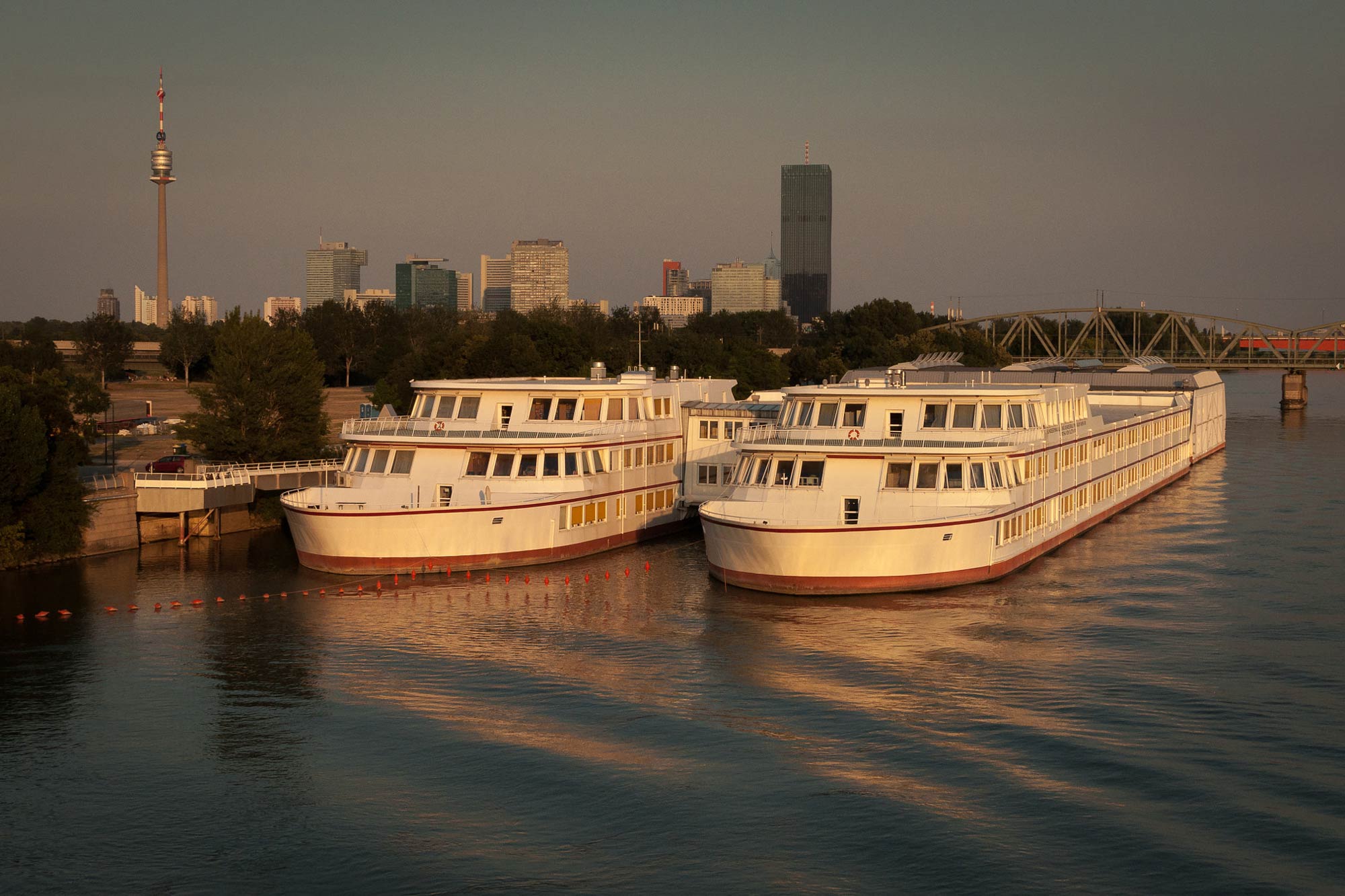
Every year, the "Schulschiff"—a Viennese school located on a ship anchored on the Danube—hosts a competition called the "Stromkilometer." In this competition, students from the University of Applied Arts are invited to design a multiple that the graduating students of that year will receive as a graduation gift along with their diploma.
## Graduation
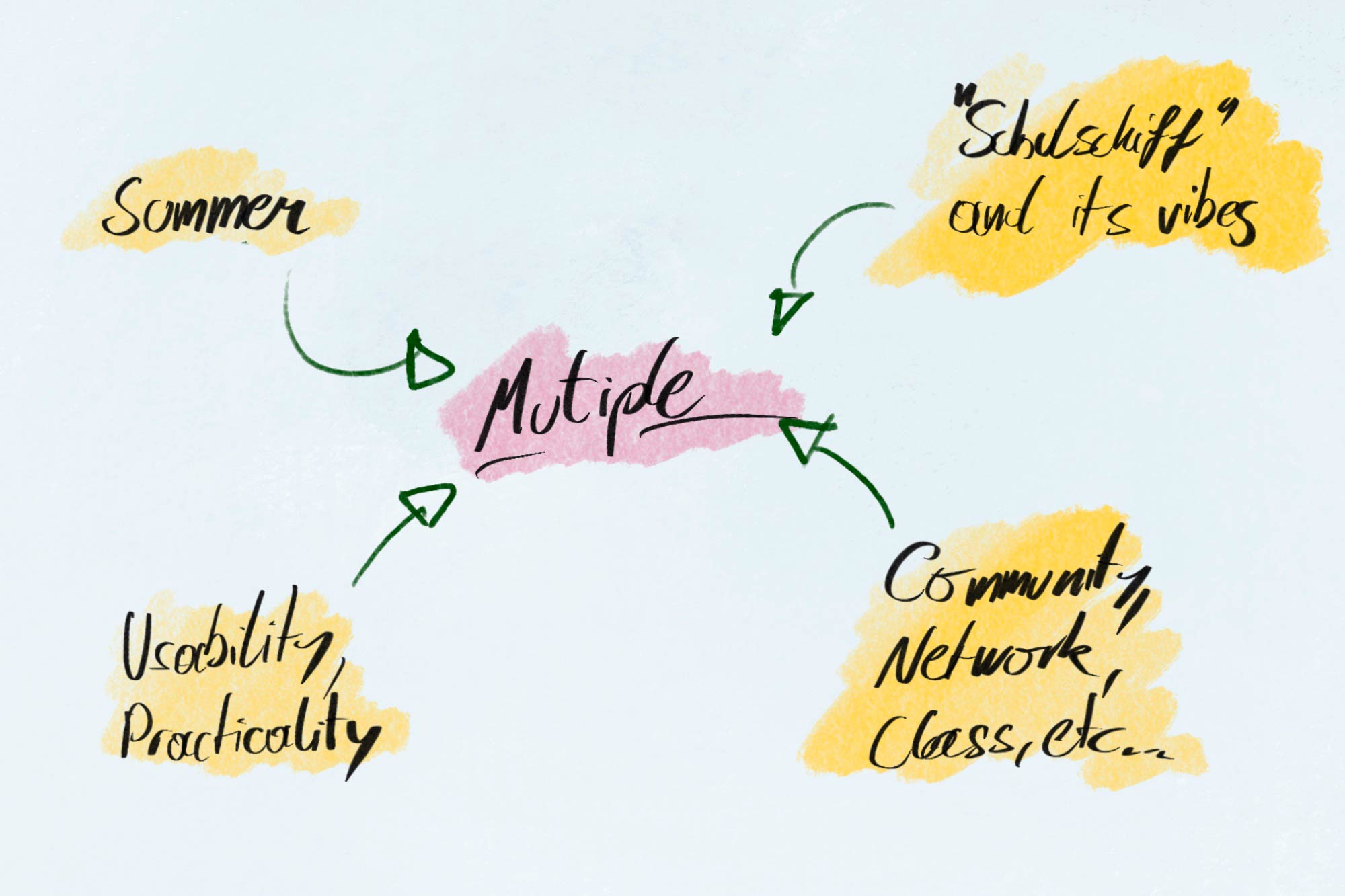
With our idea, we were awarded the project and produced an edition of 90 pieces. Our own graduation wasn't too long ago, and we can still vividly remember the emotional rollercoaster of that time. While school prepares you for many things, it fails to prepare you for the inevitable dissolution of a socially significant community: the class. This social network, which plays an enormously important role in the students' development, was something we wanted to capture with our multiple. It represents looking back on a shared time, growing up together, fun and beautiful moments, but above all, forming long-lasting friendships.
## Multiple
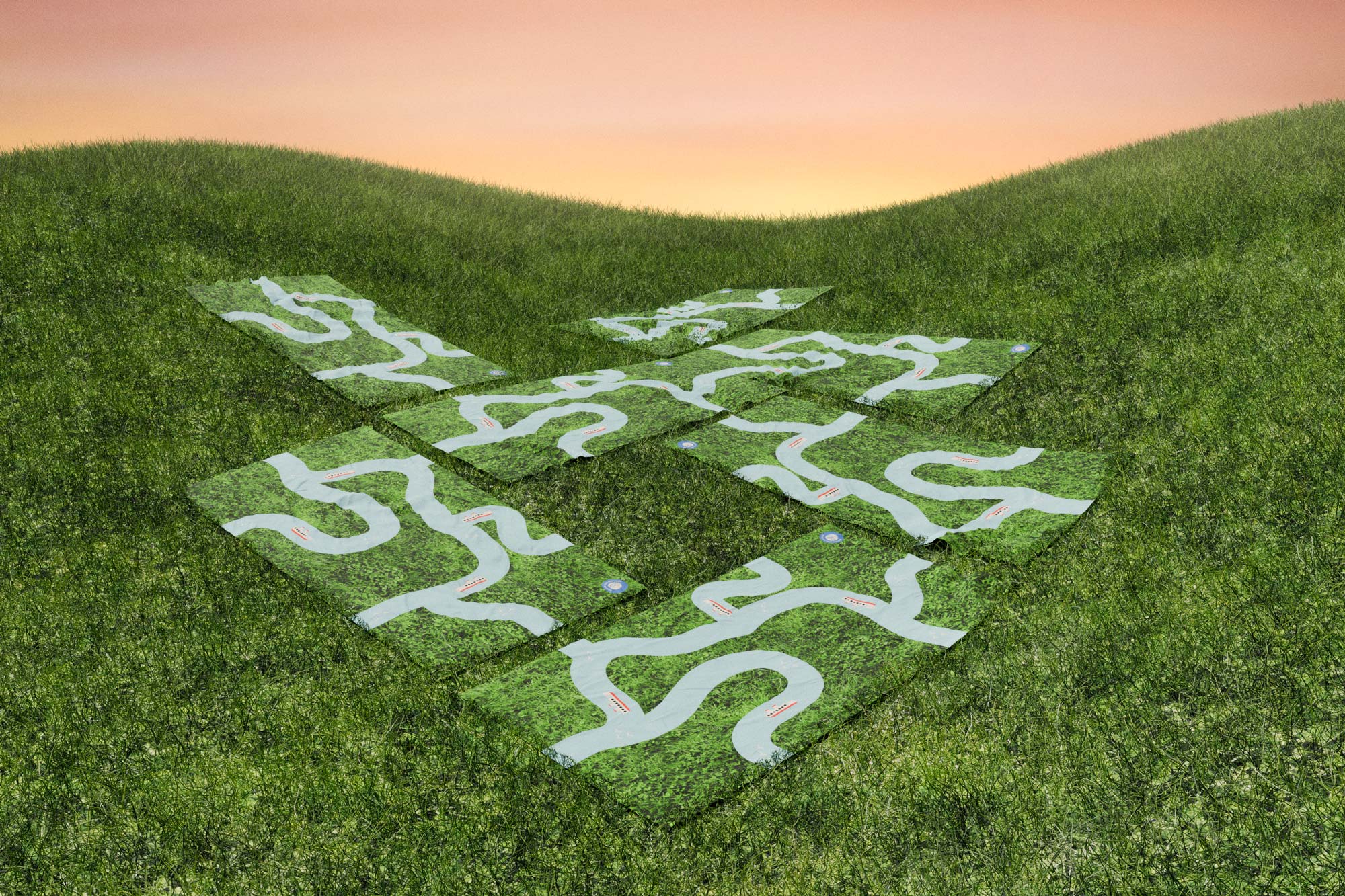
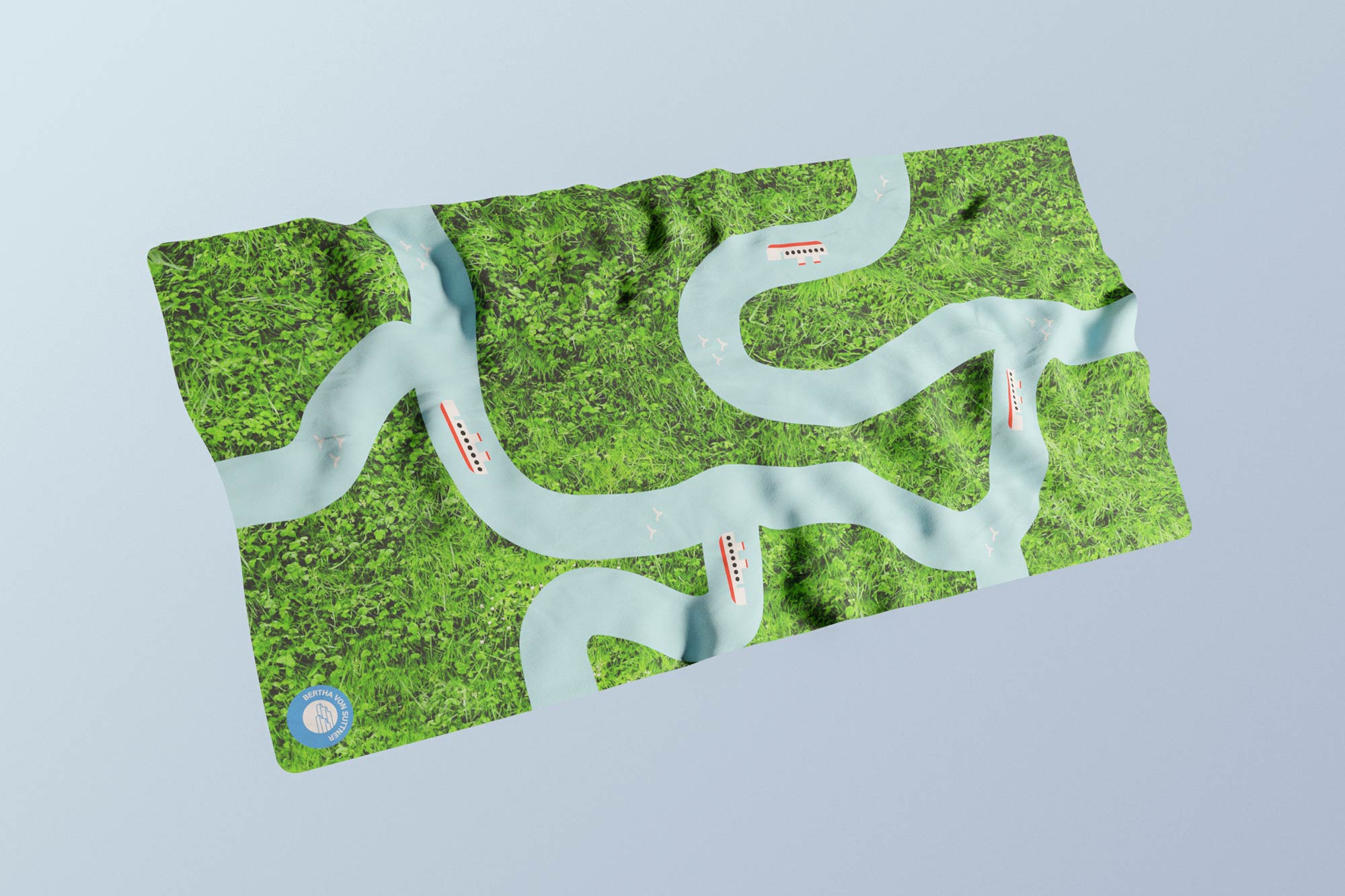
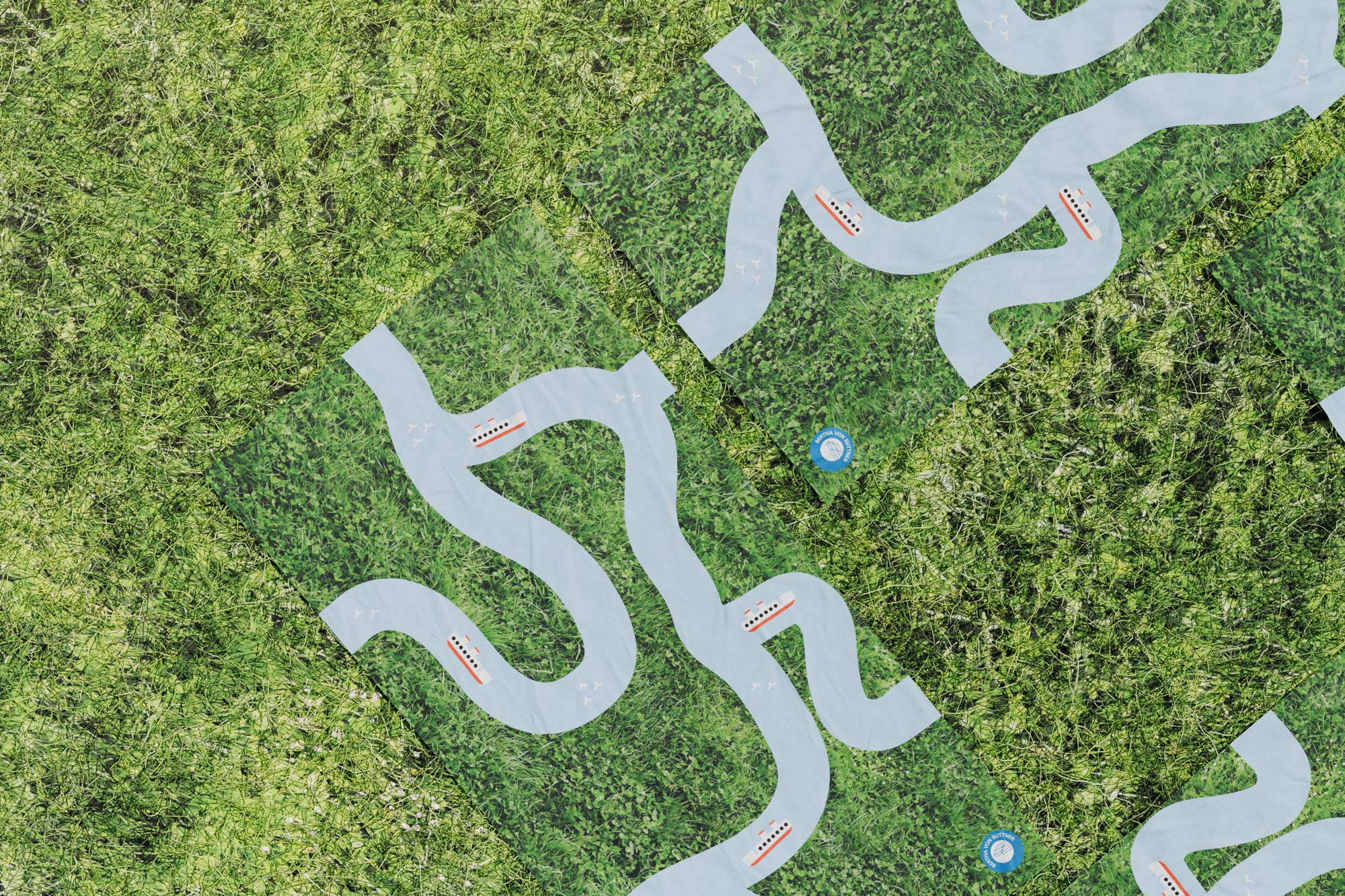
The multiple links the “Schulschiff”, the grassy banks of the Danube and the sense of community in a towel. Inspired by children's play mats with street prints, we designed an r-PET microfiber towel printed with a meadow pattern in the correct scale. When used, the background blends seamlessly with the grassy area, highlighting the second graphic element: a river network featuring a graphic abstraction of the Schulschiff navigating across the towel.
## Pattern
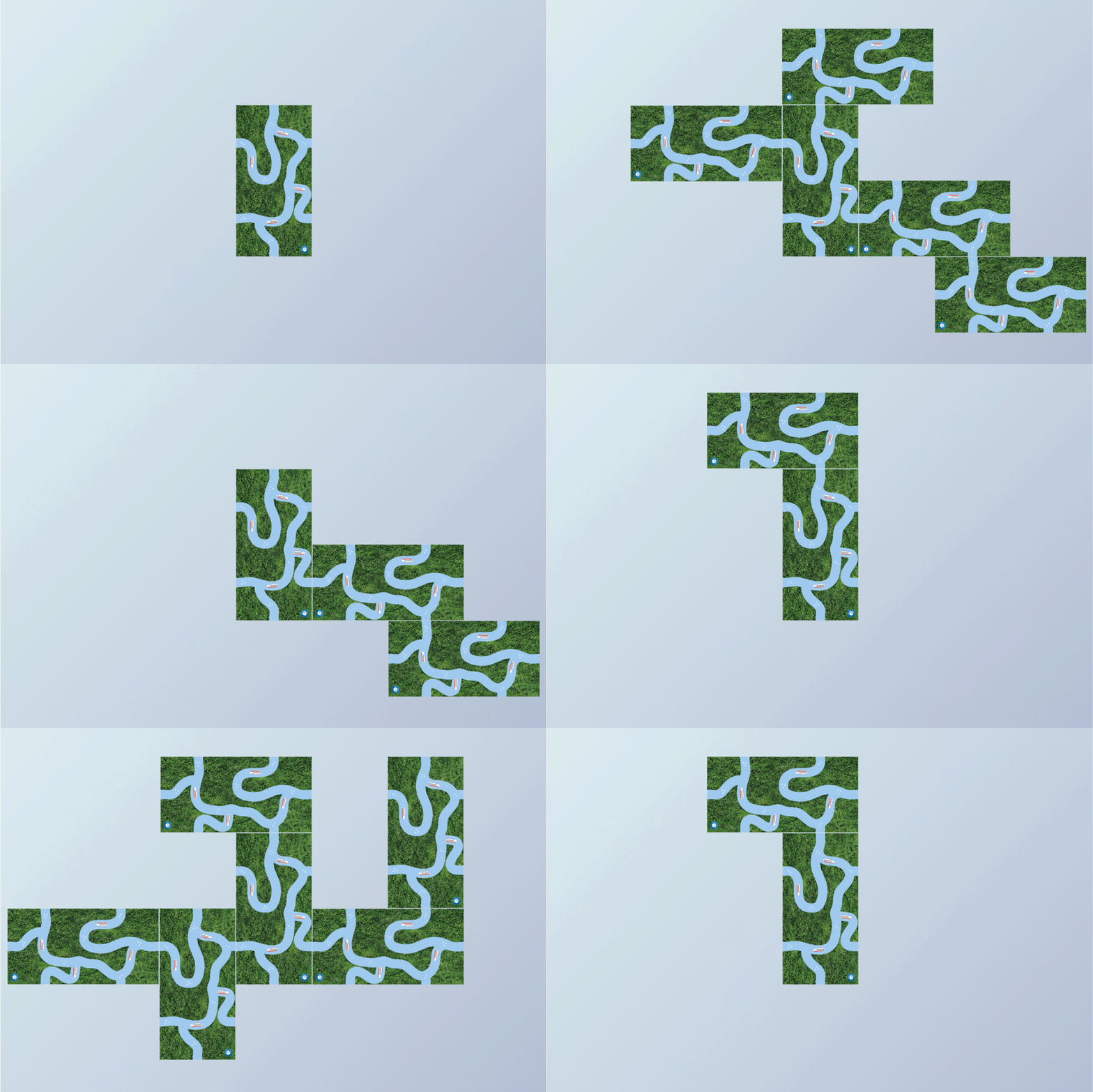
What makes it truly distinctive is revealed when the recently graduated class reunites for a swimming day at Danube Island. As each student lays out their towel, the 1:2 aspect ratio causes the individual designs to connect, forming a continuous river network across the group. The towels, once separate, come together to represent the re-emergence of their social networks.
## Credits
This project was created at [Collective Gemeindebau](https://gemeindebau.im){target=_blank} together with [Max Kure.](https://gemeindebau.im){target=_blank} Picture from the "Schulschiff" by [Thomas Kirchner](https://commons.wikimedia.org/wiki/File:Schulschiff_%28114429473%29.jpeg){target=_blank} under Creative Commons License.
---
# Design with a Purpose
Canonical URL: https://leomuehlfeld.at/en/design-with-a-purpose
---
title: 'Design with a Purpose'
for: 'Vienna Design Week'
category: 'Exhibition & Installation'
metaDesc: 'Designing an Exhibition curated by Vienna Design Week showcasing Circular Economy Design.'
thumbnail: /img/dwap-thumbnail.jpg
date: '2024-04-05T00:00'
showOnLanding: true
collab: Max Kure, Anton Posch
---
# Design with a Purpose
## Designing an Exhibition curated by Vienna Design Week showcasing Circular Economy Design.

## About the Exhibition
The exhibition ["Design with a Purpose",](https://www.biennale.wien/ausstellungen/design-with-a-purpose){target=_blank} which we were commissioned to design, is part of the [VIENNA DESIGN WEEK](https://www.viennadesignweek.at){target=_blank} on behalf of the first [Vienna Climate Biennale.](https://www.biennale.wien){target=_blank} It took place in repurposed halls of the Austrian Federal Railways. The exhibition features over 20 contributions grouped into the categories "Telling Stories," "Rethinking Connections," and "Producing Responsibly."
## The Role of Design
Design, the creation of products, plays a crucial role in sustaining our environmentally harmful consumption habits. However, the work of designers can also be a key to an ecologically and socially sustainable lifestyle. ["Design with a Purpose"](https://www.biennale.wien/ausstellungen/design-with-a-purpose){target=_blank} showcases examples of how design can take responsibility, even though it is a tool developed in the course of the planet's destruction.


## Paths to Sustainability
The objects and projects presented by ["Design with a Purpose"](https://www.biennale.wien/ausstellungen/design-with-a-purpose){target=_blank} shape ways to handle materials, energy, and people with respect, without relying on exploitation. They tell stories and create connections instead of merely inviting superficial consumption. They challenge existing systems with fresh solutions – all while maintaining a focus on aesthetics and functionality. From everyday objects to crafts and the food sector, ["Design with a Purpose"](https://www.biennale.wien/ausstellungen/design-with-a-purpose){target=_blank} brings together over 20 positions developed in the context of [VIENNA DESIGN WEEK.](https://www.viennadesignweek.at){target=_blank} Without claiming to present a solution to the climate crisis, the examples shown demonstrate that design can be responsible, sustainable, and inspiring.
---
## Space Utilization
We were entrusted with the exhibition design and the creation of the graphic design. The setting was an old paint shop characterized by rhythmically placed neon tubes and two large long grids running along the room. In the conceptual phase, we decided to reference the space in our design, making the room a carrier of the exhibition objects without stripping it of its original character. For this, we developed a grid system that visually extruded the existing grids and allowed them to grow modularly into the space.

## Modular Design
The design took form in modules. Each module functioned both as a pedestal and as a support for peripherals such as lighting and information signs. In addition to free-standing modules with heights of 40 and 80 cm, there were L-shaped tables that were 90 cm high and significantly longer, mounted to the wall on one side. Their 1:2 format allowed these modules to be ideally arranged into more complex landscapes. By skillfully placing the modules in the room, we achieved a division into thematic areas and a kind of circuit that, while repeatedly open to allow free movement in the space, still created a certain directional guidance to facilitate easier reception.


## Construction and Adaptability
These modules were assembled from square steel tubes with matching corner connectors. Adjustable feet ensured correct alignment on the damaged industrial floor. Custom-made brackets attached galvanized steel grids, visually referencing those on the floor, to the steel frames. These grids formed a new grid for which we designed and produced our own fittings, allowing the information and lighting level, as well as other add-ons like headphone holders and screen mounts, to be added easily and modularly.


## Graphic Design Elements
We also played with the character of the paint shop on the design of graphic desgign elements. During our inspection, we noticed colorful paint sprays on the walls, likely from testing spray guns. We coded the thematic areas "Telling Stories," "Rethinking Connections," and "Producing Responsibly" in primary colors. In the center of these areas, we deliberately pasted large posters on the walls, resembling the paint splashes, with stylized gradients in the respective category colors. Smaller signs describing the individual objects also featured gradients in these colors, making it easy to assign projects. The large overview poster, also pasted on the wall, contained color gradients from all three categories.


## Reflective Elements
To add an element of contrast, we introduced seven spherical mirrors in various sizes and designs. These mirrors, some up to one meter in diameter, became popular photo spots. Due to their convex shape, the entire exhibition naturally appeared in every photo taken. Conceptually, they played on the idea of reflection in a space where design is invited to critically examine itself. The stringent linear grid of the room, derived from the tiled walls, the rhythmic arrangement of the lamps, and the straightly laid conduits, was disrupted by the mirrors, which were clearly distinct elements. In their reflections, not a single straight line existed.


## Credits
An exhibition by [VIENNA DESIGN WEEK](https://www.viennadesignweek.at){target=_blank} on behalf of the [Vienna Climate Biennale.](https://www.biennale.wien){target=_blank} Enabled by the [Climate and Energy Fund.](https://www.klimafonds.gv.at){target=_blank}
Curation: Gabriel Roland
Additional Curation: Alexandra Brückner, Laura Winkler, Studio Vandasye
Exhibition Design: Designkollektiv [Gemeinde-Bau](https://gmeindebau.im){target=_blank} (Max Kure, Leo Mühlfeld, Anton Posch)
Project Management: Alexandra Brückner
## Participants
Assembly of Technologies for Material Transformation through Fire
[Johanna Seelemann](https://johannaseelemann.com){target=_blank} / [Pyrarium](https://www.pyrarium.com){target=_blank}
Children's Table Children's Choice
[überkochen e.V.](https://ueberkochen.org){target=_blank} / [GOURMET Kids](https://www.gourmet-kids.at){target=_blank}
Circular Design Rules 2.0
[IDRV](http://www.idrv.org){target=_blank}
CIRCULAR SHOWER
[EOOS](https://www.eoos.com){target=_blank} / [Vöslauer](https://www.voeslauer.com){target=_blank}
Das Fest des Wassers
[Alexandra Fruhstorfer](https://www.alexandrafruhstorfer.com){target=_blank} / [Boehringer Ingelheim](https://www.boehringer-ingelheim.com/at/de){target=_blank}
FILL IT, [Franzi.ist](https://franzi.ist){target=_blank}
[Goodgoods](https://goodgoods.at){target=_blank}
Free To Reuse - Nachnutzung von Exportverpackungen
[STUDIO RE.D](https://www.studio-red.design){target=_blank} / [PAWEL PACKING & LOGISTICS](https://www.pawel.at){target=_blank}
FUTURE CHIPS
[EOOS](https://www.eoos.com){target=_blank} 2022
GAIA - Compostable Object Series
[Georg ADAM](https://adamgeorg.com){target=_blank}
inWASTEment glass
[mischer'traxler studio](https://mischertraxler.com){target=_blank}
Klimadashboard: Daten & Fakten zur Klimakrise in Österreich
[David Jablonski](https://davidjablonski.at){target=_blank}
LAUFEN save!
[EOOS](https://www.eoos.com){target=_blank} 2019
LICKING ROCKS STONE CUPS
[simiaen.studio](https://simiaen.com){target=_blank}
Livin Farms “Hive Explorer” Insektenfarm für zu Hause
[Katharina Unger](https://www.livinfarms.com/about){target=_blank}
Membran - Stadt Vernetzen
[Julia Habarda, Julia Hahnl, Frieda Teller und Tobias Kauer](https://www.viennadesignweek.at/player/membran/){target=_blank}
Political Atmosphere
[Felix Lenz](https://felixlenz.at){target=_blank}
PUDDLE
[ante up – Benedikt Stonawski & Hauke Unterburg](https://anteup.at){target=_blank}
RAW CREAMER mini/regular
[feinedinge porzellanmanufaktur gmbh](https://www.feinedinge.at){target=_blank}
ROUGH
[Jakob Glasner](https://jakobglasner.com){target=_blank} / Markus Well
Shaping residue
[Christoph Wimmer-Ruelland](https://christophwimmerruelland.com){target=_blank}
Tokens for Climate Care
[Process – Studio for Art and Design OG](https://process.studio){target=_blank}
Trinkservice No.283 - Fortune - Editionen
[Mark Braun](http://www.markbraun.org/start/){target=_blank} / [LOBMEYR](https://www.lobmeyr.at){target=_blank}
Wasteware
[Barbara Gollackner](https://www.barbaragollackner.at){target=_blank}
YOGI Hocker / Beistelltisch
[ONE FOR HUNDRED](https://oneforhundred.com){target=_blank}
---
# Serpentine
Canonical URL: https://leomuehlfeld.at/en/serpentine
---
title: 'Serpentine'
for: 'Gemeindebau.im'
category: 'Product & Engineering'
metaDesc: 'Designing CNC-bent aluminum lamps with Gemeindebau.im, 2024 — a study in collaborative production with local fabricators in Vienna and Lower Austria.'
thumbnail: '/img/bleche.jpg'
date: '2024-02-16T00:00'
showOnLanding: false
heroImage: /img/night.jpg
---
# Serpentine
## Designing CNC-bent aluminum lamps with Gemeindebau.im, 2024 — a study in collaborative production with local fabricators in Vienna and Lower Austria.
## The idea of collaborative industry
The vision of collaborative industry proposes a local production culture based on open-source digital files, computer-aided production methods and the concept of makerspaces, which are going to be found in every major city within walking distance. By opening up designs for modification and tampering, something that could be called participatory consumation might emerge. The automatically acquired understanding flattens the hierarchy between producer and consumer and aims to create a conscious and responsible balance between production and consumption.
## Proof of concept?
The Serpentine lamp attempts to turn this vision into reality. The clamp mechanism as well as the lampshade and the holder for the E14 socket are laser-cut from a single sheet of aluminum that is precisely CNC-bent. The data for the housing and a parts list are [openly accessible](https://github.com/leomuehlfeld/Serpentine){target=_blank} and can be produced/ordered from local or international suppliers for digital manufacturing. As it is an open source system, ideas and requests can be designed, submitted and negotiated in a conversational setting. With a few simple steps, Serpentine can be assembled anywhere. The prototypes for Serpentine were produced by the Austrian manufacturer [Kovac-Stahl,](https://www.kovac-stahl.at){target=_blank} for example.
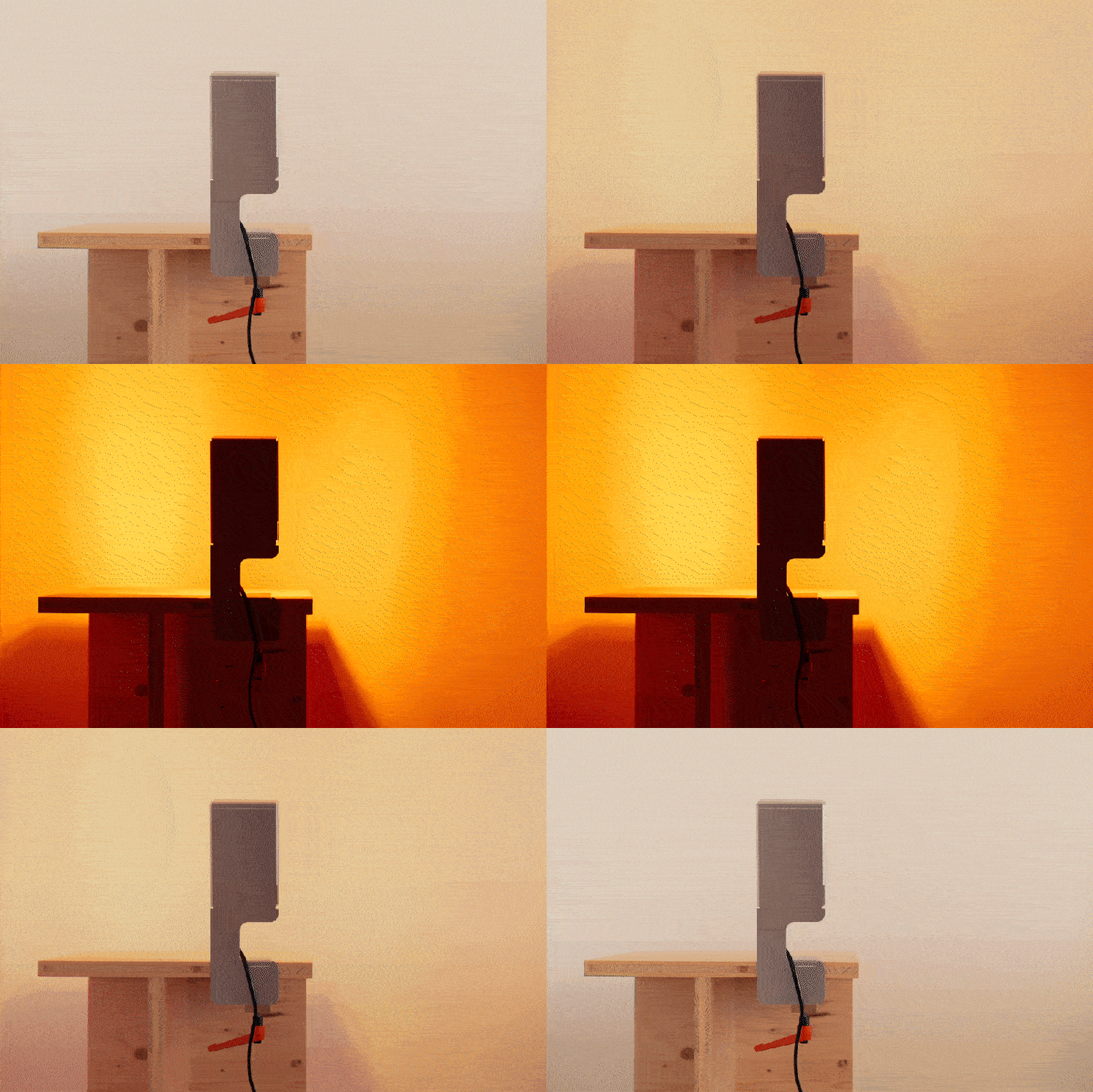
## Assembly
Serpentine is made of 1.5 mm thick aluminum sheet. While the prototype has no surface treatment to increase the patina friendliness, powder coatings, anodizing, etc. are an option. Apart from the actual aluminium housing, 4 other standard parts are required. An M8 rivet nut, a clamping lever with the matching foot and the wiring. The only manual work step is to insert the M8 rivet nut through which the clamping mechanism can be screwed.
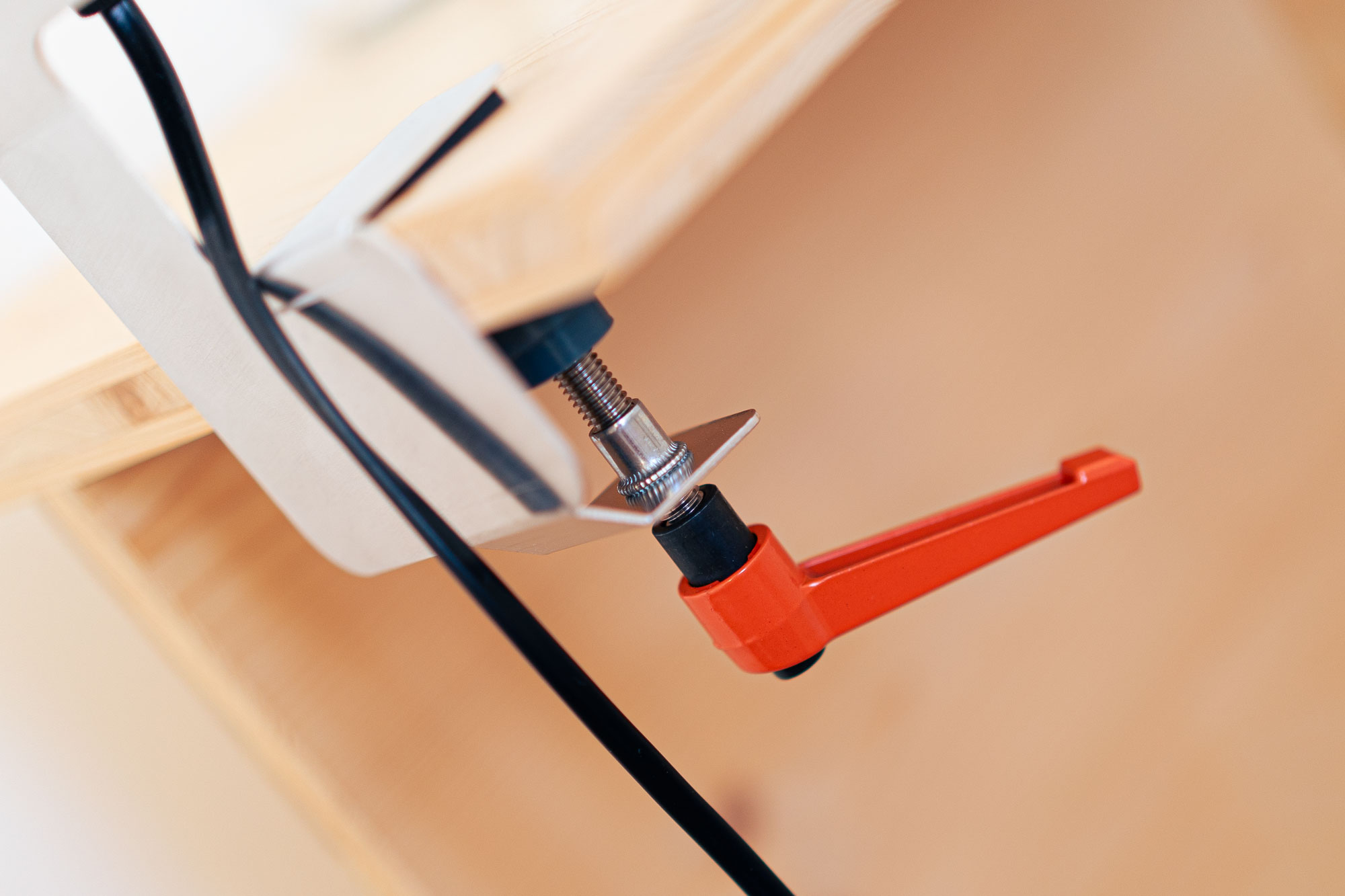
## Credits
Design by Leo Mühlfeld. Thanks to Matthias Pfeffer for engineering advice.
---
# Reality Goggles
Canonical URL: https://leomuehlfeld.at/en/reality-goggles
---
title: 'Reality Goggles'
for: 'Design Investigations'
category: 'Design Research & Speculation'
metaDesc: 'Prototyping AI-supported AR glasses revealing hidden architectural elements in urban spaces.'
thumbnail: /img/rg-blur.jpg
date: '2024-01-24T00:00'
showOnLanding: false
heroImage: /img/rg-heldenplatz.jpg
collab: Leo Hafele, Bjørn Ravlo-Leira, Johannes Mayer
---
# Reality Goggles
## Prototyping AI-supported AR glasses revealing hidden architectural elements in urban spaces.
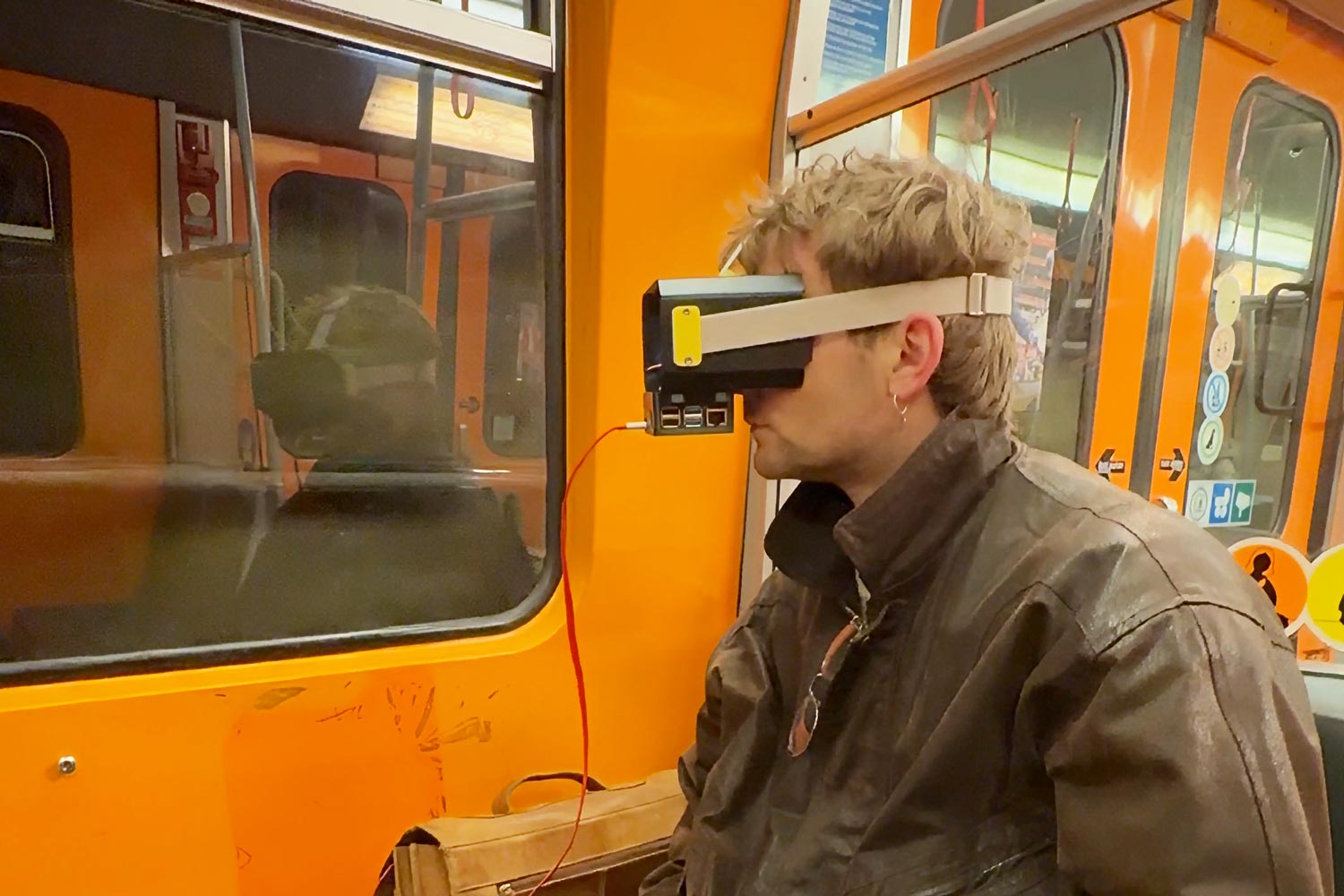
## Liminality in urban planning
We all know the voyage as a moment of liminality & transition. Worries are quickly forgotten before they pop into our minds again just before the plane lands. On long train journeys, we can enjoy the view out of the window, which gives us an insight into the course of our journey. In urban areas however, we experience architectural pragmatization resulting in serialization. One example of this is the subway, which has windows through which you can only see the wall of the tunnel. Subway-stations also serialize the city architecturally and abstract it into names on signs.
## The X-ray vision vision
We wondered how it must feel to look up while sitting in the subway and, through fancy X-ray technologoy, see the world above you. All the pipes running through the ground, secret cellars and undiscovered worlds but also the well known city of vienna up above. One could regain a sense of travelling. Of course X-ray vision really stays a vision. For now. But after seeing [Paragraphica](https://bjoernkarmann.dk/project/paragraphica){target=_blank} by [Bjørn Karmann](https://bjoernkarmann.dk){target=_blank} we thought with the help of a little bit of generative AI we could at least try to build a tangible prototype that attemps this with todays tech.
## Functional prototype
We set out to build a prototype that would bring this idea closer to reality. Our 3D-printed headset uses the so-called ["Pepper's Ghost Effect",](https://de.wikipedia.org/wiki/Pepper’s_ghost){target=_blank} in which a pane of glass tilted at 45° reflects an image shown on a screen above or below the glass into the viewer's eyes, while letting light from the real world through. This technique is actually very old and has been used in theaters for a long time.
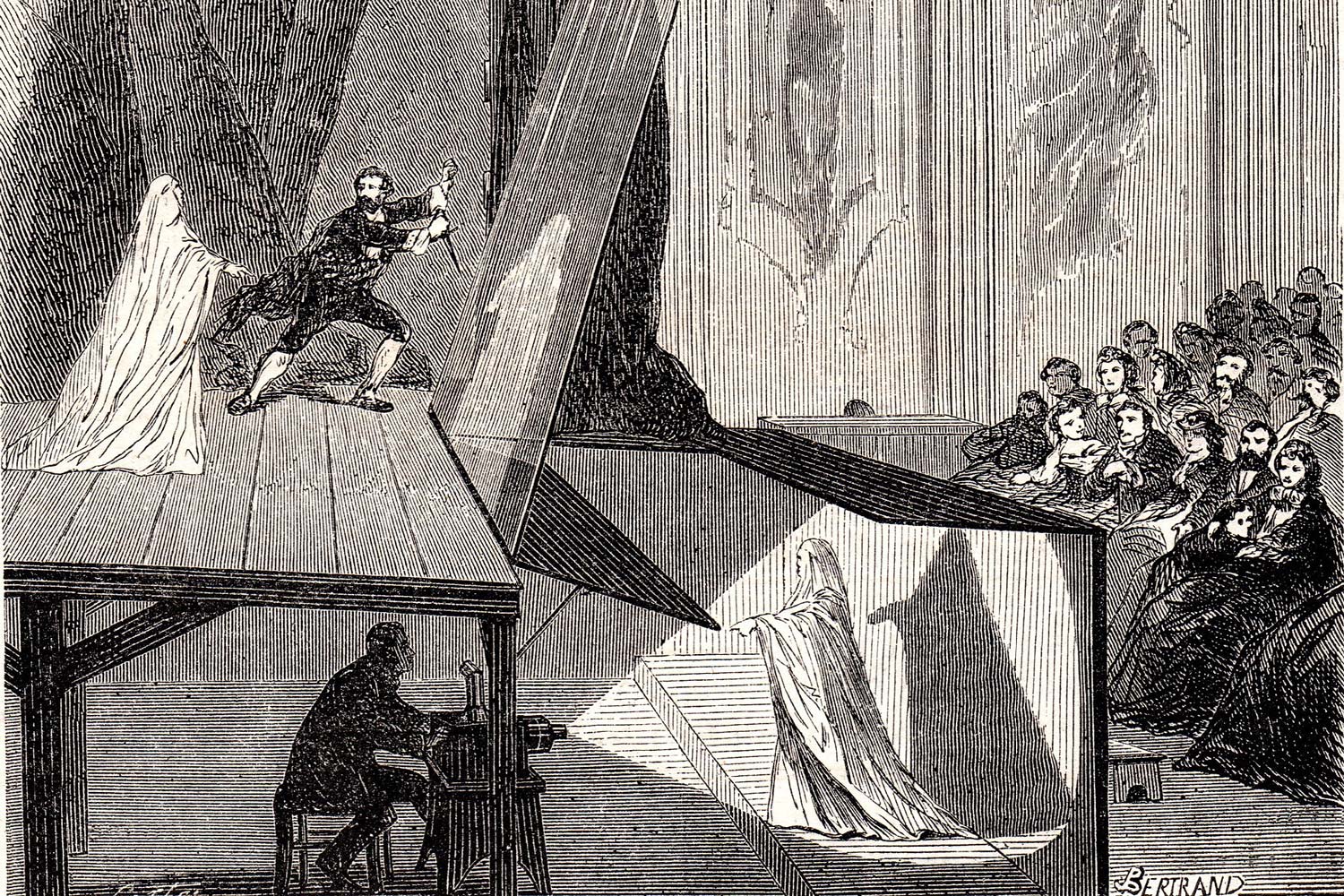
A RaspberryPI is mounted to the bottom of the headset with its screen facing upwards. Running a Python script that connects to various APIs, the little computer displays AI-generated approximated images of your surroundings on its screen. Through the tilted glass pane, the wearer can see the AI-generated image and the real world simultaneously.
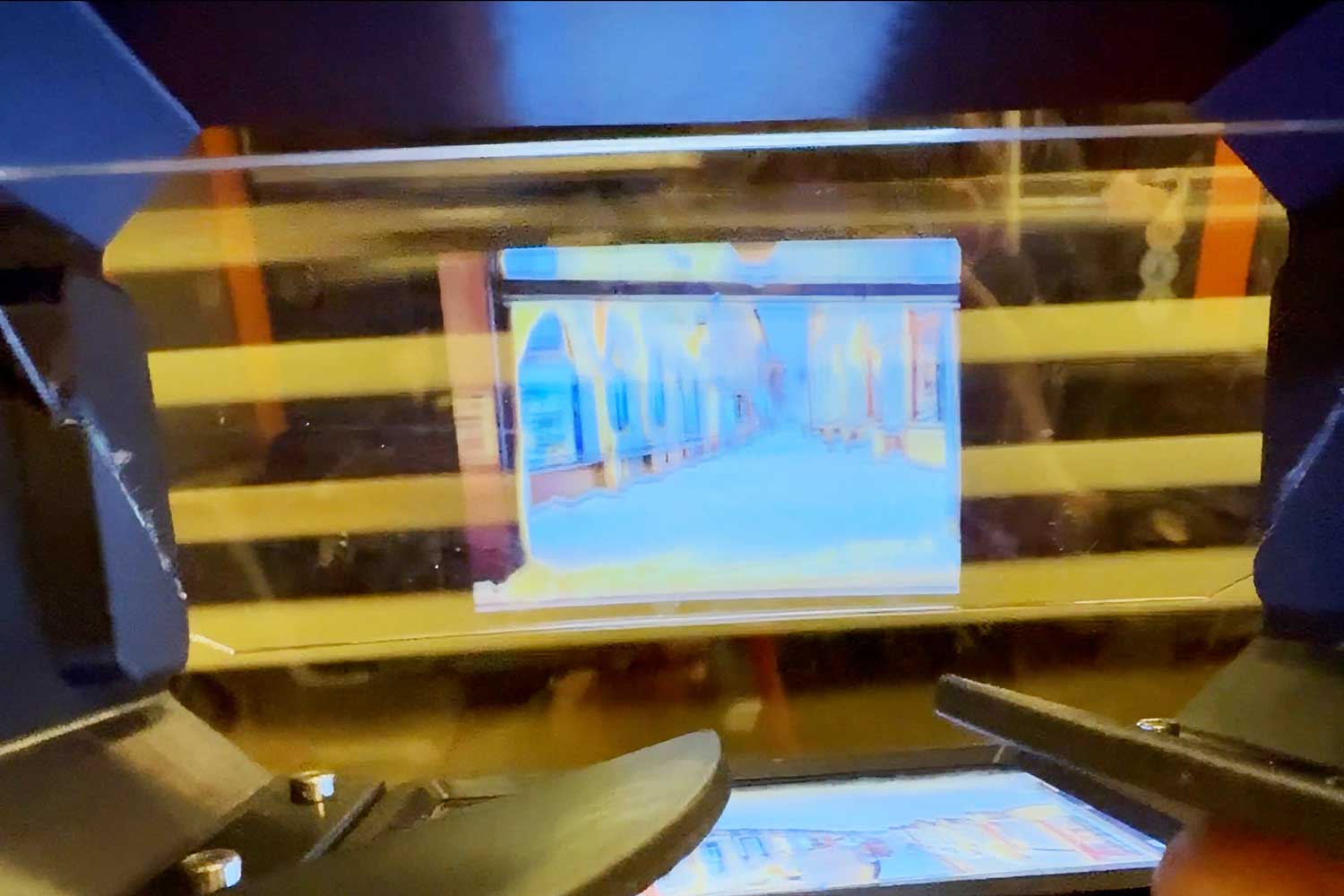
The cover is mainly used to darken the area around the eyes. At the bottom is a pod in which both the RaspbberyPi and a 3.5 inch monitor shield are mounted. The headband is modeled after the one used on the MetaQuest 2 and is held to the main body by yellow clamps. It is adjustable in size.
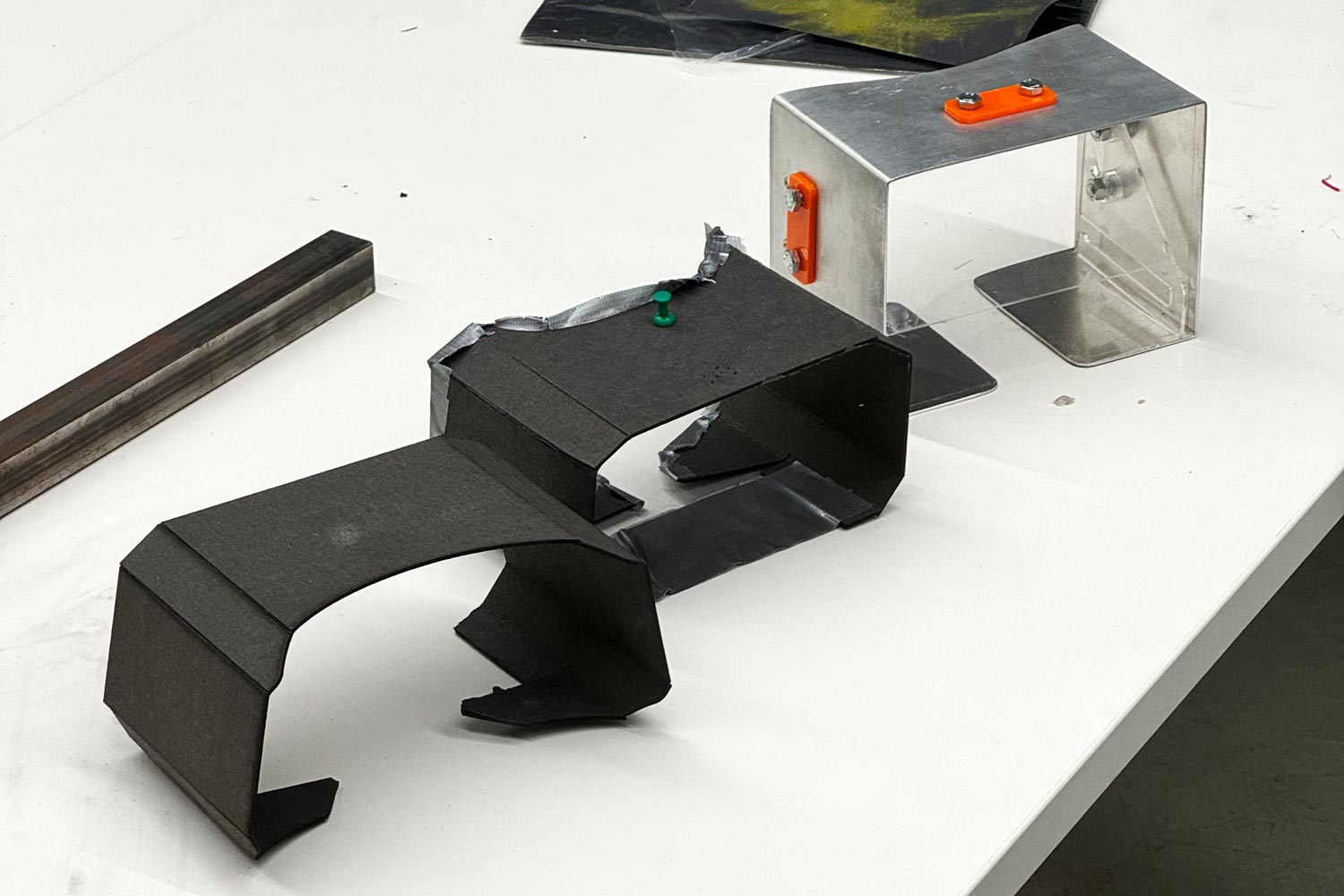
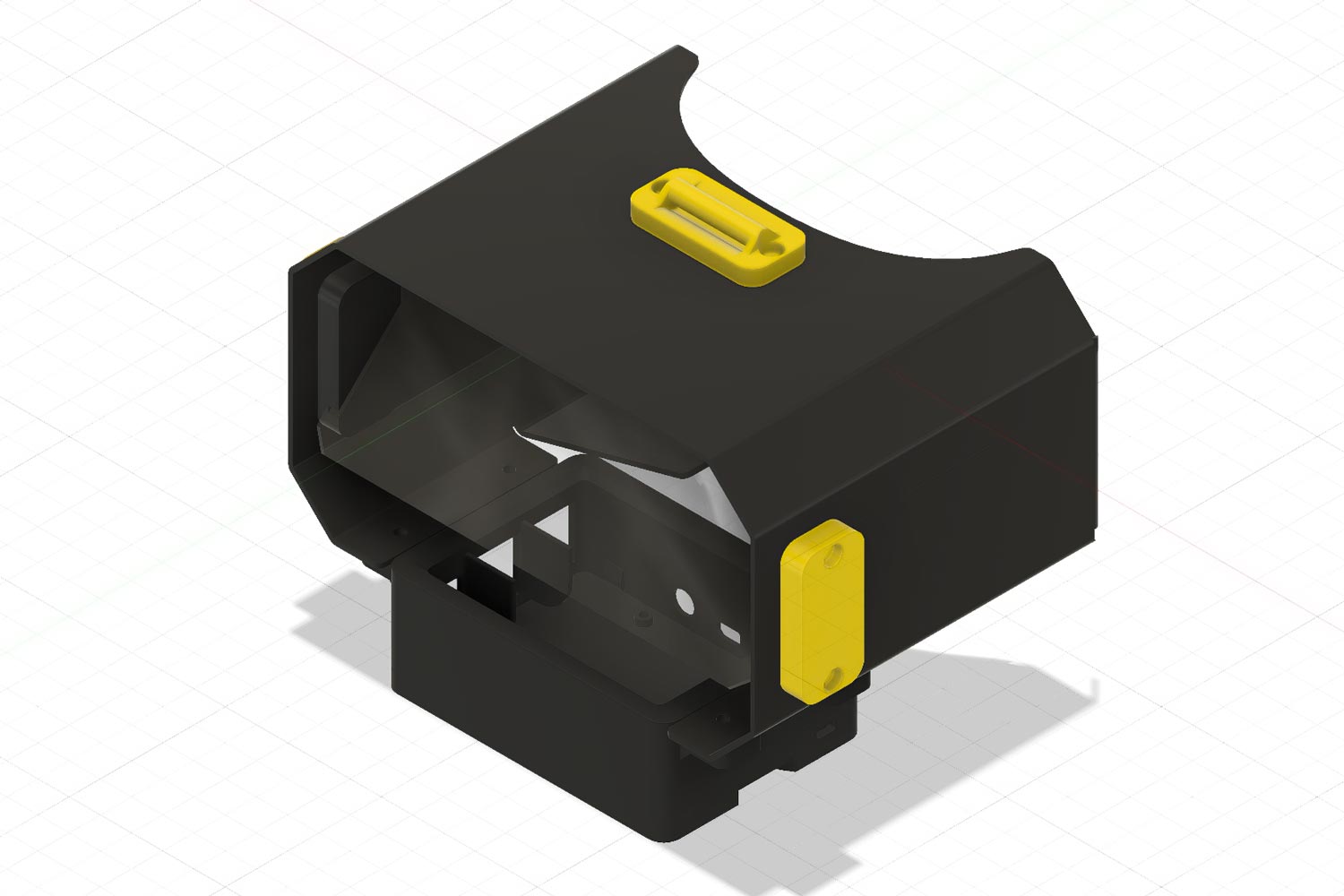
## The code
This is very similar to how [Bjørn Karmann's AI camera](https://bjoernkarmann.dk/project/paragraphica){target=_blank} works. The headset does not yet have a GPS module, which is why we had to use a little trick. The Python script scans for WiFi networks in the proximity. Based on their MAC addresses, the [Google Geolocation API](https://developers.google.com/maps/documentation/geolocation/overview){target=_blank} will return an approximate geo-location. We will further use these coordinates to collect more information such as a street address, the current weather, points of interest and more. We will also collect the current date and time. After collecting all this data, we can begin to write a readable sentence describing a photo taken at said location, where the weather is so and so, and x parks, restaurants, etc. are nearby. We also insert the time as a word (noon, dawn, morning, etc.) and the month to correctly identify the time of year. After the sentence is "written", it is passed to a Stable Diffusion API.
[Stable Diffusion](https://github.com/CompVis/stable-diffusion){target=_blank} is a powerful generative AI tool that allows us to create images from text inputs. After we get the generated image, the RaspberryPi will display it on its screen using a simple [tkinter](https://docs.python.org/3/library/tkinter.html){target=_blank} interface.
## Credits
Project created as part of [Design Investigations](https://designinvestigations.at){target=_blank} at the [University of applied Arts Vienna.](https://dieangewandte.at){target=_blank} Project created with [Leo Hafele,](https://volument.studio){target=_blank} [Bjørn Ravlo-Leira](https://bjornrleira.com/){target=_blank} and Johannes Mayer. Coding/ideation support by [Grayson Earle.](https://graysonearle.com){target=_blank} This project took heavy inspiration from [Bjørn Karmann's AI camera Paragraphica.](https://bjoernkarmann.dk/project/paragraphica){target=_blank}
---
# Hümme
Canonical URL: https://leomuehlfeld.at/en/huemme
---
title: 'Hümme'
for: 'CeKo & Freunde'
category: 'Film & Motion'
metaDesc: 'Directing an AI music video for Austropop band CeKo & Freunde''s track ''Hümme'', 2023 — Wienerlied melancholy meets stimulus-flooded image generation.'
thumbnail: /img/huemme-thumb.jpg
date: '2023-12-25T00:00'
showOnLanding: false
heroImage: /img/clouds.gif
collab: Max Kure
---
# Hümme
## Directing an AI music video for Austropop band CeKo & Freunde's track 'Hümme', 2023 — Wienerlied melancholy meets stimulus-flooded image generation.
## Hümme by CeKo & Freunde
CeKo & Freunde, an Austropop formation from Vienna, describe themselves as follows: "The songs describe scenes from wishes and dreams, small impressions of the mondane, apparent trivialities, humor without background but with depth, and the wind blows through everything...". Two albums have been released since 2017: "A Ewigkeit" and "Es wird heit spät". In spring 2023 they started recording their third album "Hümme", which will be finished at the end of 2023. Freely translated from [ceko.co.at.](http//ceko.co.at){target=_blank} As stated; the album "Hümme" is the third release and will be available for Christmas 2023. We were commissioned as [gemeindebau.im](https://gemeindebau.im){target=_blank} to create a music video for the song "Hümme" - which is included on the album of the same name.
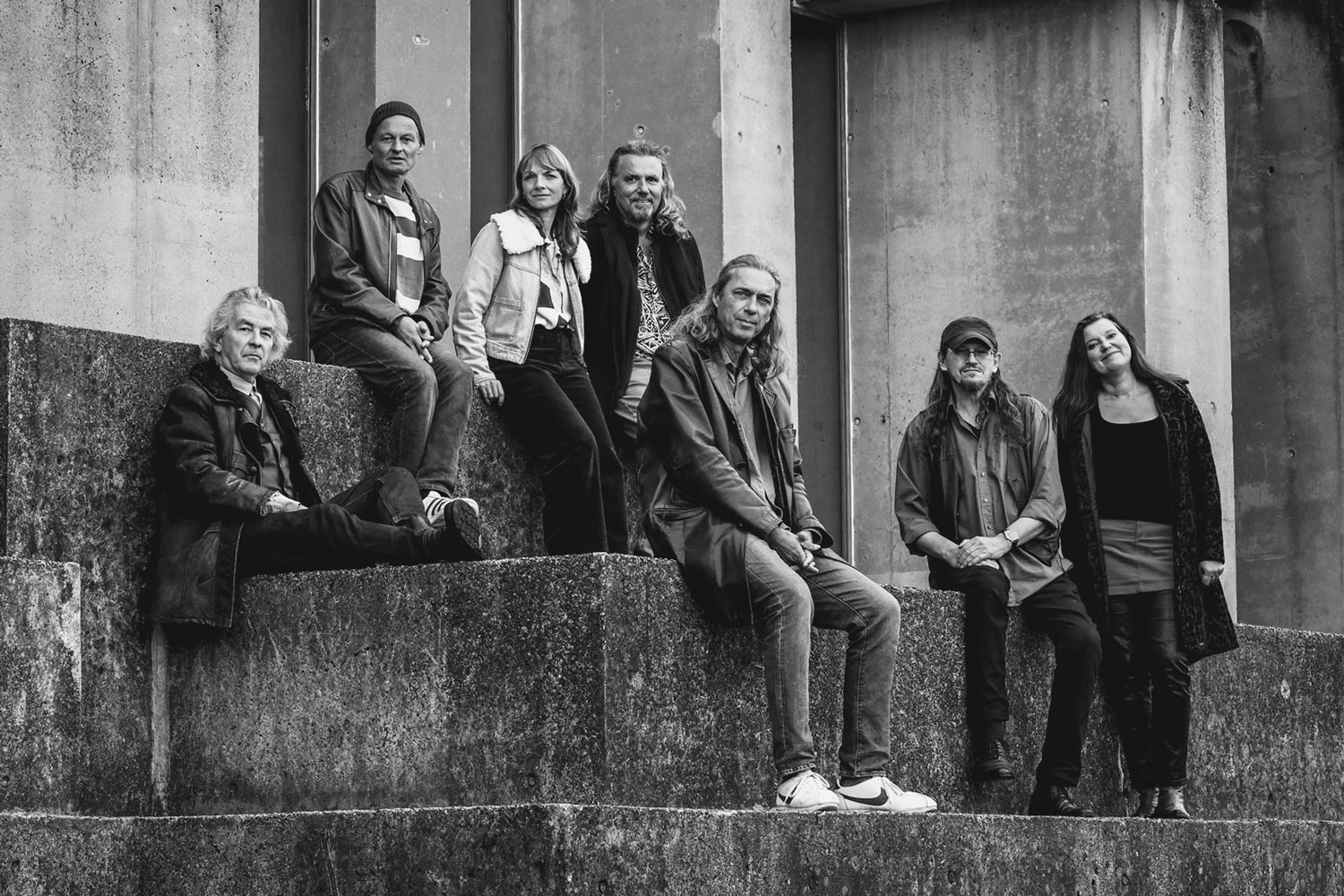
## AI Video
The decision to create this video with AI image generators was made at a very early stage. We were particularly interested in the poetic potential that could emerge from the encounter between these two - aesthetically so different - worlds. The dark gray, melancholy "Wienerlied" meets the stimulus-flooded, super-colorful image generators.
The creative task was to moderate this confrontation towards mutual acceptance and appreciation. Both the traditional "Wienerlied" and the flashy image generators had to venture into areas outside their respective comfort zones, which culminated in productive compromises. The "Wienerlied" opened itself up to a new visual aesthetic and dreamy interpretations, while the generative AI was able to indulge in a completely new visual language.
## Visual style
We tested a number of generative AI models and started with a variety of aesthetic experiments. After an initial phase, we decided on Stable Diffusion + Deforum and started with visual tryouts. A particular difficulty here was the tendency of the AI models towards certain image content such as people, animals and objects.
In addition, these models are unable to generate geometrically and/or artistically abstracted image content in concrete color schemes. However, since this was precisely our visual goal, we wanted to consciously circumvent these tendencies. We finally achieved this by using negative prompts, which we defined globally throughout the video.
The list of negative prompts grew steadily as the video progressed. The result was a page-long document - a kind of script - containing prompts, keyframe data and more information that served as input for the AI model. So instead of the role of creators, we took on the role of moderators and curators.
## Credits
Song [Hümme](https://youtu.be/xAZFUilF6C0?si=sGJ_3JBtiMupTjkx){target=_blank} by [Ceko & Freunde.](http://ceko.co.at){target=_blank} Video by [Max Kure](https://maxkure.net){target=_blank} and Leo Mühlfeld for [gemeindebau.im](https://gemeindebau.im){target=_blank}
---
# Tiny Art Run
Canonical URL: https://leomuehlfeld.at/en/tiny-artrun
---
title: 'Tiny Art Run'
for: 'Gemeindebau.im'
category: 'Exhibition & Installation'
metaDesc: 'Contributing interactive section to remote-controlled car exhibition at Angewandte Festival 2023.'
thumbnail: /img/artrun-car.jpg
date: '2023-06-27T00:00'
showOnLanding: false
collab: Max Kure, Anton Posch
---
# Tiny Art Run
## Contributing interactive section to remote-controlled car exhibition at Angewandte Festival 2023.
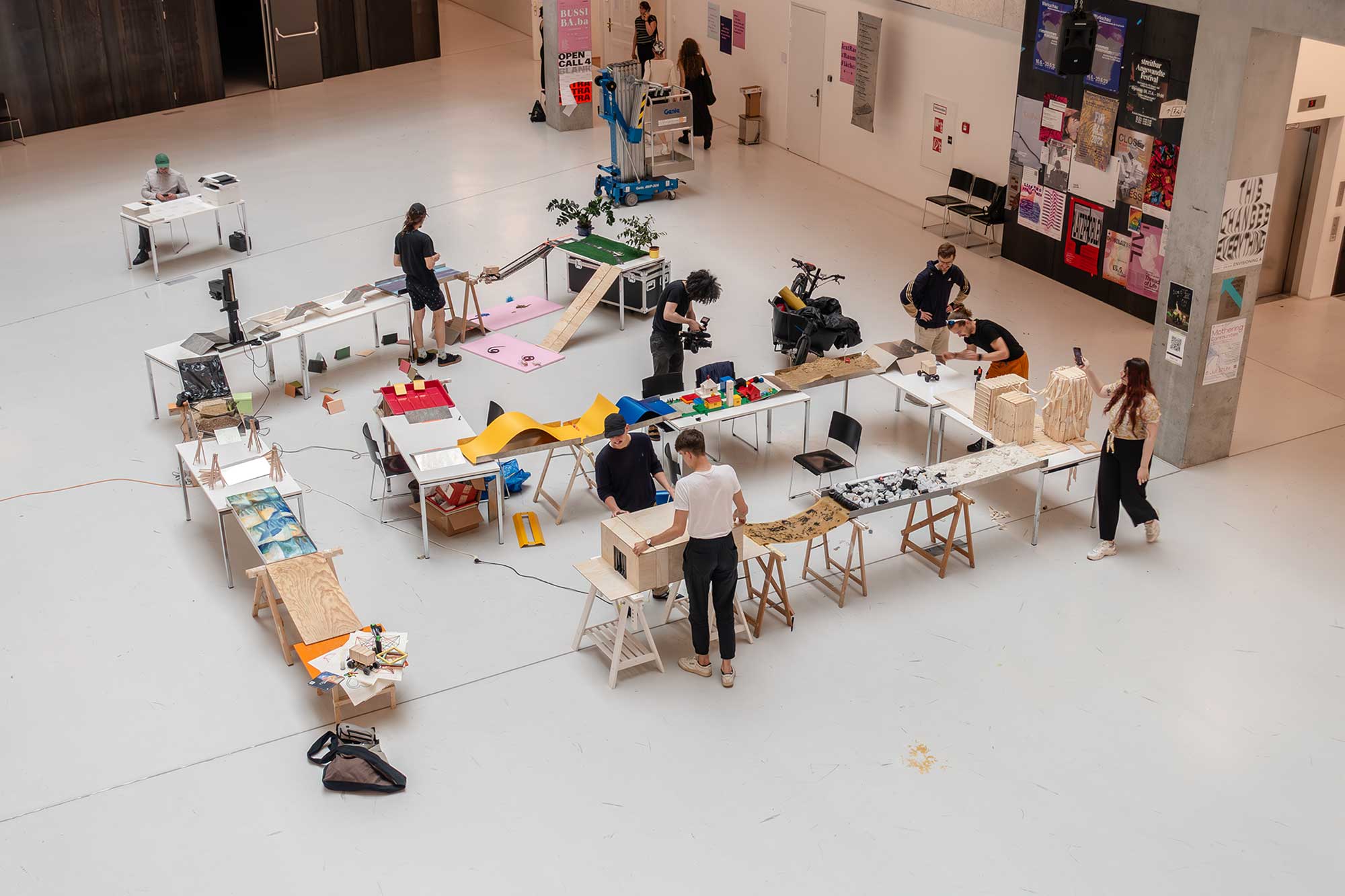
## Tiny Art Run
The Tiny Art Run is an interactive group exhibition initiated by [Carlo Zapella](https://zappella.art){target=_blank} and created by many. The exhibition takes visitors on a journey from the initial spark that led them to art to "Tiny Art Basel". Visitors are invited to drive a remote-controlled car carrying a transport box. On their way through the collectively designed exhibition, they encounter all kinds of obstacles that put their skills to the test. The route consists of several sections designed by students from different departments of [die Angewandte.](https://www.dieangewandte.at){target=_blank}
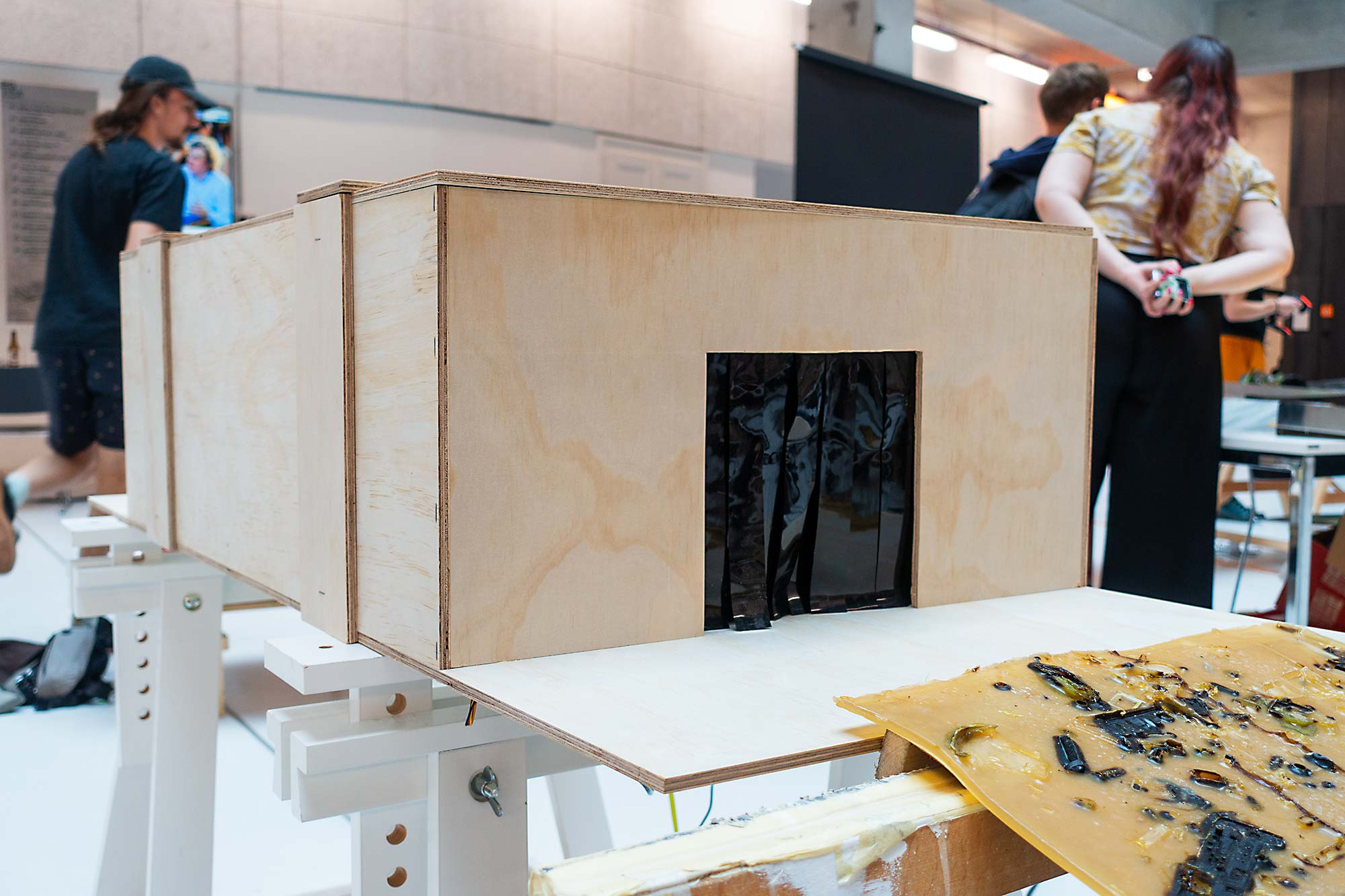
## Our contribution
With my collective [gemeindebau.im](https://gemeindebau.im){target=_blank}, we worked on a submission for the Tiny Art Run. A large wooden box with only one entrance and one exit was covered with PVC slats to prevent visitors from seeing inside the box. While the visitors were distracted to master the parkour a light barrier was triggered by the car. A microcontroller recognized this and randomly played one of twenty sound files over a radio link at a completely different location in the building.
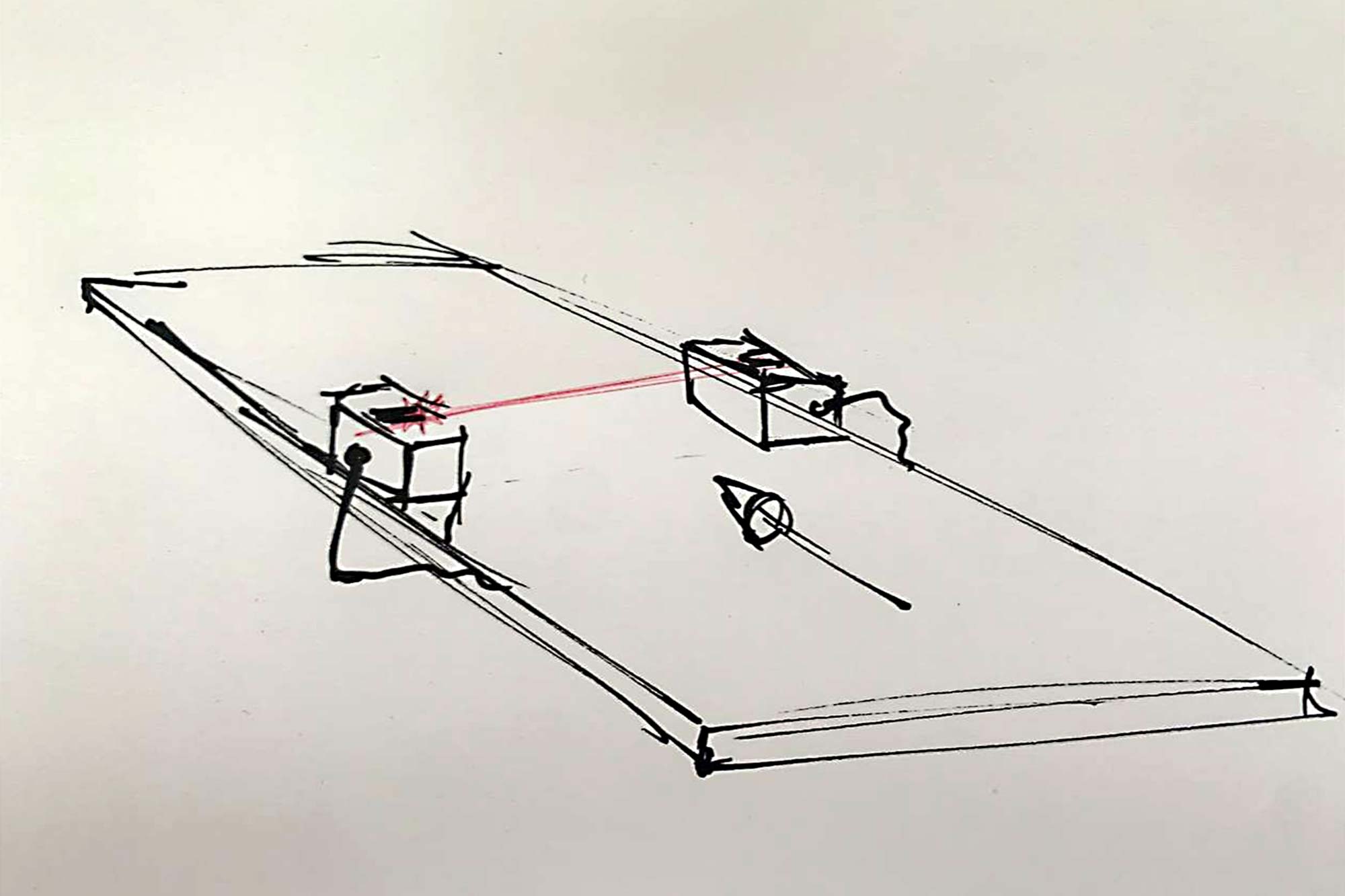
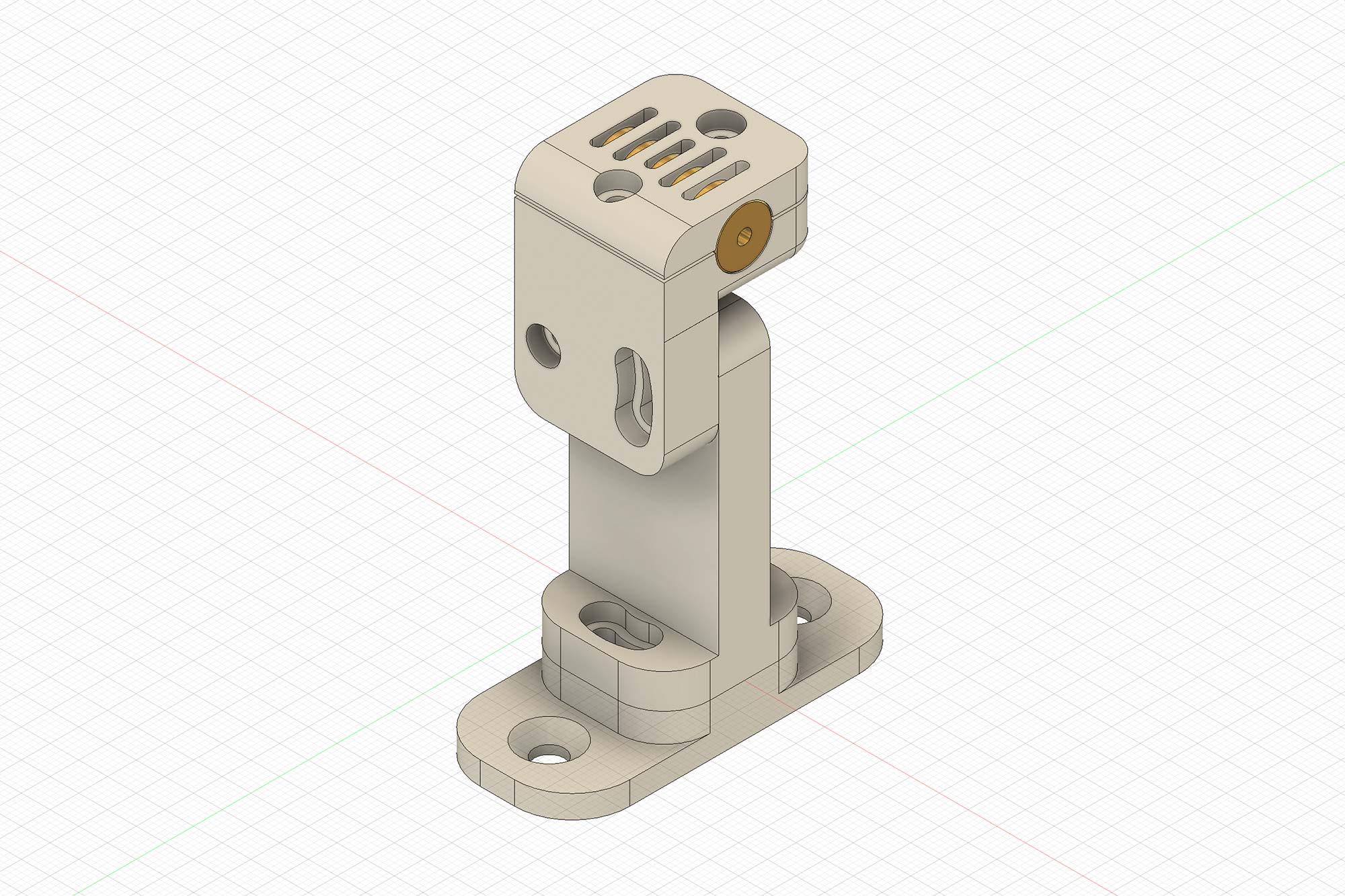
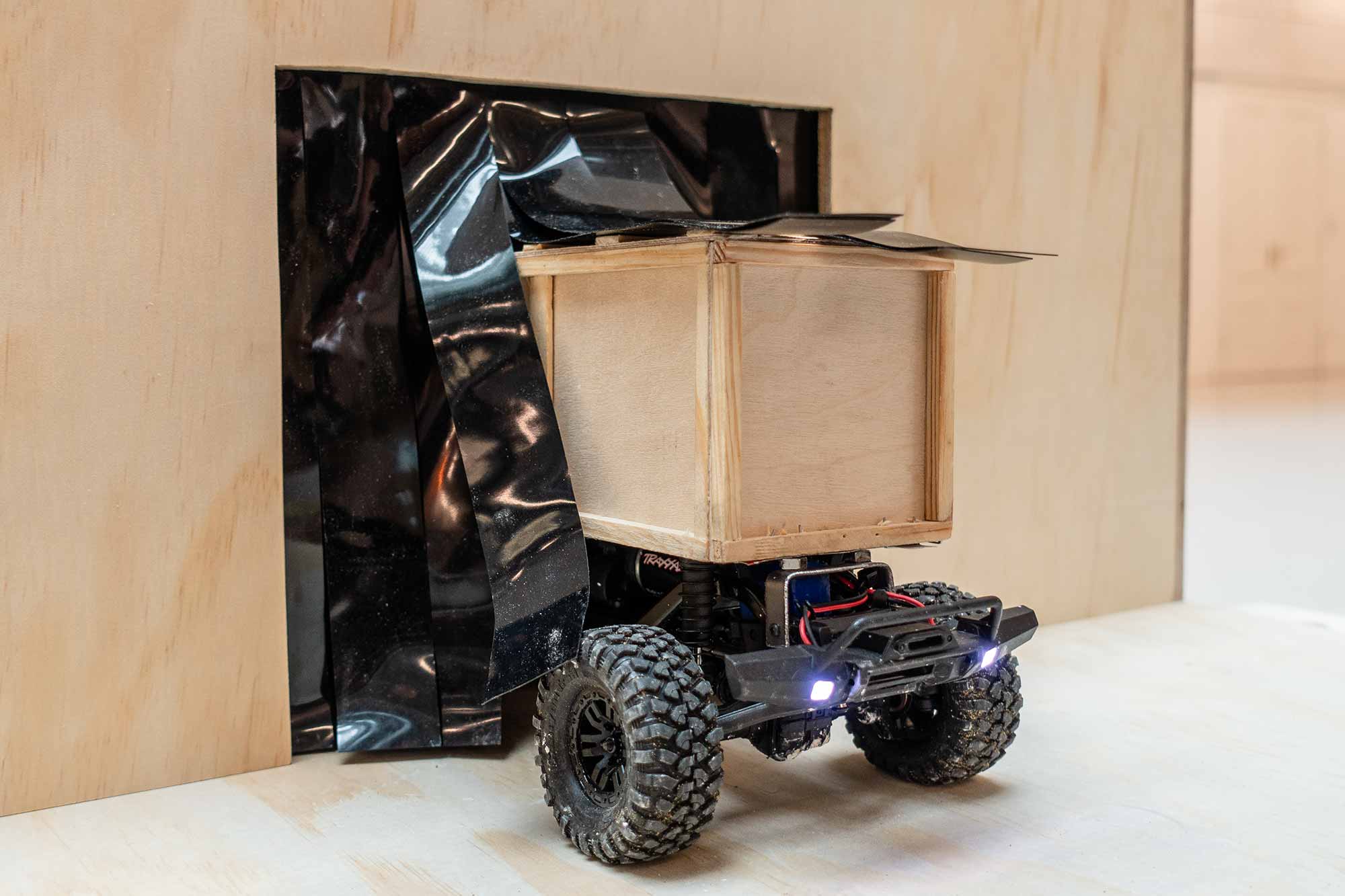
## Credits
Project created with [gemeindebau.im](https://gemeindebau.im){target=_blank}. Tiny Art Run is a collective show initiated by [Carlo Zapella.](https://zappella.art){target=_blank} Last minute coding support by [Lucy Li.](https://lilucy.at){target=_blank}
---
# KEB Branding
Canonical URL: https://leomuehlfeld.at/en/keb-branding
---
title: 'KEB Branding'
for: 'KEB'
category: 'Brand & Type'
metaDesc: 'Building brand identity and interactive website for Kaisermühlen Electric Band, a Vienna trio named after their 22nd district home, 2023 — full visual stack.'
thumbnail: /img/cards-funky.jpg
date: '2023-06-11T00:00'
showOnLanding: false
---
# KEB Branding
## Building brand identity and interactive website for Kaisermühlen Electric Band, a Vienna trio named after their 22nd district home, 2023 — full visual stack.
## Website
[The website](https://keb.wien){target=_blank} is based on NextJS and gets the data from a simple json database. Especially the time information is sorted via dayjs and rendered as an unobtrusive list view. past events are automatically grayed- and crossed out. NextJS also generates subpages and paths from the database entries. Dynamic thumbnails for sharing links are generated via an API. A viewer based on threejs displays an interactive 360° image of the band members.
## Business Cards
The front page shows the four members of the band in front of the Danube Tower. A building of the post-war modernist era which was built from 1962 to 1964 on the occasion of the Vienna International Garden Show. The Tower is considered a landmark of the 22nd district of Vienna, which also includes the district Kaisermühlen, from which the band takes its name. On the back you will find all the information cleanly placed.
## Credits
Design & Code by Leo Mühlfeld. Photograph printed on business cards by [Lucy Li.](https://lilucy.at){target=_blank}
---
# VLF Antenna
Canonical URL: https://leomuehlfeld.at/en/vlf-antenna
---
title: 'VLF Antenna'
for: 'Felix Lenz'
category: 'Product & Engineering'
metaDesc: 'Building hand-wound VLF antenna capturing electromagnetic frequencies for Felix Lenz audio installation.'
thumbnail: /img/vlf-exhibition.jpg
date: '2023-04-04T00:00'
showOnLanding: false
---
# VLF Antenna
## Building hand-wound VLF antenna capturing electromagnetic frequencies for Felix Lenz audio installation.
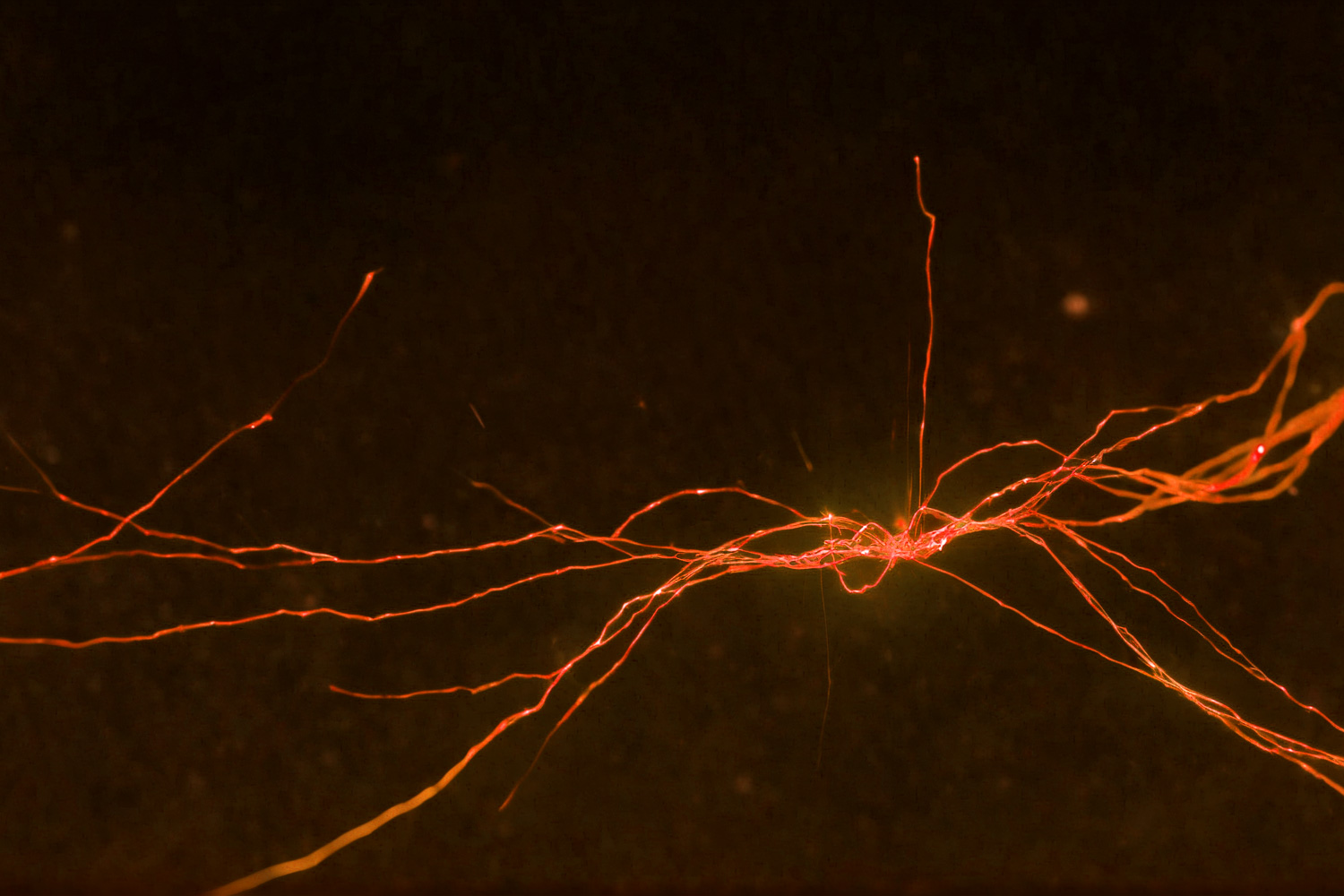
## What is VLF
VLF is a radio sepctrum ranging from 3kHz to 30kHz. The electromagnetic signals are produced naturally by the earths ionosphere and include lightning strikes, northern lights and some technologies that emit waves in this spectrum. A famous example would be the low 50hz hum emitted from 50hz power grids.
## The Antenna
These Frequenices can be picked up by an inductor which is basically a large loop of conducting wire that picks up magnetic fluctuations. If we solder the two ends to an audio-jack. We can amplify the signal and listen to it.
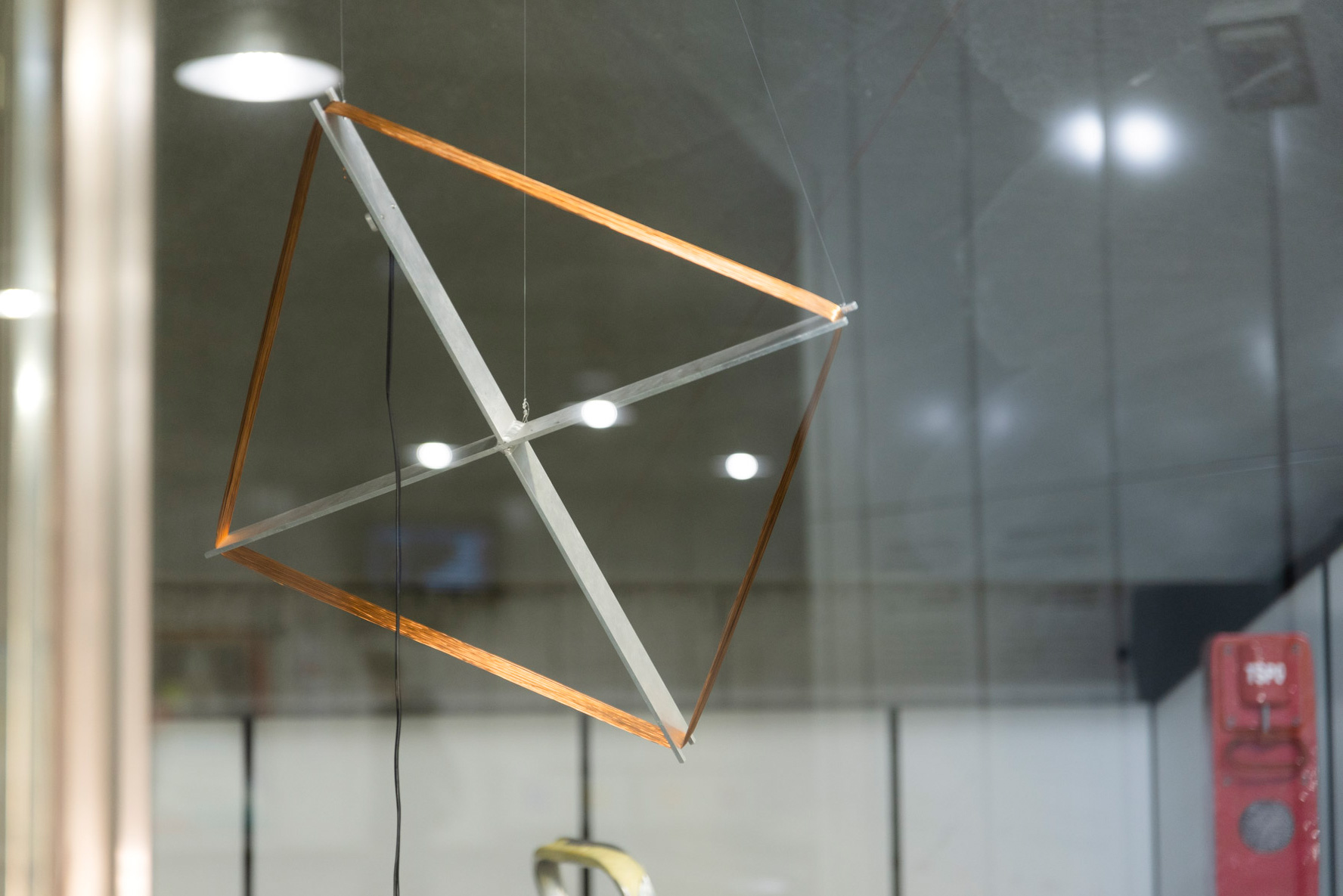
## Frame
The flightweight frame consists of two welded aluminum rods with a recess milled in the end. The copper wire was wound around it and passed through a strain relief.
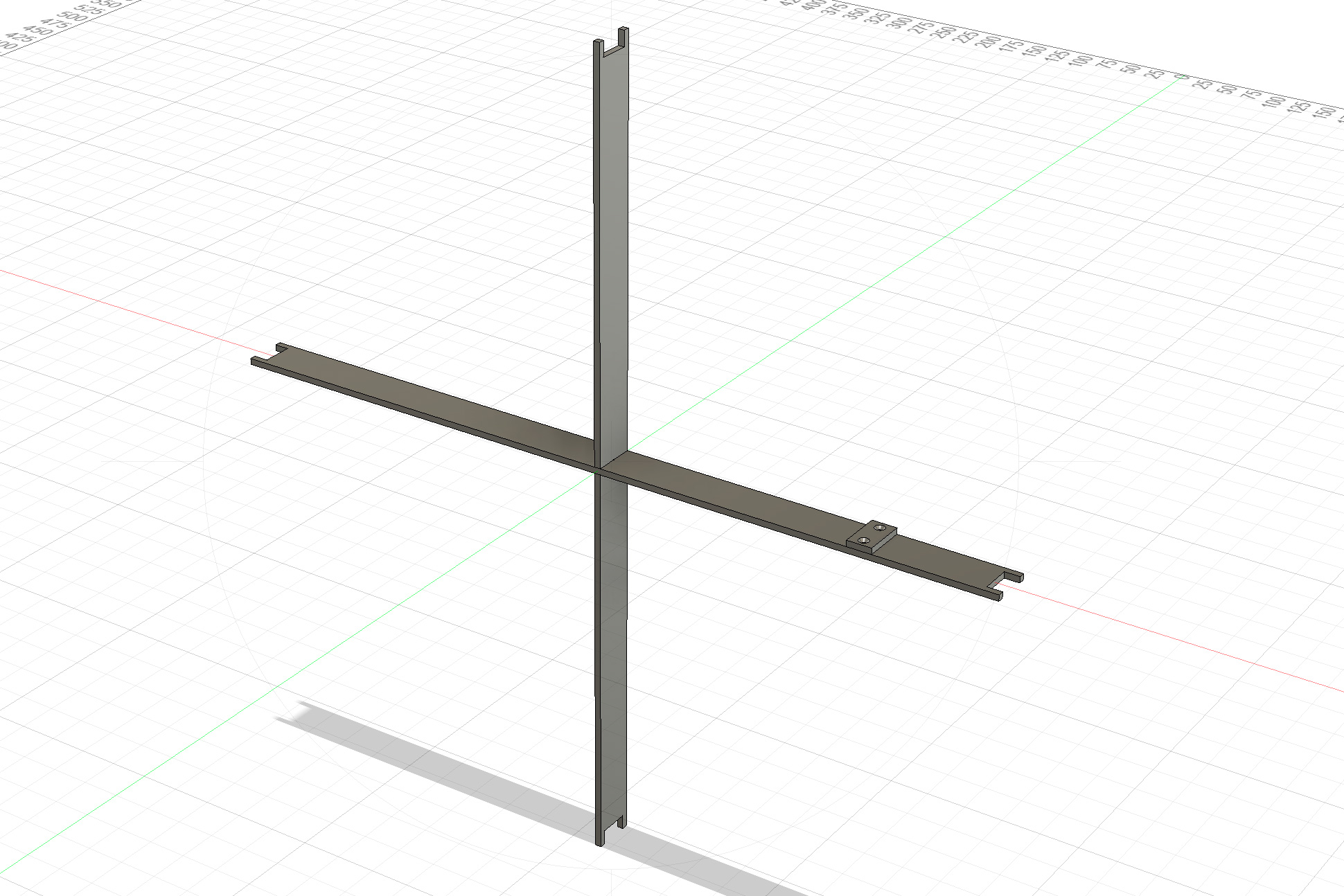
## Credits
Project designed for- and together with [Felix Lenz.](https://felixlenz.at){target=_blank}. Milling by [Angewandte Metallwerkstatt](https://www.dieangewandte.at/institute/kunst_und_technologie/metalltechnologie){target=_blank}.
---
# Die Letzten ihrer Art
Canonical URL: https://leomuehlfeld.at/en/bonn-die-letzten-ihrer-art
---
title: 'Die Letzten ihrer Art'
for: 'dform'
category: 'Film & Motion'
metaDesc: 'Creating animations exploring endangered professions and traditional craftsmanship for Bundeskunsthalle Bonn.'
thumbnail: /img/dlia-thumbnail.jpg
date: '2022-12-03T00:00'
showOnLanding: false
collab: true
heroImage: /img/types-of-bread.gif
---
# Die Letzten ihrer Art
## Creating animations exploring endangered professions and traditional craftsmanship for Bundeskunsthalle Bonn.
## The last of their kind
During my internship at the Viennese design studio [dform](https://dform.at){target=_blank} I was tasked with creating some animations for the exhibition project "Die Letzten ihrer Art". In the course of history, countless professions have emerged and disappeared or had to adapt to social and technical change, particularly as a result of industrialization. This process has gained additional momentum through globalization and digitization. The exhibition "Die Letzten ihrer Art" takes a look at professional change in North Rhine-Westphalia (GER) and is dedicated to five endangered professions.
## Types of bread
A list of over 500 types of bread was fed via a script into an After Effects template I created. The bread types then moved smoothly along a path. The projection background was an exhibit of the Bundeskunsthalle Bonn. On an old wooden board of a bakery the animation was projected onto two baguettes.
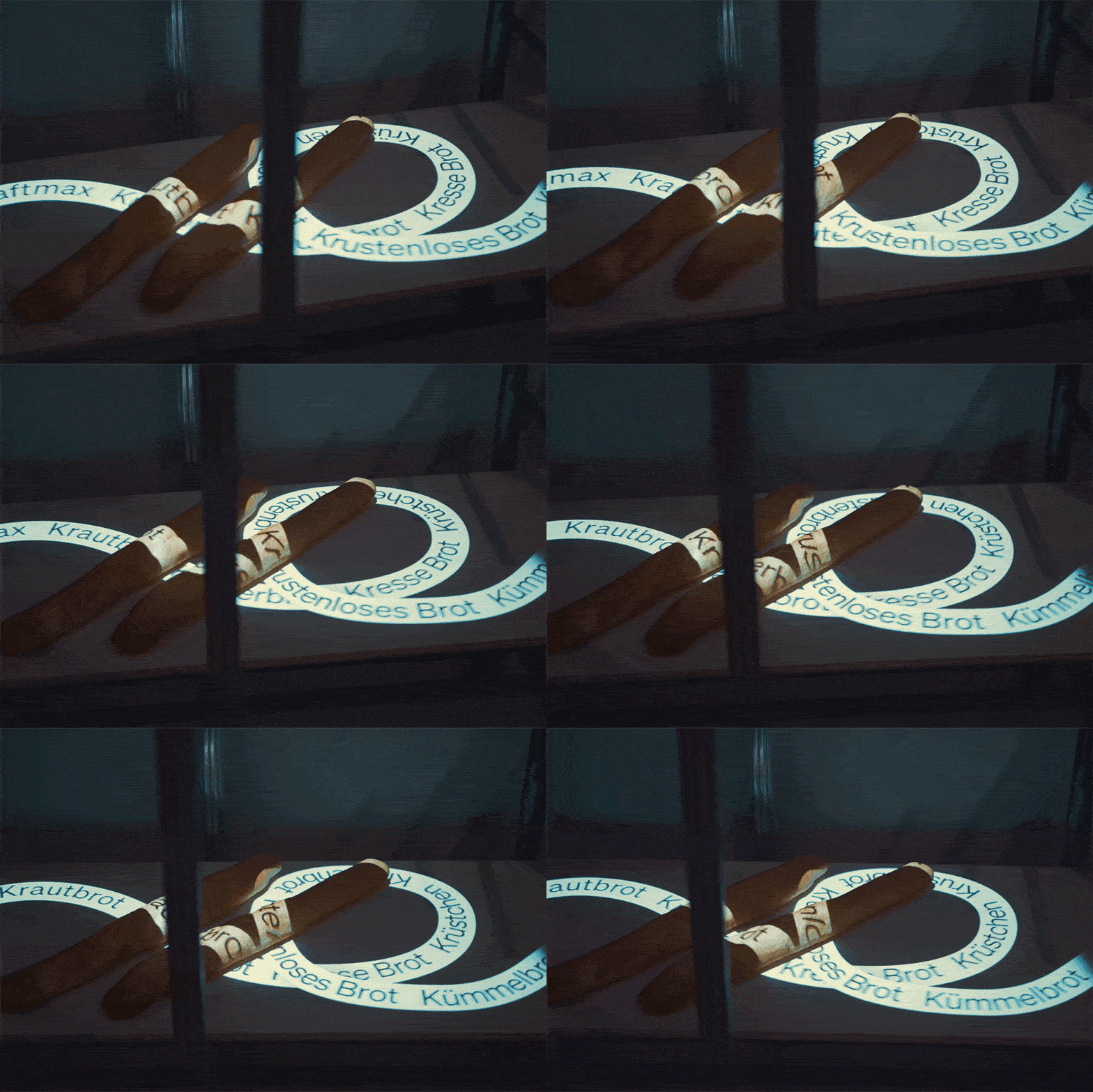
## Jobs in flux
In a separate projection room the animation "Jobs in flux" was shown. In this typo-animation job descriptions of the past dissolved and became part of a gigantic sea of letters. Afterwards, job descriptions of newly emerging professions were formed from the letters.
## Loops!
For the promotion of the exhibition, I took the poster designed by Bernhard Poppe and created animated loops for Instagram as well as a video signet, bumpers for the documentary video and a large loop in 16:9 format, which was shown on the large LED wall in the outdoor area of the Bundeskunsthalle Bonn.
## Credits
The exhibiton "The last of their kind" was designed by [dform](https:/dform.at){target=_blank}. Poster design by [Bernhard Poppe.](https://www.bernhardpoppe.at){target=_blank}
---
# Navigational Superpowers
Canonical URL: https://leomuehlfeld.at/en/navigational-superpowers
---
title: 'Navigational Superpowers'
for: 'Lucy Li'
category: 'Design Research & Speculation'
metaDesc: 'Exploring screen-less navigation systems through human-centered design research and spatial memory.'
thumbnail: /img/headset-detail.jpg
date: '2022-06-30T00:00'
showOnLanding: false
collab: Lucy Li
---
# Navigational Superpowers
## Exploring screen-less navigation systems through human-centered design research and spatial memory.
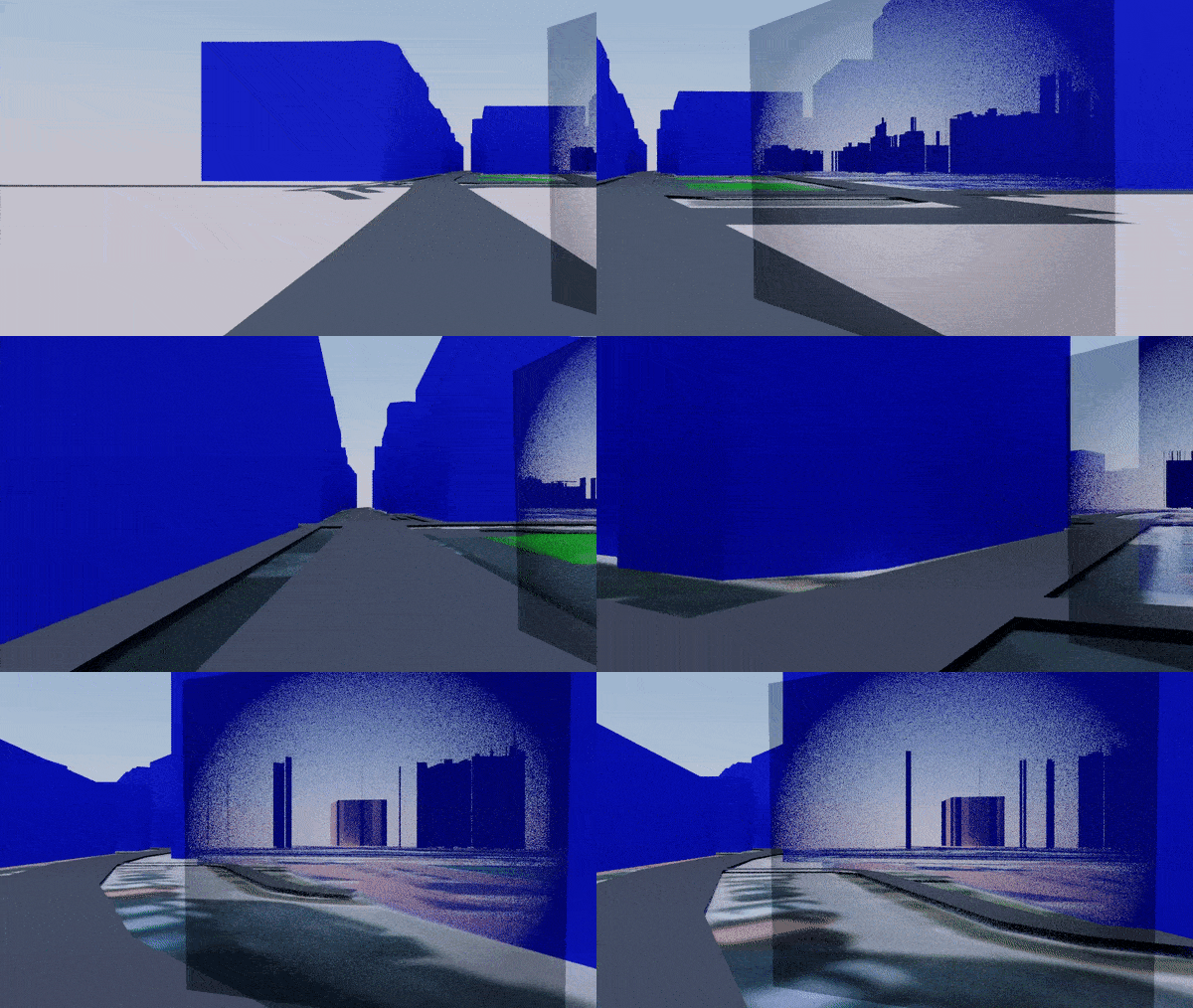
## How do we Navigate?
In the beginning, a lot of interviews were conducted aksing differnt people the same simple question: How do you remember a route? One thing became evident: The navigation technology we use on a daily basis is not made for people.
## Car-Centered tech
People are much more resourceful and non-linear. People have different ways of moving through our cities, and yet we all use the same car-centric technology. Following a strict line on a screen requires a lot of attention. However, humans react to their surroundings in a much more complex and idiosyncratic way. Their sensory perceptions translate directly into decisions, states of mind, and feelings. We propose to fully engage in this journey and don’t just passively listen to the suggestions of algorithms and companies.
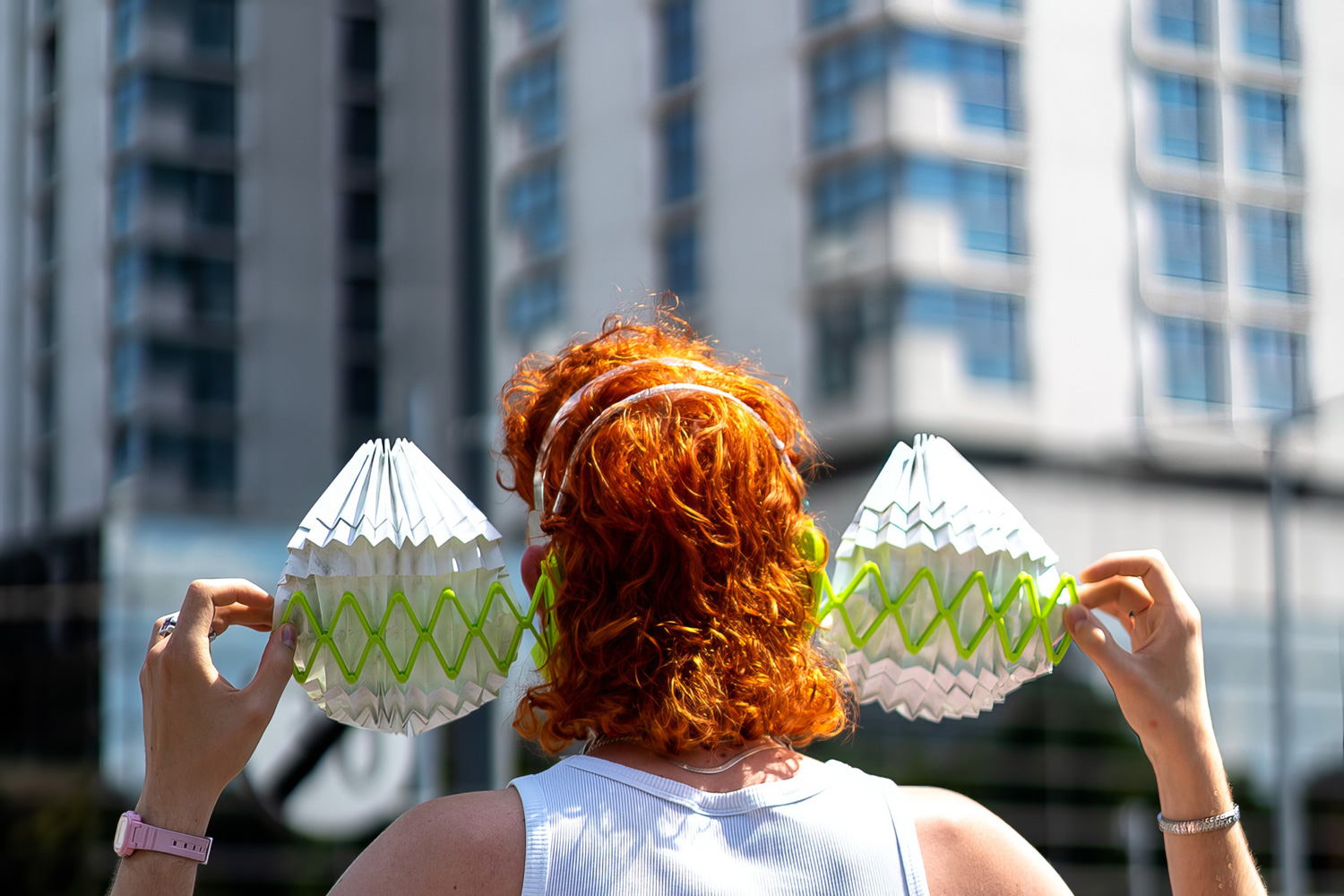
## Animal Navigation
If we venture a look into the world of animals, we find a variety of navigational artists. One in particular stands out: The bat. In collaboration with animal cognition scientists Lucy Li unterstood their ways in context and make their navigation process experienceable for humans.
## Headset
With this headset, you can orient yourself acoustically in the city. Based on the echolocation of bats, this wearable invites you to perceive the world beyond the boundaries of the screen and intuitively orient yourself based on directional hearing, volume and beat.
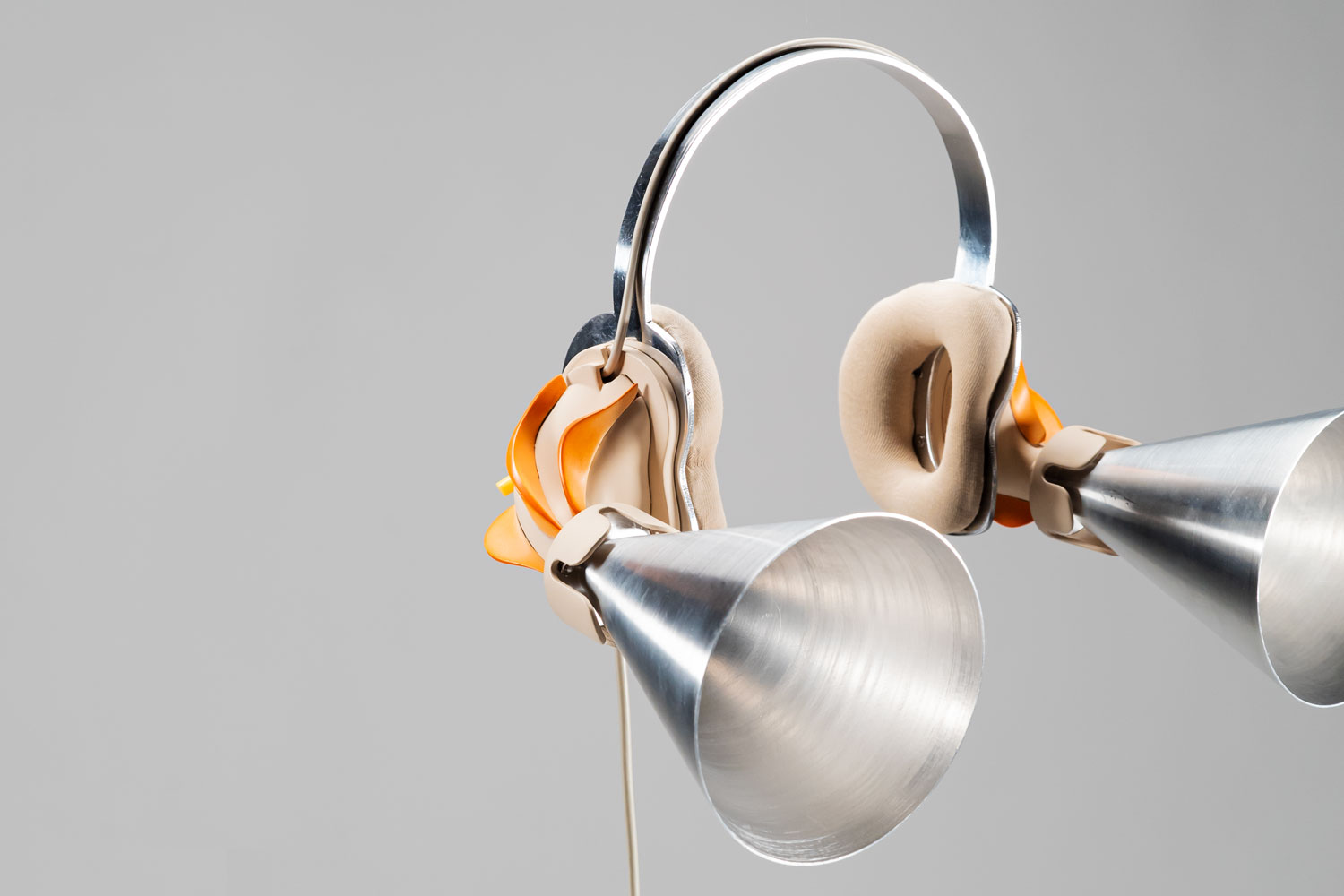
## Making of
The plastic housing is painted. The plastic "fins" were painted with airbrush gradients and attached to the housing. Inside the headphones is the ear canal, which connects the funnels spun from aluminum sheet to the ear. A passive speaker and a push button are also built in. The data is transmitted to the navigation computer via a cable. This is fully functional. It is carried in a belt pouch.
## How it works
The computer reads your position and has the destination stored as a waypoint. The resulting vector is compared with your current compass heading. Therefore, with this form, it is not so important whether you turn right or left, walk on the main or secondary road, or are motivated to take a detour by an interesting landmark. The more the compass course coincides with the target vector, the more present and rhythmic the sound. As they move away from each other, the soundscape becomes more ambient and broad.
## Credits
Design and electronics by Lucy Li & Leo Mühlfeld. Zoologist and Bat experts: Dr. Guido Reiter, Dr. Andrea Flack (Max Planck Institute of Animal Behaviour). Metal spinning by Wilhelm Seidl Metalldrücker und Gürtler.
---
# Heating Habits
Canonical URL: https://leomuehlfeld.at/en/heating-habits
---
title: 'Heating Habits'
for: 'Die Angewandte'
category: 'Design Research & Speculation'
metaDesc: 'Investigating human relationships with energy consumption through interactive heating system prototypes.'
thumbnail: /img/blanket-totale.jpg
date: '2022-06-22T00:00'
showOnLanding: false
---
# Heating Habits
## Investigating human relationships with energy consumption through interactive heating system prototypes.
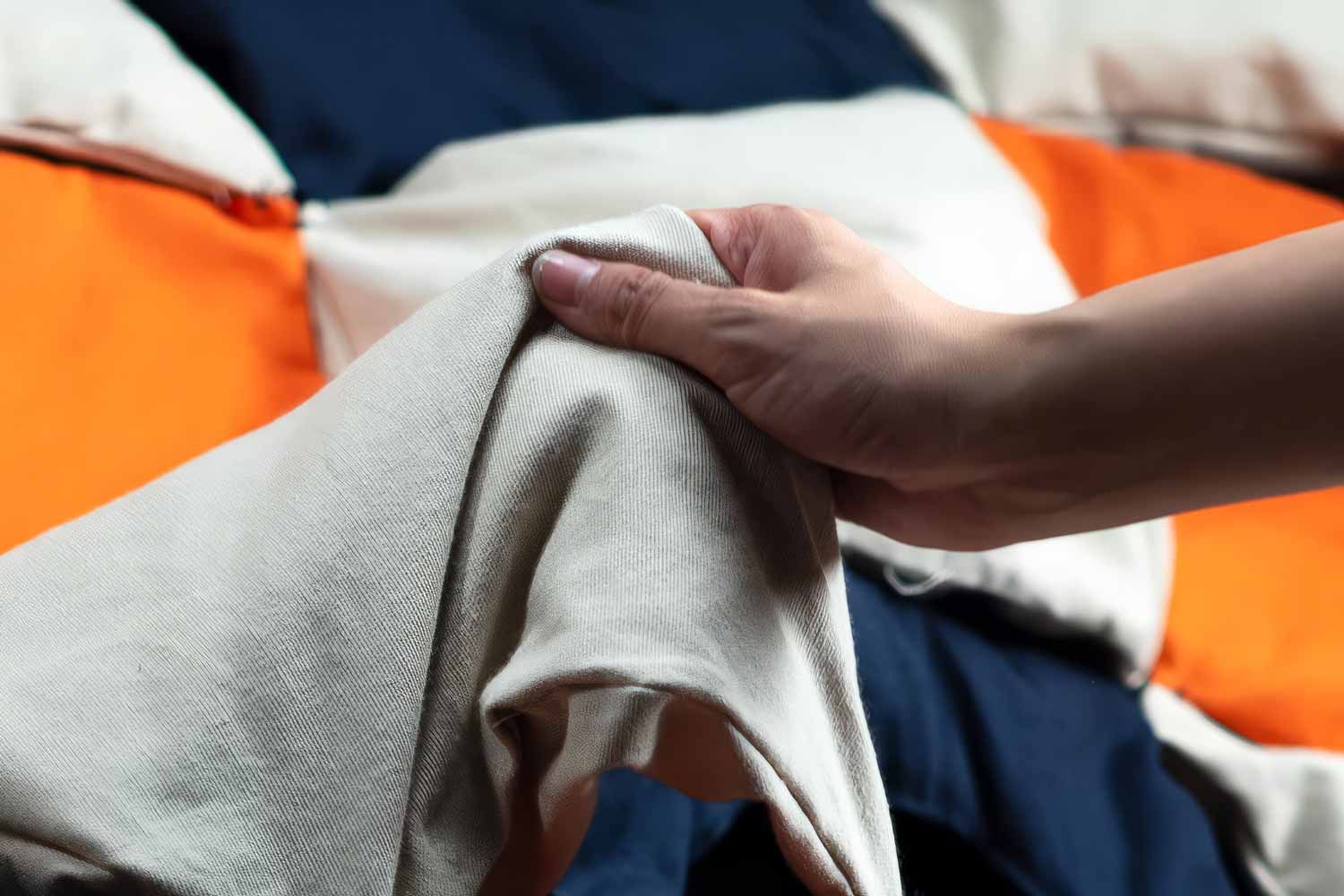
> Paradox of the fireplace: While social function manifests itself in multiple different products (stove, TV, etc) the heating function (which was once the combining force) is centralized in a central heating system.
>
> Rem Koolhaas, Elements of Architecutre, Taschen, Fireplace, p.8
## Enery Relationships
If we look at the architectural history of the fireplace from its "invention" to the present day, we find that the development of central heating systems hidden behind the walls of today's buildings has resulted in the complete disappearance of the social functions that evolved around the fireplace, leading to an alienation of the energy we use. This is especially important in times of climate crisis, as our emotional relationship with energy has the potential to quickly and permanently alter consumption patterns. I set out to explore examples of how lifestyle habits can change our energy consumption.
> The flame is concealed by the stove, the stove is exiled to the basement, and the iron pipe is the new heating apparatus of choice.
>
> Rem Koolhaas, Elements of Architecutre, Taschen, Fireplace, p.133
## Rituals & Structure
The fireplace had to be ritualistically kept in good condition. If we look at the cultural significance of the fireplace, we see that social structures and order were organized around the maintenance of the fire. Today's central heating roughly heats the entire air column of the room, making it unstructured and uncomfortable. Lowering the ambient air temperature by 4 degrees would already result in energy savings of around 36%. The logical consequence is small ritualistic heating sources that structure the space and radiate localized heat without using the total air of the room as the main carrier medium.
> Small, radiant heat sources structure the space and create a network of paths and areas in the room.
>
> Christopher Alexander, A Pattern Language, p.646, p. 1080, p. 1162
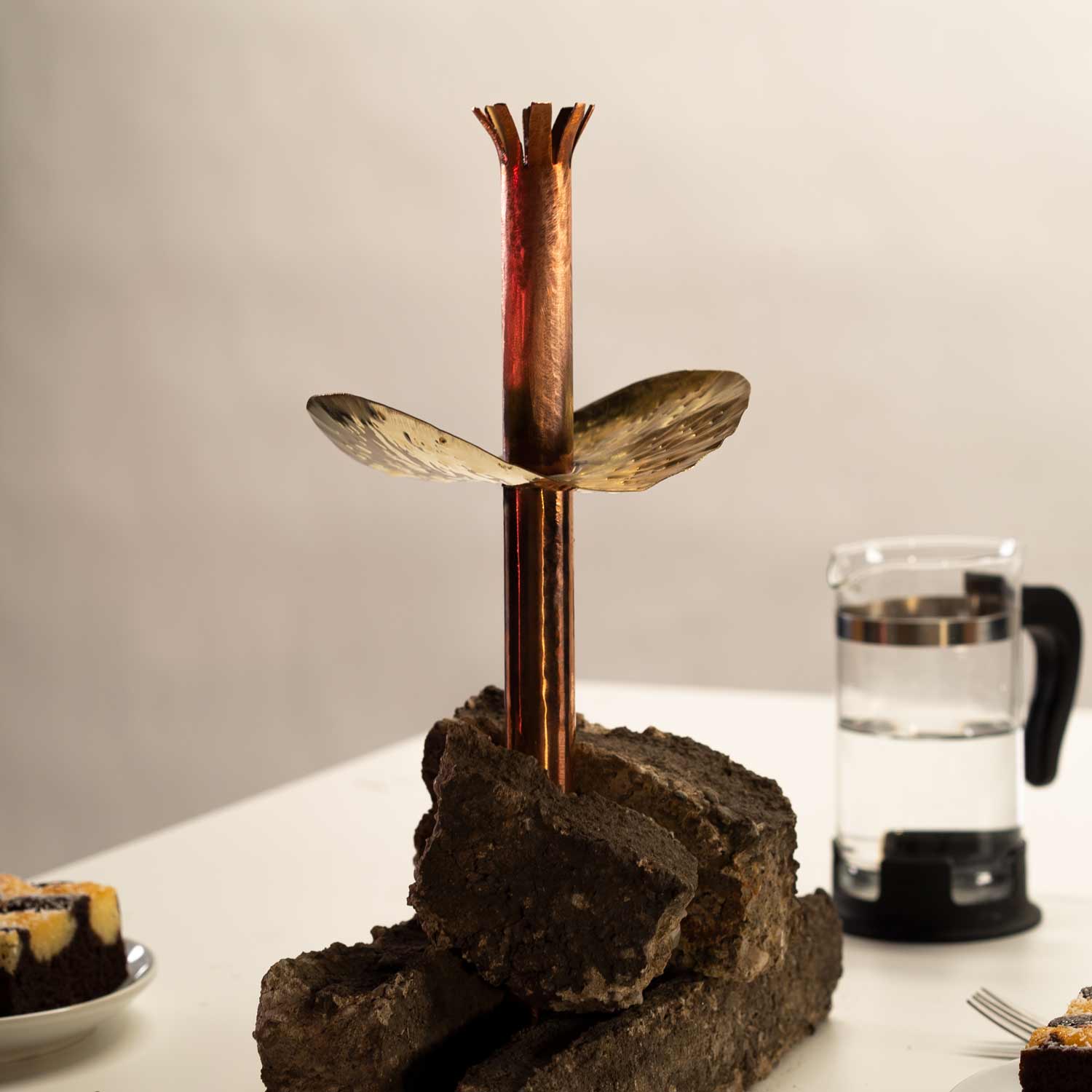
## Zeolite
Zeolite means boiling stone in Greek. Actually of vulcanic origin, it is used today as a synthetically produced aluminum silicate in industry, but also in the household (dishwasher, heatpump). Zeolite is very porous. So porous, in fact, that heat is generated when water molecules - which rub against the surface of its countless tiny channels - are absorbed. Zeolite is therefore a potential battery, that can store energy in the form of a potential (dryness). By adding heat (e.g.: solar oven) the material can be dried again. After that, the activation process can start again.
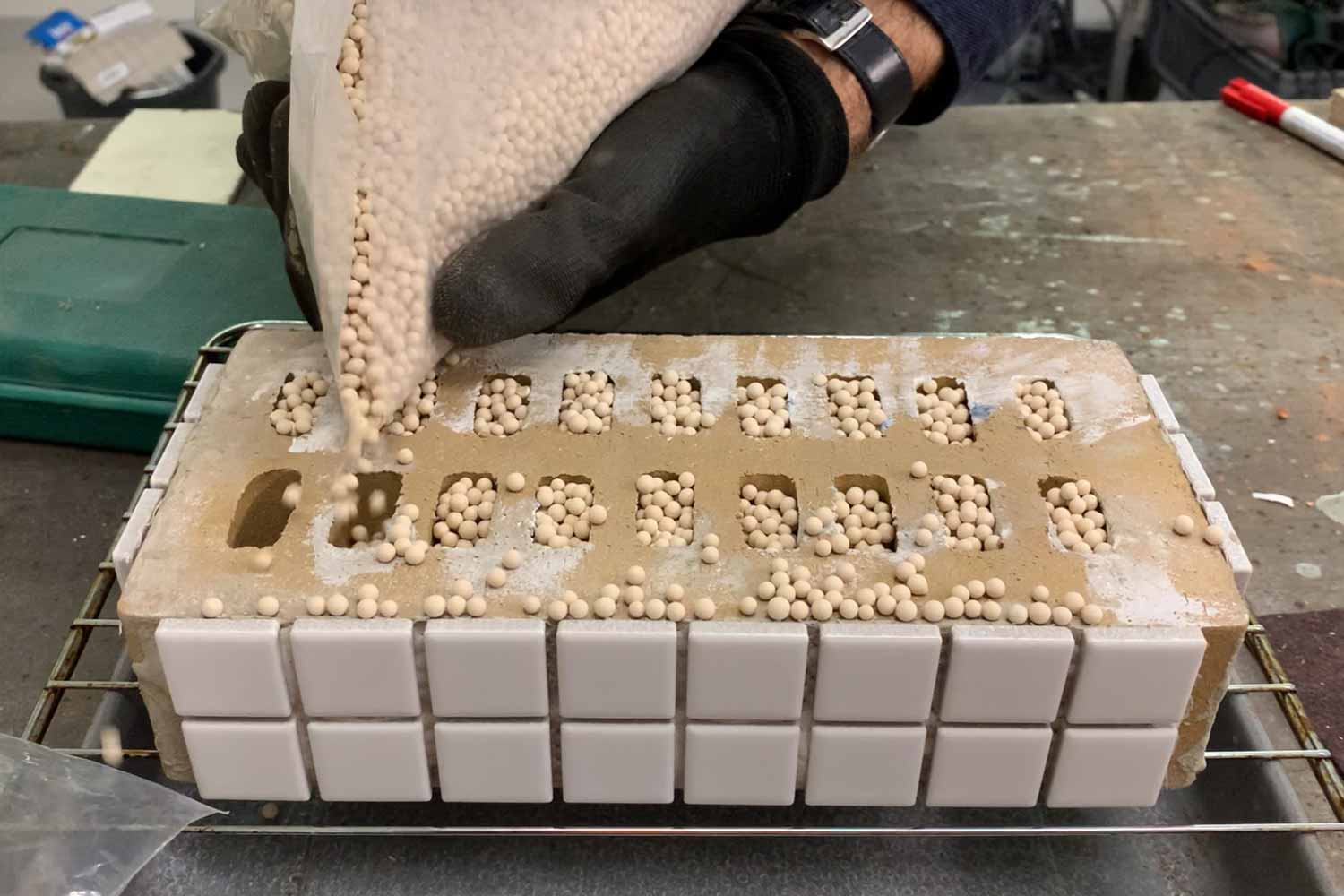
## The Torch
Because of the feedback that the properties of the zeolite were almost considered mystical, I soldered a copper "torch" which could be placed like a vase in the middle of a dining table. While staying at the table, water had to be poured constantly onto the zeolite inside the torch to maintain the heat production. A graphic interpretation of the fireplace.
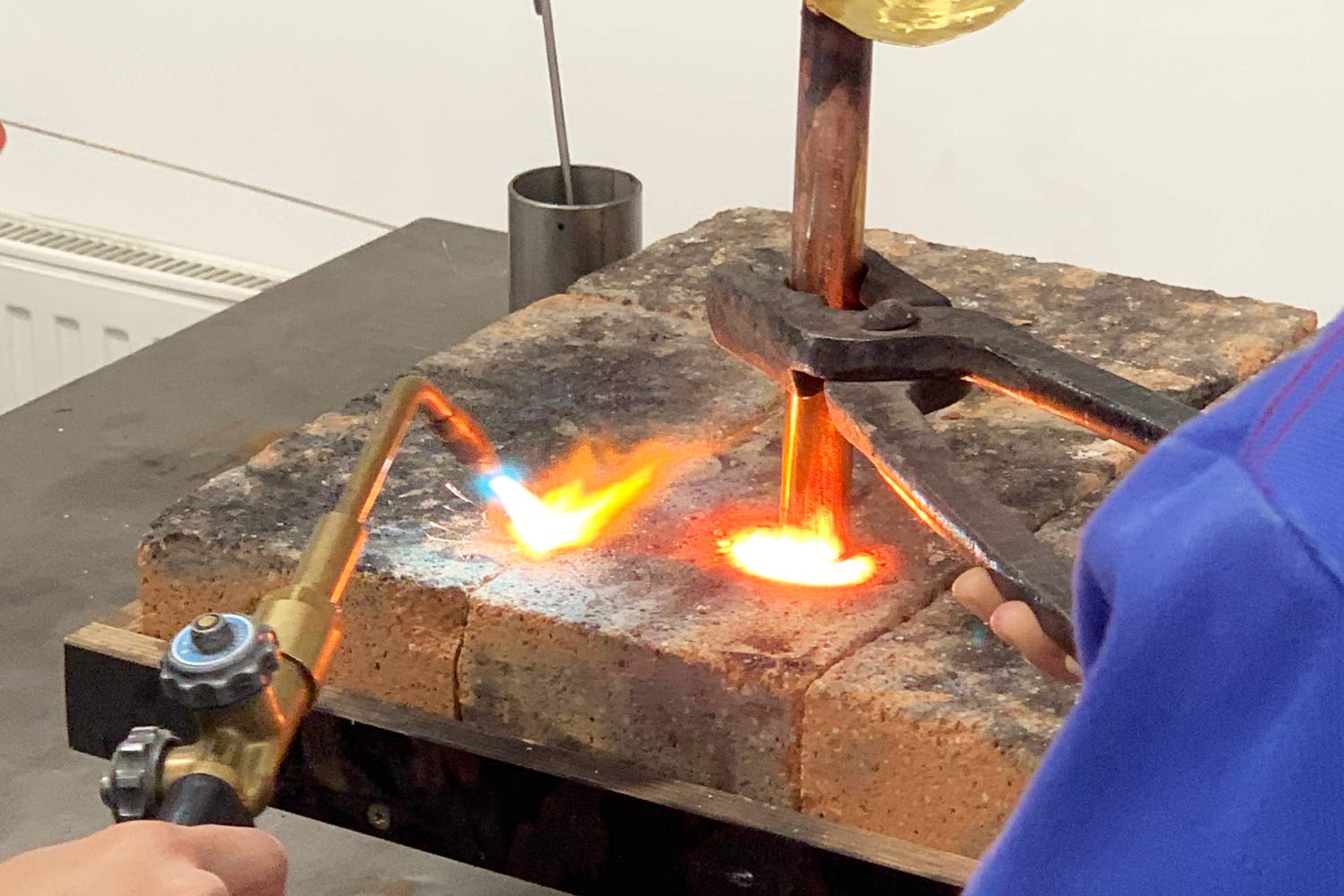
## Sodium acetate
Then I turned my attention to another potential heat storage material. The choice fell on sodium acetate, which is well known from hand warmers. If you dissolve sodium acetate in distilled water in the right ratio, you get a supersaturated salt solution. If this solution is made to crystallize, heat energy is generated during the crystallization process. If the cushion is warmed up again (water bath), the solution liquefies and - when it has cooled down to room temperature - is ready for use again. This cycle is infinitely repeatable.
## Modular blanket
This time a large surface turned out to be more suitable. As a test, I HF-welded a 50x50cm PVC cushion and filled it with about 1.8l of the solution. Result was about 60C° over 30min. By kneading again, the reaction could be cranked up once more, thus extending the duration of heat generation. I decided to make contact heat and molding and kneading an application mode of a speculative product. A modular blanket or, depending on the size, a rug or cape was designed and patterned from three modules. By walking on it, wrapping oneself in it and other movements, the heat-generating reaction should be triggered and maintained.
## Credits
Project was created during my guest semester in the [Industrial Design](https://www.angewandte-id.com){target=_blank} class of Prof. Stefan Diez. Project supervision Elisabeth Wildling and Peter Mahlknecht. Thanks to Lilian Marie Furrer.
---
# Renunciation Rebellion
Canonical URL: https://leomuehlfeld.at/en/renunciation-rebellion
---
title: 'Renunciation Rebellion'
for: 'Design Investigations'
category: 'Design Research & Speculation'
metaDesc: 'Designing performative rituals for fictional anti-consumerist religion exploring capitalism through design.'
thumbnail: /img/sitzkreis.jpg
date: '2022-01-20T00:00'
collab: 'Julia Hahnl, Stefan Schönauer, Mia Tešić'
---
# Renunciation Rebellion
## Designing performative rituals for fictional anti-consumerist religion exploring capitalism through design.
## Public Relations
Sigmund Freud advocated the thesis that man is always subject to his innermost drives and incapable of any permanent rational action. His nephew Edward Bernays was fascinated by this thesis and constructed communication practices that became known as public relations. Linking products with our identities, we started worshipping them.
## Capitalism as religion
Replacing devotion to religion with devotion to consumption, this new kind of religion grew to be one of the main pillars of society. However, increasing social problems and climate change expose this model as unsustainable and bring to light a desocialized and selfish society. How will people find their inner peace in a sustainable world of tomorrow?
## Designing a performance
Since a designer of the 21st century cannot simply go about his work quietly behind a desk, but must always seek confrontation with activities outside their comfort zone, we designed a performance and the necessary props. The performance was designed in collaboration with the [Angewandte Performance Lab.](https://www.dieangewandte.at/institute/angewandte_performance_laboratory_apl){target=_blank}
Four costumes were designed and produced. In addition, steel tubes were bent and welded into rings that could be disassembled. For the resulting transportable "altar", a fabric cover was also tailored which made the steel construction look like a wormhole when stretched over it. With the help of an Arduino and a DMX IC a light show was programmed. The power was provided by a car battery and an inverter.
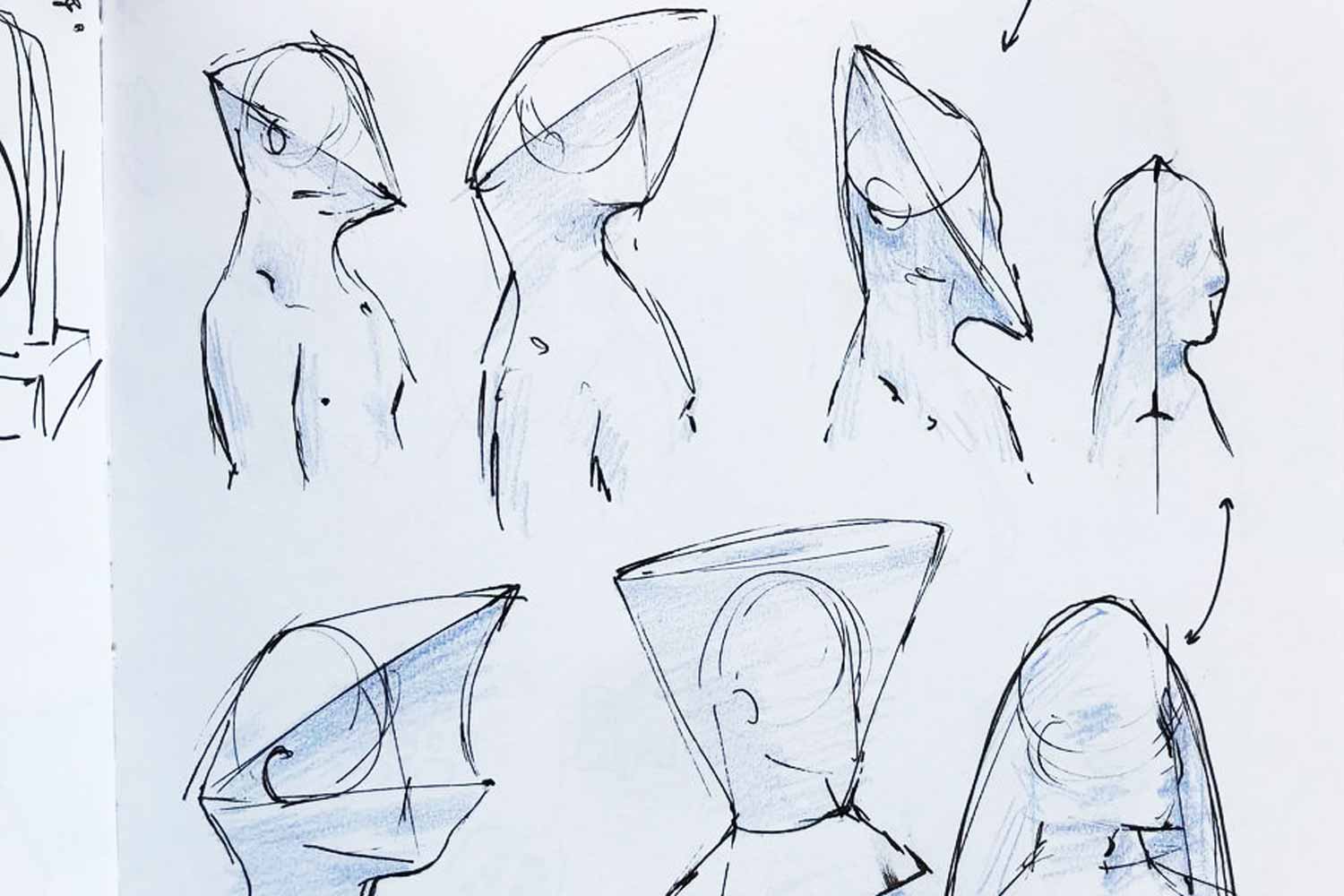
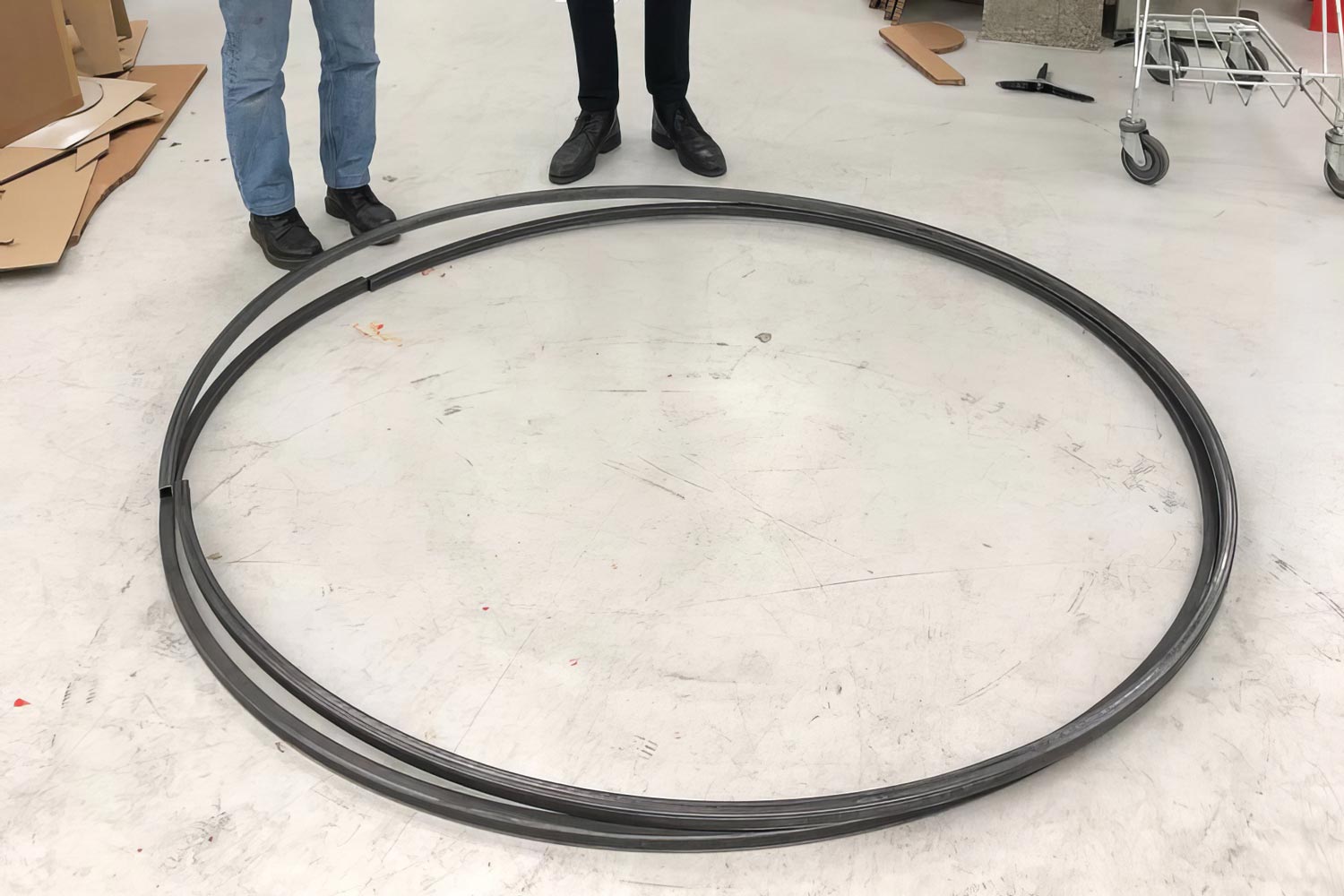
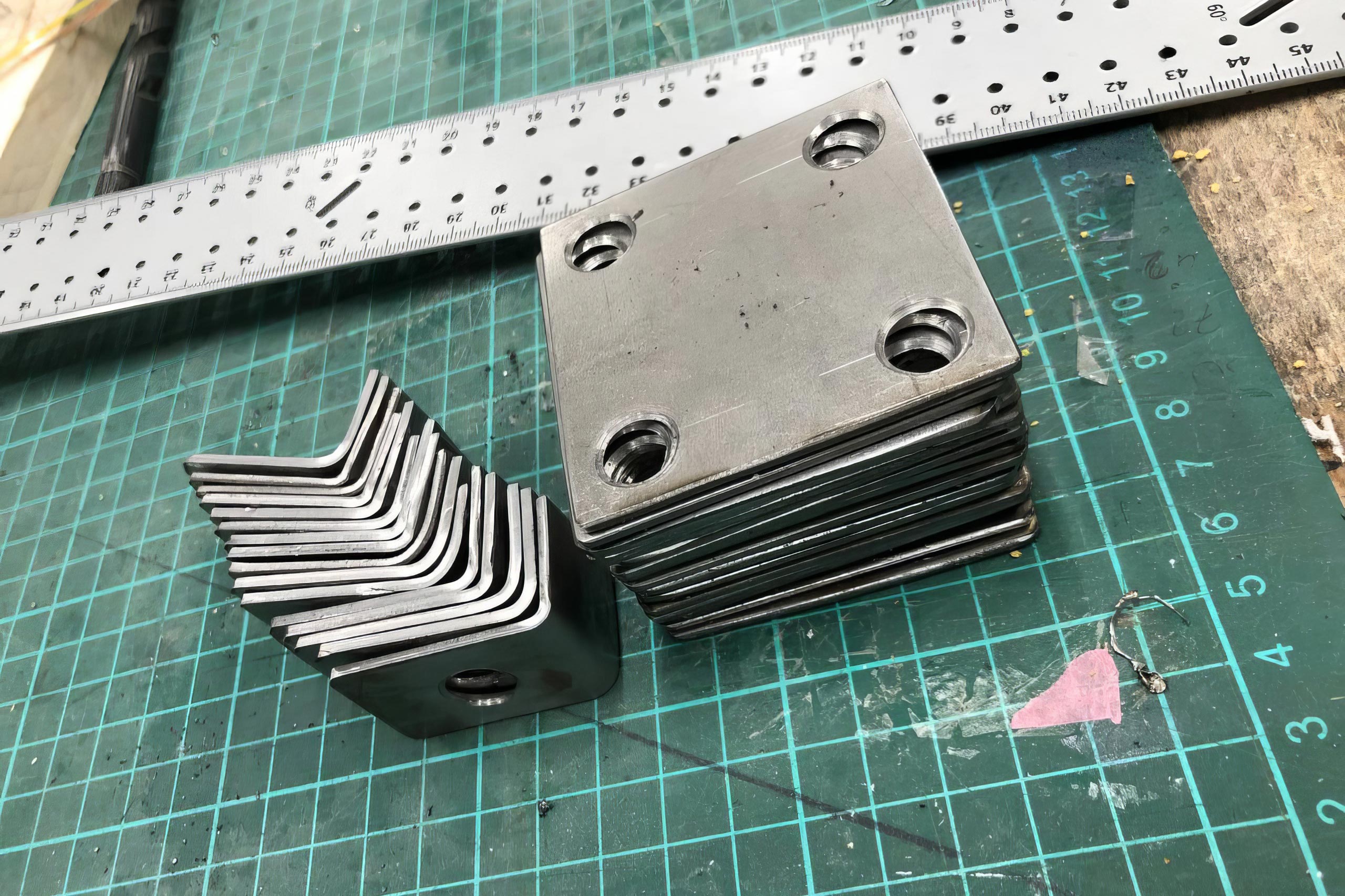
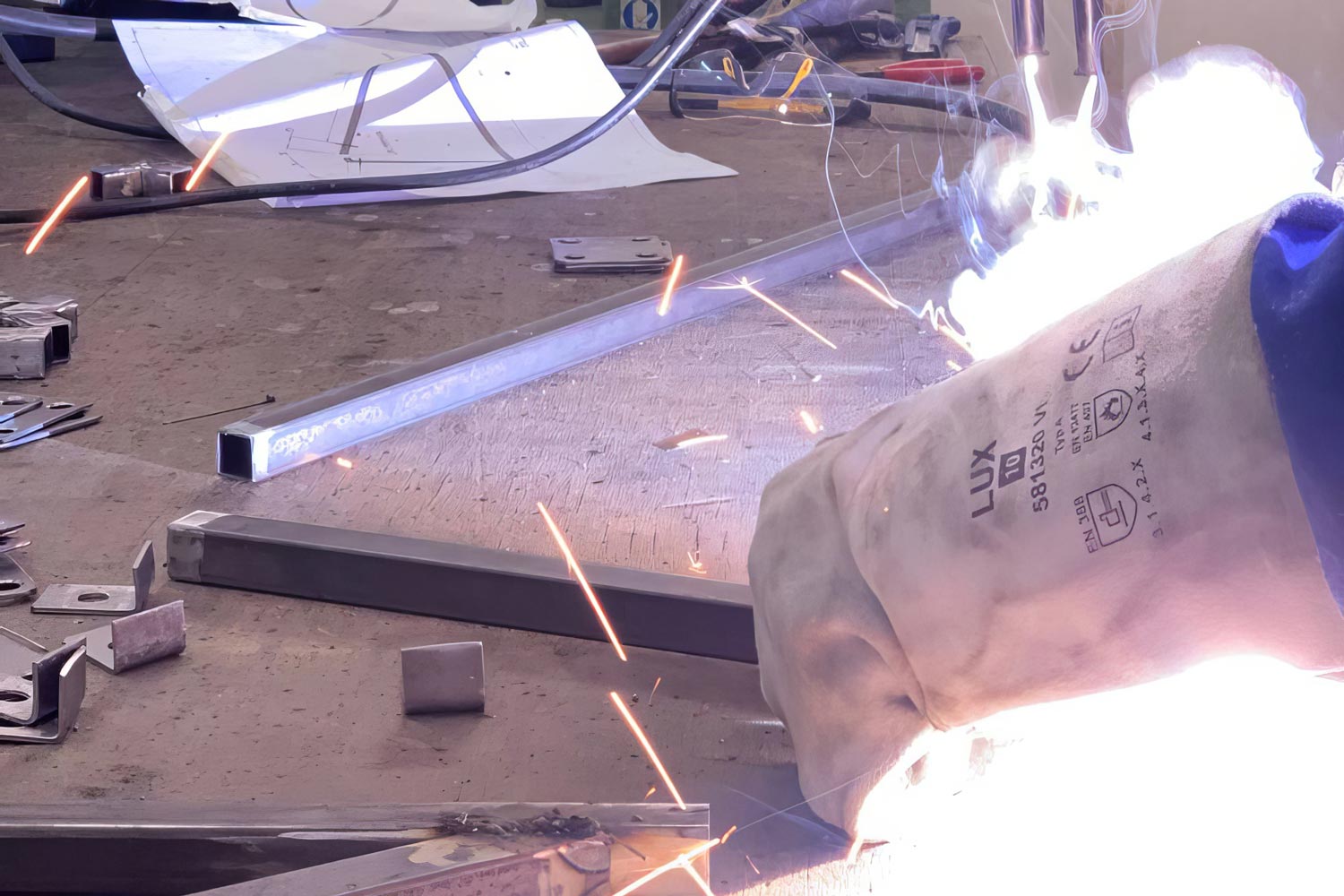
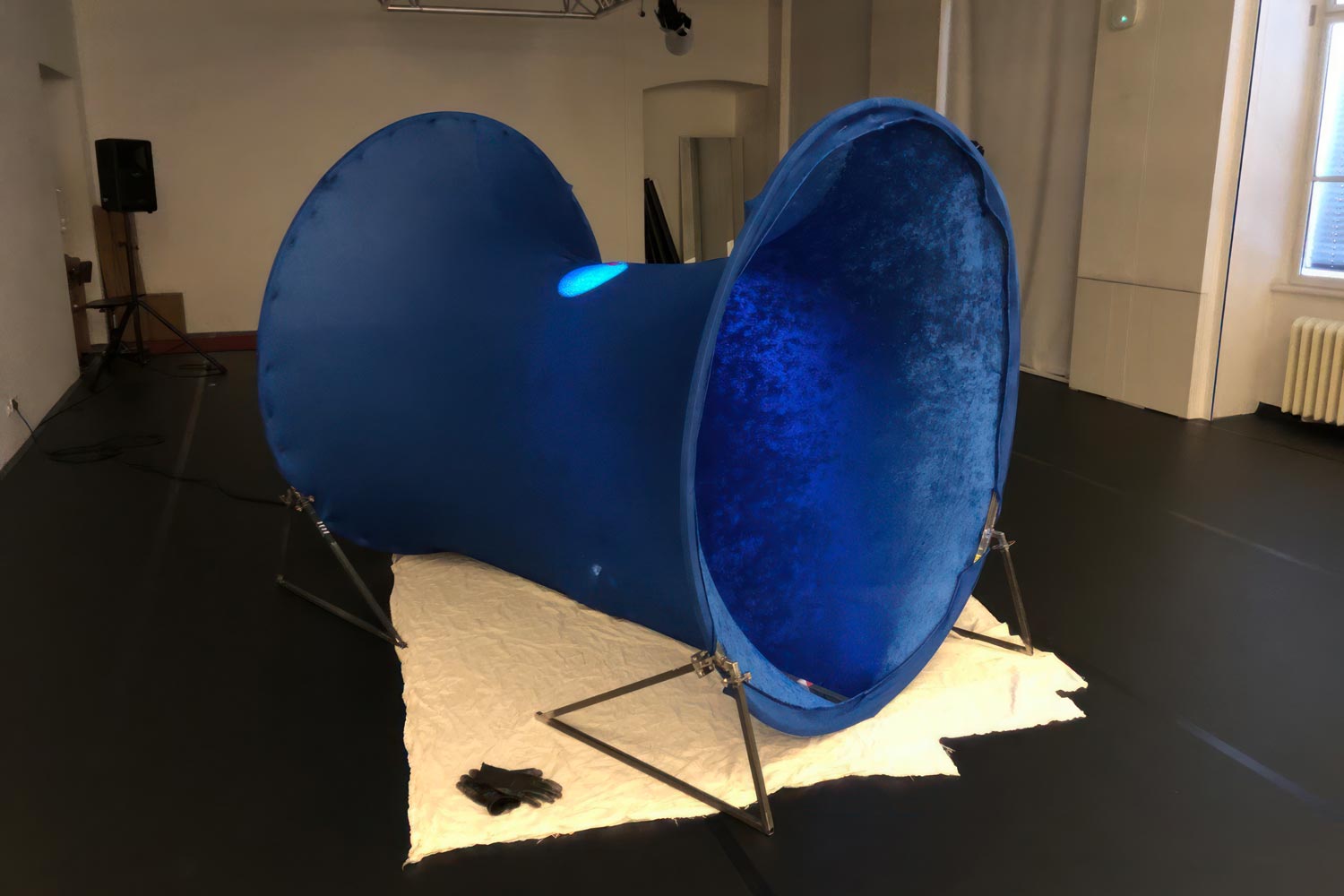
## The Plot
The resultign performance shows the rite of passage of the renunciation rebellion, an antithesis to the religion of consumerism. In the course of the plot, the protagonist experiences a personal ascent in the midst of the community. The diary of the ascending one is burned. In the following rite, the ascendant will confess their sins and wash them away. Finally, they are granted the ceremonial garment, stride through the portal of waiver and put on the ascetic headpiece. They are now perceived as an equal member. You can watch the final performance [at the top of this page.](#)
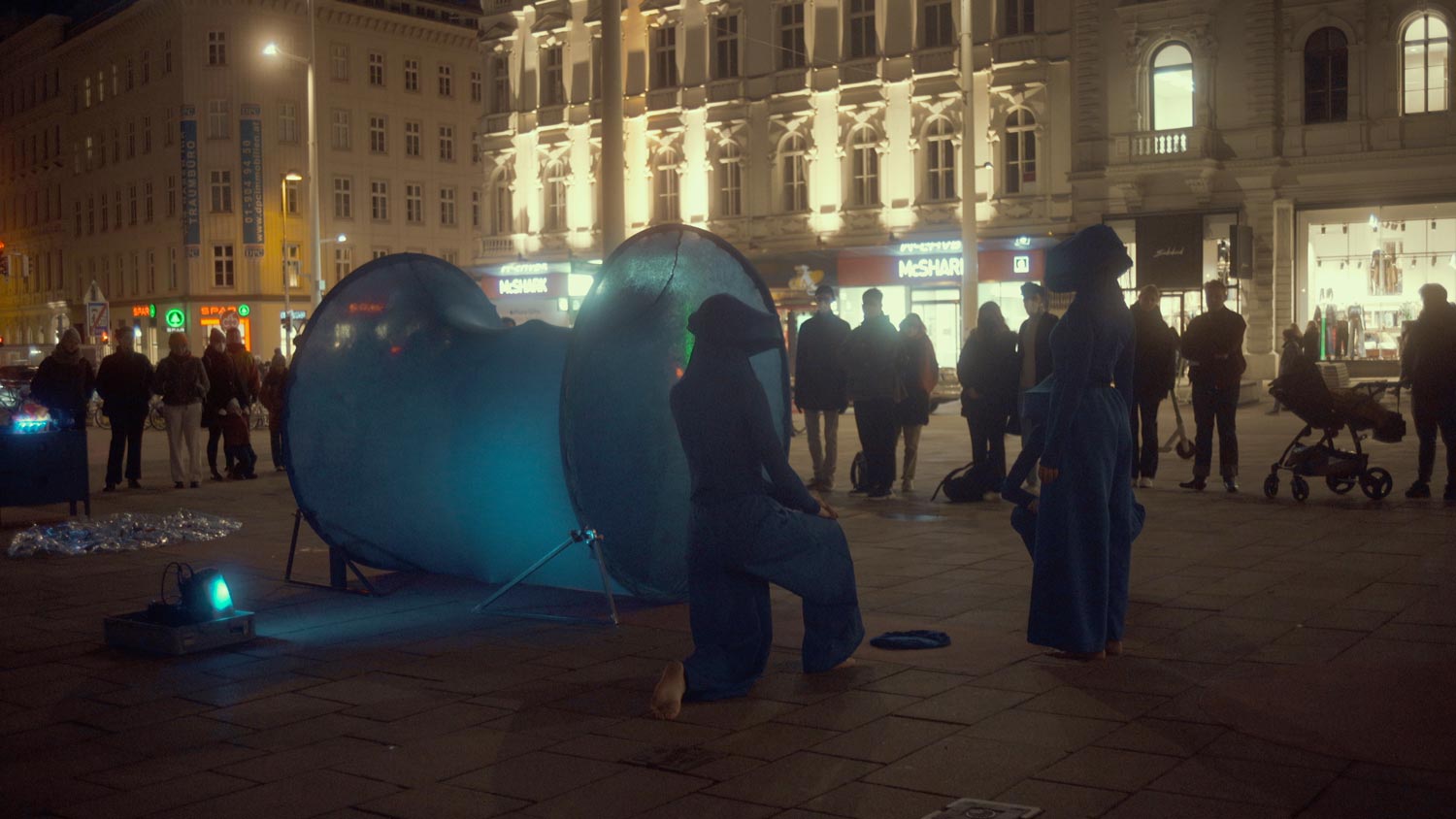
## Credits
This project was created by Julia Hahnl, Stefan Schönauer and Mia Tešić. Project in collaboration with [Angewandte Performance Lab.](https://www.dieangewandte.at/institute/angewandte_performance_laboratory_apl){target=_blank}
---
# Wood-e Videos
Canonical URL: https://leomuehlfeld.at/en/wood-e-videos
---
title: 'Wood-e Videos'
for: 'Cartbrothers'
category: 'Film & Motion'
metaDesc: 'Creating promotional videos showcasing solar-powered wooden vehicle for Cartbrothers Vienna.'
thumbnail: /img/woode-wheel.jpg
date: '2021-11-11T00:00'
showOnLanding: false
---
# Wood-e Videos
## Creating promotional videos showcasing solar-powered wooden vehicle for Cartbrothers Vienna.
## Main Video
The main video shows the vehicle from different angles. In particular, the video shows the vehicle design as well as important features such as solar operation and the possibility of using the vehicle as a power source for various 230V applications with the help of a built-in inverter.
## Solar Power
The first of the two short clips shows that one can use the vehicle's batteries as a mobile power-bank anywhere. The inverter installed for this purpose supplies the power via a 230V socket at the rear of the vehicle. A toaster can thus be connected to this socket without any problems.
## Sunpark
For a long time, finding a shaded parking space was considered a must for drivers. With wood-e, the arithmetic is reversed and parking in the sun helps the solar cells recharge the battery.
## Credits
[Wood-e](https://www.wood-e.at){target=_blank} is manufactured by [Cartbrothers.](https://cartbrothers.at){target=_blank}
---
# Talking House
Canonical URL: https://leomuehlfeld.at/en/talking-house
---
title: 'Talking House'
for: 'Lucy Li'
category: 'Exhibition & Installation'
metaDesc: 'Designing interactive audio installation exploring tourist experiences through soundscapes.'
thumbnail: /img/button-press-sharp.jpg
date: '2021-11-04T00:00'
showOnLanding: false
collab: Lucy Li
---
# Talking House
## Designing interactive audio installation exploring tourist experiences through soundscapes.
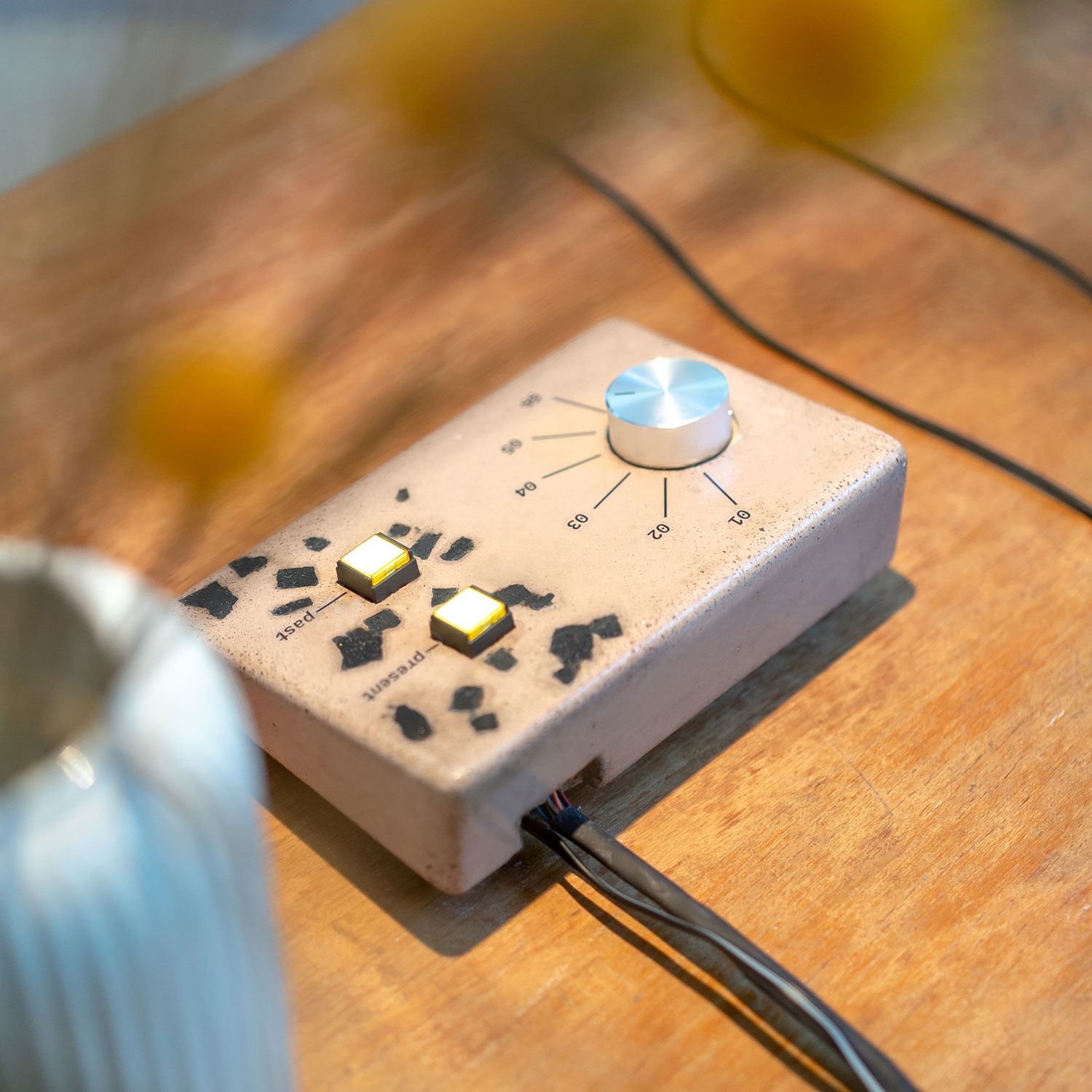
Talking House is a project that addresses the question of how to experience tourist sites on an auditory rather than purely visual level. An interactive object, that is the focal point of an informative spatial installation, was designed. After putting on the headphones, the user selects a location by turning a dial and then presses one of two buttons to select an audio track from the present or the past. The history and development of a place can be experienced intuitively.
## Residency in Glaus Switzerland
For the auditory narratives, voiceovers were recorded by Swiss locals. In addition, the soundscape was recorded on location in and around Glarus. The project was open to the public as part of the "Gepäckausgabe Glarus" an outpost of the Kunsthalle Glarus.
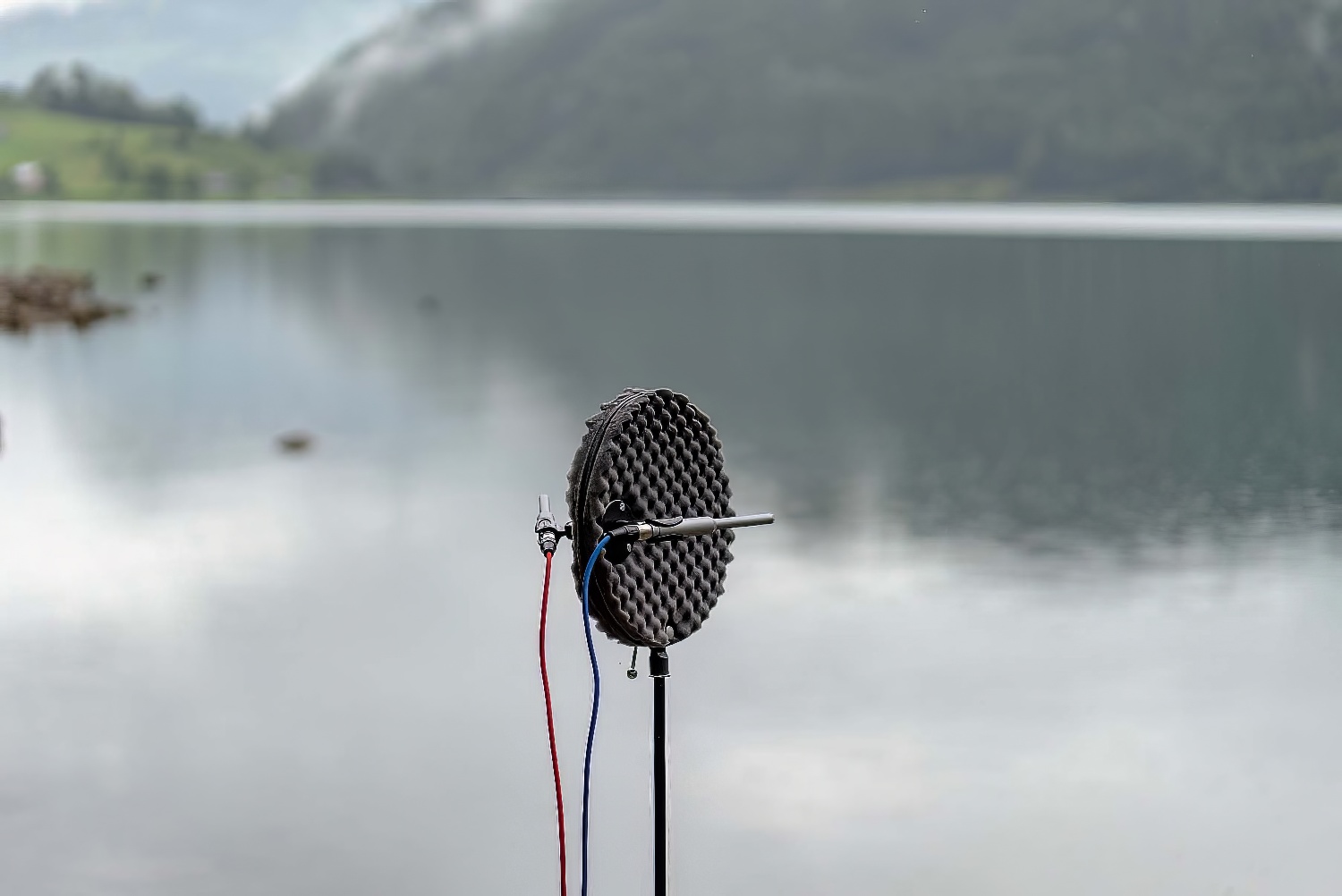
## Linth Limmern PowerPlant
The construction of the Linth-Limmern hydroelectric power plant is an example of the transformation of landscapes and places. The concession for the construction of the power plant was granted by the cantonal council on March 30, 1957. On May 5, the people approved the cantonal participation in the construction of the power plant.
This place can also be selected as one of 6 in the exhibition "Talking House". Here, visitors are immersed in today's world of sound or in the acoustic landscape before the construction of the power plant. The filigree of a place is quickly recognizable.
## Electrics & Interface
The housing of the interface was cast from concrete. Various rock inclusions lead to a terrazzo surface after grinding and polishing.
The interface consisted of a 6-position rotary switch and two spring loaded push-buttons that also featured a built in LED. I designed a simple router board to avoid a cable mess. It connects all inputs and outputs with resistors, transistors and the PINS. The board was mounted inside the panel and was connected to the RPI and +12V DC to power the two LEDs inside the switches.
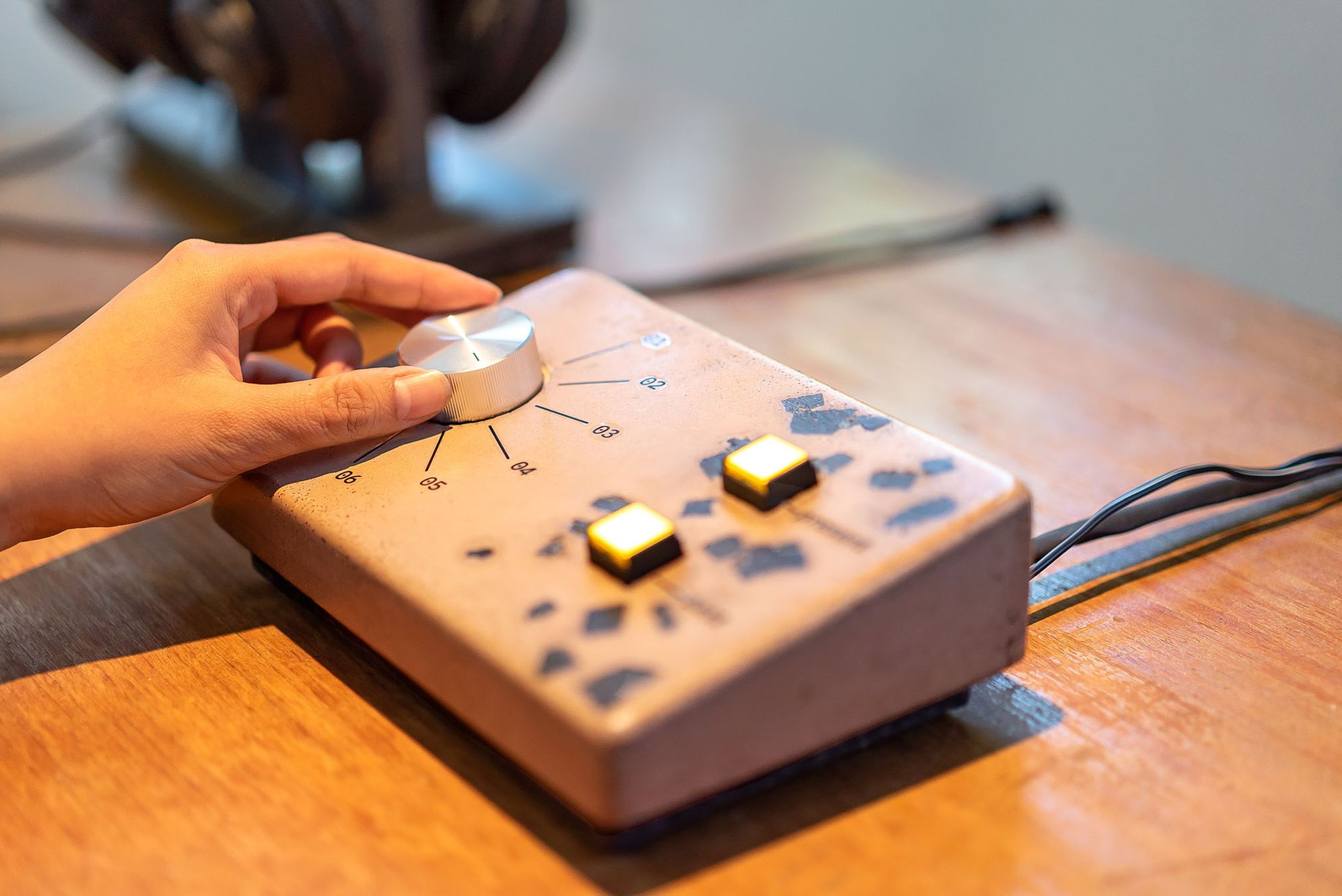
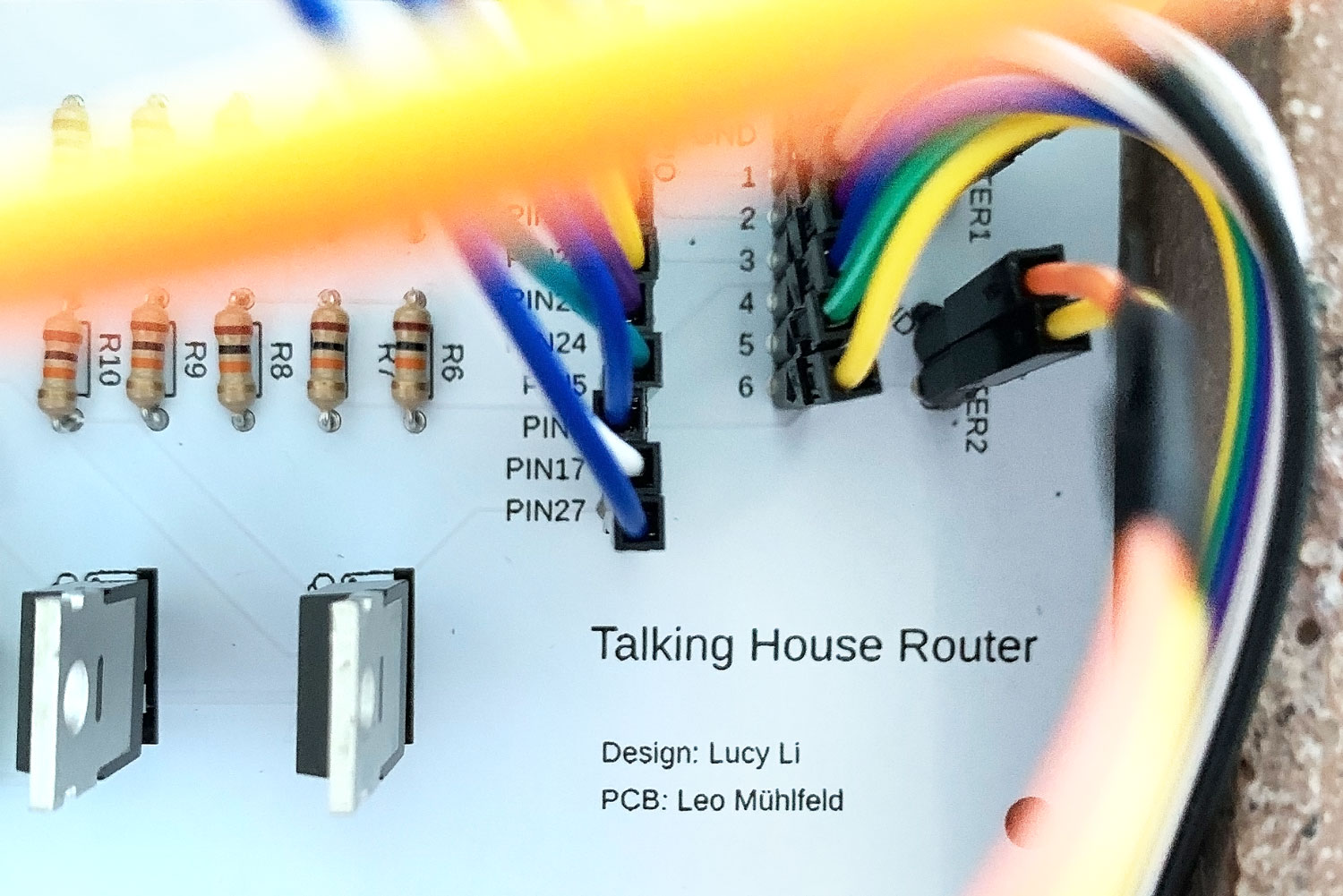
A [Node.js](https://nodejs.org/en/){target=_blank} script read the button states and sent out the data over a websocket. The visual interface was rendered by a [React App](https://reactjs.org/){target=_blank} that received the data over the websocket. The app, which ran inside [Electron,](https://www.electronjs.org/){target=_blank} was then able to display the appropriate contents.
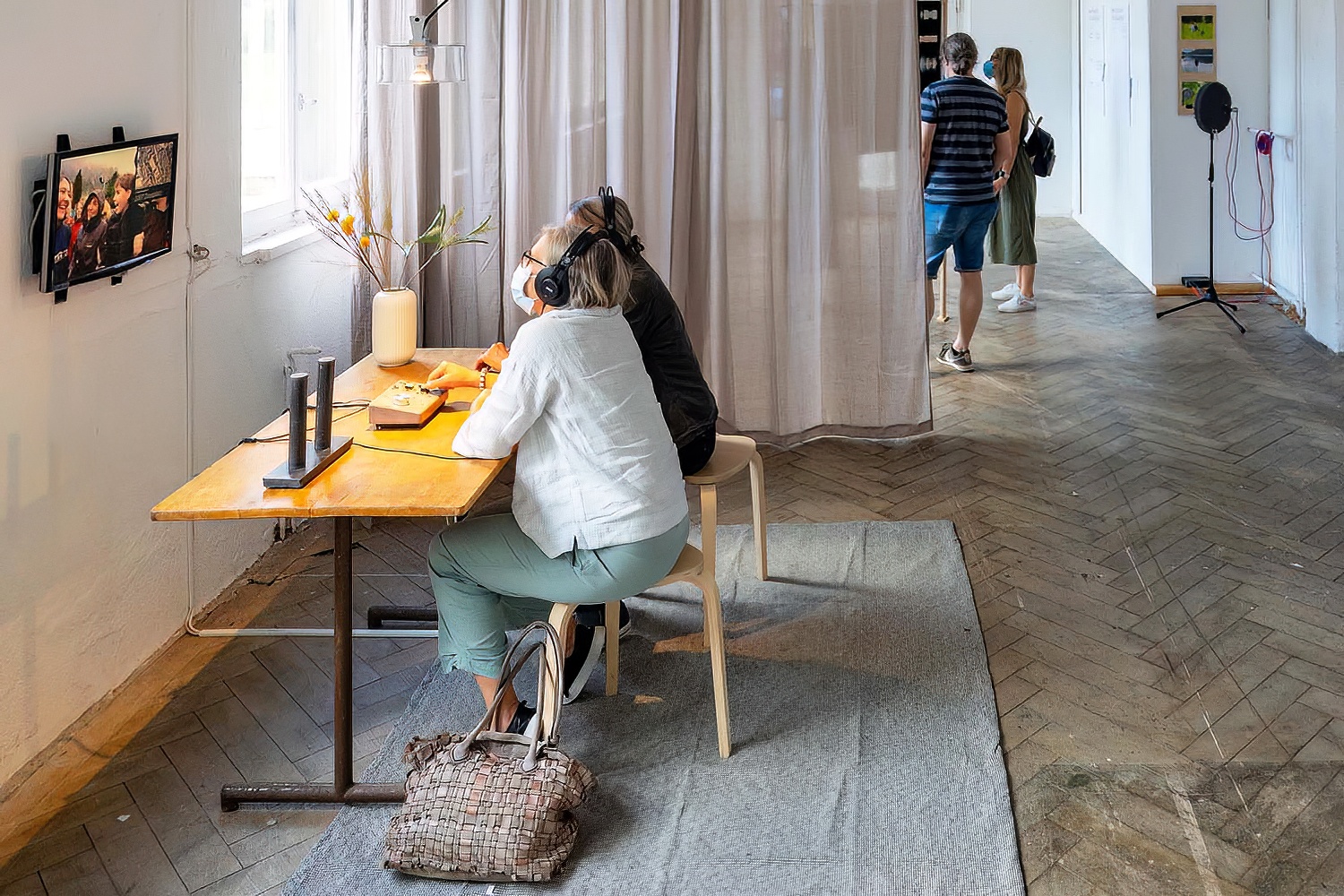
## Credits
Designed by Lucy Li & Leo Mühlfeld, Electronics & Code by Lucy Li & Leo Mühlfeld, Commissioned by “Gepäckausgabe Glarus”, Building Support: Julia Brandl
---
# Centaur Design
Canonical URL: https://leomuehlfeld.at/en/centaur-design
---
title: 'Centaur Design'
for: 'Design Investigations'
category: 'Design Research & Speculation'
metaDesc: 'Exploring co-creation between children and text-to-image AI in 2021. A Project on designing in the age of AI.'
thumbnail: '/img/girl-sherwoled-action.jpg'
date: '2021-06-25T00:00'
showOnLanding: true
heroImage: '/img/exhibition-detail-1.jpg'
---
# Centaur Design
## Exploring co-creation between children and text-to-image AI in 2021. A Project on designing in the age of AI.
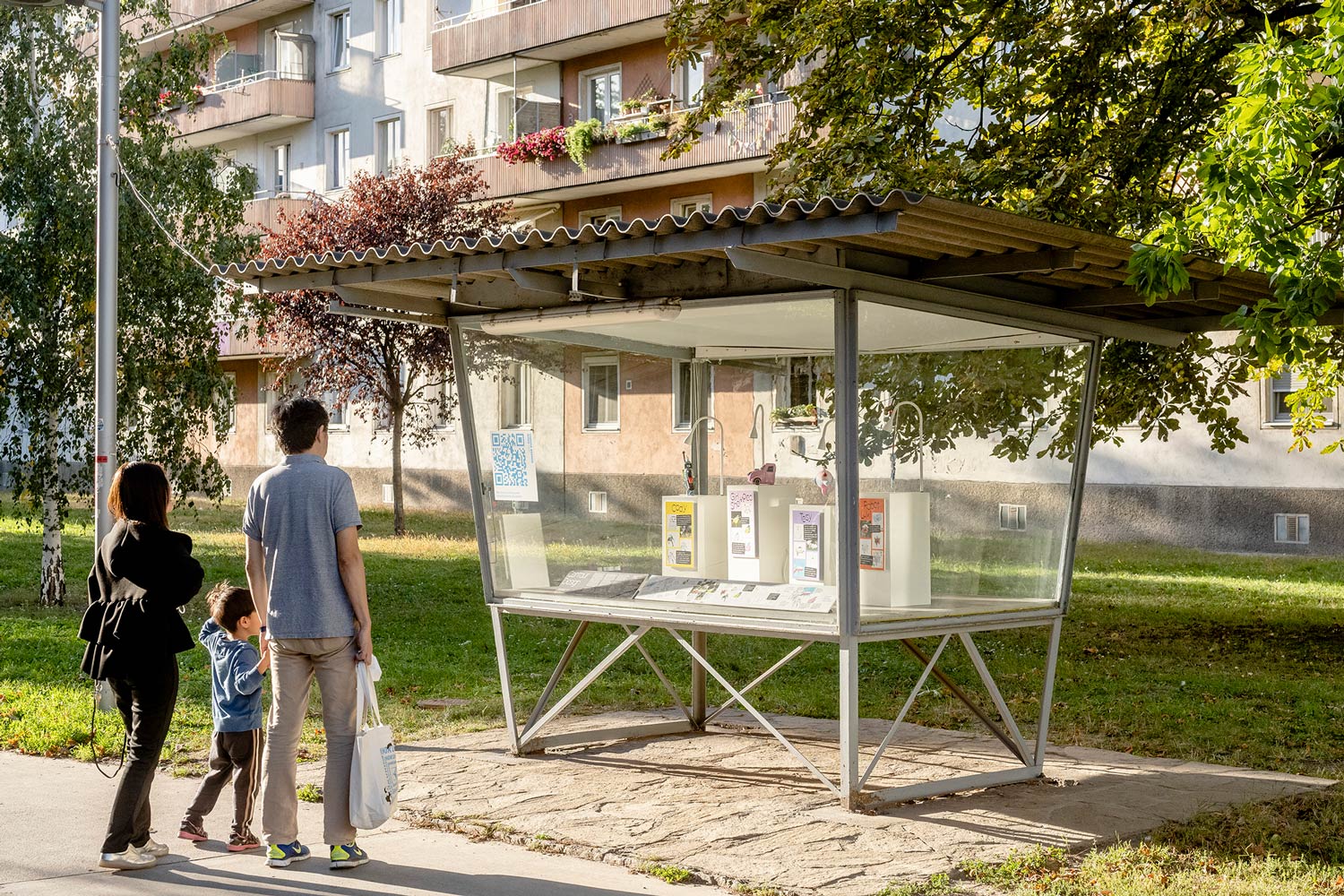
## Humans & AI
With artificial intelligence as the next frontier in the design process, the question how future designers and AI will coexist, arises. Art and culture don't seem to be an optimization problem. Especially as a design student, I was interested in how to approach these technologies as a tool.
## Collaboration
Instead of fear and rejection, I wanted to find out how some of these tools can be used in a creative process. It became clear that productive collaboration would require rethinking the image of AI as an adversary and exploring collaborative modes. Besides the cliché of AI replacing humans, there are other theories on how AI and humans can coexist. An exciting one is the "Centaur" approach, in which humans and machines bring their best features to the table.
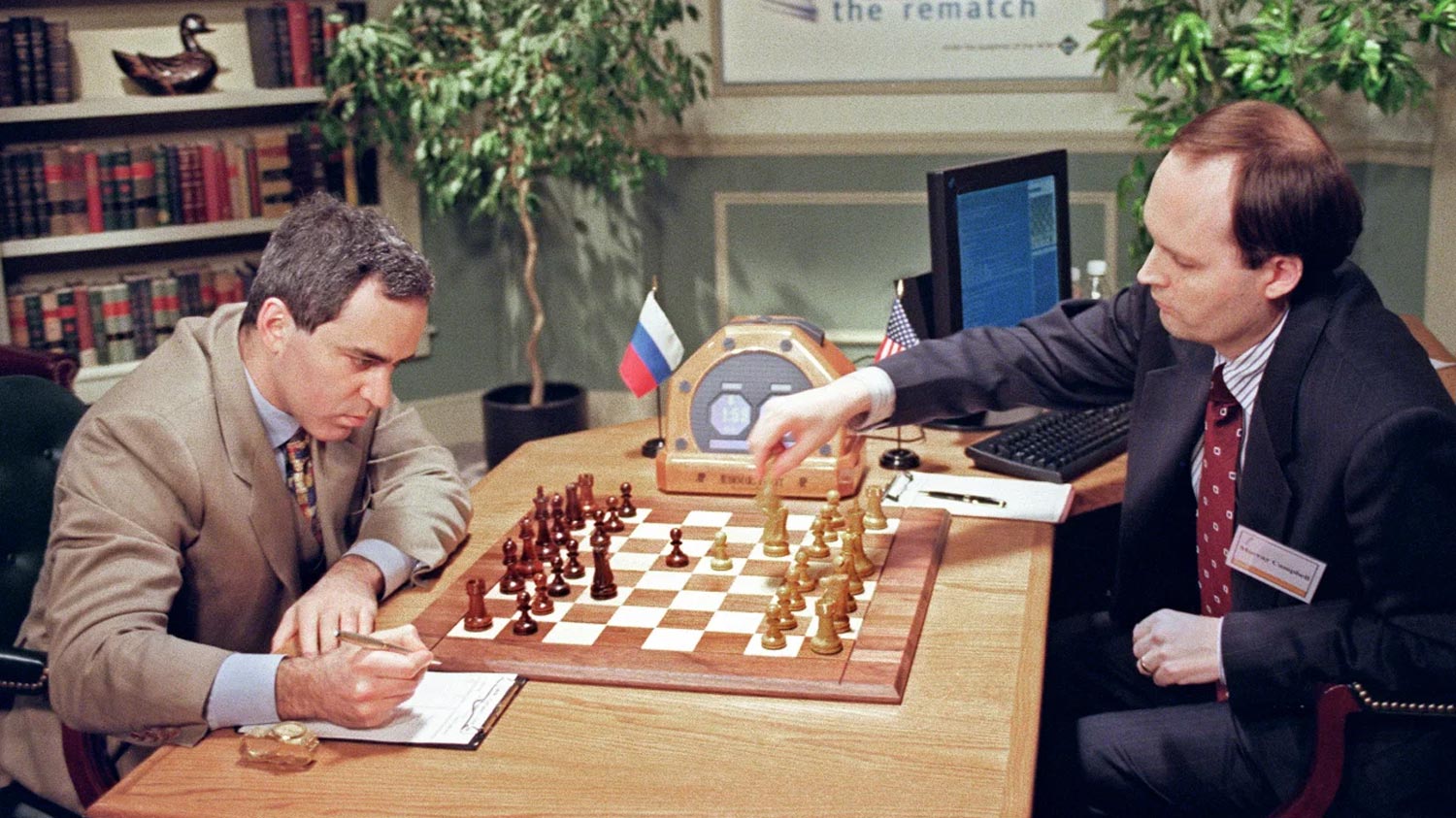
## Centaur Design Experiment
The Centaur approach was theorized when Garri Kasparov lost a chess tournament to IBM's Deep Blue in 1997. Instead of feeling replaced as a human chess player, he saw a new and exciting form of chess emerging in which machines and humans share the best features. To explore collaborative modes between humans and AI in a design related context, this experiment will explore this approach in a design process. In this iterative process, which is tailored specifically for children, humans and AI work together to design toys.
## Cody
At the beginning, a child is asked to provide some information (text, sketch, material) about her or his desired toy. One child gives his toy the name "Cody", draws a robot and describes it like this:
> "He is a robot, he can tinker, he has many different tools. He develops human emotions and can save people. He can swim and so many things."
The information taken from sketch, text and choice of material was used as written input for a text to image model (BigSleep by Ryan Murdock) to generate a first draft of the toy. It is interesting how elements of the story told by the child, significantly influence the draft of Cody. The neutral network "BASNet" is then going to cut out the background.
Two models trained to convert images into sketches (Artline & Photosketch) are now fed the masked images. The results are further processed into a template sketch and shown to the child.
The child is now required to describe the image and to complete the approximated sketch.
> "I can see a half finished robot dog. I can see only one leg. One head. A half finished body. A weird horn."
From the text and the sketch, we get a definition of the geometries as well as a structured anatomy, distinct facial elements and a kind of horn. In addition, we get a new element: the antenna/tail. Cody began as a clear narrative and a rough sketch. Through the use of AI collaborators, a character, that supports the story with emotional traits and a variety of tools, was created.
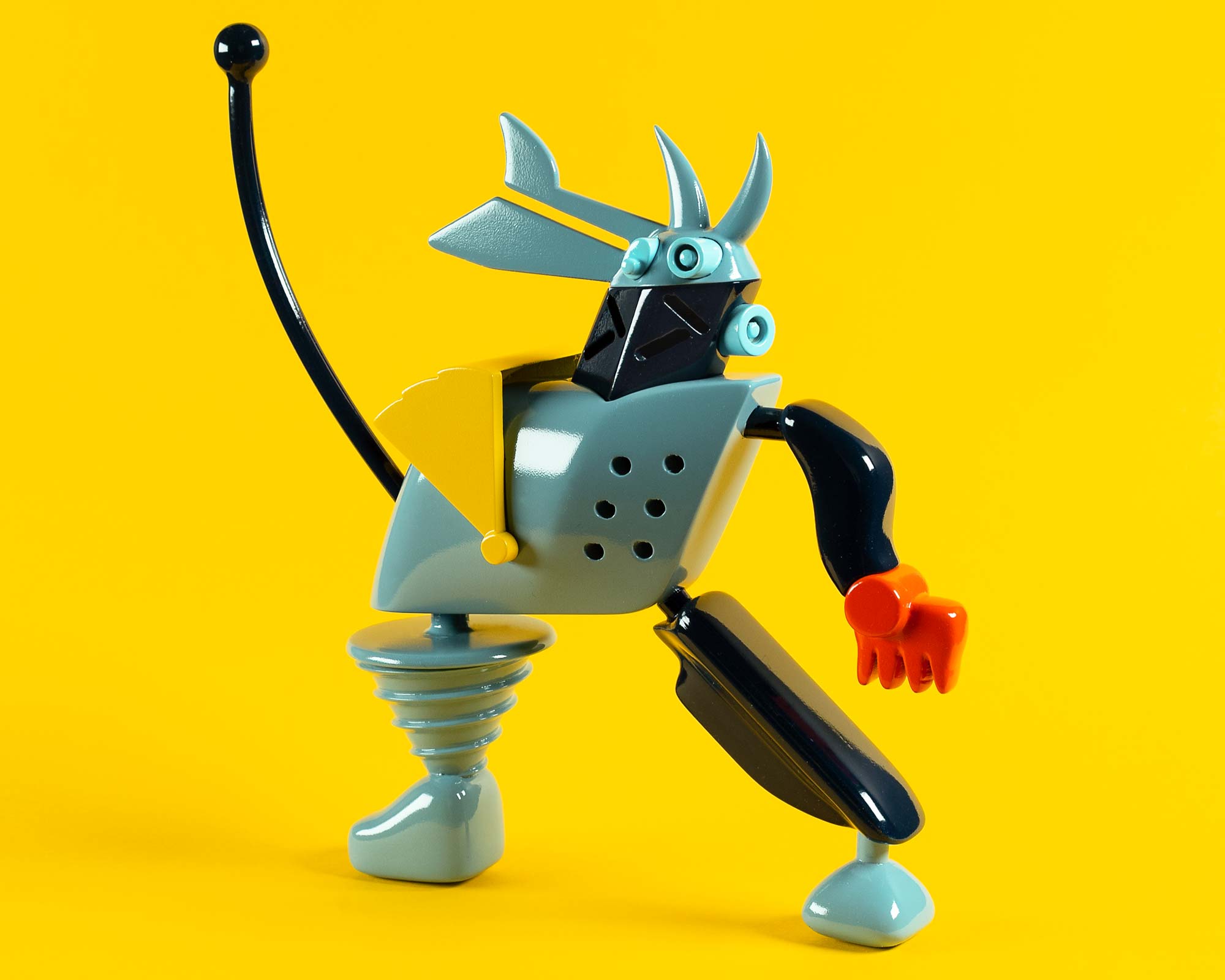
## Girl Sherwoled
A child gives its toy the name "Girl Sherwoled" and draws a car with stereotypical feminine attributes. It describes it like this:
> "It can drive, light up, and talk."
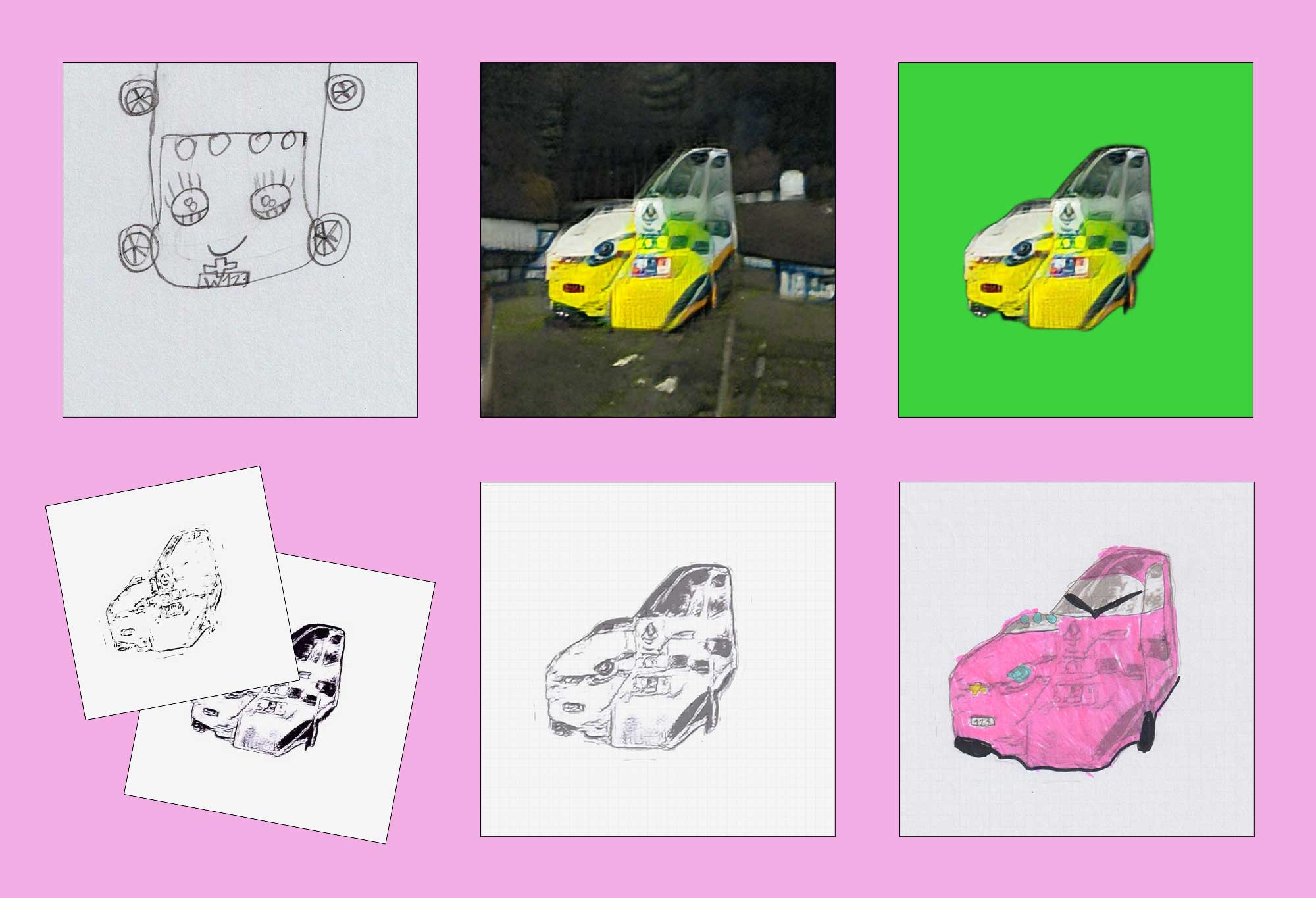
After going through the process described before, the child is now required to describe the colored image and to complete the approximated sketch.
> "I can see that it is small and not big. I can see that the front is big and the back is small."
The gender-specific design elements (as propagated) originally removed by the AI are brought back by dipping the whole car in a rich pink. The supposed cross was implemented as a Chevrolet logo which gives more sense to the name "Sherwoled". "Girl Sherwoled" is a good example how the biases, of the designing parties involved, can influence the design.
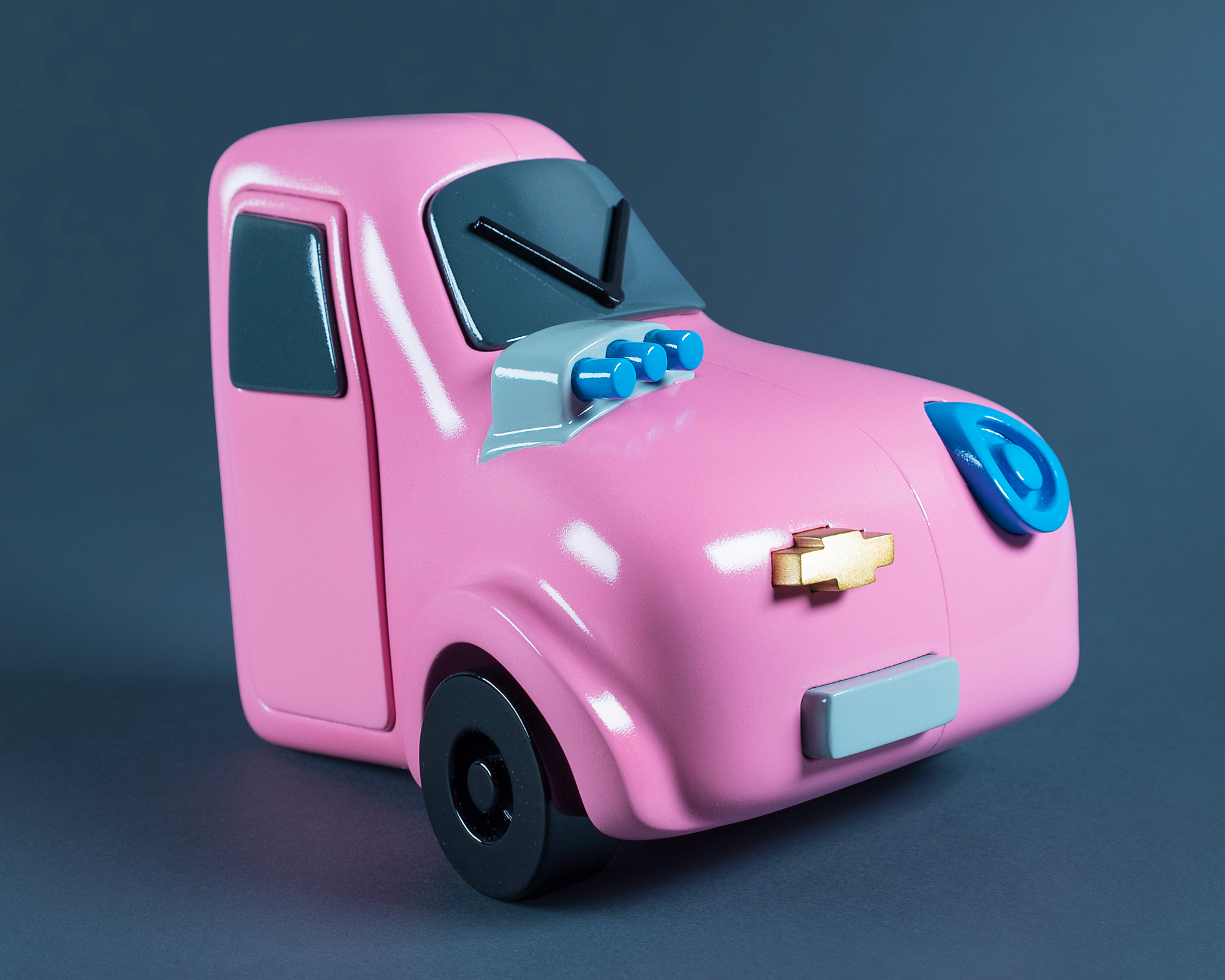
## Tesy
A child gives its toy the name "Tesy" and draws a sketch that shows an animal that looks like a hybrid of cat, pig and unicorn. The child describes Tesy as follows:
> "She can talk and she is very fluffy and cute. Sometimes she makes noises like, "I'm hungry!" Or, "I want to dance and listen to music."
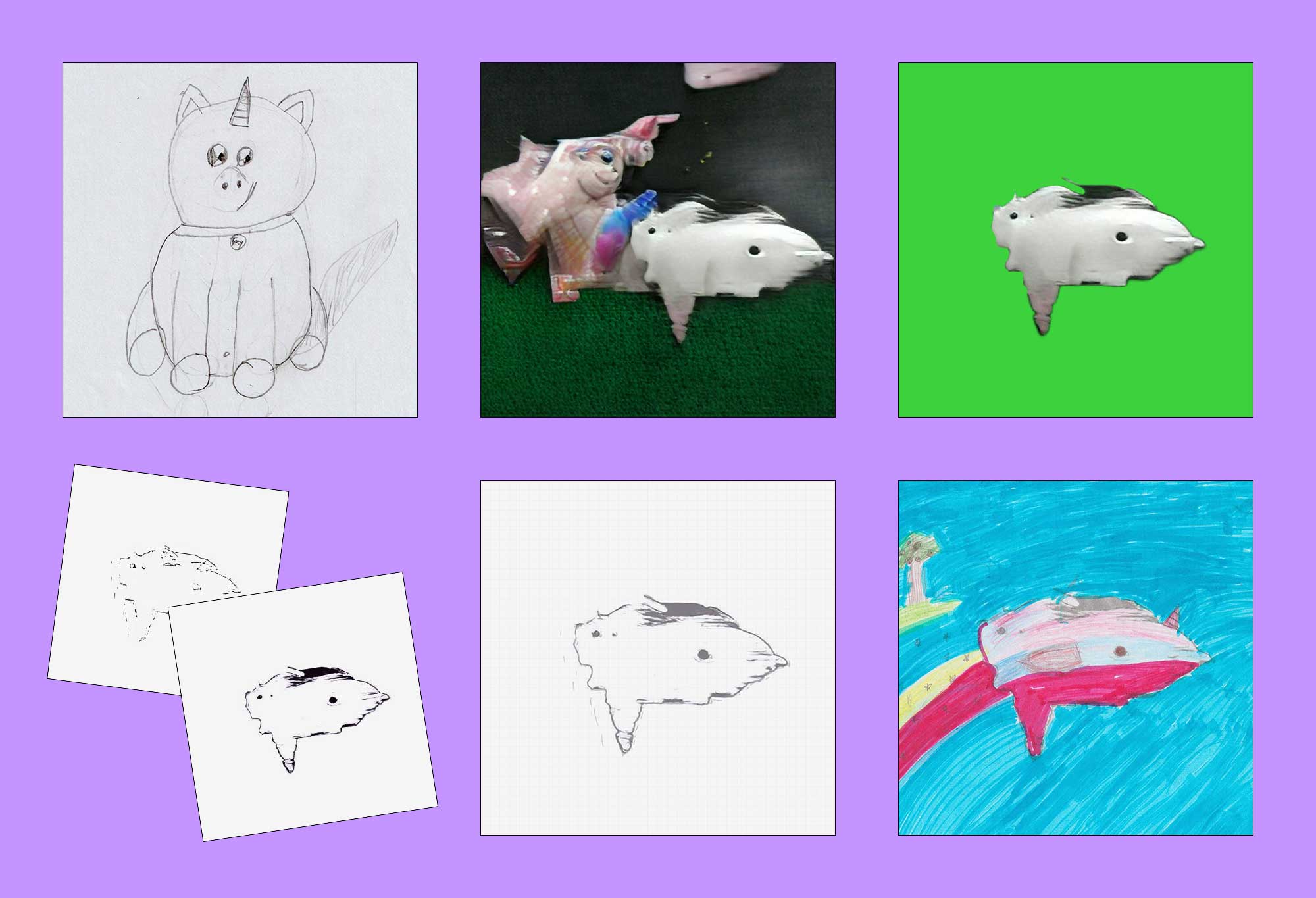
After going through the iterative process described before, the child is now required to describe the colored image and to complete the approximated sketch.
> "I can see a dolphin. It has black eyes and a pointy nose."
Here, the direction of movement and the color scheme are defined. In addition, the child gives us the information that "Tesy" is probably a kind of dolphin. "Tesy" began as a toy that used familiar aesthetics. Through the collaborative process with AI, a unique and charismatic character was born.
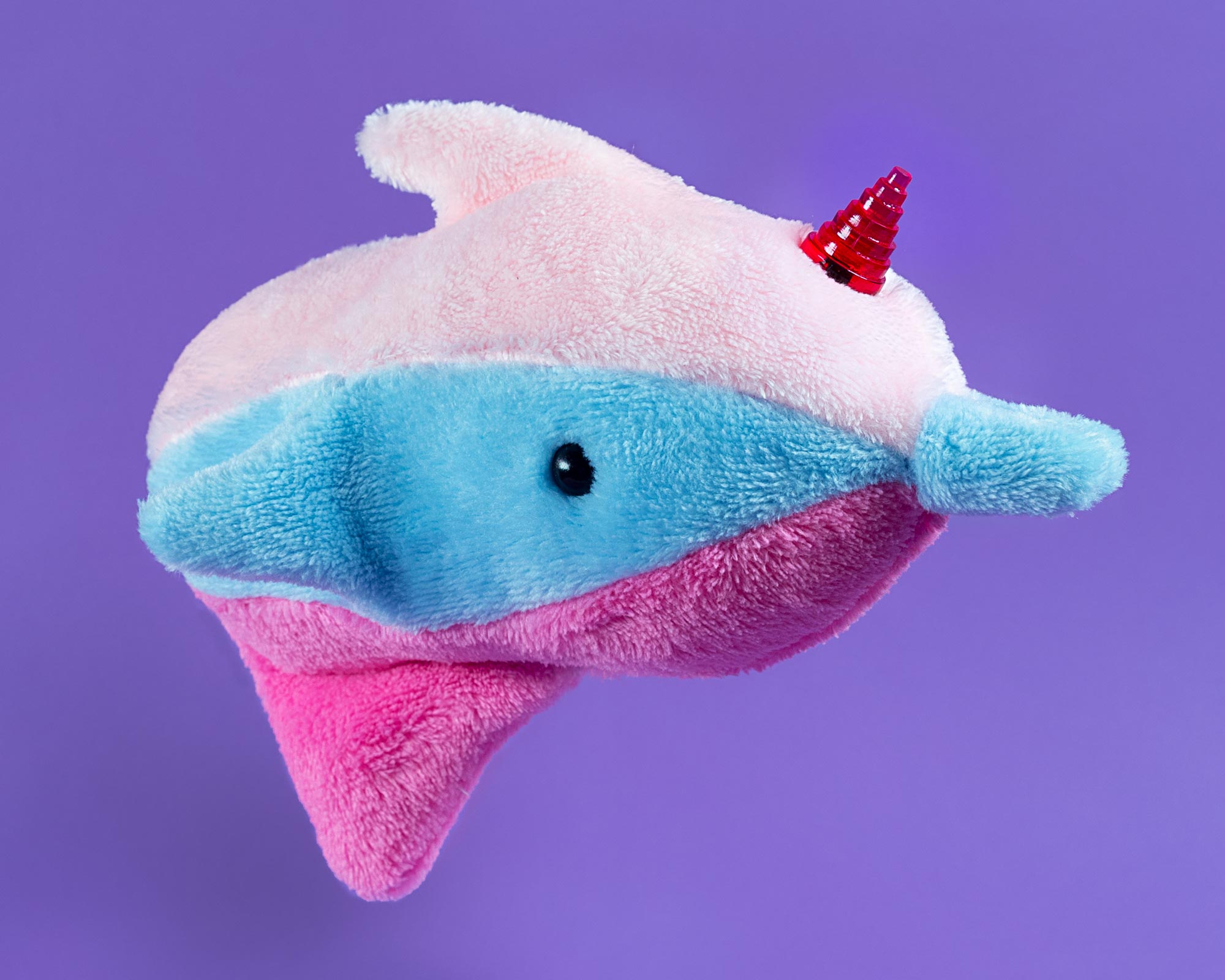
## Robot Luxi
A child gives its toy the name "Robot Luxi" and draws a classic robot with big wings and some tomatoes on the ground. It describes it like this:
> "He can fly and he has a lot of tomatoes."
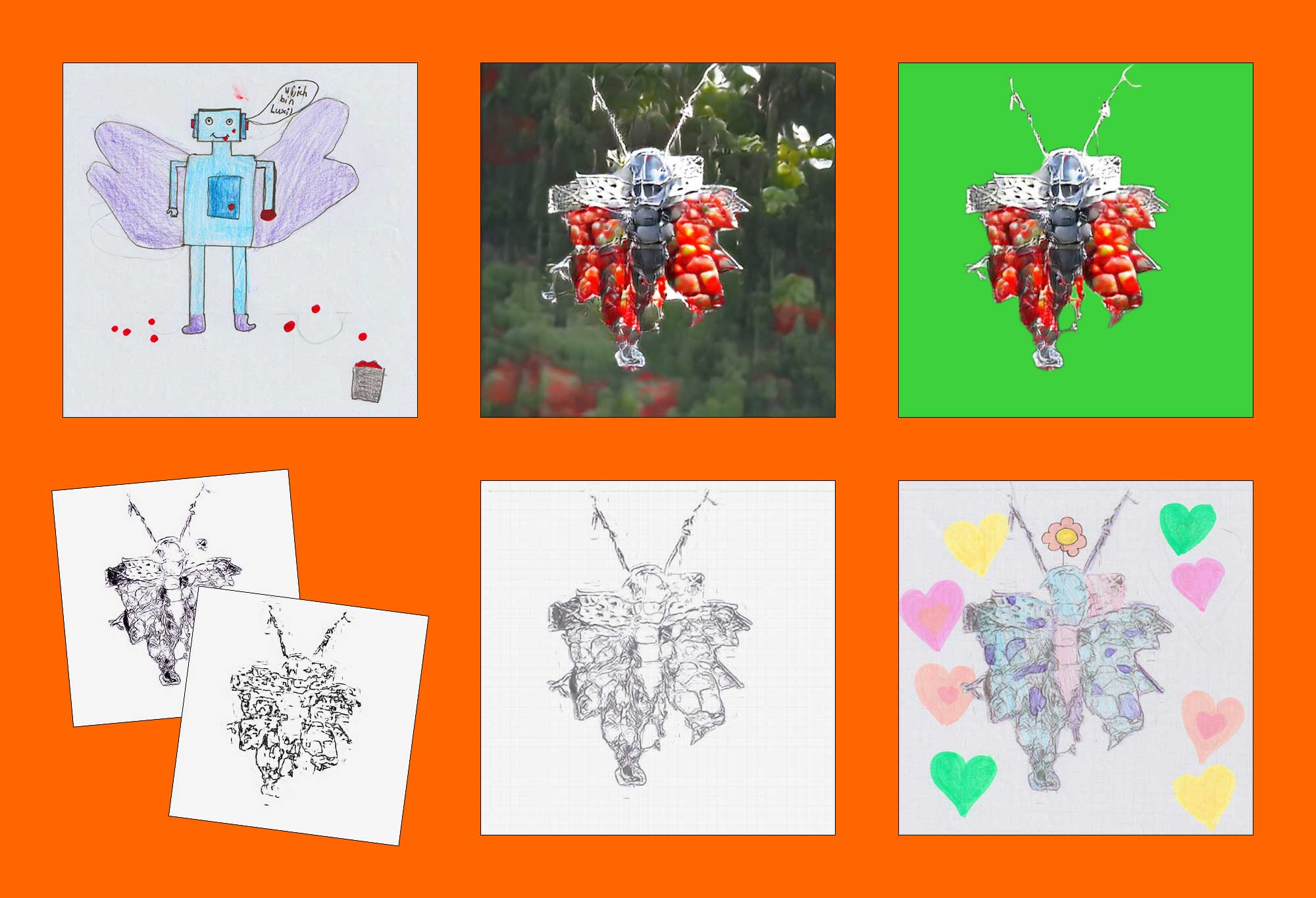
After going through the iterative process described before, the child is now required to describe the colored image and to complete the approximated sketch.
> "I can see a robot butterfly with many bright colors."
The interesting geometry, which was generated only because of the input that "Robot Luxi" should have many tomatoes, was ignored by the child and has been supplemented with purple color. The otherwise problematic command and control behavior, which executes human commands without question, is used here as a design tool that leads to exciting geometries in "Robot Luxi".
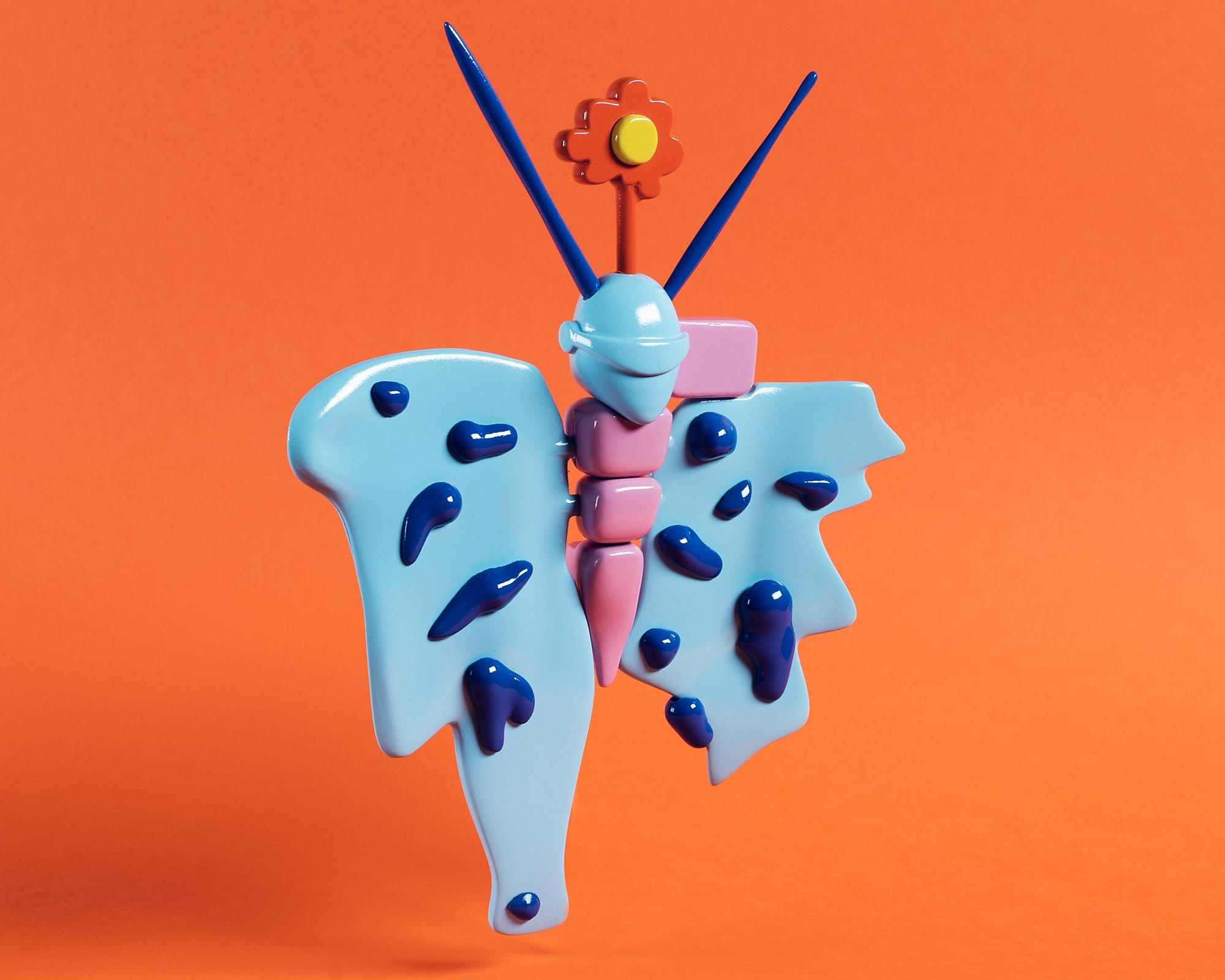
## Exhibition
For the exhibition at the Angewandte Festival 2021, four A1 posters containging information about the project were printed. The toys were placed on custom-made pedestals and staged by also custom-made lamps. The posters were designed in collaboration with [Lucy Li.](https://lilucy.at/){target=_blank}
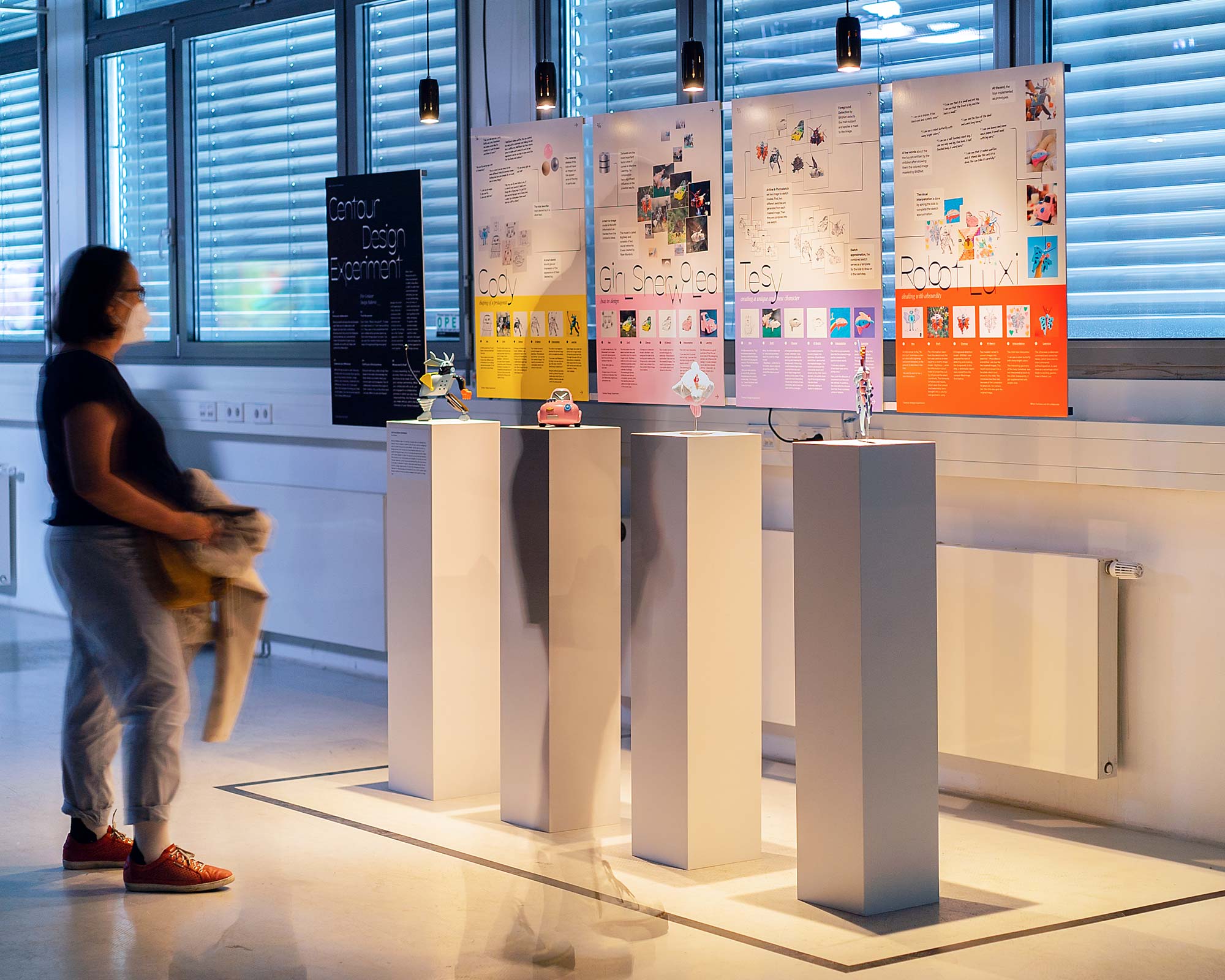
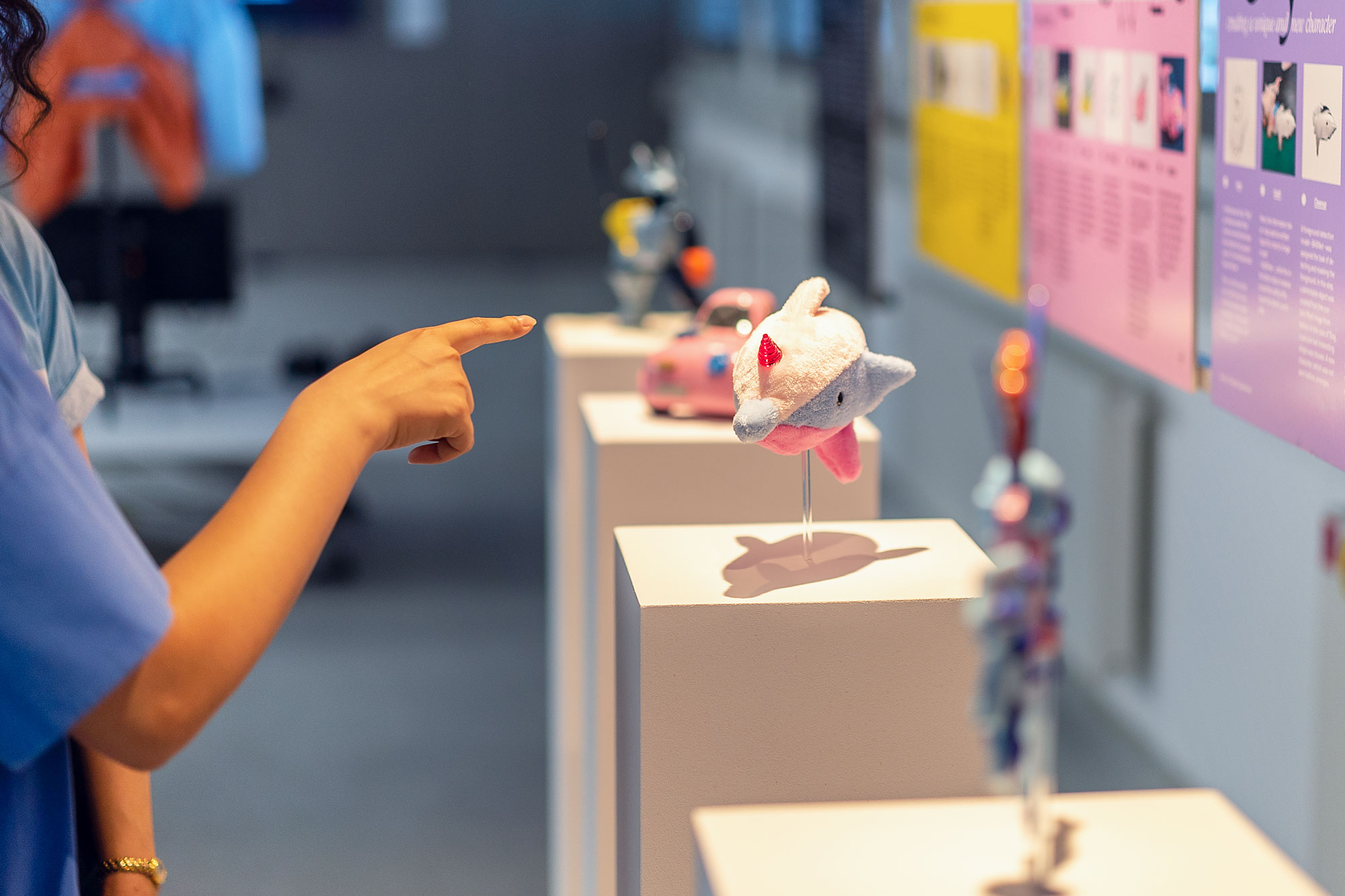
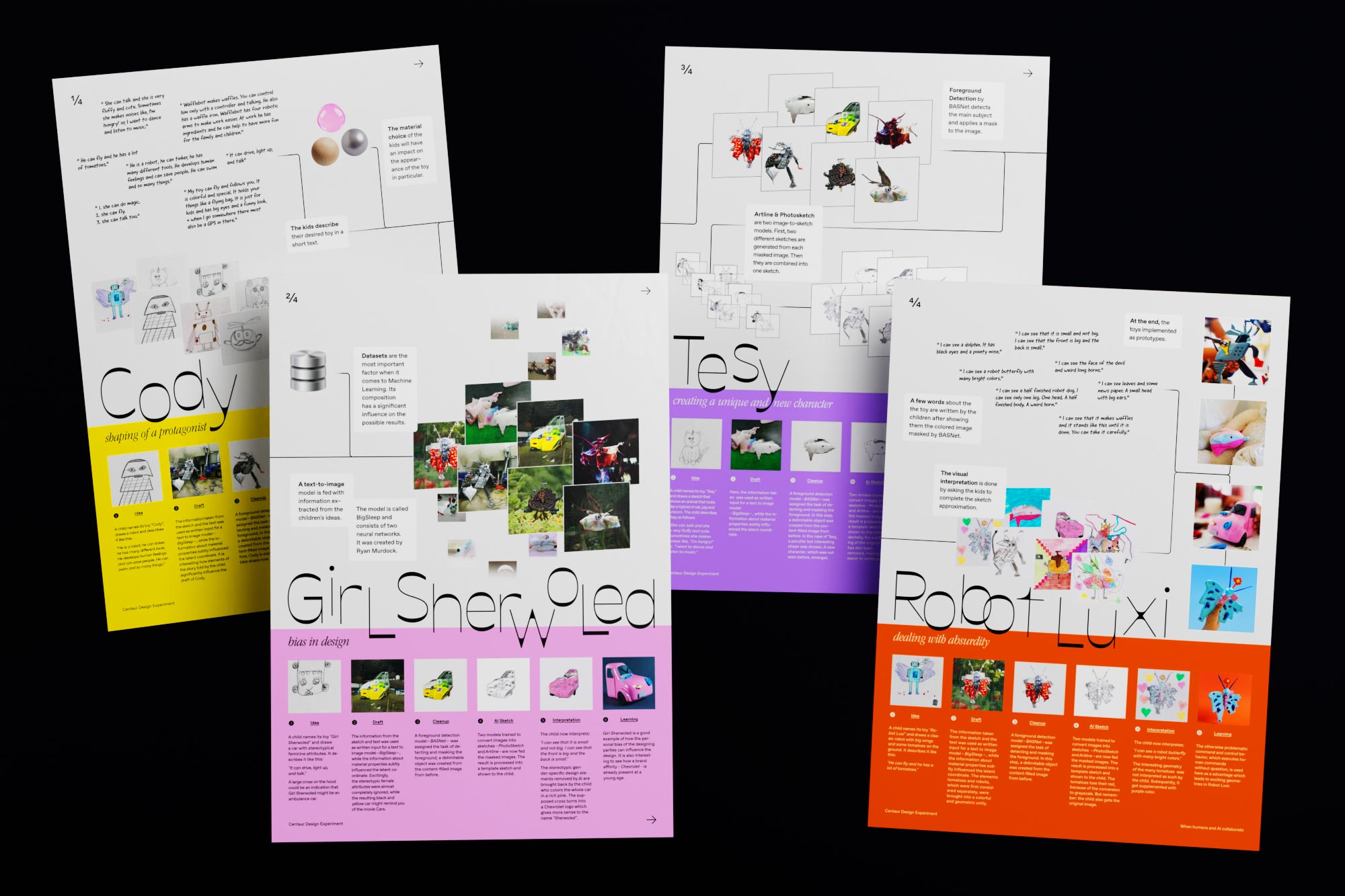
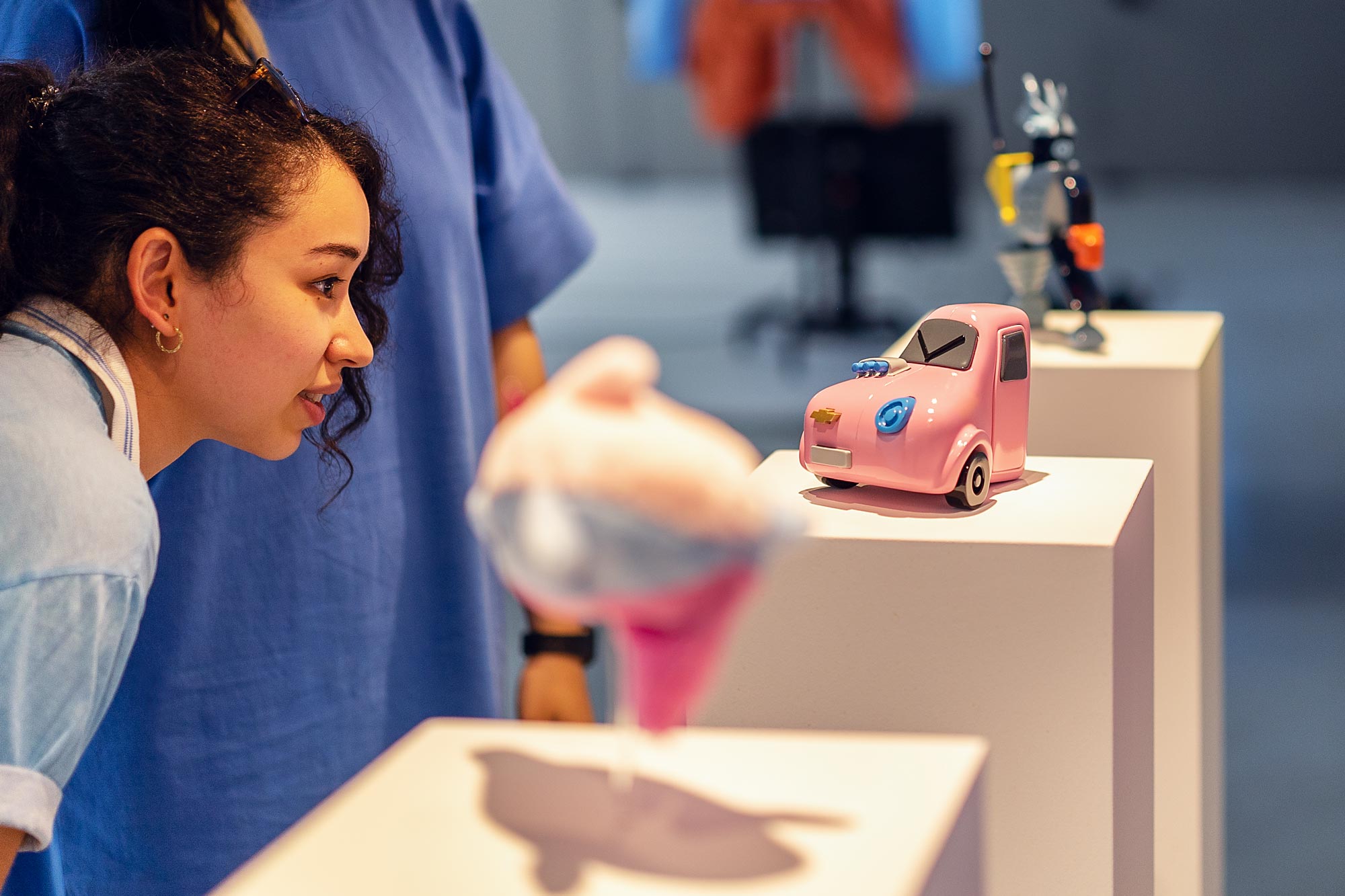
## Five Centaur Design Patterns
After the experiment, it became clear that designers will collaborate with AI more often. That's why I set out to write the first five Centaur Design Patterns. Simple patterns and clues that designers should keep in mind when working with AI.
## 1. Know your collaborators
Inform yourself well about the technologies used. Treat your AI collaborators with respect and value their contributions. Knowing where they come from (datasets, training methods, etc.) and what their means of production is (open source, corporate, non-profit, etc.) helps with productive collaboration.
## 2. Trust the process
Don't think: "What's the point?", "It doesn't make sense" or "I can't see anything in it". Stay open to the possibilities that your collaborative process opens up. Don't shut things down too soon. Can you spot the creative twists and new ways of imagining things emerging?
## 3. Celebrate your differences
While AI has access to vast amounts of data and can process them quickly, you bring human intuition, imagination, and creativity. Celebrate this difference, thrive on it. Give each other the freedom to bring your best to the table. Can the process benefit from these differences?
## 4. Clarify your ethical positions
Everyone and every entity brings their biases to the table. Acknowledge that these biases are present. Keep your process open and transparent. Your AI collaborator must share the origins of their creation. You, on the other hand, can you reflect on your own biases?
## 5. Whose word is final?
In every rewarding, highly iterative process, there are always many decisions to be made. Even in your centaur partnership. When you collaborate with an AI, you are engaged in a collaborative process in which you also have responsibilities. Are the decisions you make ethical, and in the best interests of your fellow humans?
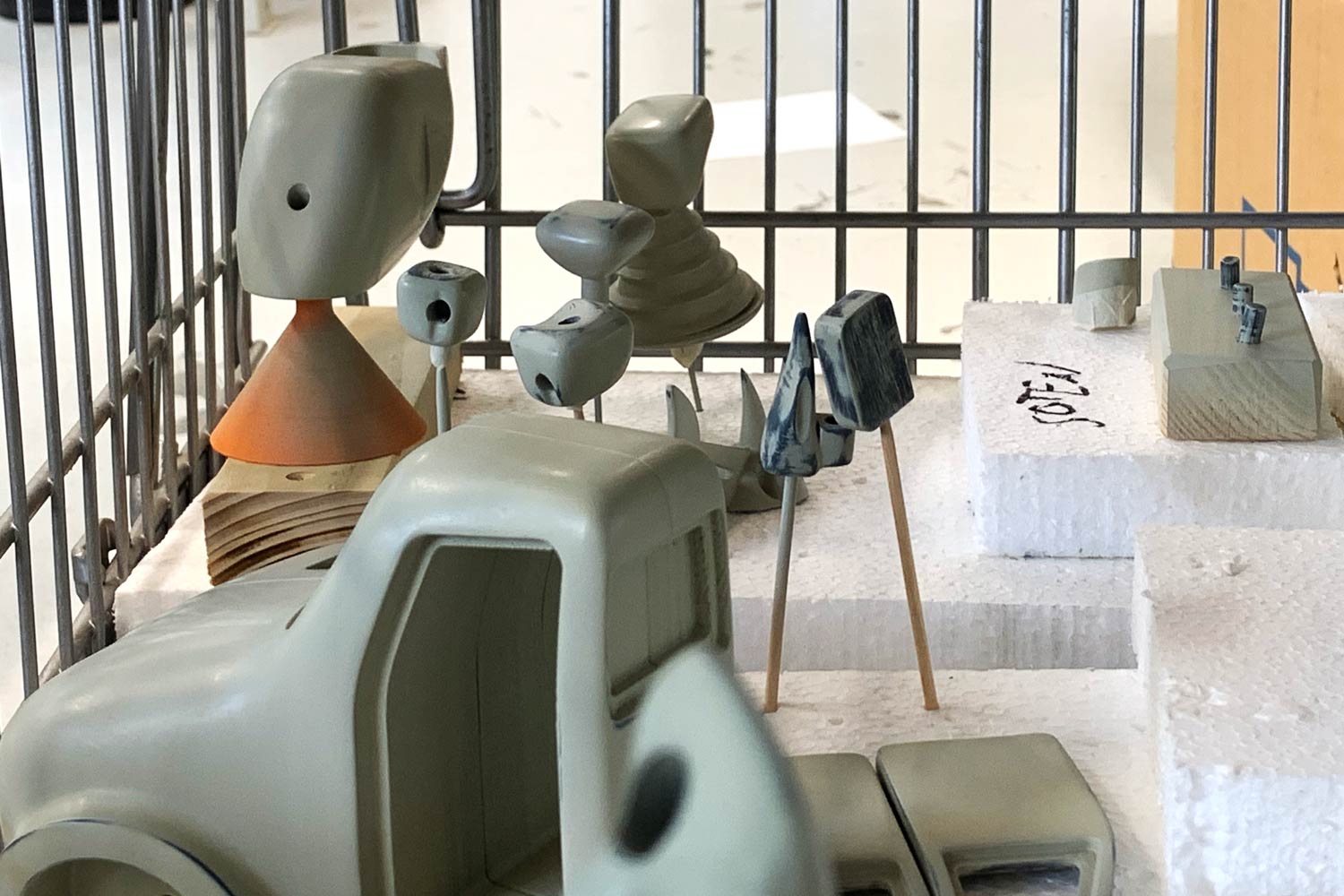
## Process
The addidivally manufactured plastic bodies were filled and primed. Several layers of paint and a clear coat were then applied. The connector system I installed made assembly easy.
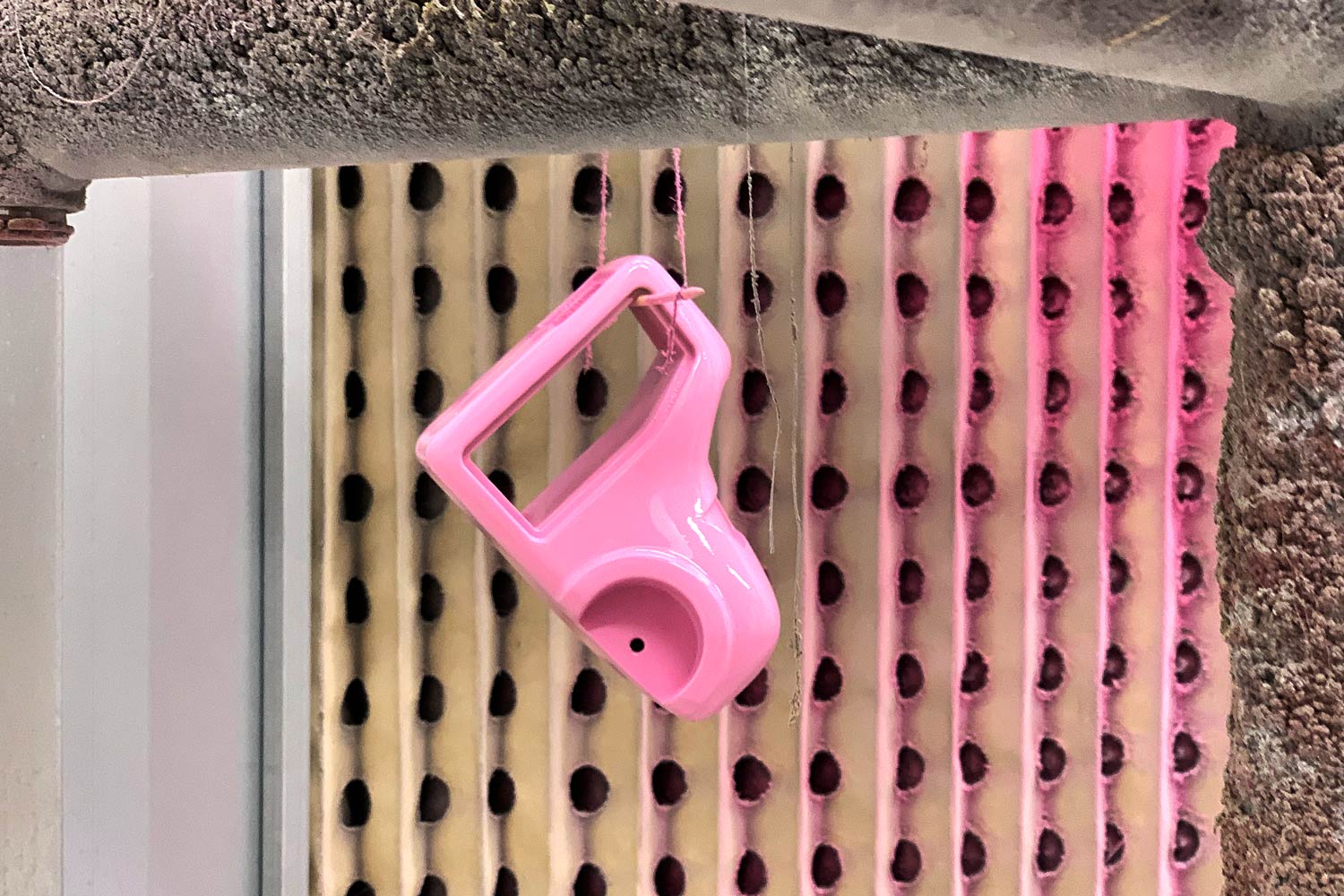
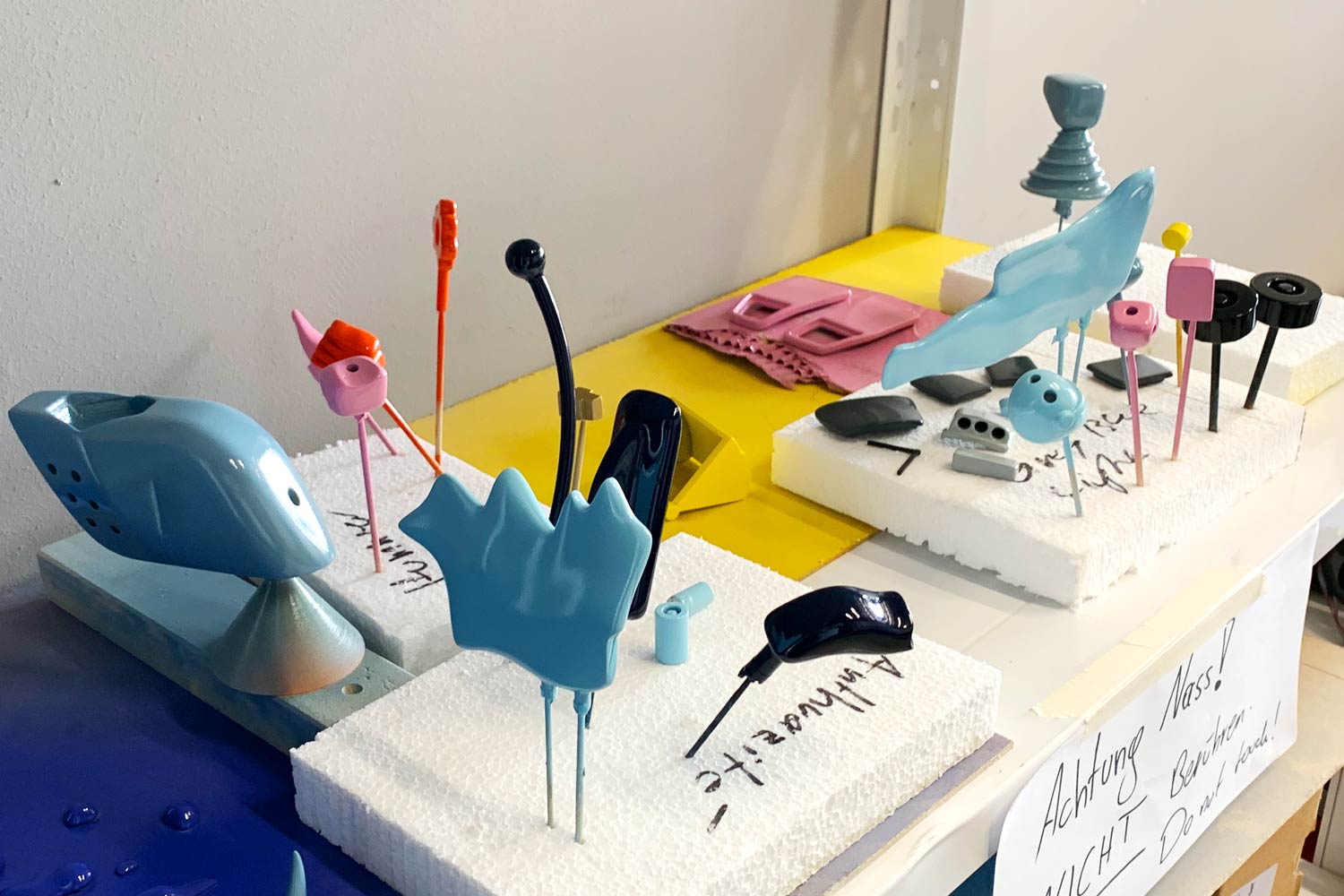
## Credits
For this project I was supported by: Viviane Freismuth-Wohlfarth, Max Kure, Lucy Li, Selma Mühlbauer, Julian Paula, Florian Semlitsch, Elizabeth Sharp, Valentina Sturn and the ID2 / DI team at the University of Applied Arts Vienna.
---
# Kite Like Display 21
Canonical URL: https://leomuehlfeld.at/en/kld-21
---
title: 'Kite Like Display 21'
for: 'dform'
category: 'Film & Motion'
metaDesc: 'Producing brand films for Kite Like Display 21, dform''s tool-free wooden display system using Lignotubes, 2021 — circular design for trade shows.'
thumbnail: /img/kite-like-display.jpg
date: '2021-05-10T00:00'
showOnLanding: false
---
# Kite Like Display 21
## Producing brand films for Kite Like Display 21, dform's tool-free wooden display system using Lignotubes, 2021 — circular design for trade shows.
A short video should show the product Kite Like Display 21 and explain the setup of the wooden stand. Kite Like Display 21 is an environmentally friendly display system, made from renewable raw materials, following the guidelines of Circular Design. Special attention is paid to the construction using Lignotubes® and the set-up and dismantling of the wooden stand without the need of tools.
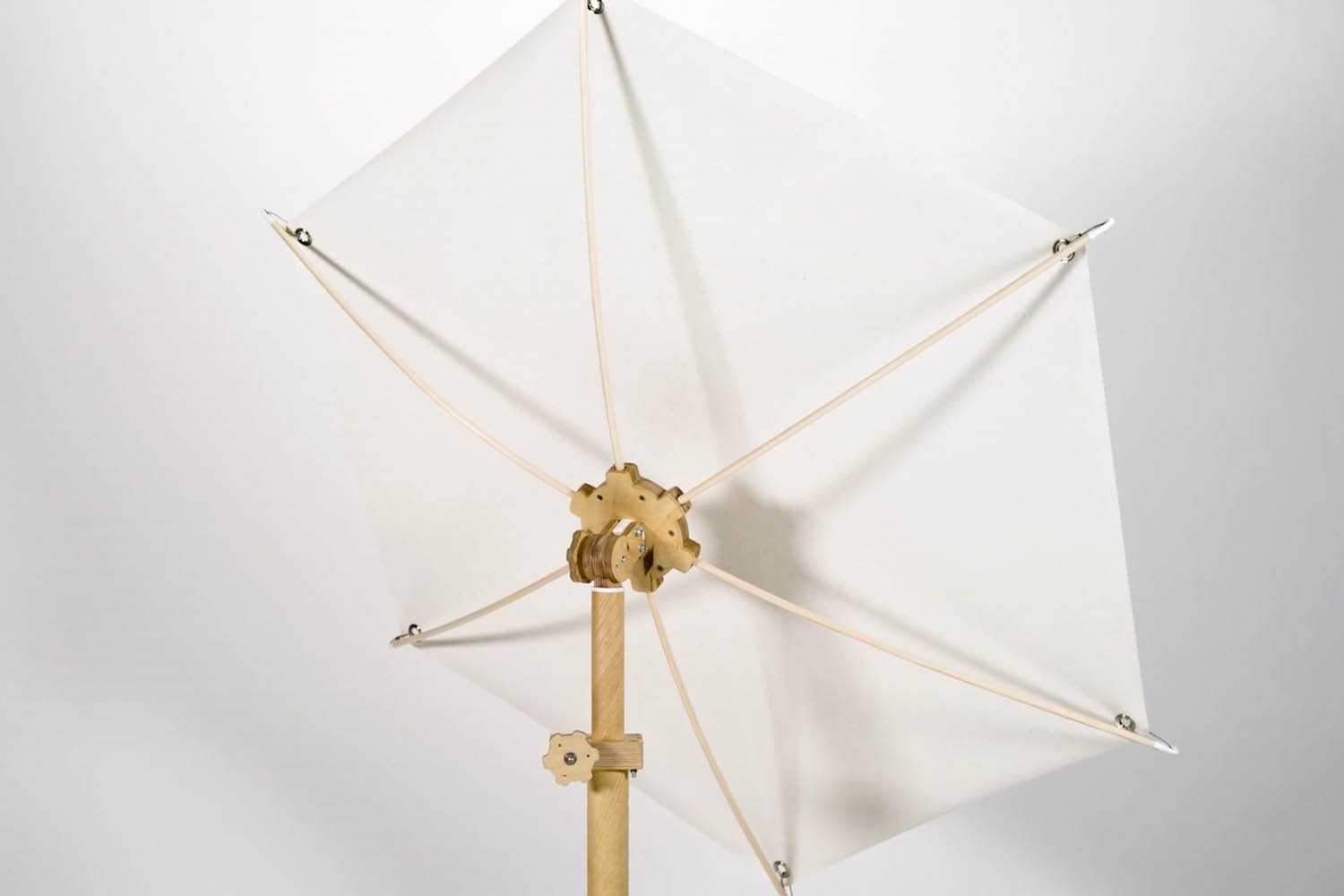
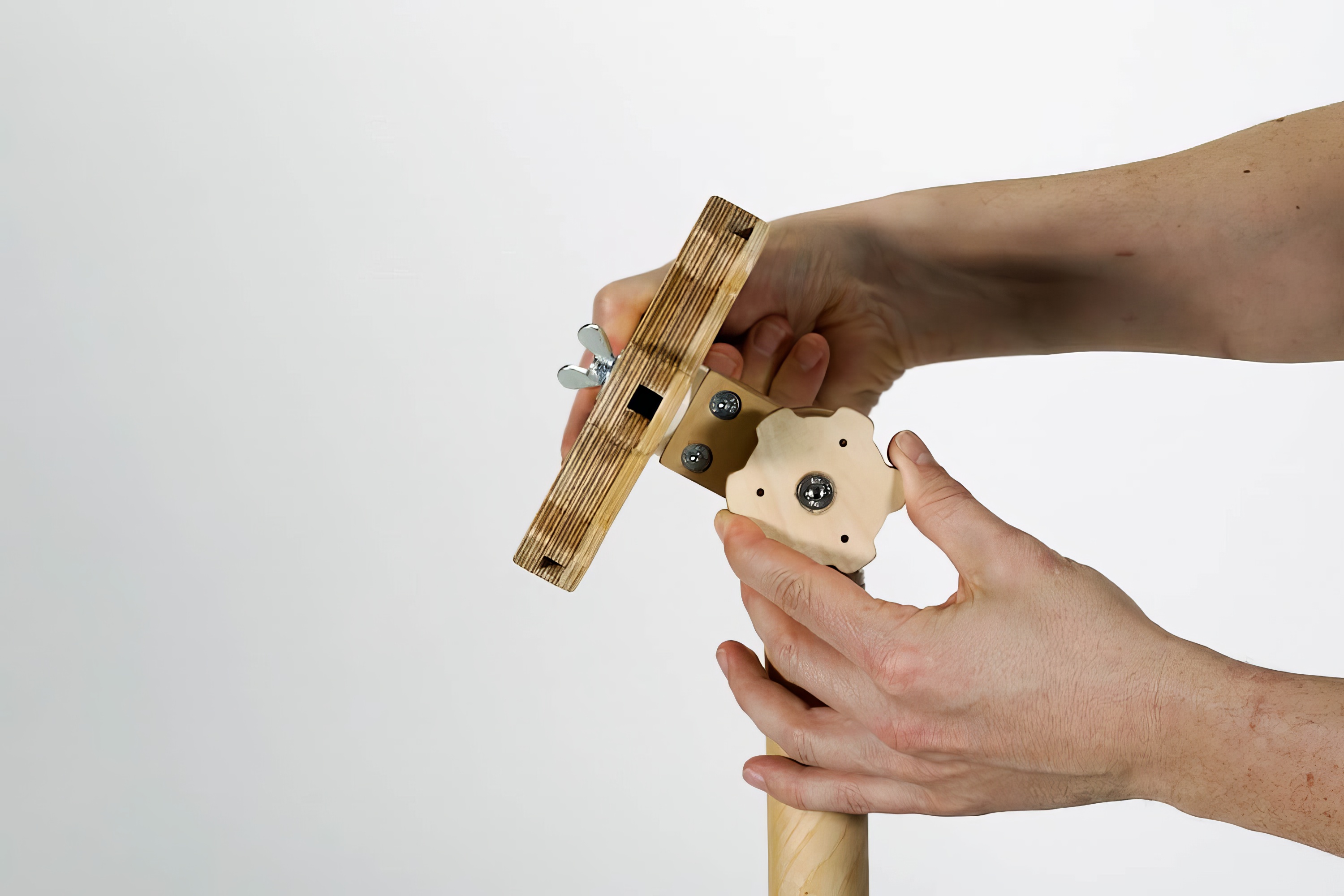
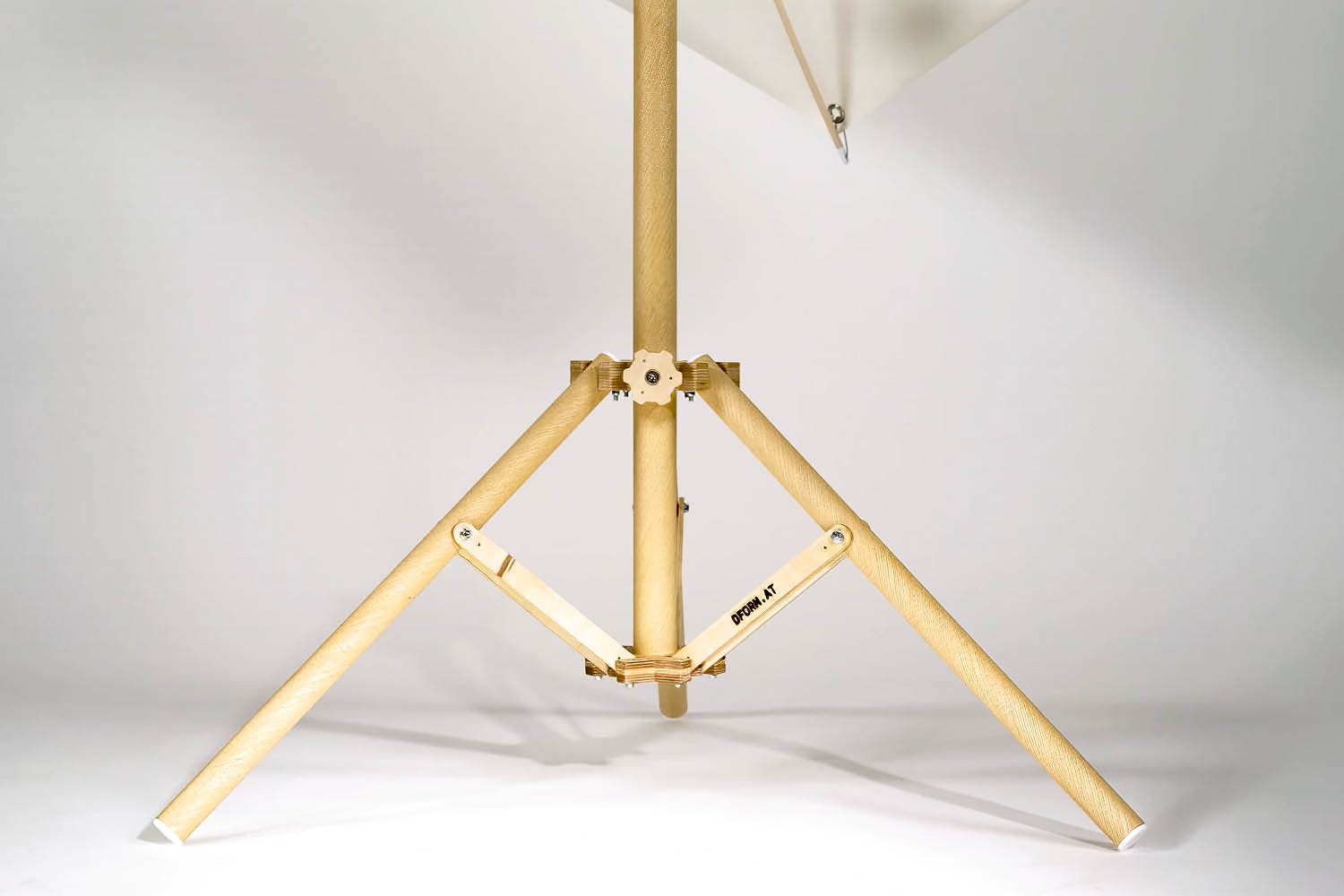
## Credits
Kite Like Display 21 was designed by [dform.](https://dform.at){target=_blank}
---
# Norbert Kure
Canonical URL: https://leomuehlfeld.at/en/norbert-kure
---
title: 'Norbert Kure'
for: 'Gemeindebau.im'
category: 'Brand & Type'
metaDesc: 'Designing personal identity and business cards for Norbert Kure, a Vienna building restoration specialist, with Gemeindebau.im, 2021 — DIN green and stamps.'
thumbnail: /img/norbert-kure-thumbnail.jpg
date: '2021-02-23T00:00'
showOnLanding: false
collab: Max Kure
---
# Norbert Kure
## Designing personal identity and business cards for Norbert Kure, a Vienna building restoration specialist, with Gemeindebau.im, 2021 — DIN green and stamps.
## Business Cards
Norbert Kure is a Viennese one-man business specializing in the restoration of furniture and household items. To facilitate customer contact, we designed and implemented a small edition of business cards. The illustration shows various furniture and everyday objects from earlier times. The color is based on the standardized DIN green for technical devices. With a clean and clearly structured typography we convey a steadfast appearance.
## Credits
Illustrations by [MaxKure](https://gemeindebau.im){target=_blank}
---
# Soul Sweeper
Canonical URL: https://leomuehlfeld.at/en/soul-sweeper
---
title: 'Soul Sweeper'
for: 'Design Investigations'
category: 'Design Research & Speculation'
metaDesc: 'Investigating crisis exploitation through a video essay examining pseudoscientific products and hoax remedies.'
thumbnail: /img/soulsweeper-thumbnail-1.jpg
date: '2021-01-18T00:00'
showOnLanding: false
collab: Johannes Lotze, Valentina Sturn
---
# Soul Sweeper
## Investigating crisis exploitation through a video essay examining pseudoscientific products and hoax remedies.
## Bodies in Crisis
Soul Sweeper is a product-design research project. Crises always affect people's worries and needs, making them more susceptible to comforting claims, hoax products and lies. Energized water, placebo pills and DVDs with 60 minutes of a healing gaze are just a few examples showing how creative some “inventors” become to earn the extra dollar. As with many products that are promising the supernatural. An easy pseudoscientific alternative is offered in parallel to a scientific – but maybe uncomfortable – consens. These machinations boom during a crisis.
## Superfiction
Based on our observations, we set out and created a fictional venture in the field of pseudoscience. How do you make such a convincing alternative, how much function is too much, what are matters of belief, and perhaps most important how does one end up creating these systems?

## The Movie
We ended up imitating a teleshopping situation to implement known tactics in an exaggerated form. Our protagonist, Dr. Bea Alphin-Blois, developed the Soul Sweeper, a pseudoscientific product to rid the body of bad light. In the film, we alternate between two situations. On one side we see our protagonist struggling with the legal and moral consequences of her invention while on the other side we can observe how she, supposedly a little earlier, tries to market her pseudoscientific product with questionable methodologies.
## Making the Soul Sweeper
Mainly focusing on the user interaction and the associated effects on the body – we developed our very own fake health tool. A light-brush. A 3D-printed housing was primed, painted and equipped with a bright LED. The bristles were carefully fixed into a perforated acrylic sheet, which was connected to the housing. The LED-driver was borrowed from my [Ambient Light](https://leomuehlfeld.at/works/ambient-light) project and controlled the LEDs brightness.
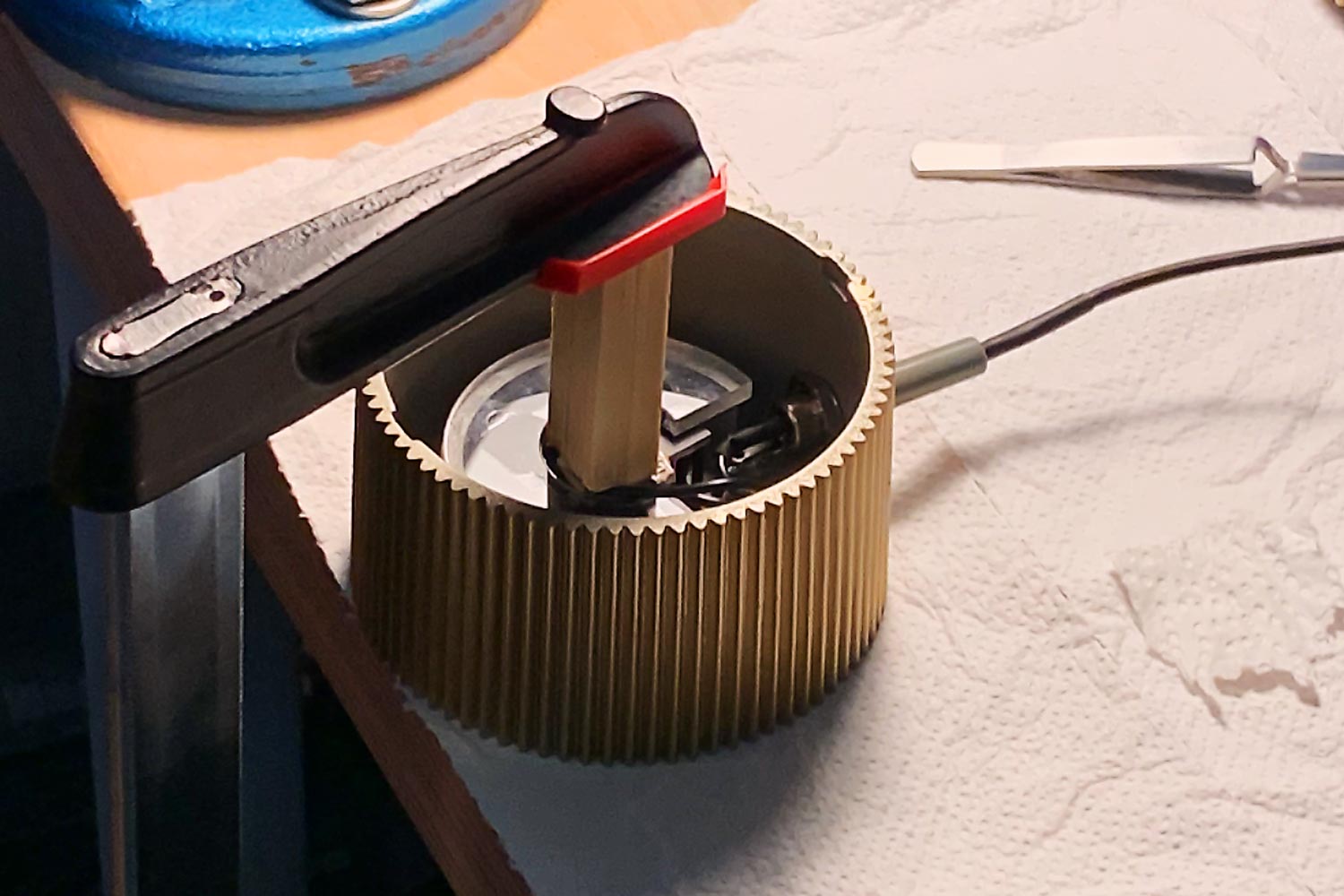
## How it "works"
The Soul Sweeper transports the bad light - which reaches our skin cells every day through environmental factors such as screens, street lighting and urban light pollution - through a special crystalline filter. The good light, which is simultaneously delivered to the skin through the bristles, replaces the bad light in the cells of the body with the good and correct light. Thus, an increased sense of well-being can be achieved. To achieve an optimal effect of the Soul Sweeper, the special filter can be cleaned at certain time intervals for a small fee. The Soul Sweeper is obviously not a real but a sarcastic product which questions dubious machinations from a design perspective.
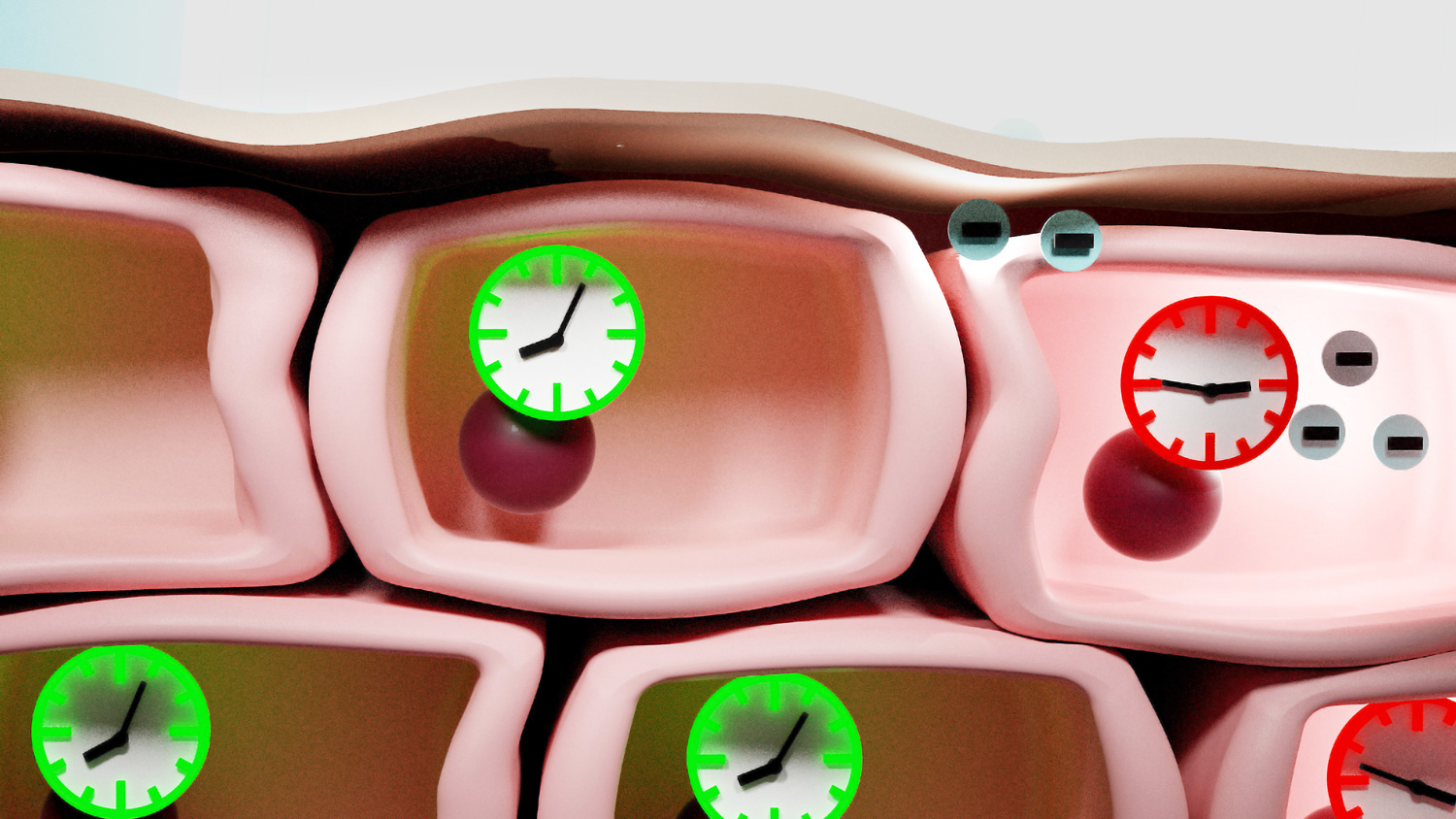
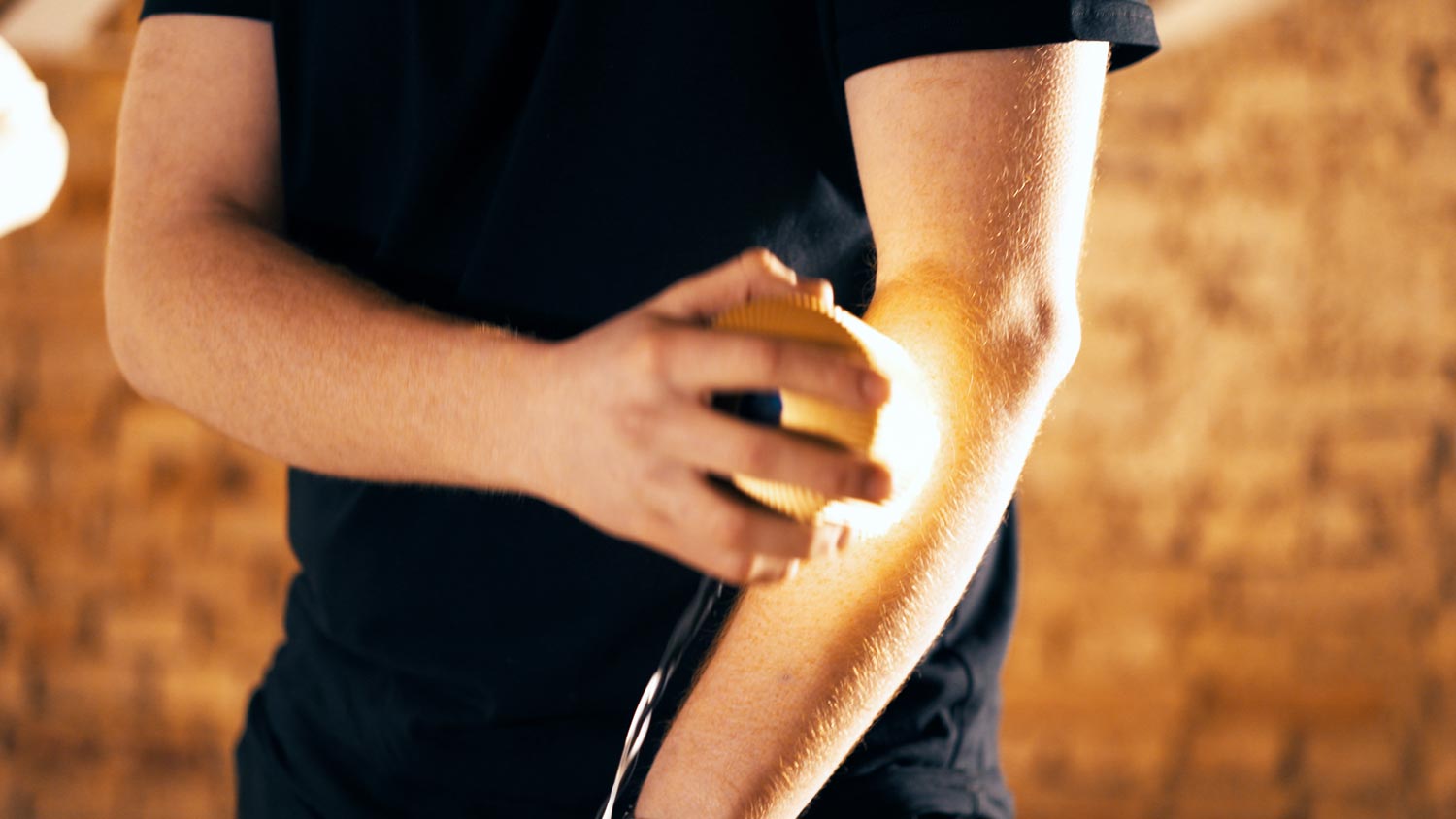
If you are interested you can watch the finished movie at the [top of this page.](#)
## Credits
Starring Lena Golker, Antonia Patzak, Florian Fleischer and Johannes Lotze. This project was co-created by Valentina Sturn and Johannes Lotze. Special thanks to Universität Wien, Lukas Siller, Michael Schmidl and the DI Team.
---
# Political Atmosphere
Canonical URL: https://leomuehlfeld.at/en/political-atmosphere
---
title: 'Political Atmosphere'
for: 'Felix Lenz'
category: 'Exhibition & Installation'
metaDesc: 'Developing interactive installation visualizing flight turbulence, climate change, and geopolitical conflicts.'
thumbnail: /img/gearbox.jpg
date: '2020-11-09T00:00'
showOnLanding: false
collab: true
---
# Political Atmosphere
## Developing interactive installation visualizing flight turbulence, climate change, and geopolitical conflicts.
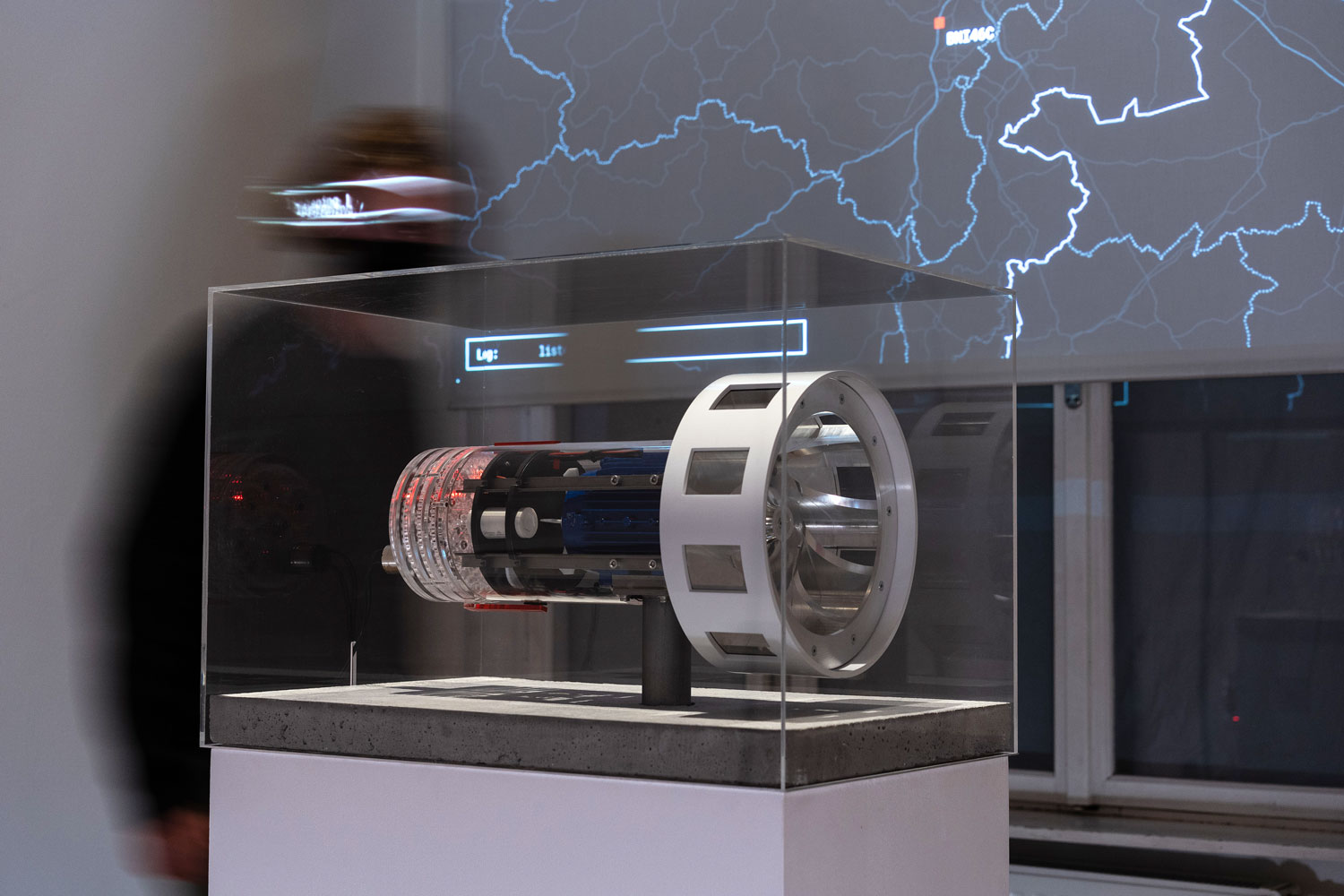
"Political Atmosphere" traces the invisible connections between flight turbulence, climate change and war. Flight data is captured by an antenna and sent to a controller. Felix asked me to visually display the flight data and correlate the measured flight density in the sky with the speed of a DC motor. This motor turned a gearbox which ultimately triggered a siren. The more planes in the sky, the more frequently the centerpiece of the exhibition - the deafening siren - is triggered.
## The Code
The open source software [dump1090](https://github.com/antirez/dump1090){target=_blank} was used to translate the antenna data to json data. This data was then sent to an [Electron](https://www.electronjs.org){target=_blank} UI. If there was a change in flight-density, the App emitted the data via a websocket. The controller was therefore able to set the speed of the DC-Motor by changing the [pwm](/led-driver) signal. This was done by using a double-h-bridge board.
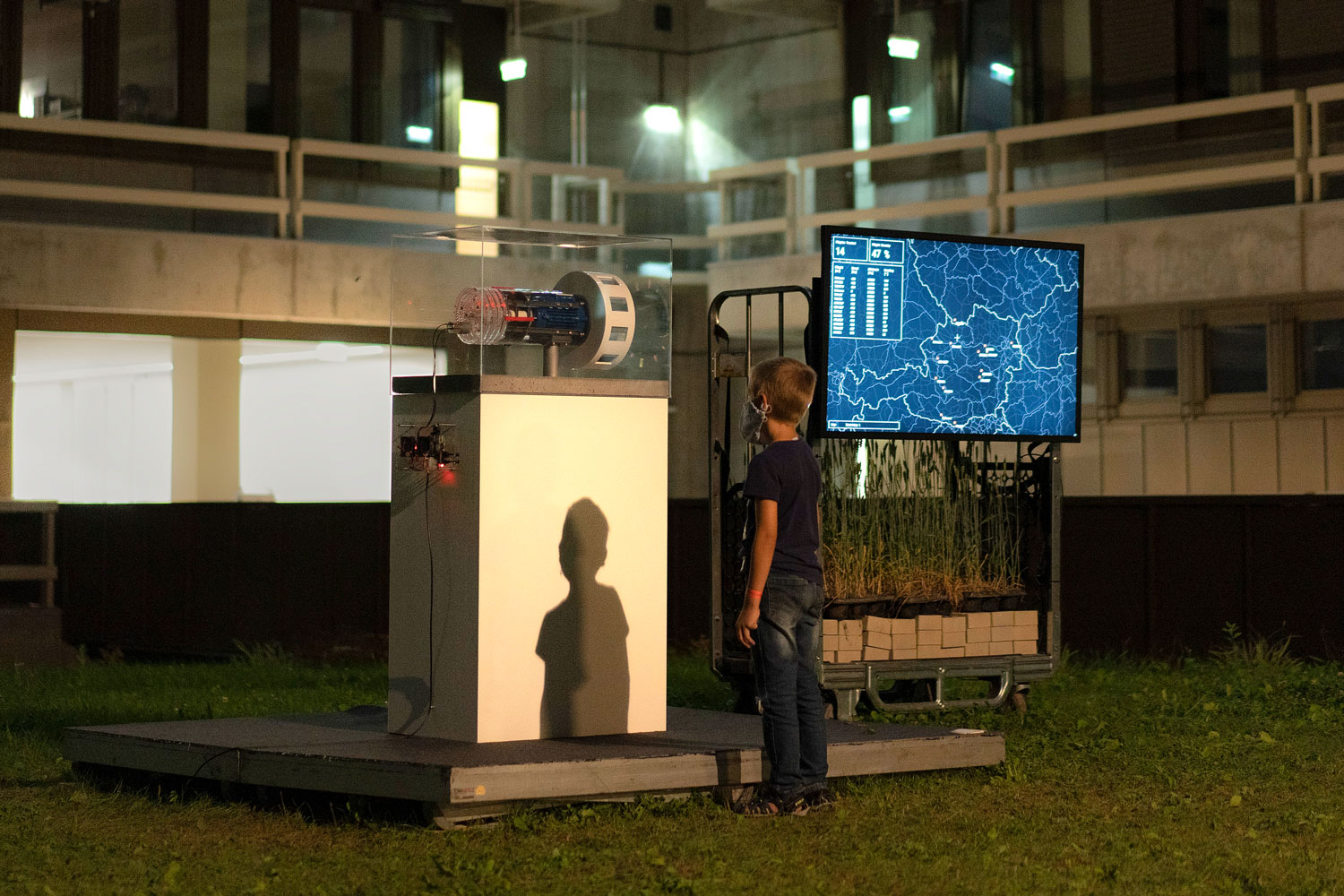
All images are © Felix Lenz 2020. The Project “Political Atmosphere” was designed by Felix Lenz. If you want to read more about it, visit [his website.](https://felixlenz.at){target=_blank} Learn how to run a React App inside Electron [here.](https://dev.to/mandiwise/electron-apps-made-easy-with-create-react-app-and-electron-forge-560e)
---
# Zoetrope
Canonical URL: https://leomuehlfeld.at/en/zoetrope
---
title: 'Zoetrope'
for: 'Maresch & Sturm OG'
category: 'Product & Engineering'
metaDesc: 'Building motorized zoetrope with synchronized strobe lighting creating animation illusions.'
thumbnail: /img/zoetrope-ontop.jpg
date: '2020-07-02T00:00'
showOnLanding: false
collab: Mimi Schmidl
---
# Zoetrope
## Building motorized zoetrope with synchronized strobe lighting creating animation illusions.
## Zoetrope
A zoetrope is a rotating animation device consisting of a spinning platform and a synchronous strobe light system. A carrier plate with a two- or three-dimensional scenery can be placed on the rotating plate. The illusion of animation is created by rotating the plate while simultaneously flashing the scenery in time. For example, the plate is divided into 16 frames and flashed accordingly. 16 frames per rotation results in 16 flashes per rotation.
## What for
The project is the result of a collaboration between the motion design studio Maresch & Sturm and my friend, the Viennese artist/designer Michael Schmidl. The Zoetrope is intended to vividly convey the basic principles of animated film in various learning situations and invites you to create your own interchangeable sceneries for the animation device via the interchangeable cover plate.
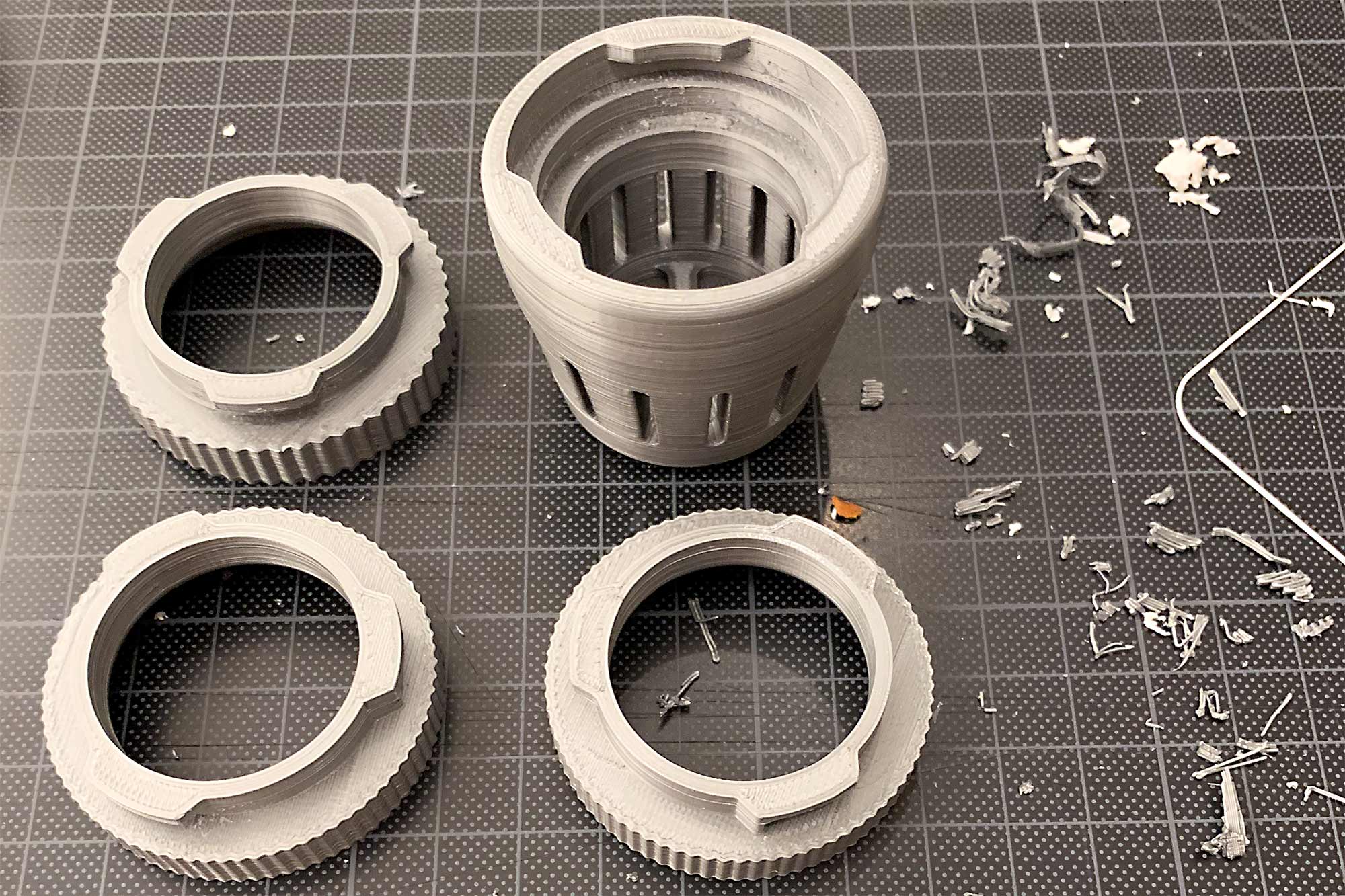
## Technicalitites
Inside the converted turntable is a DC motor that can be operated at two speeds. The 12 V input current is also passed to a custom circuit board that controls the light. To properly expose the animation, the light pulse is transmitted via 3 DC sockets to 1 A LEDs with custom housings on 1/4-inch magic-arms. The lamp housings are equipped with a bayonet catch so that colored inserts or diffusors can be placed in front of the LED.
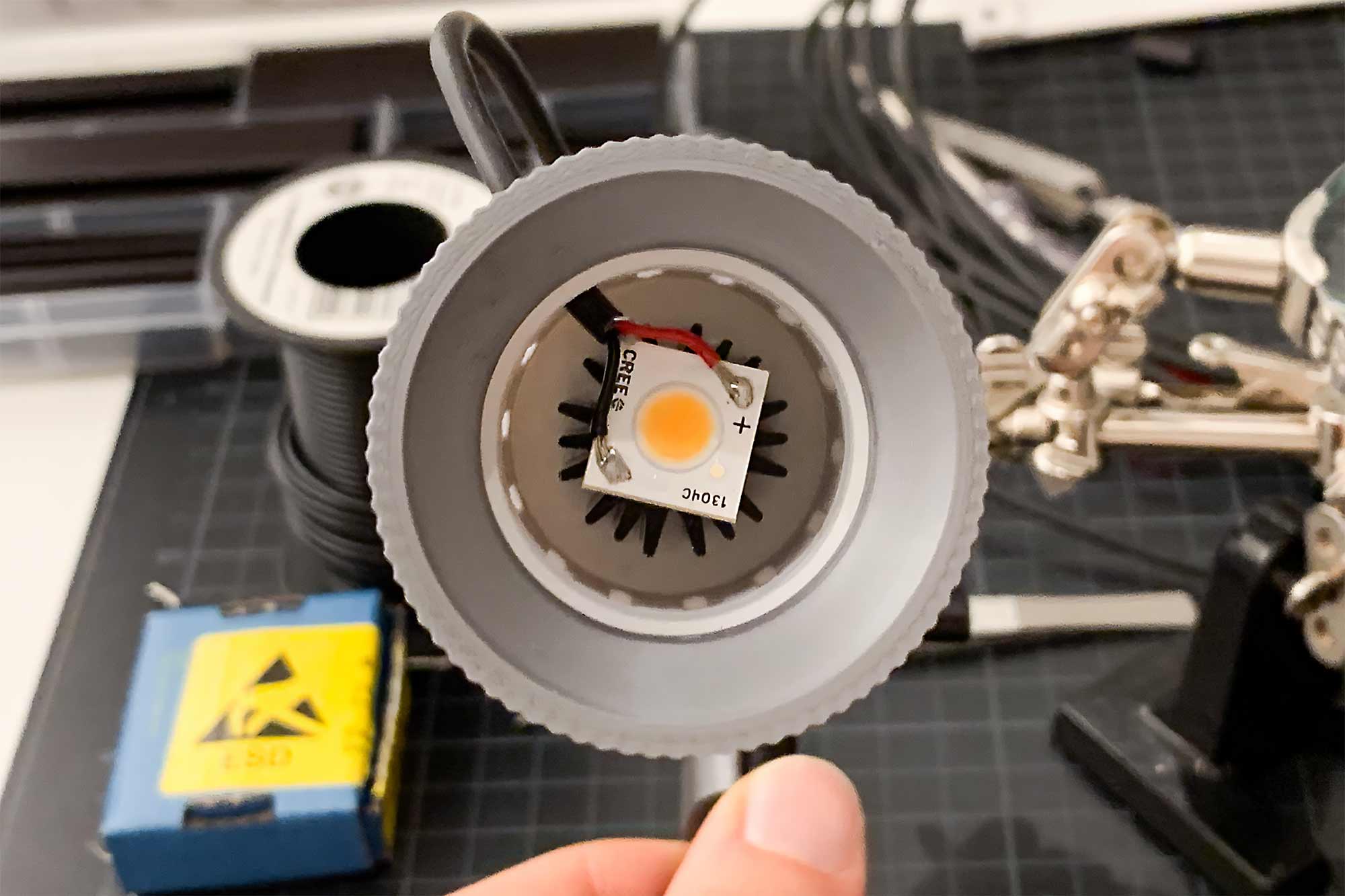
## Frame Exposure
The rotary part of the Zoetrope houses a custom ring with 16 magnetic inserts. Since the geometry of the ring is matched to the frames, the magnetic polarity changes with each frame. This change in polarity is measured with a Hall sensor and serves as a trigger for a monostable multivibrator (monoflop) whose pulse can be adjusted with a "focus" potentiometer. "Focus" because the duration of the exposure (or flash) simultaneously constrols the amount of motion blur. The LEDs in the magic arms are then fed with power via a mosfet.
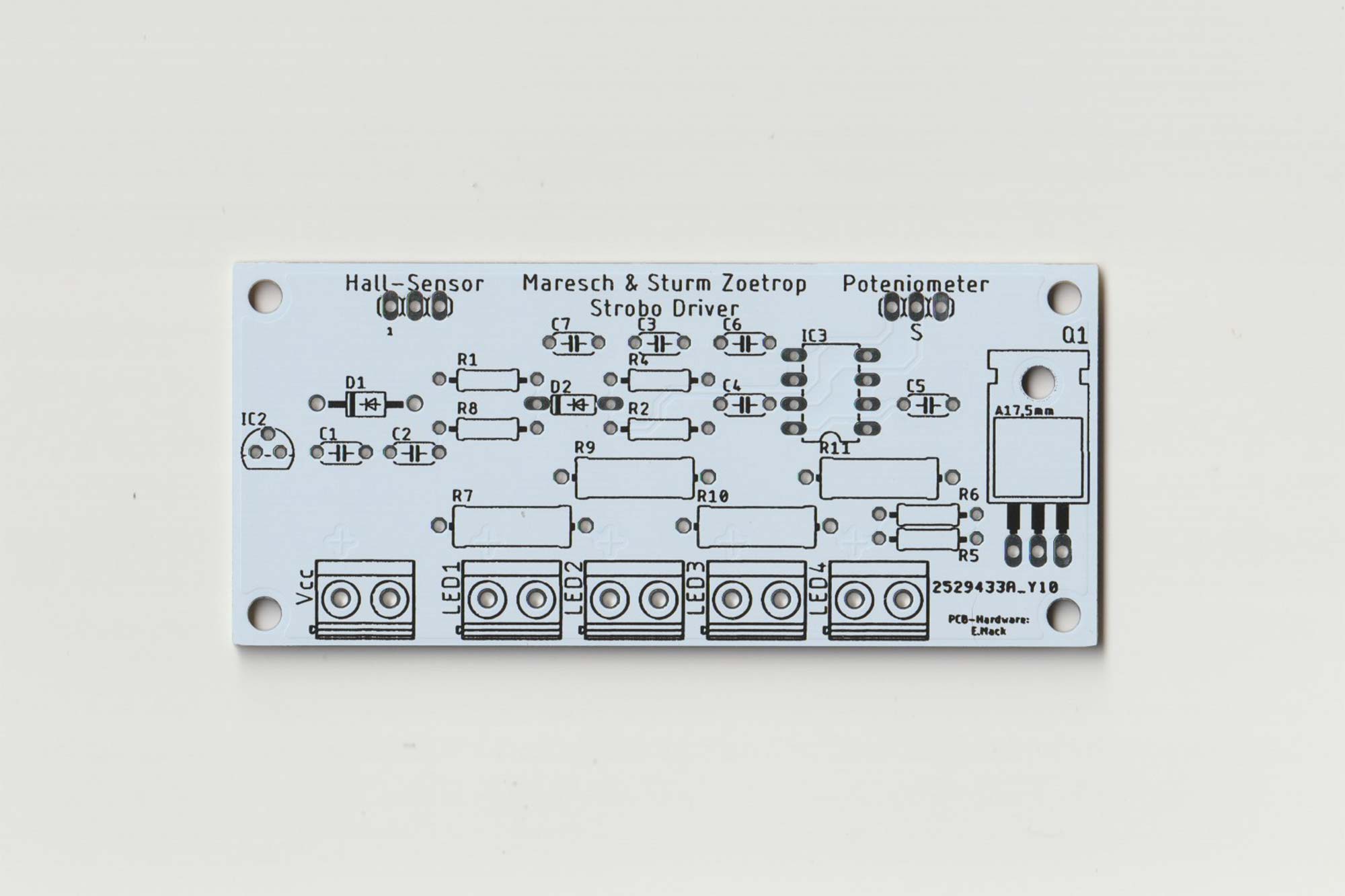
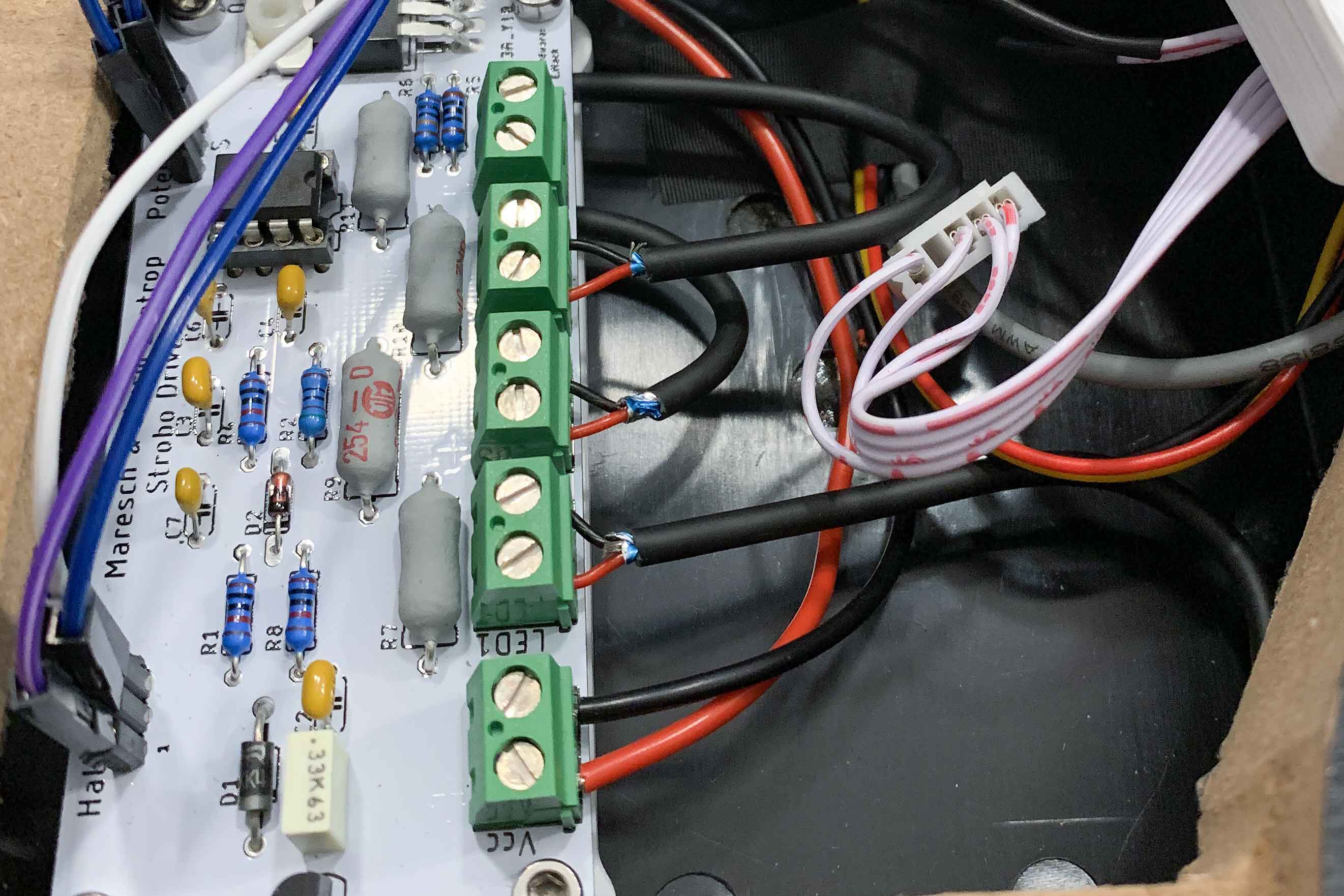
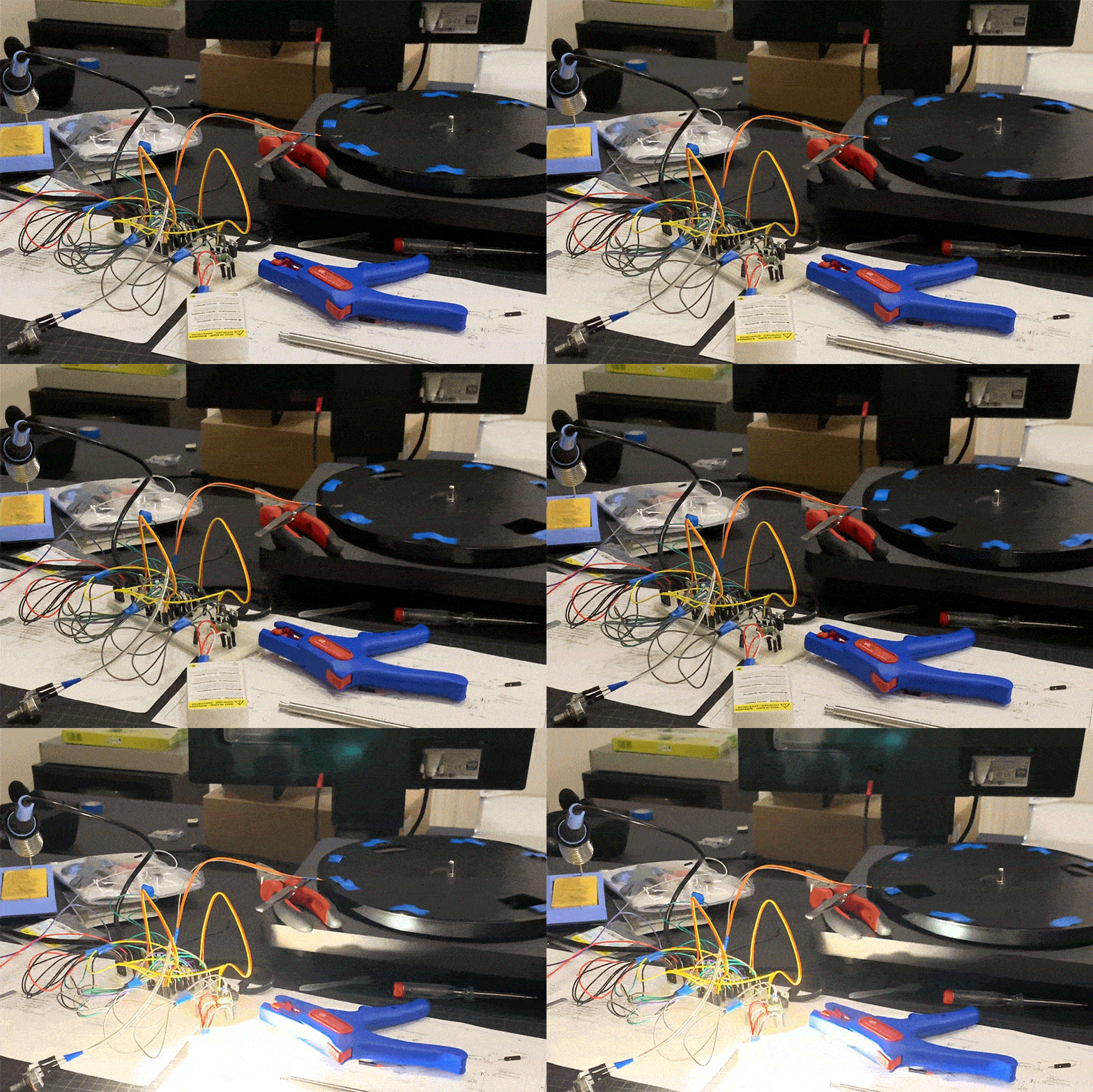
## WIP
The Zoetrope platform is ready, but the scenery never will be. Although we are currently working on a three-dimensional scenery, the long-term idea is to make the platform available for workshops and educational institutions to creatively explore this tangible style of animated film.
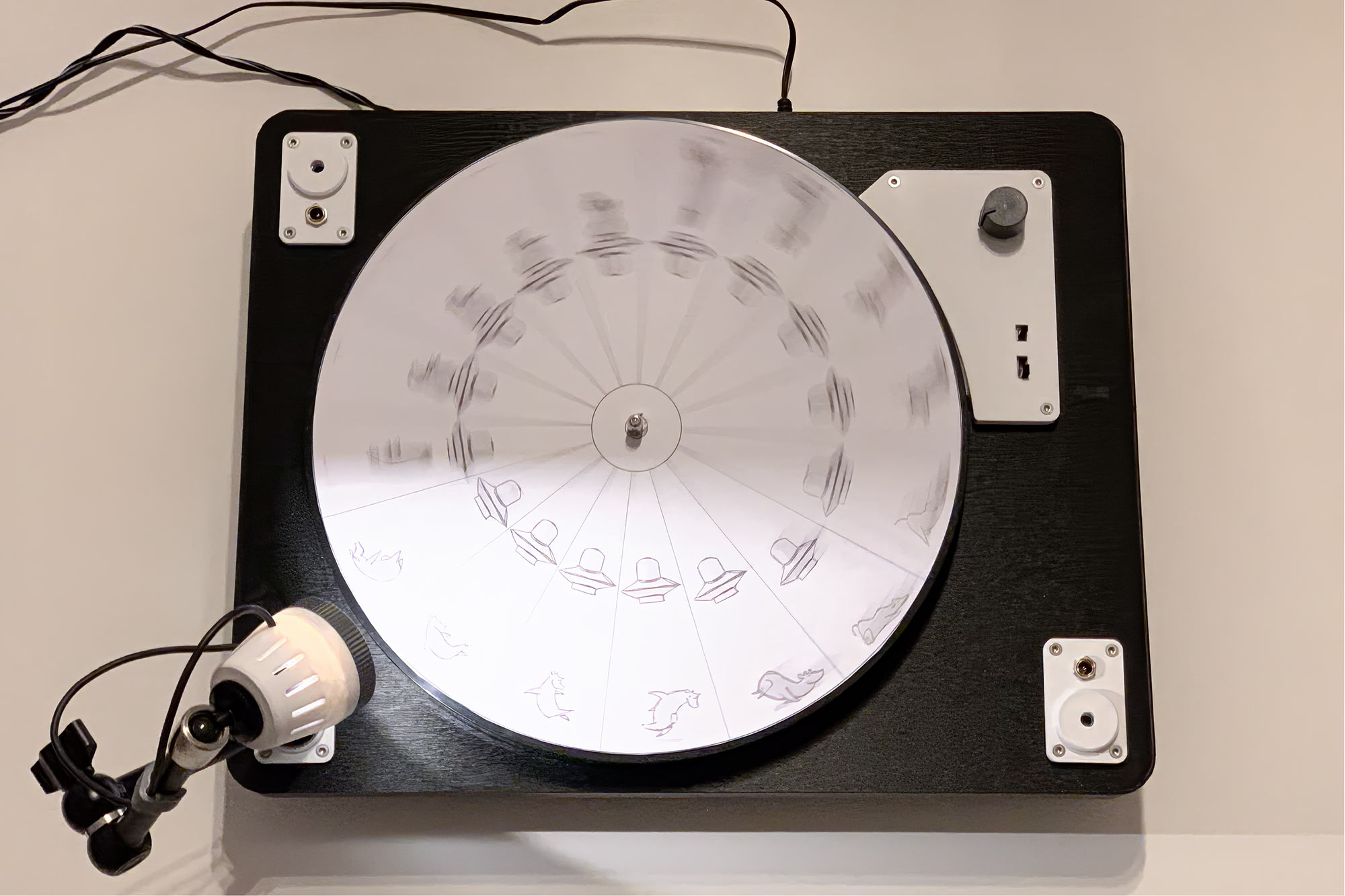
## Credits
The project was developed for [Maresch & Sturm](https://mareschsturm.com){target=_blank} in collaboration with [Michael Schmidl.](https://michischmidl.com){target=_blank} Electronics by Elias Mack.
---
# Schienenwagen
Canonical URL: https://leomuehlfeld.at/en/schienenwagen
---
title: 'Schienenwagen'
for: 'Gemeindebau.im'
category: 'Design Research & Speculation'
metaDesc: 'Prototyping a passenger railcar concept for Vienna''s idle nighttime tram tracks with Gemeindebau.im, 2020 — an urban infrastructure speculation.'
thumbnail: /img/railcar-drive.jpg
date: '2020-02-06T00:00'
showOnLanding: false
collab: Max Kure
---
# Schienenwagen
## Prototyping a passenger railcar concept for Vienna's idle nighttime tram tracks with Gemeindebau.im, 2020 — an urban infrastructure speculation.
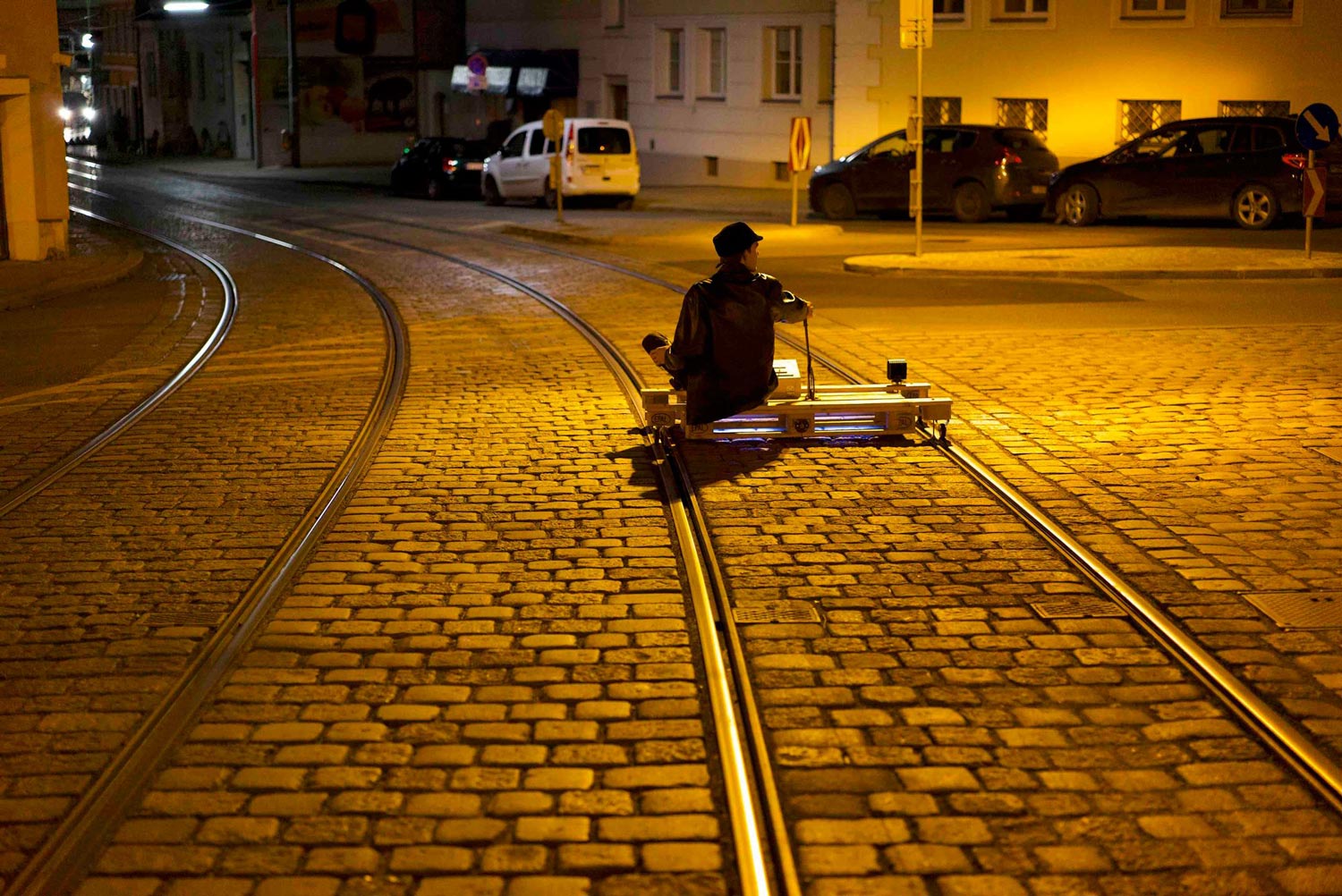
## The idea
It's getting dark in Austria's capital, Vienna. On the way home, Max and I notice the empty, unused tram tracks. Since the tram stops running after a certain time, Vienna's extensive streetcar network is practically empty. This observation gave us the idea to build a kind of soapbox for this rail network. The idea was forgotten for the time being, but seemed to be bubbling up inside us. During a long evening at a bar, the idea was put on paper and some sketches were made.
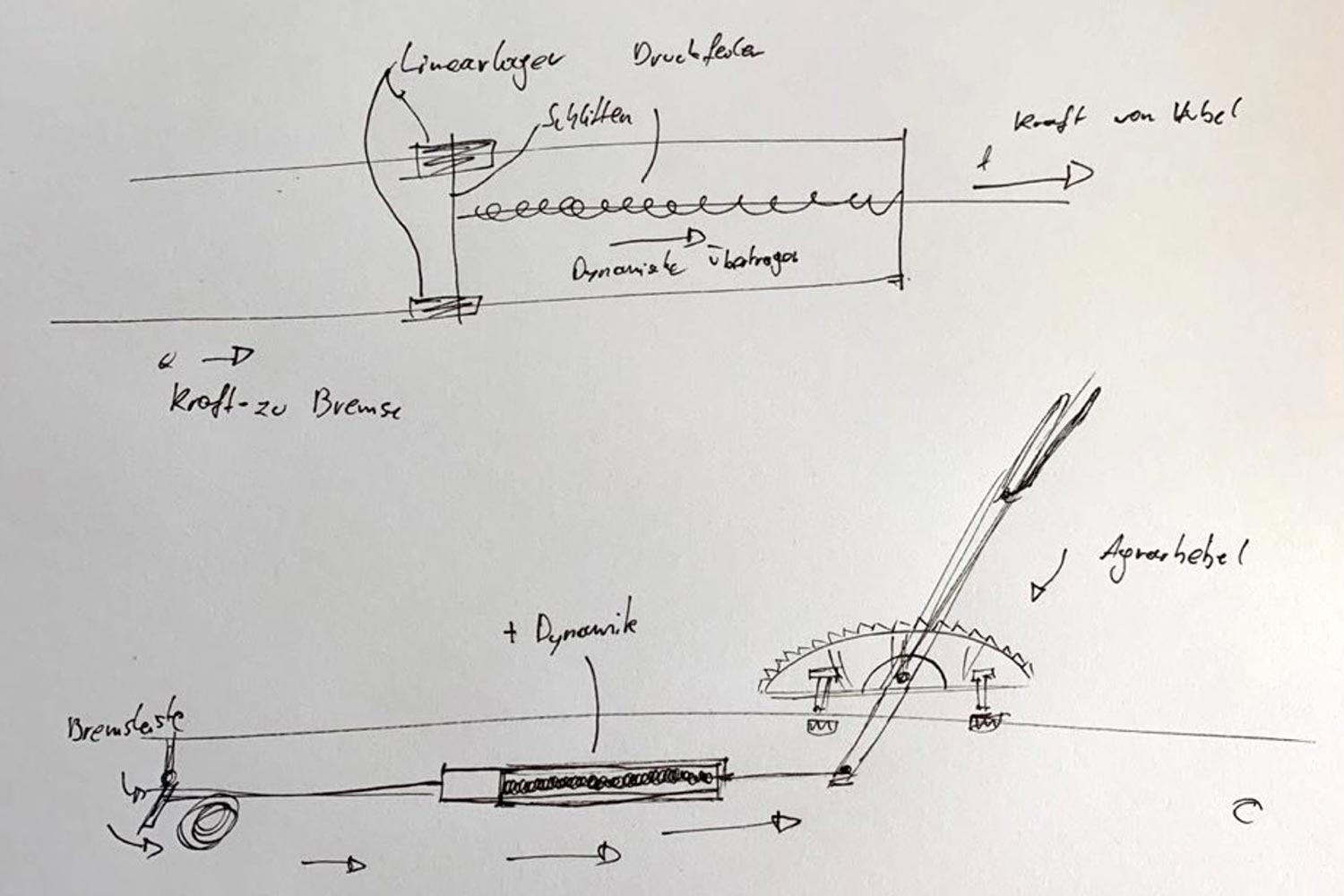
## Railcar
Soon we had scraped together the necessary material and got started. A standard Euro pallet extended to the Central European rail dimensions, four block rollers and some bearings on threaded rods make up the basic framework of a track-ready soapbox with space for two people. A mechanical brake and electric lighting with a warning light increase safety. It's still not that safe though 🤫
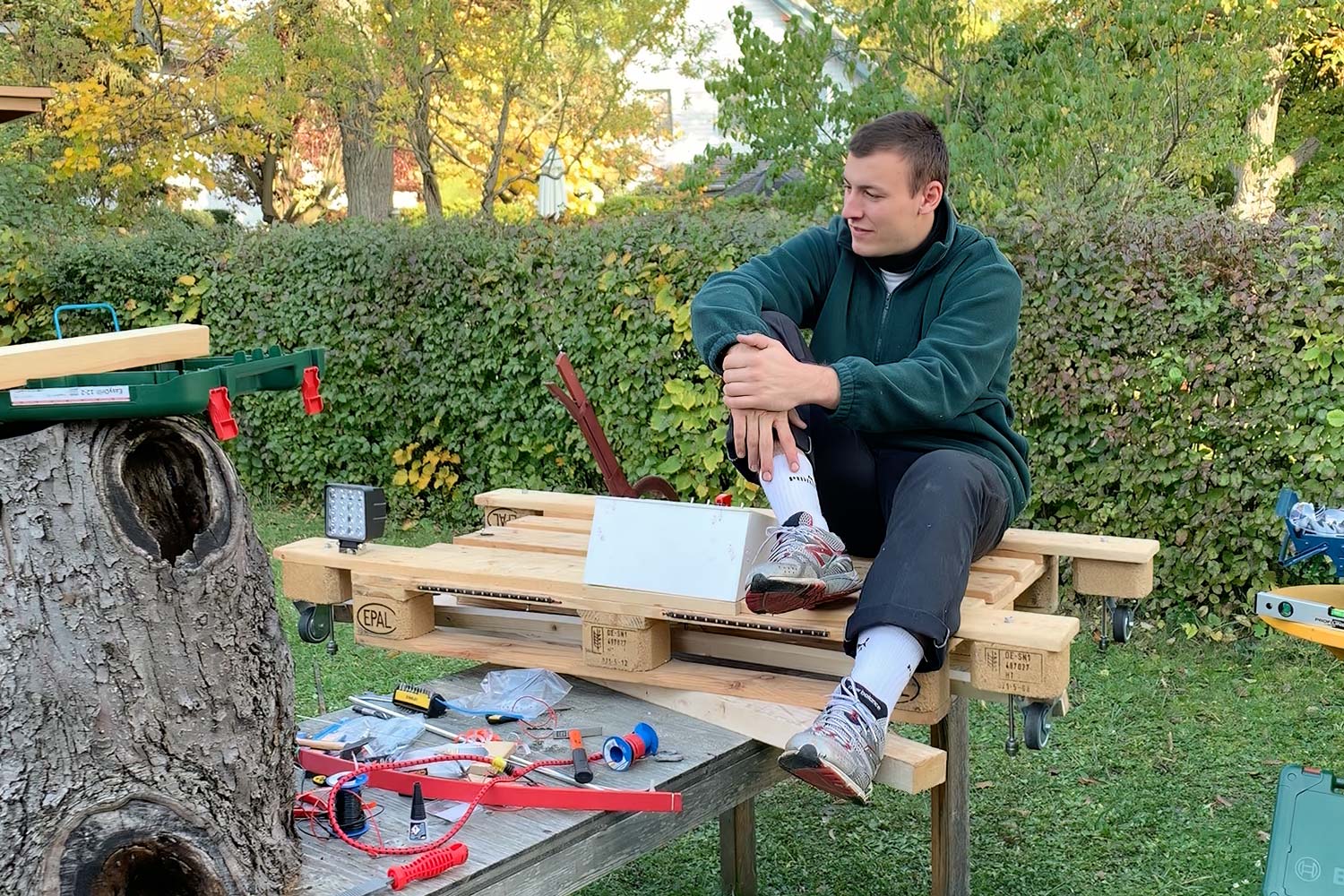
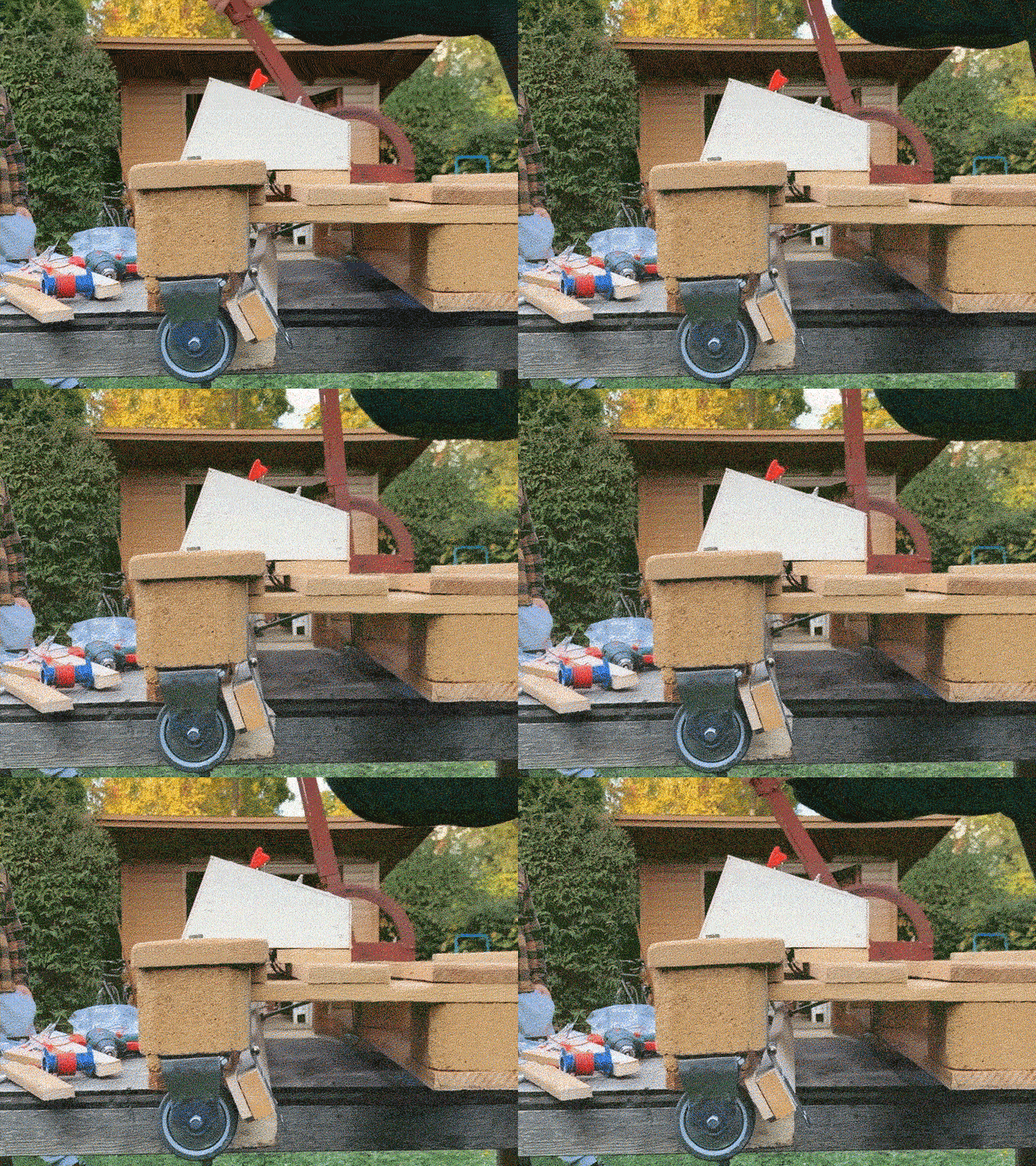
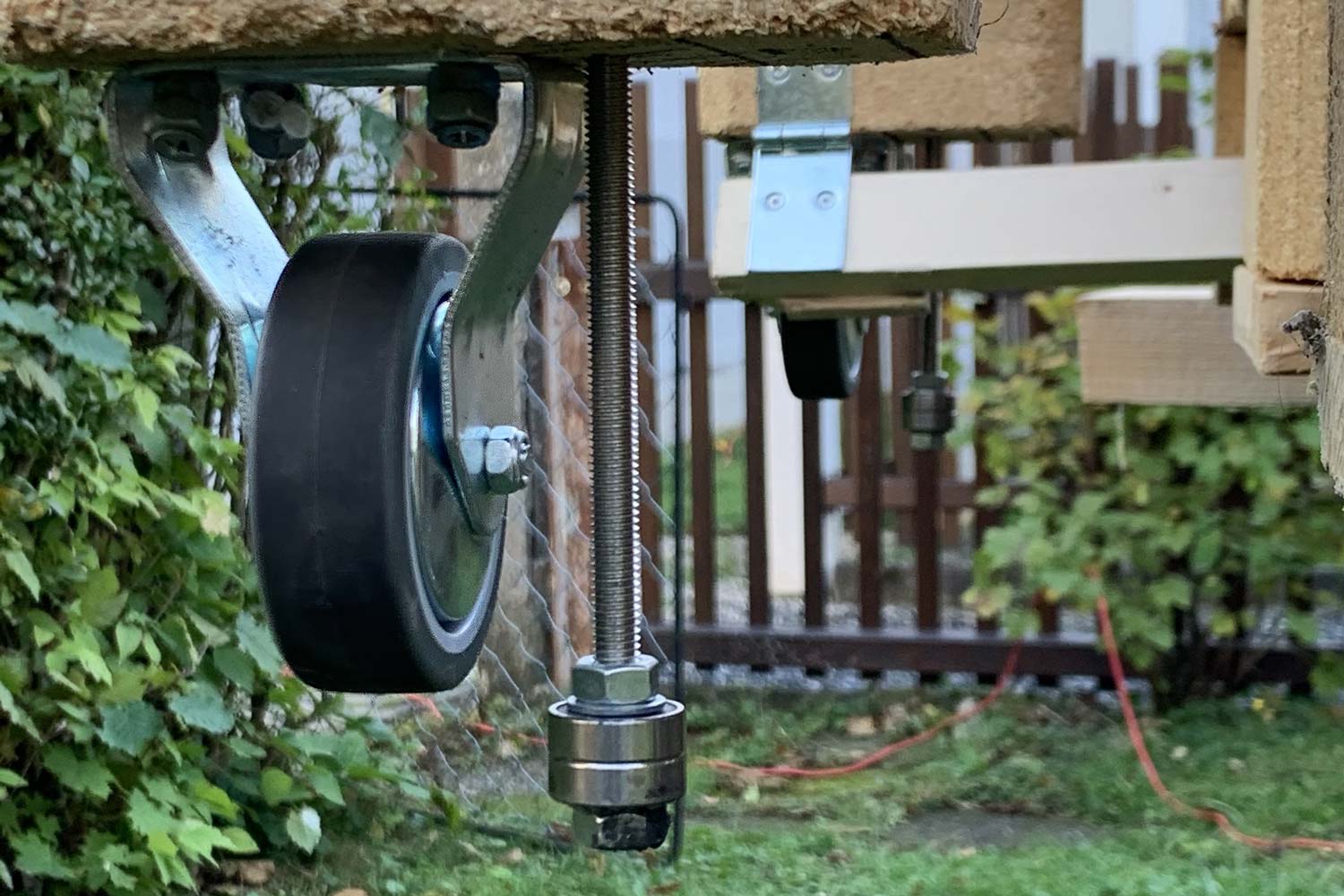
## Testing
On a sloping track we put the railcar on the rails. We discussed the whole thing with the police beforehand. To our surprise, they agreed. Then we switched on the lights, released the brakes and drove off! An unconventional idea became reality.
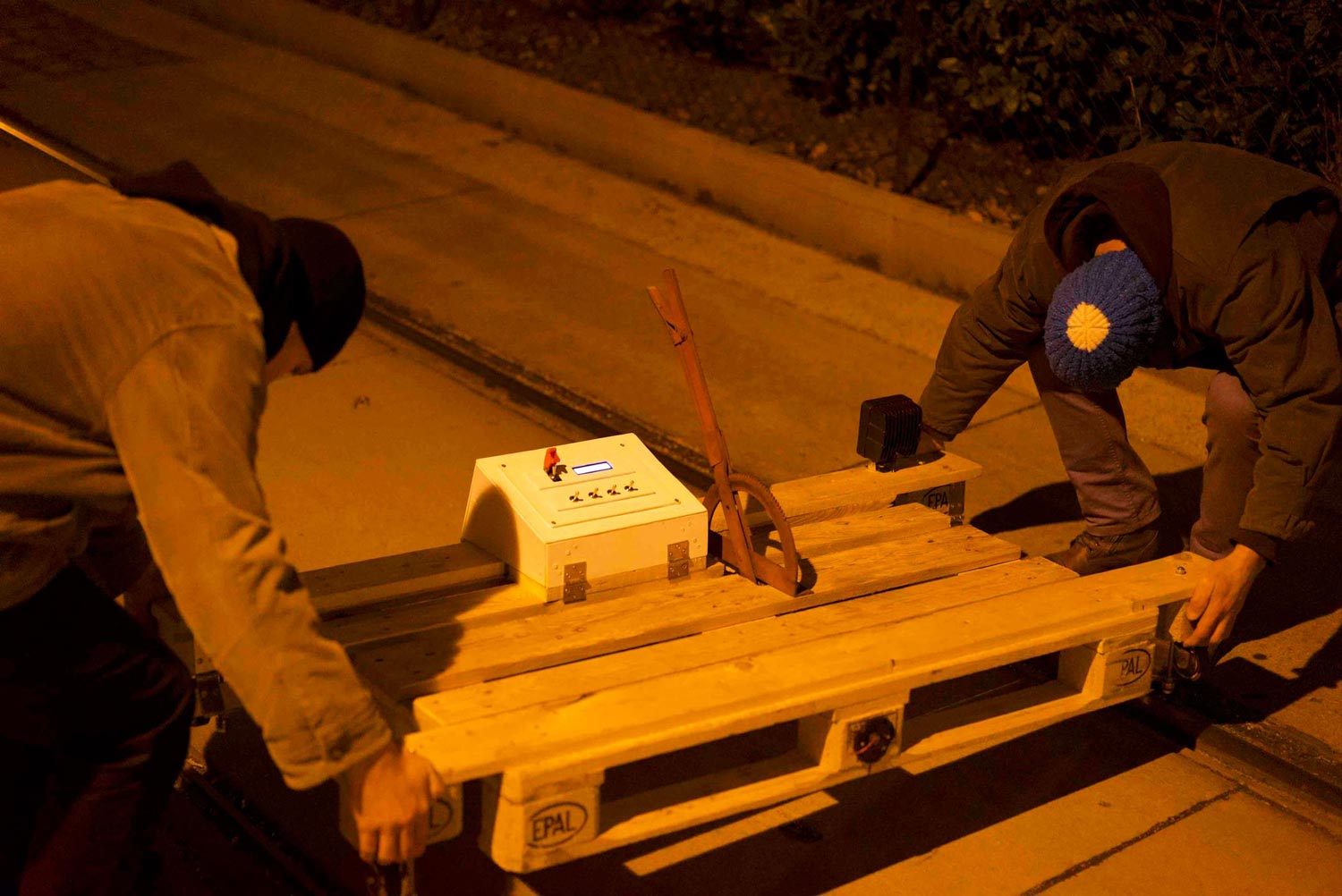
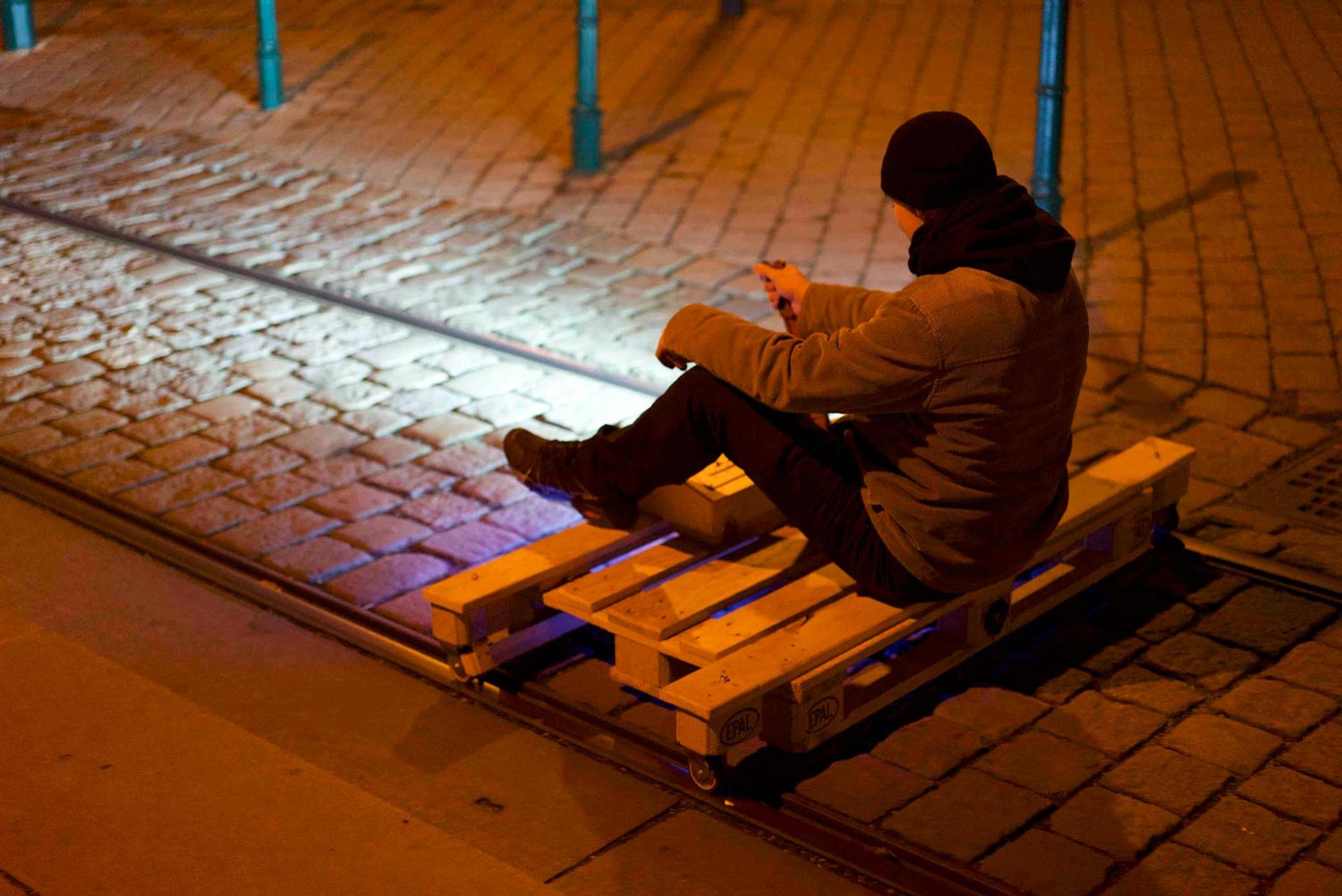
## Credits
This Project was co-created by [Max Kure](https://gemeindebau.im){target=_blank} Bernhard Utz and [Raffael Harrer](https://gemeindebau.im){target=_blank}
---
# Overcoming Disgust
Canonical URL: https://leomuehlfeld.at/en/overcoming-disgust
---
title: 'Overcoming Disgust'
for: 'Design Investigations'
category: 'Design Research & Speculation'
metaDesc: 'Investigating cultural food barriers through insect cuisine show kitchen and future protein research.'
thumbnail: /img/cover-image.jpg
date: '2020-01-28T00:00'
showOnLanding: false
collab: Claudia Montalvo, Paul Mairböck
---
# Overcoming Disgust
## Investigating cultural food barriers through insect cuisine show kitchen and future protein research.
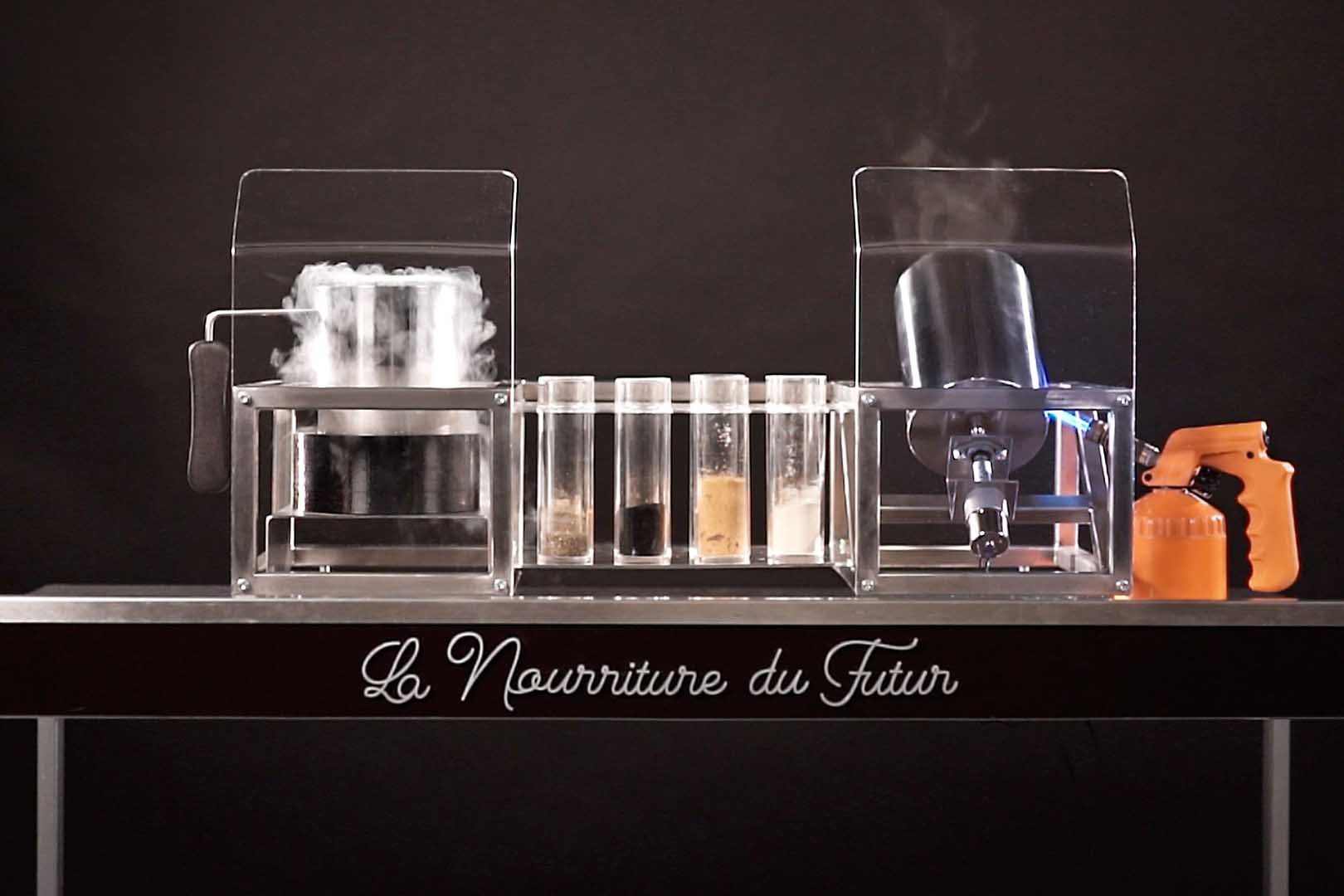
## Eating Insects
Although it would have environmental advantages – the most relevant ones amongst them being the low amount of water required to produce 1kg of protein and the rapid rate of reproduction – many people find the thought of eating insects repulsive. To move insect food in a familiar environment, the cliche-heavy show-cooking experience «La Nourriture du Futur» was invented.
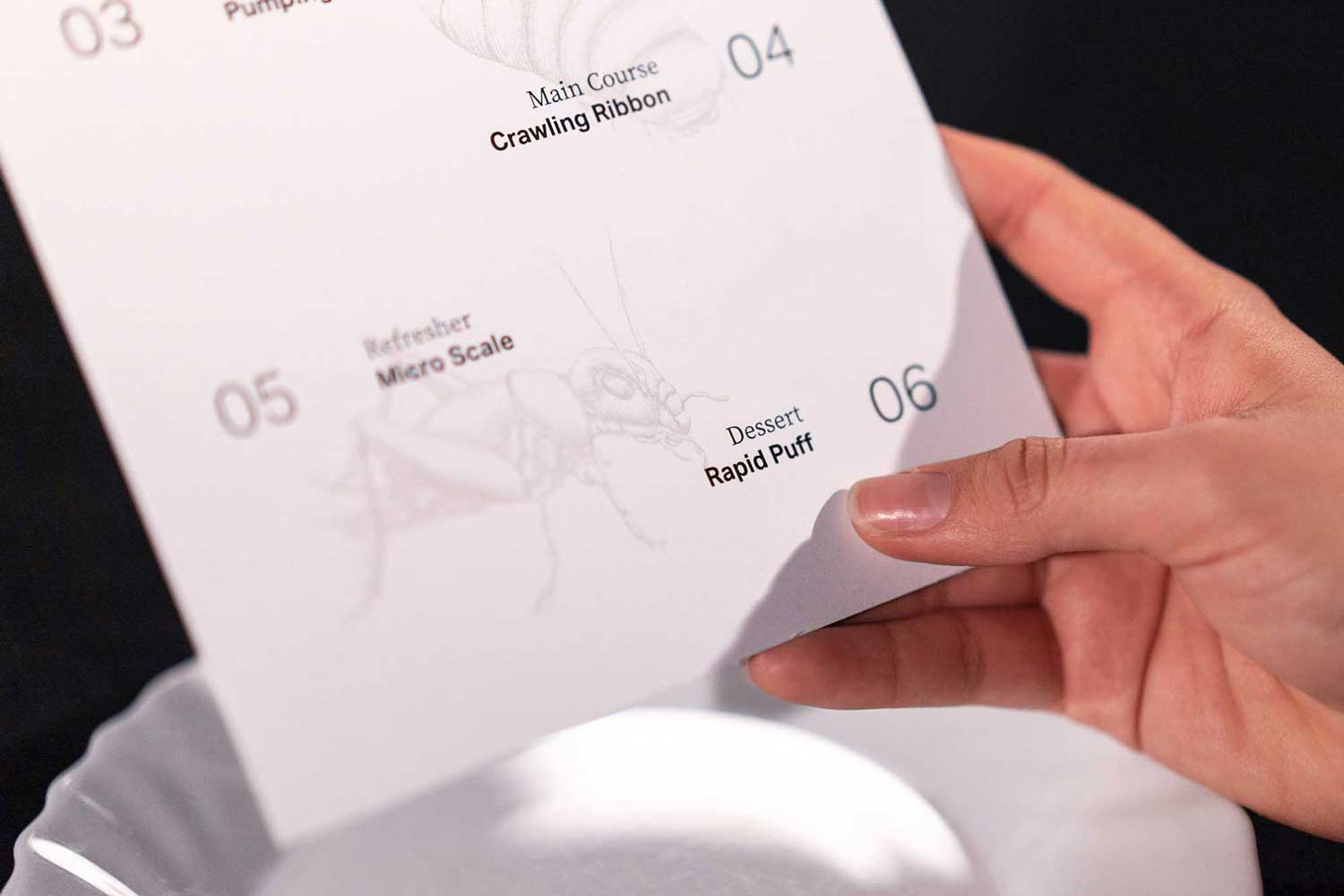
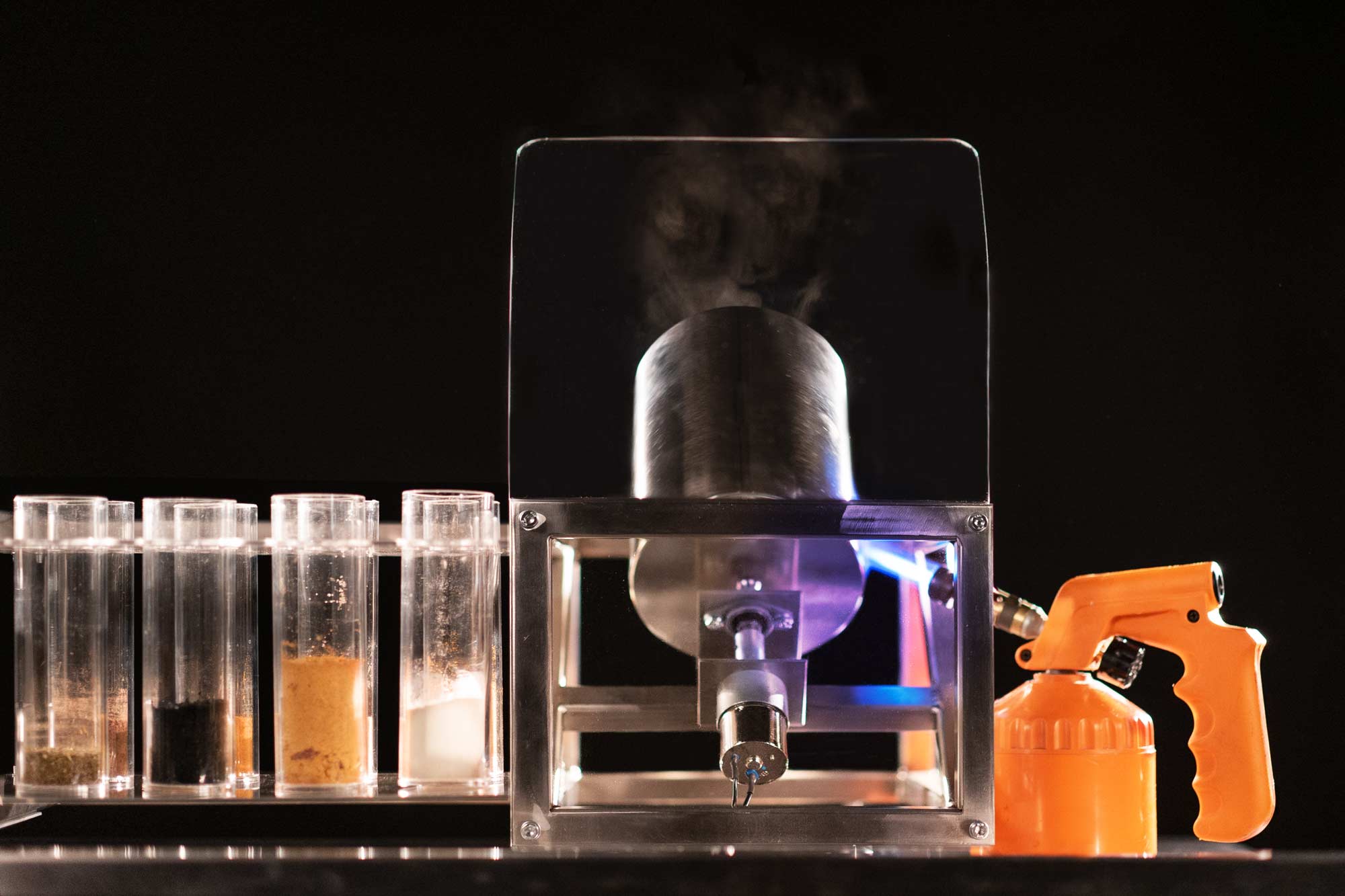
## The cooking machine
The centerpiece of the project is the cooking machine with which the chef creates a show for the customers. He begins by freezing the insects in the cold sector of the machine, using liquid nitrogen(LN2). He then proceeds to cook the ingredients (insects included) within the heated, rotating drum and adds the necessary spices. Depending on the dish, certain special effects can be created throughout the process, for instance, a flambé during the making of the dessert.
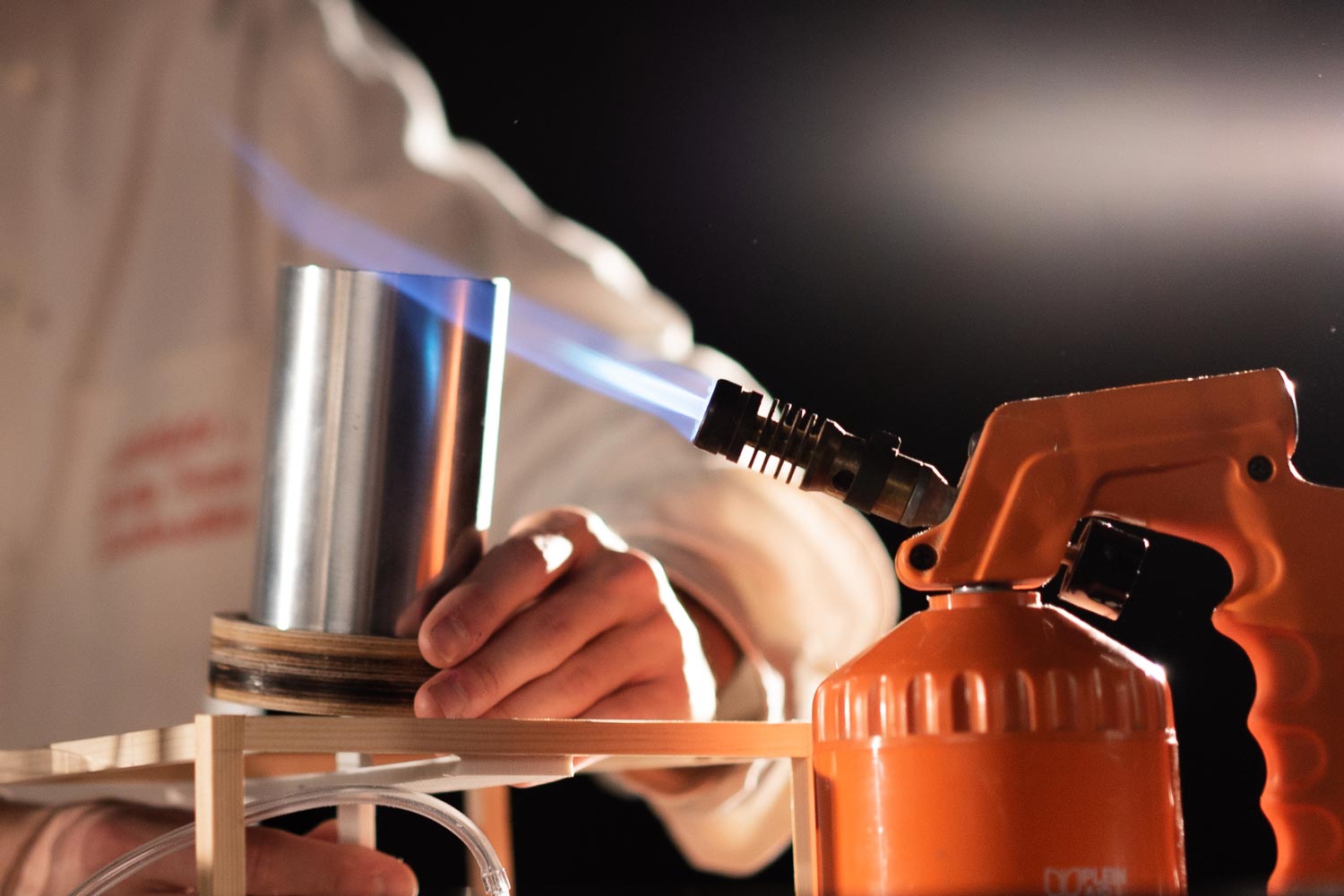
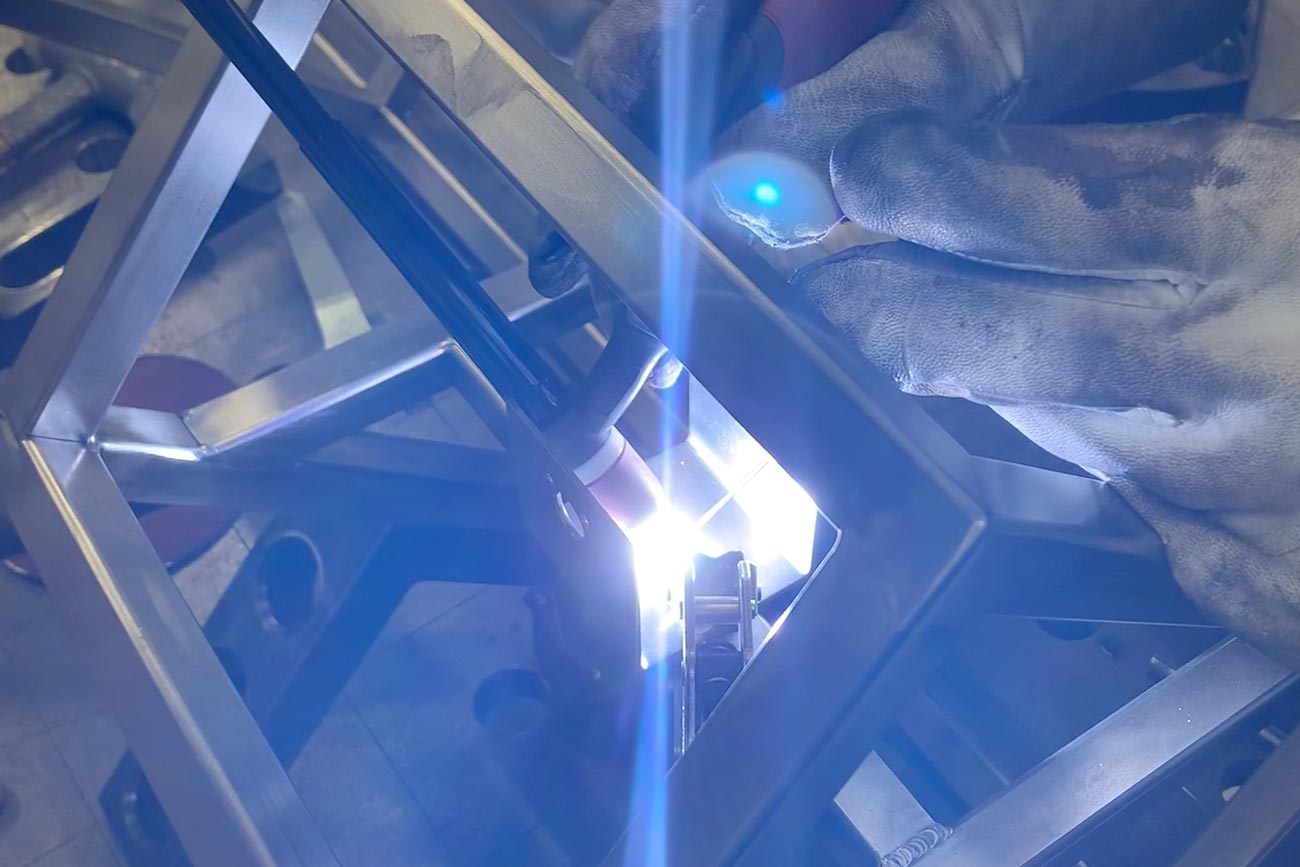
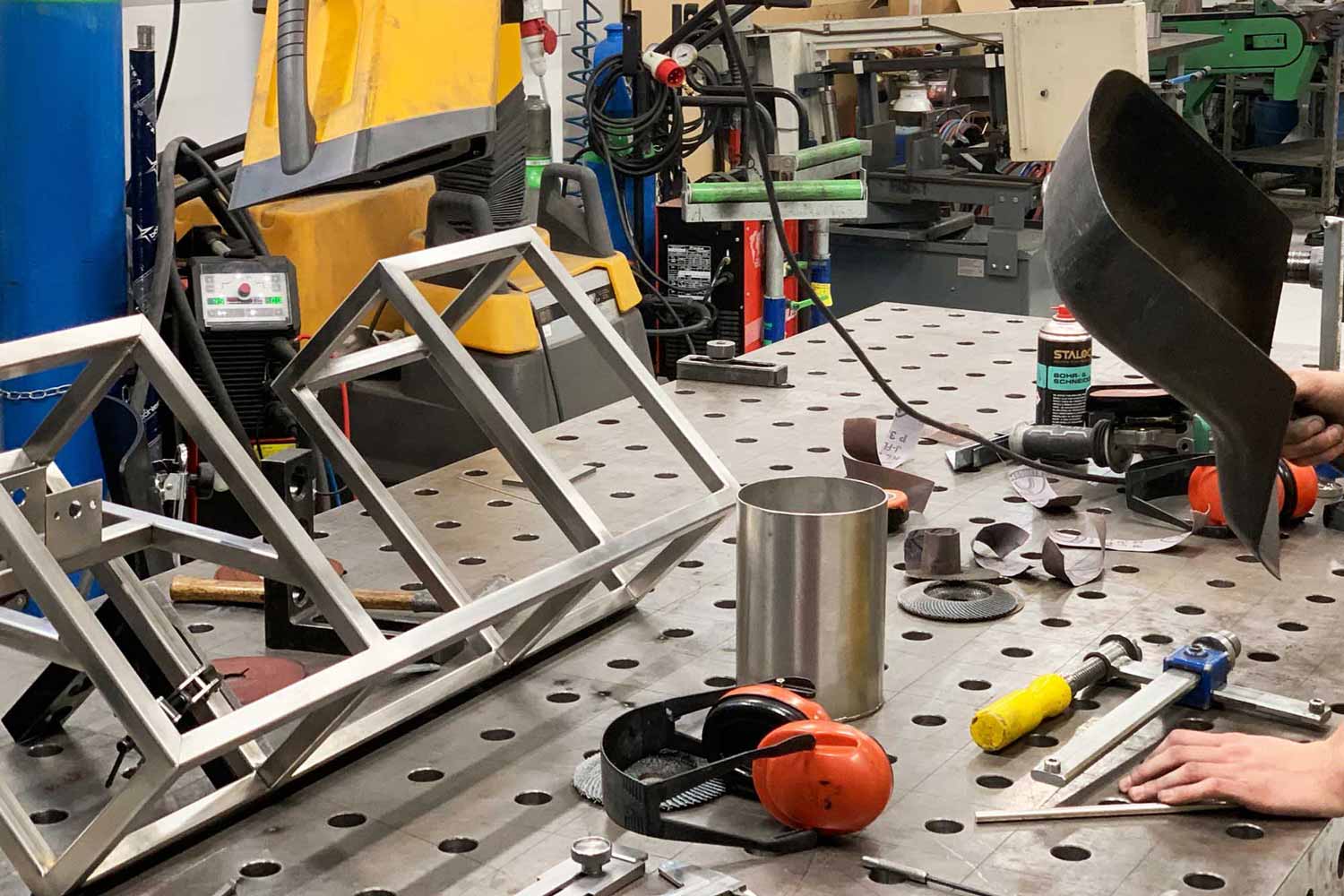
## La Nourriture du Futur
The chef prepares seven different meals – all containing insects – on a custom-made cooking machine. This would allow the customers to see exactly what they are consuming (thus creating a tighter connection between them and their food) as well as perceive it in a different light due to the appealing smell, taste and aesthetic, both of the food and the restaurant itself. By using the cliché of the «fancy restaurant», we try to critique the justification of eating environmentally questionable food by hiding it behind appealing aesthetics.
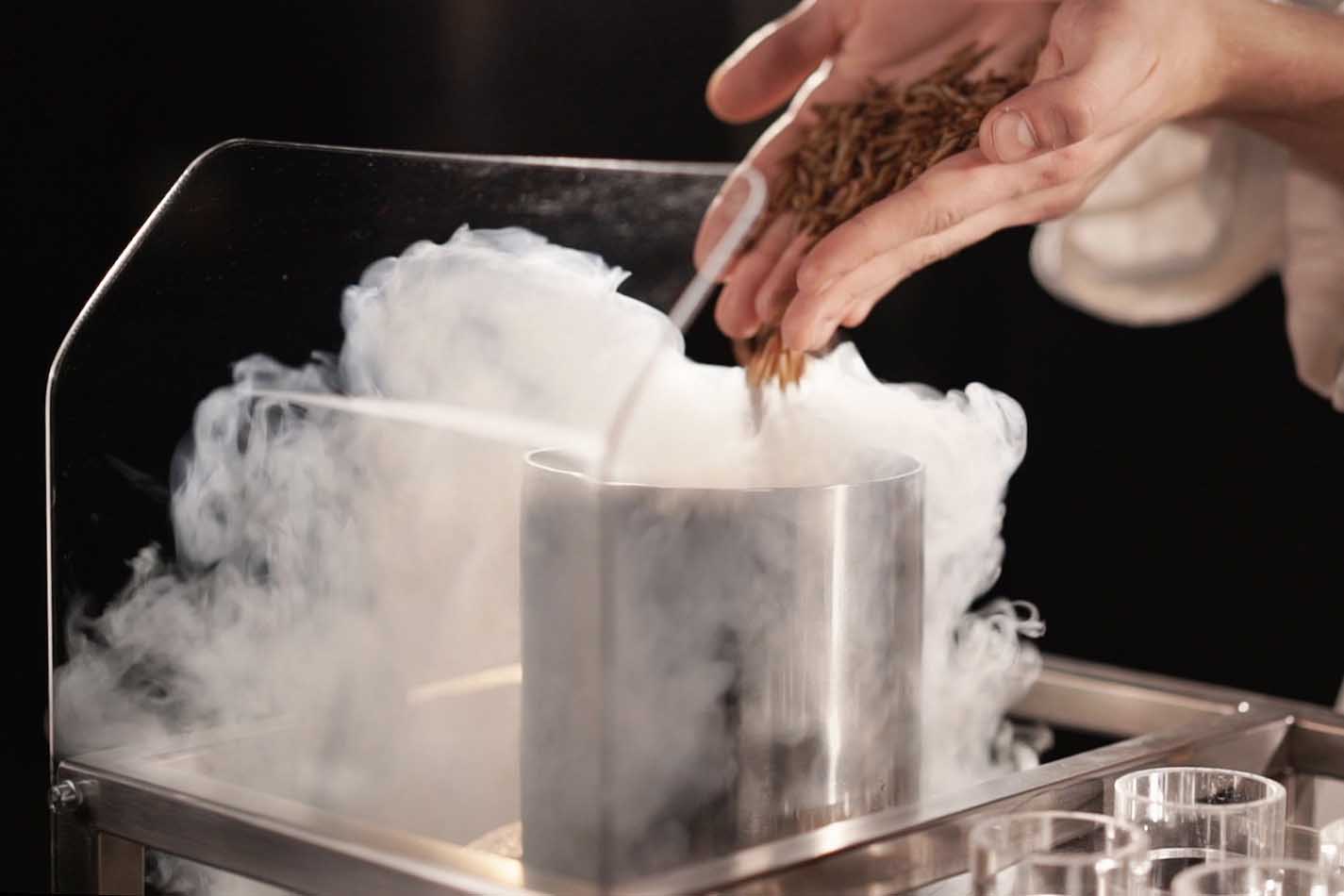
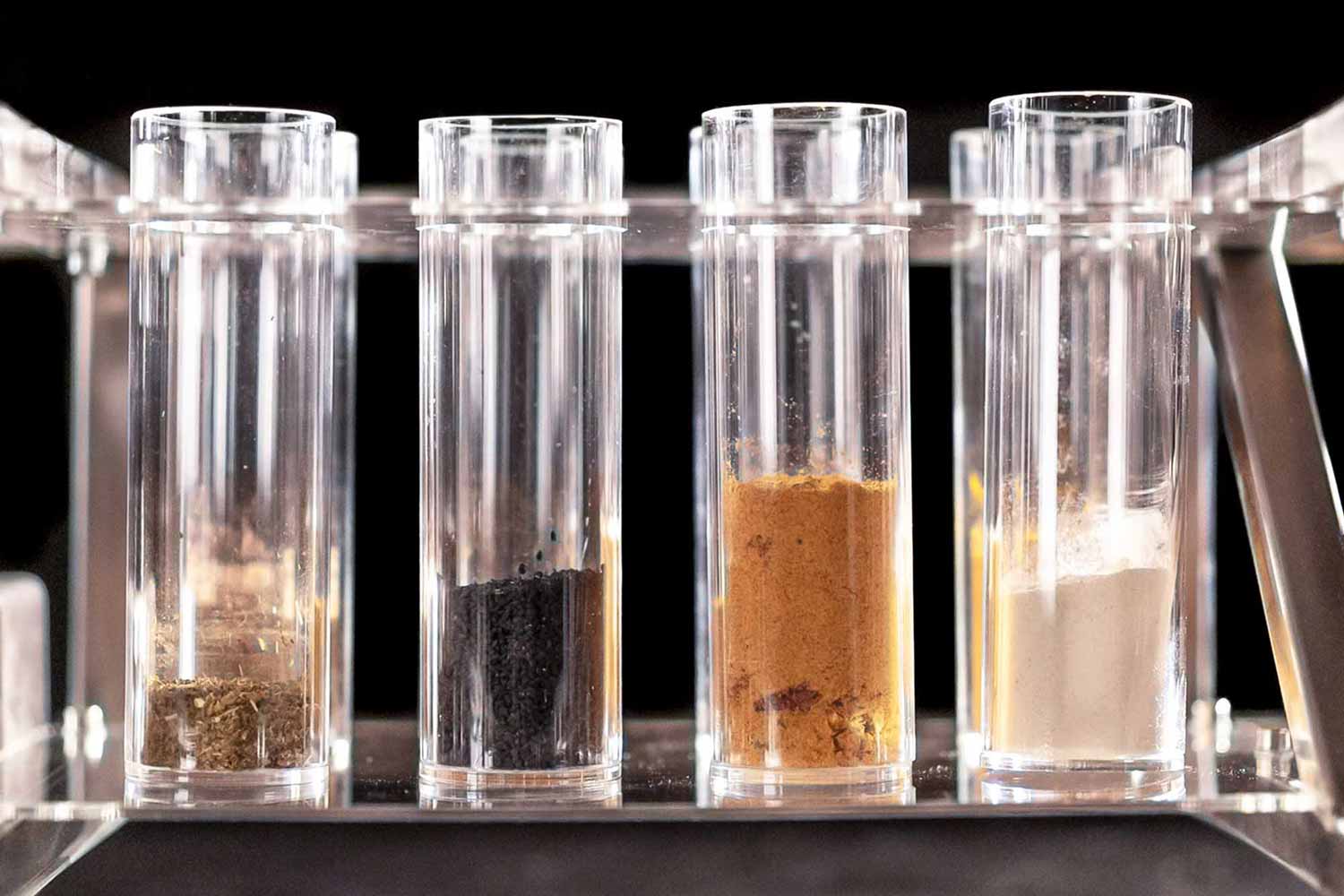
## Credits
Design by: Claudia Montalvo, Paul Mairböck, Leo Mühlfeld. Support by: DI-Team and the "dieAngewandte" Metall-Workshop.
---
# Retropia
Canonical URL: https://leomuehlfeld.at/en/retropia
---
title: 'Retropia'
for: 'dform'
category: 'Film & Motion'
metaDesc: 'Producing exhibition documentation exploring idealized countryside imagery at Volkskundemuseum Vienna.'
thumbnail: /img/retropia-bilder.jpg
date: '2019-07-04T00:00'
showOnLanding: false
---
# Retropia
## Producing exhibition documentation exploring idealized countryside imagery at Volkskundemuseum Vienna.
## Idealized landscapes
The longing for a life on the countryside is shaped by images of idealized landscapes. Which images get curated by generations to write the history of the countryside? Based on the photo collection of the Volkskundemuseum Wien, the exhibition shows results of the research projects "Stadt-Land-Kind" and "Stadt-Land-Bild" of the [Academy of Fine Arts Vienna](https://www.akbild.ac.at/){target=_blank} in cooperation with the [Laboratory for Empirical Image Science of the University of Vienna](https://crea.univie.ac.at/de/){target=_blank}, the [Ludwig-Maximilians-University Munich,](https://www.lmu.de/){target=_blank} the [Werkraum Bregenzerwald](https://www.werkraum.at){target=_blank} and the [Volkskundemuseum Vienna.](https://www.volkskundemuseum.at){target=_blank}
## Image conversations
We also accompanied one of the numerous workshops with our camera. In these workshops, visitors were able to engage in so called "image conversations" and share their impressions and interpretations of the various images with other participants.
## Citizen Scientists
One of the research questions was: How do children and young people look at certain places? Which location or landscape do they choose to capture in a photograph? In photo-expeditions, the young Citizen Scientists conducted active-reflective research, creating new images of the countryside along the way. The resulting postcard exhibition was documented by us with special attention.
## Image relations
A database of images could be tagged by visitors of the exhibition. Two large interactive walls then presented the image relations diagrammatically. As these walls formed the visual and contextual focal point of the exhibition, we paid special attention to the walls and played through all the possible interaction methods.
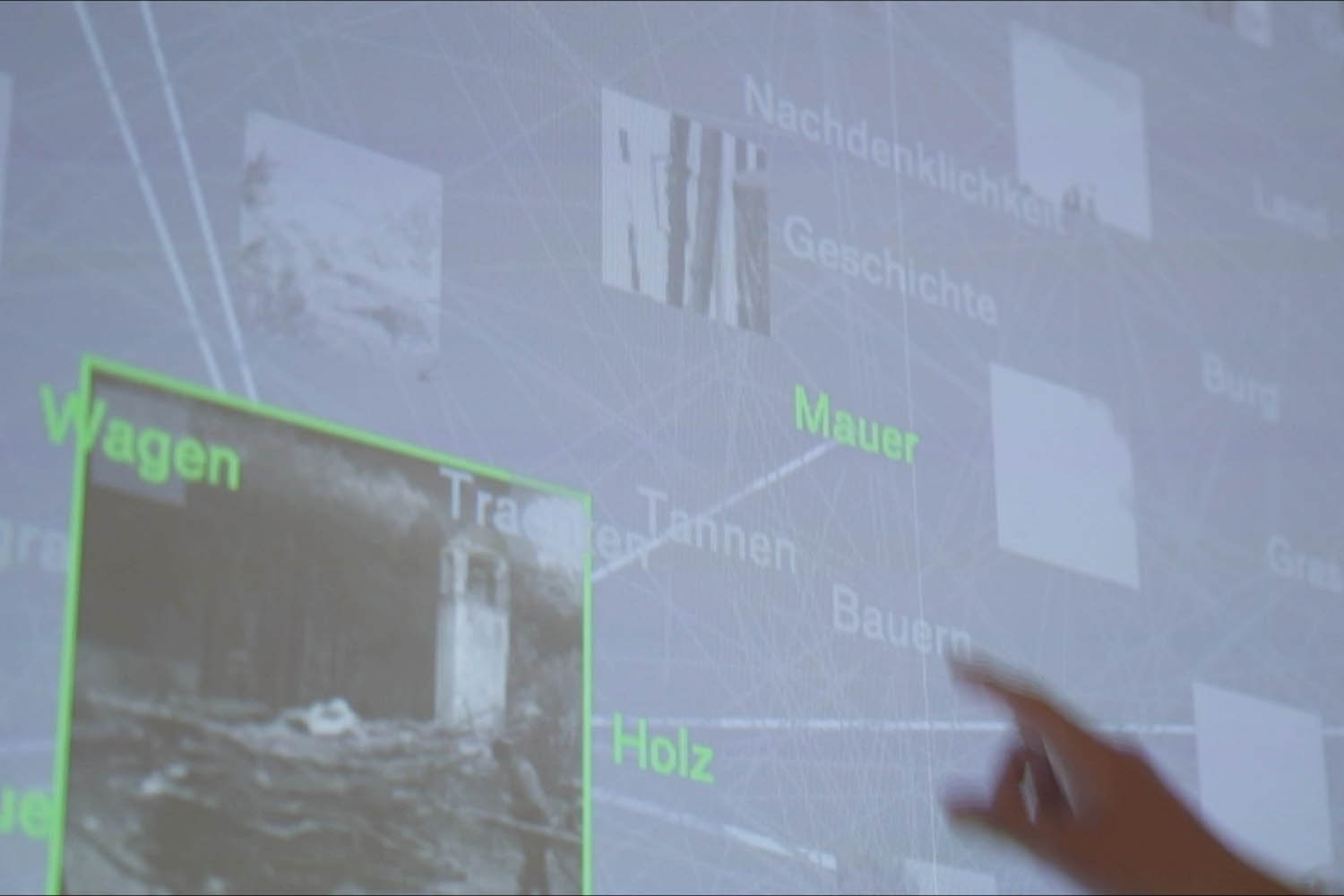
## Credits
The video was created in collaboration with [Stella Butz.](https://stellabutz.com){target=_blank} The exhibiton was part of the research projects "Stadt-Land-Kind" and "Stadt-Land-Bild" from the [Academy of Fine Arts Vienna](https://www.akbild.ac.at/){target=_blank} in cooperation with the [Laboratory for Empirical Image Science of the University of Vienna](https://crea.univie.ac.at/de/){target=_blank}, [Ludwig-Maximilians-University Munich,](https://www.lmu.de/){target=_blank} the [Werkraum Bregenzerwald](https://www.werkraum.at){target=_blank} and the [Volkskundemuseum Vienna.](https://www.volkskundemuseum.at){target=_blank}. The exhibition was designed by [dform.](https://dform.at){target=_blank}
---
# Democrazy
Canonical URL: https://leomuehlfeld.at/en/democrazy
---
title: 'Democrazy'
for: 'Design Investigations'
category: 'Design Research & Speculation'
metaDesc: 'Documenting citizen engagement challenges with Viennese politics through an illustrated brochure.'
thumbnail: /img/booklet.jpg
date: '2019-03-29T00:00'
showOnLanding: false
collab: Camilla Giani, Elena Doncev
---
# Democrazy
## Documenting citizen engagement challenges with Viennese politics through an illustrated brochure.
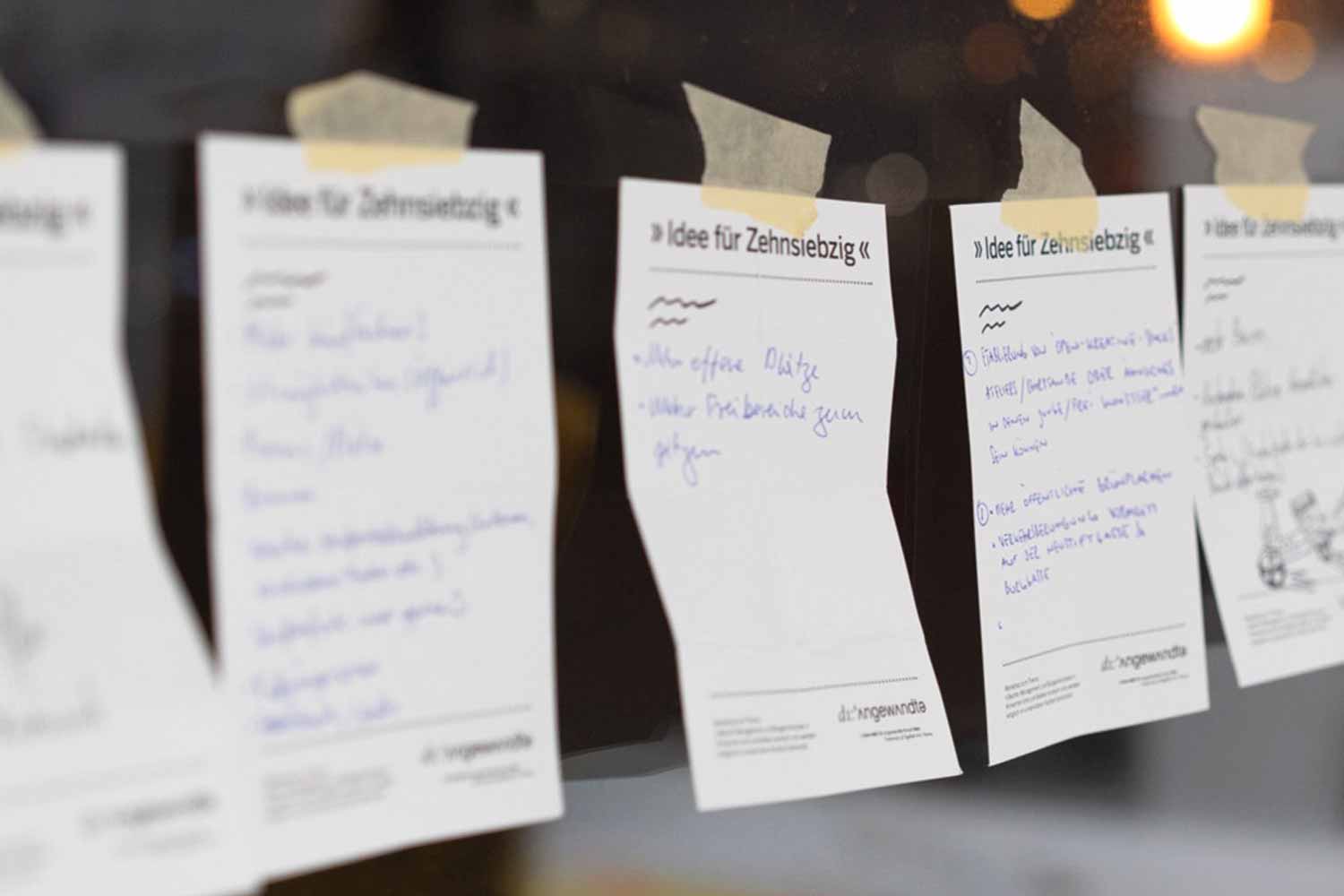
## Crazy Democracy
As part of a project to study the development of democracy in today's world, we tried to find out what it takes to make a change in our residential area. The specific reason for this was to find out how easy it is for individual citizens to have a productive conversation with local politicians. It turned out that it was not as easy as leaflets, commercials and information material suggest. Since not all team members live in the same area, we decided to conduct a survey in a Viennese coffee house. The idea was to include the results of this survey in the political discourse to find out how an original idea is treated by the official side.
## The Booklet
After two weeks of never-ending attempts to reach conversation partners, we initially had to overturn the project's objectives. Since we were so surprised by our experiences, we felt it was necessary to express these experiences in a final product. Just an example: We were invited to a so-called «Grätzel Meeting». A «Grätzel Meeting» is a way for citizens to get involved in the political process in a productive manner. The «Grätzel Meeting» announced at the address of an retirement home took place in March at around 5 degrees Celsius outside the venue. The first hypothermic retirees left the poorly announced event after a few minutes. This was just one of many experiences on our way that felt a little clumsy.
To document our findings and difficulties, we decided to tell our story illustratively in a short, sarcastic brochure.
## Credits
This project was co-created by Camilla Giani and Elena Doncev.
---
# Credit Criminals
Canonical URL: https://leomuehlfeld.at/en/credit-criminals
---
title: 'Credit Criminals'
for: 'Design Investigations'
category: 'Design Research & Speculation'
metaDesc: 'Creating speculative video essay exploring social credit systems and sustainability scoring in Austria 2030.'
thumbnail: /img/elena.jpg
date: '2019-03-19T00:00'
showOnLanding: false
collab: Carmen Farr, Lucy Li
---
# Credit Criminals
## Creating speculative video essay exploring social credit systems and sustainability scoring in Austria 2030.
## Social Credit Systems
Austria, 2030. The State acknowledges the environmental crisis. Every citizen’s smallest social activity is recorded, nudging the population into ‘well behaved’ citizens in order to achieve the goal of a zero carbon society. It is under such conditions that we encounter Tom Grolan, a brazen, successful businessman who has made millions working in the oil industry.
While such systems are still unthinkable and downright dystopian for us, they have long been a reality in other countries. Mainly because of online behavior, people are systematically evaluated socially. This social assessment, which begins with the well-known star rating, then also affects real life and interpersonal relationships. With this short film, we tried to visualize such a scenario for Austria in 2030 in order to give the viewer the opportunity to think about the topic at an early stage.
## Vienna Design Week
After we had exhibited the project at the 2019 Angewandte Festival, we had the opportunity to exhibit it again at the Vienna Design Week 2019. In order to present our project, a poster was designed and an interactive extra was installed. To involve the visitor in our narrative, I coded a small Electronjs app that runs on a Raspberry Pi that we installed on Location. The visitor can print out his or her own social credit score. The randomly generated social credit statement lets the visitor experience what it means to be socially judged, rewarded or even punished simply by making (invented) lifestyle choices.
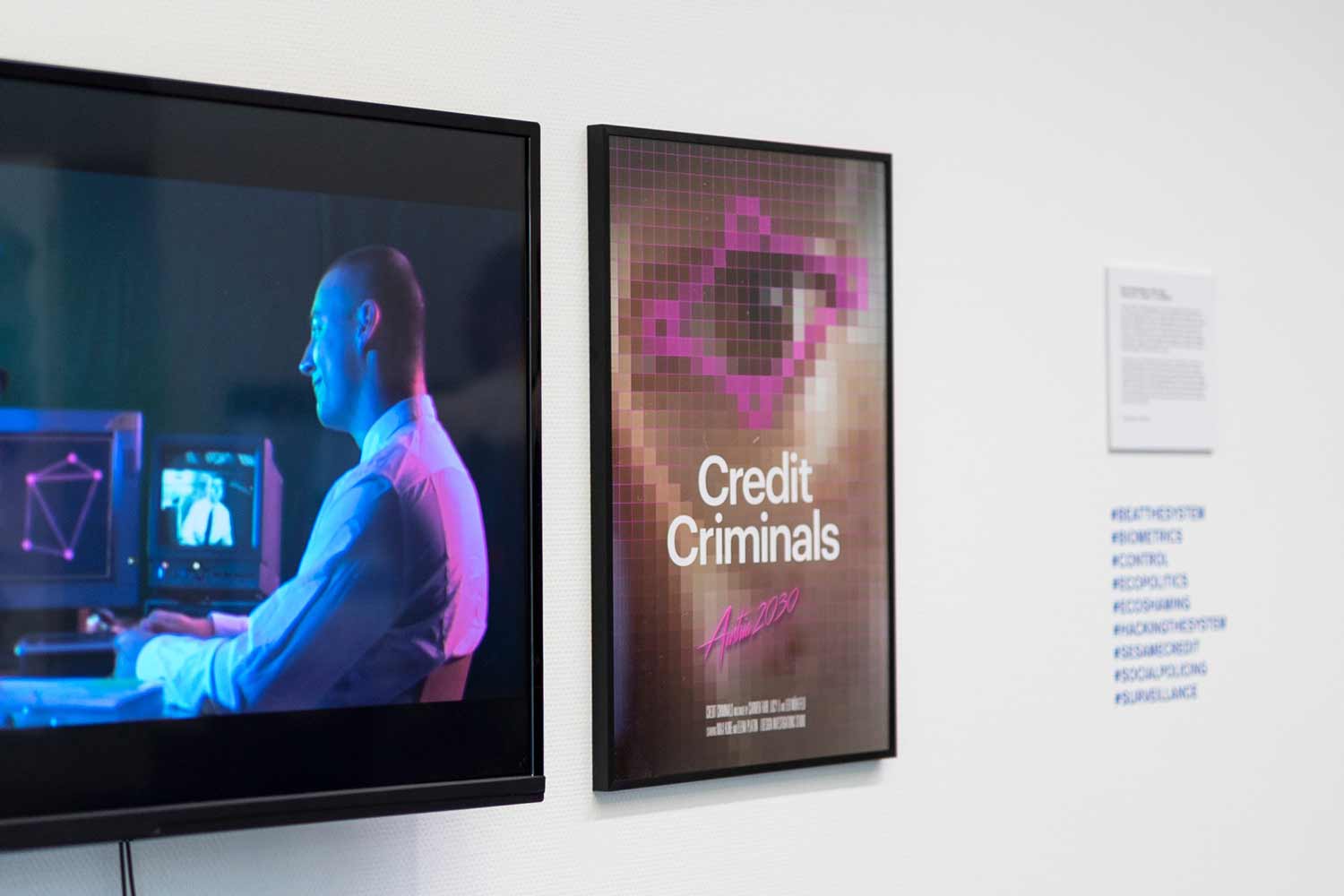
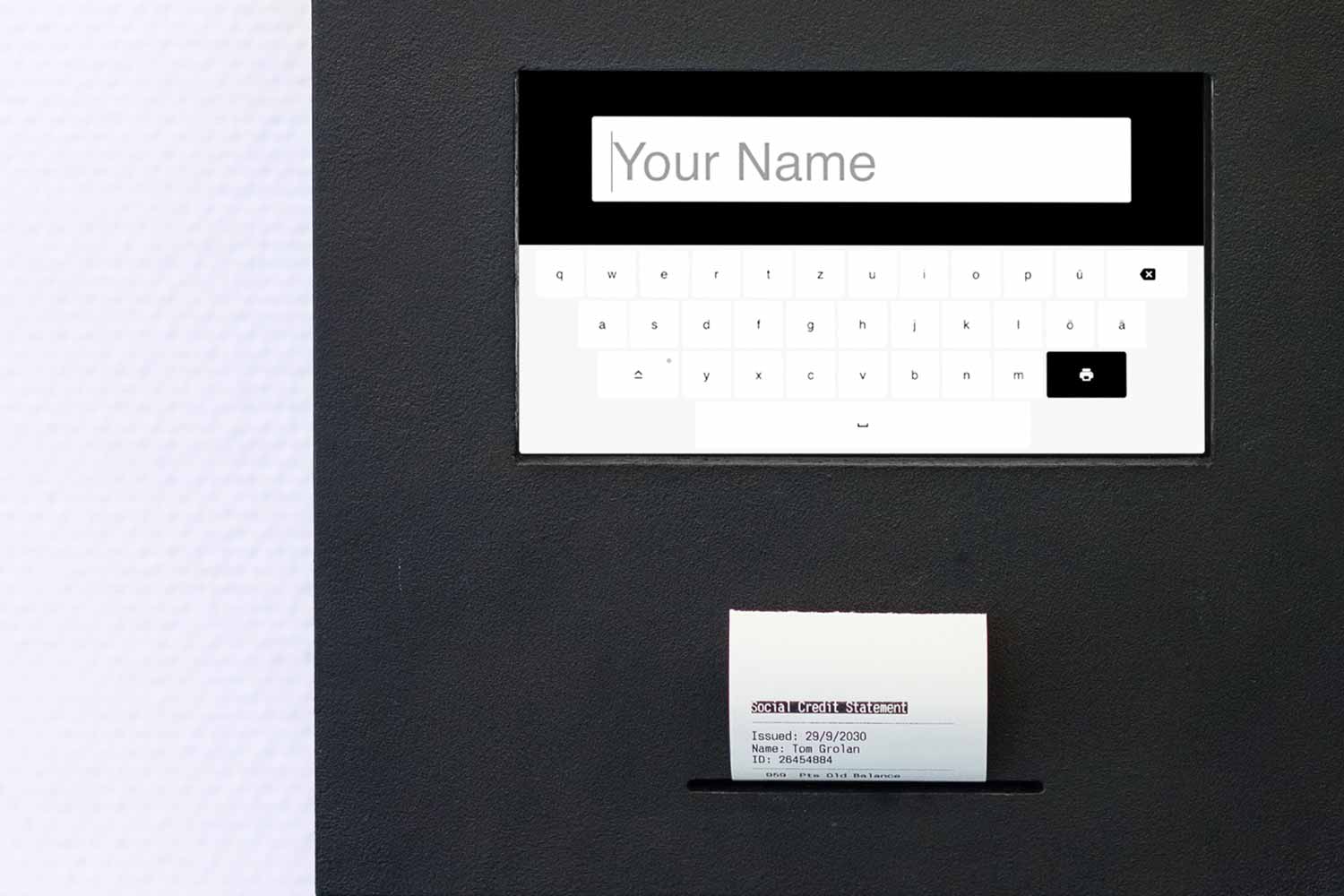
## Credits
Starring Max Kure and Elena Platon. Created by [Carmen Farr](https://designinvestigations.at/people/carmen-farr/){target=_blank}, [Lucy Li](https://lilucy.at){target=_blank} and Me. This Project would not have been possible without the help of [Bernhard Riedl](https://bernhardriedl.net){target=_blank}, [Can Denzer](https://designinvestigations.at/people/can-denzer/){target=_blank} and [DI Team.](https://designinvestigations.at){target=_blank}
---
# Turbine Wings
Canonical URL: https://leomuehlfeld.at/en/turbine-wing
---
title: 'Turbine Wings'
for: 'Design Investigations'
category: 'Product & Engineering'
metaDesc: 'Developing algorithmic 3D system creating lightweight wind turbine wings through laser-cut plywood.'
thumbnail: '/img/cad.jpg'
date: '2019-01-23T00:00'
collab: Pauline Laval, Lucy Li
---
# Turbine Wings
## Developing algorithmic 3D system creating lightweight wind turbine wings through laser-cut plywood.
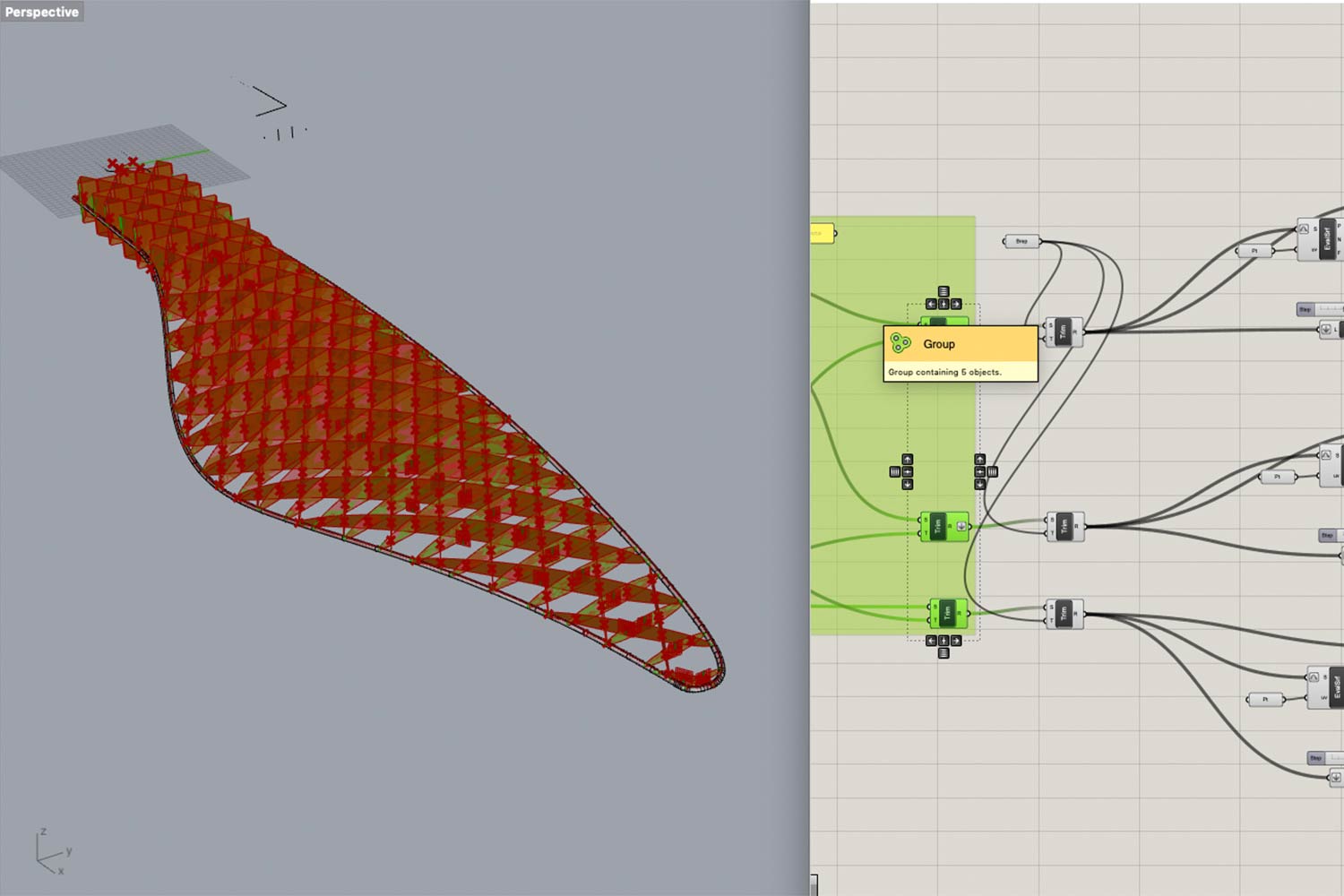
## Wind Energy
What does it take to produce your very own energy? We, a team of three students, were developing wings that would fit onto the mount of an electric generator. The objective was to come up with an interesting and replicable way of freeform model-building. With the help of Eva Kitting, the team and I developed a «Grasshopper» script that splits any freeform-body into three curvature approximating axes and generates a vector template that can then be lasercutted afterwards.
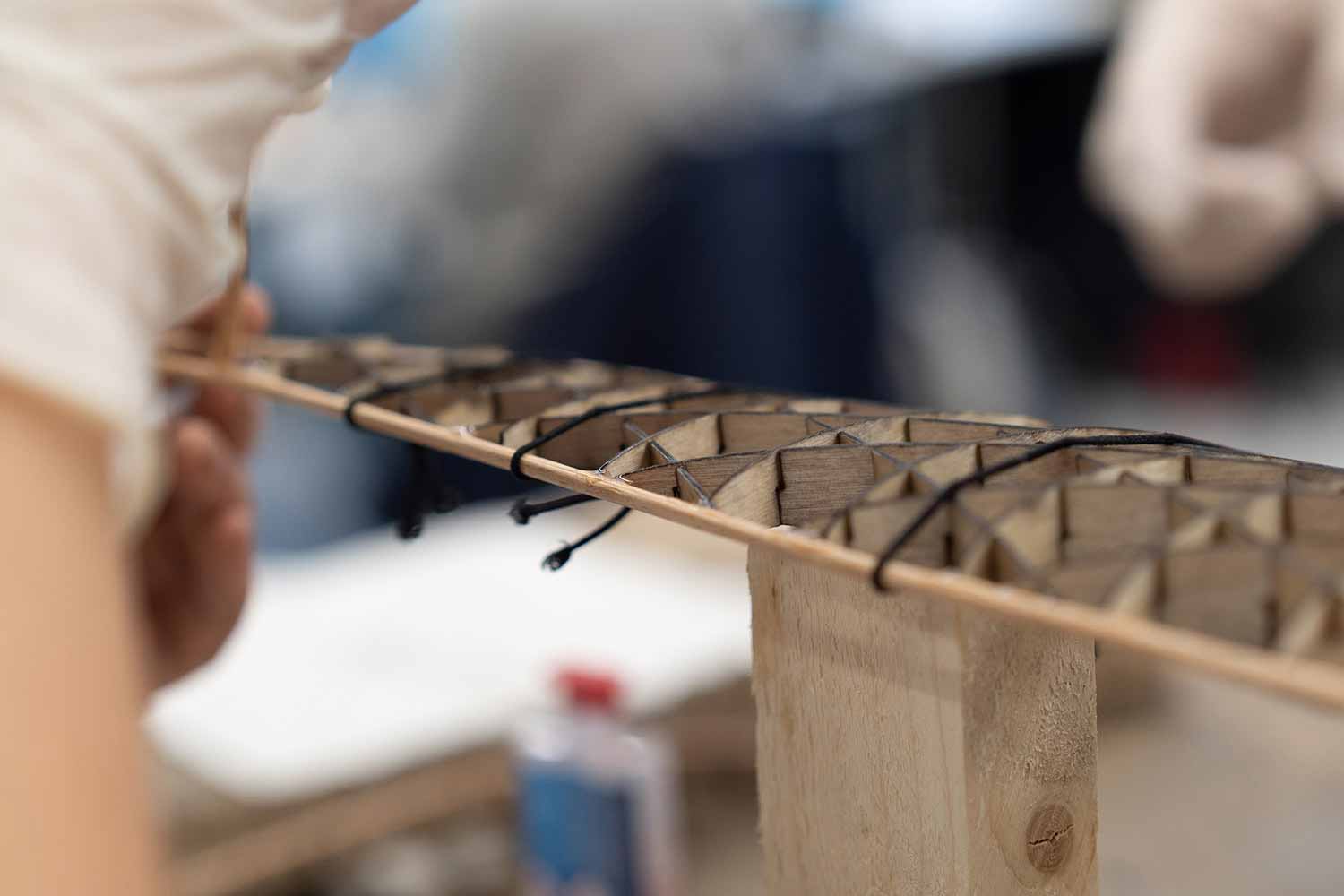
## Assembly
After the individual ribs of the wing skeleton were cut out of 1 mm airplane-quality plywood, it was put together like a puzzle and we had the complete inner structure ready within 1-2 hours. Wooden rods were steam-bent to complement the outer contour of the wings.
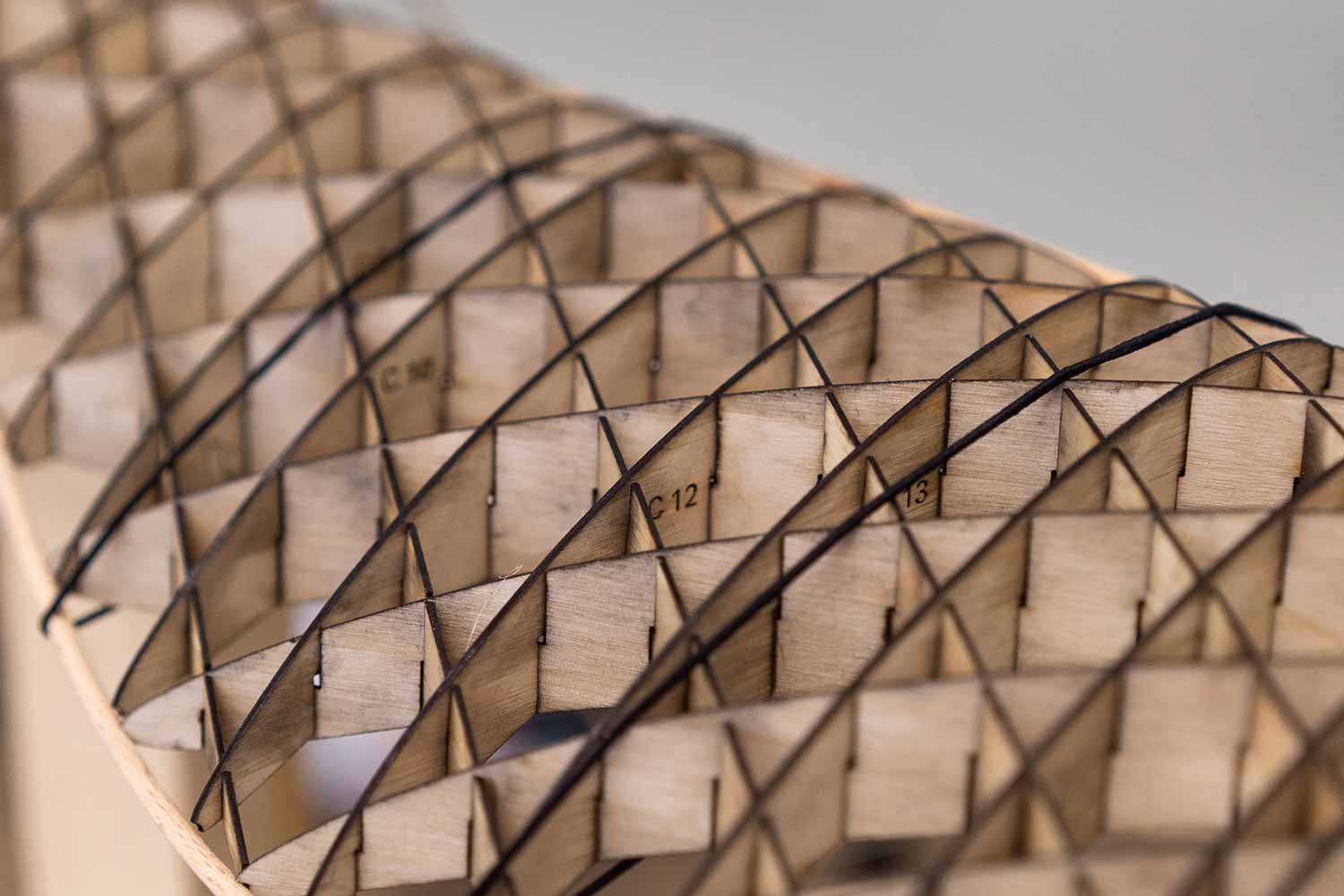
## Laminating
The finished interior was laminated with fiberglass and epoxy to provide sufficient contact area for the air. The strength and the lightness that resulted from the honeycomb pattern in combination with the epoxy-reinforced glass fiber was enormous.
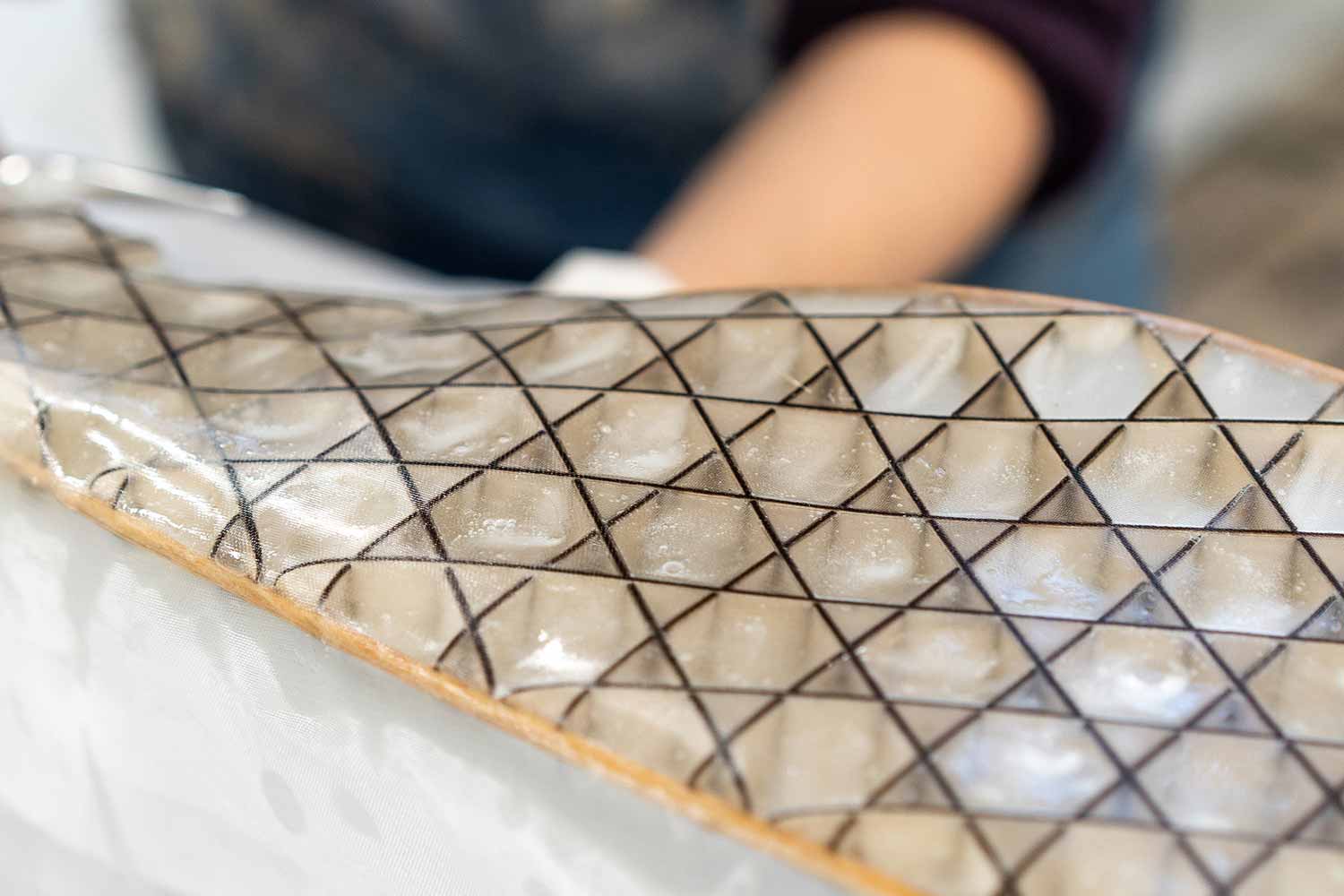
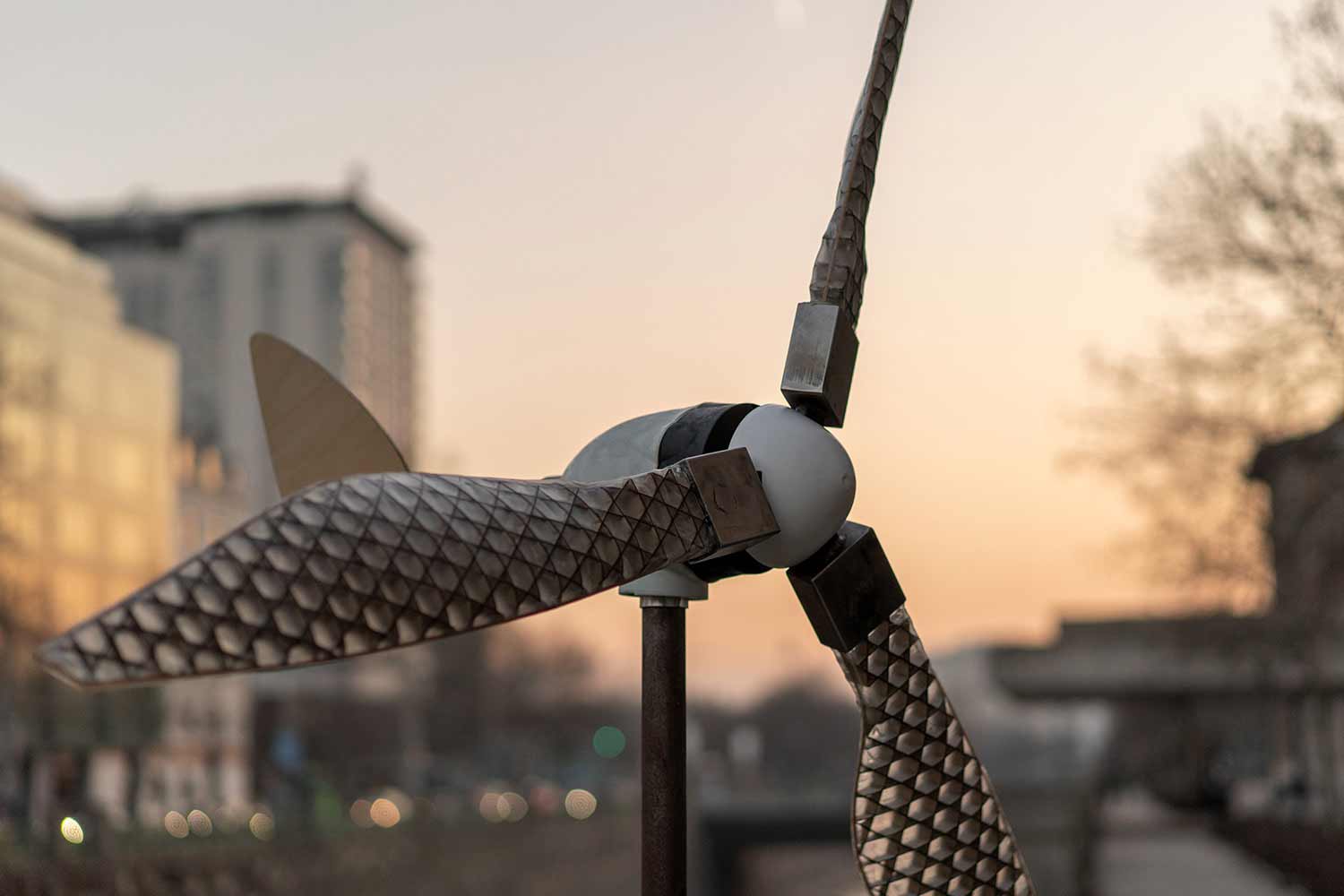
## Credits and Afterlife
The wings were co-created by [Lucy Li](https://lilucy.at){target=_blank} and [Pauline Laval](https://www.paulinelaval.com){target=_blank}. The finished turbine participated in a small exhibition at the University of Applied Arts Vienna, in which the six turbine designs resulting from the semester course were put to the test.
---
# Ruhmeshalle-VR
Canonical URL: https://leomuehlfeld.at/en/ruhmeshalle-vr
---
title: 'Ruhmeshalle-VR'
for: 'dform'
category: 'Film & Motion'
metaDesc: 'Documenting virtual reconstruction of Ruhmeshalle frescoes through VR technology at Military History Museum Vienna.'
thumbnail: /img/lead.jpg
date: '2018-11-19T00:00'
showOnLanding: false
---
# Ruhmeshalle-VR
## Documenting virtual reconstruction of Ruhmeshalle frescoes through VR technology at Military History Museum Vienna.
## The Frescos
The frescos in the "Ruhmeshalle" of the Museum of Military History Vienna, were created by Karl von Blaas in the year of 1861. Due to the large viewing distance, the narratives shown are difficult to understand and hardly communicable.
Therefore, the designstudio [dform](https://dform.at){target=_blank} brought the frescoes closer to the visitors
and, with that, allowed an intuitive reception of the whole story. The installation acts as an innovative supplemental offering in the area of mediation for contemporary transfer of knowledge at the museum, in the virtual space and also in the Internet.
## Video Documentation
[Stella Butz.](https://stellabutz.com){target=_blank} and I were commissioned to document the installation with a video. We paid particular attention to the three-dimensional reconstruction of the "Hall of Fame", which can be experienced both two-dimensionally on the screen and spatially via a VR headset. We also showed the information stand developed by [dform.](https://dform.at){target=_blank} with all its details.
## Credits
The video was created in collaboration with [Stella Butz.](https://stellabutz.com){target=_blank} Product- and exhibition design by [dform.](https://dform.at){target=_blank}
---
# Subtext: Typedesign
Canonical URL: https://leomuehlfeld.at/en/subtext
---
title: 'Subtext: Typedesign'
for: 'dform'
category: 'Film & Motion'
metaDesc: 'Documenting Austrian typography exhibition showcasing 50+ designers at Vienna Museums Quartier.'
thumbnail: /img/watch.jpg
date: '2017-05-17T00:00'
showOnLanding: false
---
# Subtext: Typedesign
## Documenting Austrian typography exhibition showcasing 50+ designers at Vienna Museums Quartier.
## Exhibition
Subtext: Typedesign archives designs by over 50 designers working locally to worldwide and presents typeface designs with a connection to Austria. The exhibition design was developed by the Viennese design studio dform and consists of a wooden construction held together by laser-cut metal letters. Panels, posters, exhibits and interactive stations were built into the resulting system.
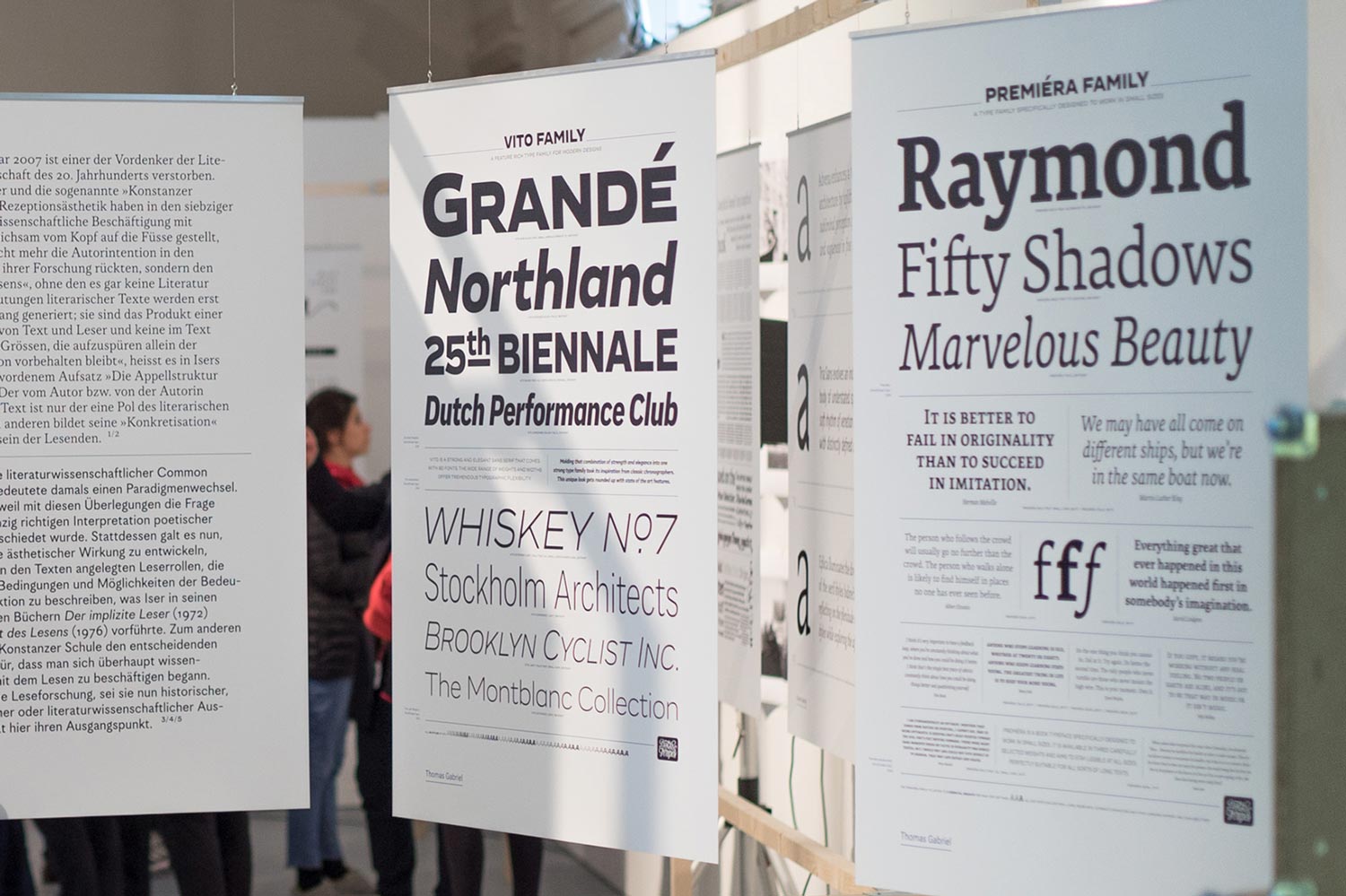
## Documentation
Together with [Rafael Schlager](https://safepapers.org){target=_blank} I was asked to capture the exhibition audiovisually. We made numerous film recordings and put them together to a short video. In addition, I sampled a typewriter and created the appropriate music for the video. [Rafael Schlager](https://safepapers.org){target=_blank} created the photographic documentation for the exhibition.
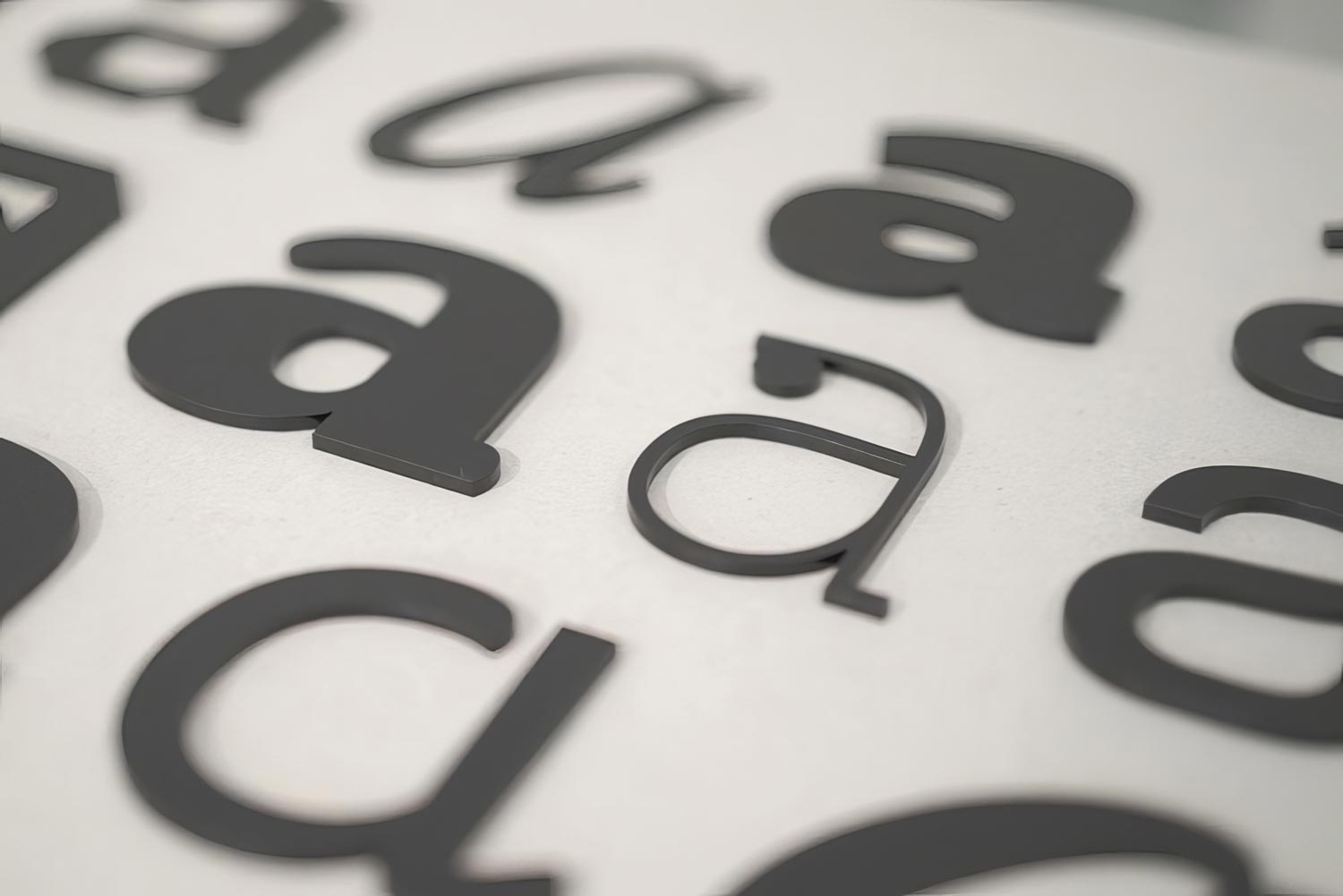
## Hands-On Stations
Special attention was paid to hands-on stations and the Specimen-Bot programmed by Johannes Lang. The bot printed out dynamically generated font specimens that visitors could take with them. Interactive communication of content is one of dform's specialties and was therefore given special attention.
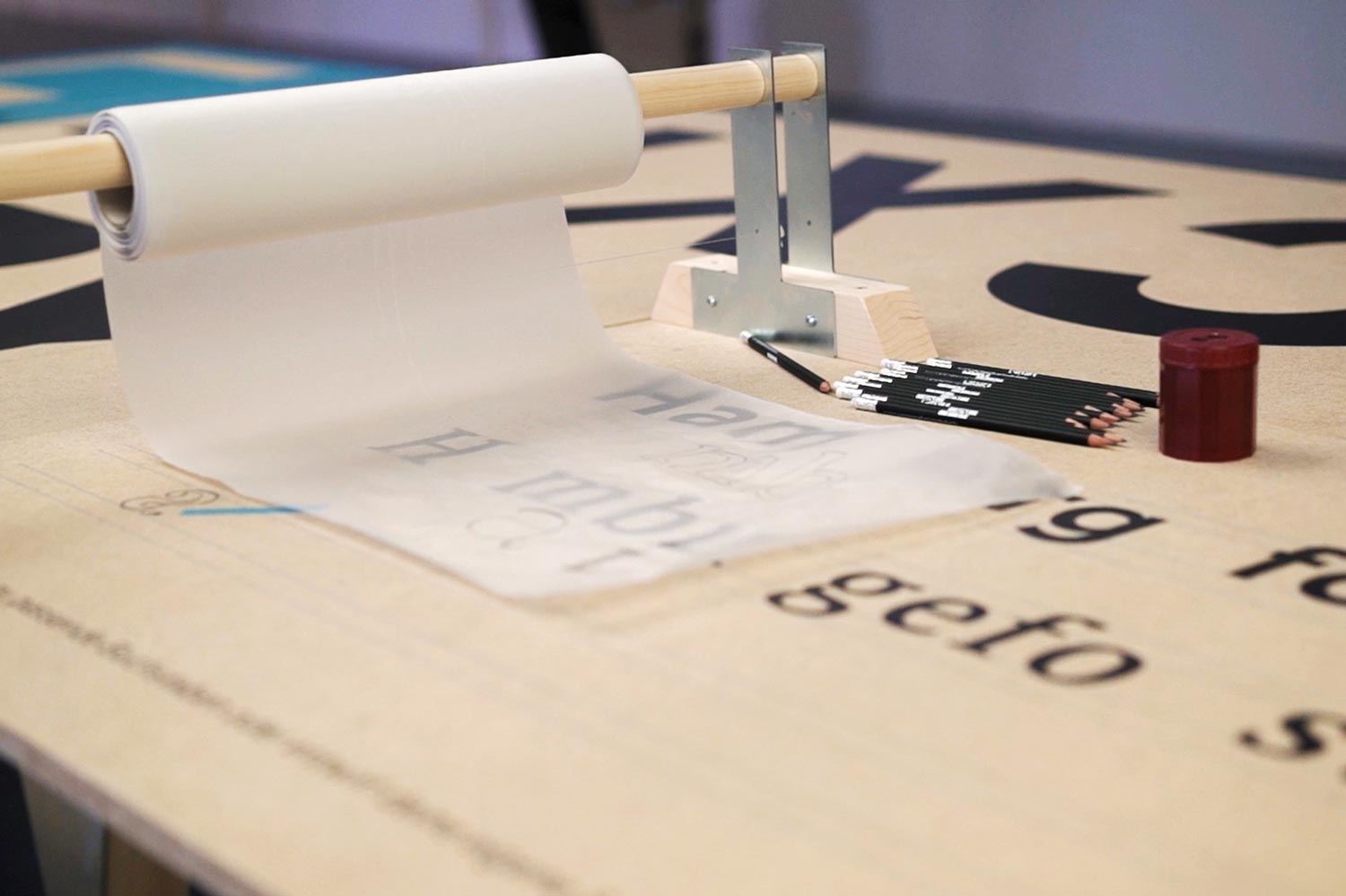
## Credits
Pictures & Co-Videograohy by [Rafael Schlager.](https://safepapers.org){target=_blank} Exhibiton design by [dform.](https://dform.at){target=_blank}. Exhibiton by [Typographische Gesellschaft Austria.](https://typographischegesellschaft.at){target=_blank}
---
# The best is yet to come
Canonical URL: https://leomuehlfeld.at/en/the-best-is-yet-to-come
---
title: 'The best is yet to come'
for: 'dieGraphische'
category: 'Film & Motion'
metaDesc: 'Creating a participatory animation collecting Vienna residents'' future visions, 2016 — drawn responses from schools and public spaces, w/ dieGraphische.'
thumbnail: '/img/treehouse.jpg'
date: '2016-03-13T00:00'
showOnLanding: false
collab: Alina Groer, Daniela Kubesch
---
# The best is yet to come
## Creating a participatory animation collecting Vienna residents' future visions, 2016 — drawn responses from schools and public spaces, w/ dieGraphische.
## Participatory design
The project was conceived as a participatory design project that collects ideas, wishes and visions of our common future across all age groups. To do this, we went to various places, including schools, parks and public spaces in Vienna that are bustling with life. We asked people numerous questions about housing, mobility, politics, the environment and much more.
## Animation
Some watercolour sheets were created to be used as textures for the upcoming animations. We sifted through the material and created a production database. Scenes from the described visions of the future were then illustrated and subsequently animated and accompanied by sound effects.
In the end, we edited a quarter-hour film from the video material recorded during the interviews and the animated sequences in which the two domains converged. The project won an honorary mention in the U19 category at ARS Electronica 2016 and was shown at "Funkenflug" at the Künstlerhaus Vienna (AT), at "Projekt Europa" (AT) and at the Migros Kulturprozent in Zurich (CH).
## Credits
The project was created during classes at ["dieGraphische"](https://www.graphische.net){target=_blank} in collaboration with [Alina Groer](){target=_blank} and [Daniela Kubesch.](https://dnikub.dev){target=_blank}